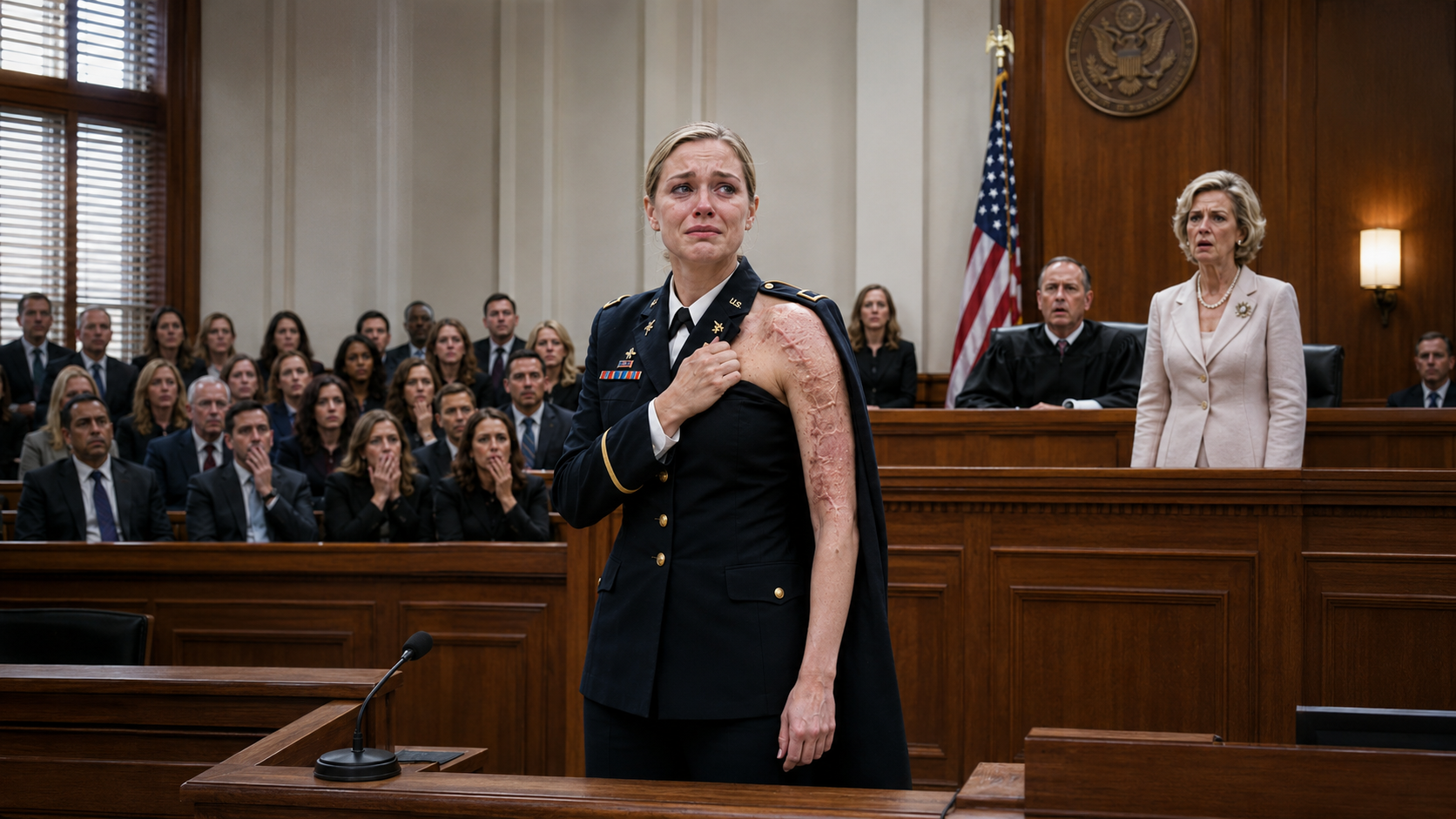
They called her a liar in front of a packed courtroom.
Not quietly. Not privately. Not behind closed doors where family secrets are usually buried.
They did it under oath.
With one hand on the Bible and the other wrapped around a carefully rehearsed lie, Elaine Wright looked directly at the judge and told the court that her own daughter had never served in the military.
“She was never a soldier,” Elaine said, her voice calm enough to sound believable. “She faked the scars, the medals, all of it.”
A cold silence fell across the room.
Reporters stopped typing. Jurors shifted in their seats. Spectators leaned forward as if they had just witnessed the collapse of a decorated veteran’s entire life.
At the defense table, Captain Mara Wright sat perfectly still.
She did not scream. She did not cry. She did not jump from her seat to defend herself.
She simply stared forward, her hands flat against the table, while her mother tried to erase twelve years of service with one sentence.
But Elaine Wright did not know one thing.
The truth had already been scheduled to arrive.
And in thirteen minutes, the courtroom doors would open.
A Family Battle That Turned Into a Criminal Case
The case had started as a dispute over money, power, and inheritance.
Mara Wright’s father had spent years building Titan Tactical Systems, a defense company with contracts, advanced technology, and deep ties to the military world. Before his death, he left Mara controlling shares of the company and appointed her executor of his estate.
To Mara, it was not just a business decision. It was her father’s final act of trust.
He believed she could protect the company.
He believed she could stop it from falling into corrupt hands.
But three days after his funeral, Mara’s younger brother, Curtis Wright, produced a new will.
That document gave everything to him.
The company. The shares. The authority. The future.
Mara challenged it immediately, believing the new will was fake. What should have remained a civil fight over an estate quickly turned into something far more dangerous.
Curtis did not simply claim Mara was wrong.
He claimed she was a fraud.
According to Curtis, Mara had manipulated their sick father by pretending to be a decorated soldier. He accused her of inventing her military record, faking medals, exaggerating injuries, and using stolen valor to gain control of Titan Tactical Systems.
Then the allegations became criminal.
Mara was suddenly facing claims of fraud, falsified federal documents, stolen valor, and inheritance manipulation.
If Curtis succeeded, Mara would not only lose the company.
She could lose her freedom.
The Mother’s Testimony That Shocked the Courtroom
Elaine Wright became the prosecution’s most emotional witness.
To the jury, she presented herself as a devastated mother forced to expose her own daughter’s deception. She wore grief like a costume, her voice breaking only when it helped her story.
She claimed Mara had never deployed overseas.
She claimed Mara had never served in the United States Army.
She claimed the medals were fake.
She claimed the scars were staged or exaggerated.
And because she was Mara’s mother, the lie carried extra weight.
People often believe family members know the deepest truth. That is what made Elaine’s testimony so damaging. If a stranger had accused Mara, the court might have remained skeptical. But when her own mother said it, many people in the room accepted it as fact.
The prosecutor lifted a shadow box containing Mara’s Silver Star, Purple Heart, and a scorched unit patch she had carried home from war.
Elaine looked at the medals with theatrical disgust.
“She bought those online to deceive everyone,” she said.
A murmur moved through the courtroom.
Several jurors turned toward Mara with visible suspicion. Some spectators looked disgusted, as though they were staring at someone who had stolen honor from the dead.
But Mara remained still.
Her silence made people believe she had nothing to say.
In reality, she had been ordered not to speak.
The Records That Could Not Be Found
Curtis’s legal strategy depended on one powerful fact: Mara’s service records were not visible in ordinary military databases.
That appeared damning.
The prosecution displayed enlarged federal search results showing no deployment history under her name. No combat assignment. No commendation order. No medical evacuation record.
To the jury, it looked simple.
If there was no record, there was no service.
Curtis’s attorney pressed Mara hard.
“Ms. Wright, you claim your records were sealed by the government?”
“They are officially sealed,” Mara replied.
“That is very convenient for you,” the attorney said with a sneer.
“It is convenient for some people,” Mara answered, “but not for others.”
The courtroom laughed softly at the attorney’s sarcasm, but the judge leaned forward.
“Explain that answer to the court,” Judge Halpern said.
Mara looked at the clock above the bench.
It was 11:47 a.m.
“I cannot yet, Your Honor,” she said.
That answer made her look guilty to nearly everyone in the room.
But Mara knew exactly what was coming.
A Classified Past Used Against Her
Mara’s military service had not disappeared because it was fake.
It had disappeared because parts of it were classified.
Years earlier, she had served in a restricted special activities unit attached to a mission in Kandar Province. The operation had remained sealed, and the public version of her file was incomplete by design.
Her silence was not a strategy.
It was an order.
Only a few people outside the military had ever known the truth. Her father was one of them. Before cancer stole his voice, he had warned Mara that Elaine and Curtis were moving company money through illegal vendors and preparing to take control of Titan Tactical Systems.
He trusted Mara to protect the company.
But he also understood the danger.
If Mara publicly exposed her military history, she could compromise classified information and people still connected to the operation.
So she stayed silent.
Curtis knew her records were sealed. That was why he attacked them.
He believed he had found the perfect weapon: a truth Mara could not prove.
The Forged Statement That Nearly Destroyed Her
Curtis’s attorney then introduced what appeared to be the strongest piece of evidence yet: a notarized statement supposedly signed by Mara’s father six months before his death.
In that statement, he allegedly claimed Mara had fabricated her military career, exploited his illness, and pressured him to change his estate plan.
The signature looked authentic.
The wording was devastating.
Reporters typed quickly as the document was displayed. Elaine relaxed in the witness chair. Curtis sat across the aisle, struggling to hide a smile.
To the jury, it looked as if Mara’s own father had condemned her from the grave.
But the document had one fatal problem.
It was fake.
Curtis had allegedly paid Delwyn Johnson, the former executive assistant to Mara’s father, to create it. Delwyn had access to old company files, procurement approvals, and examples of his signature. The forged statement had been designed to look perfect.
But Delwyn had contacted Mara before accepting the money.
Instead of simply refusing, she cooperated.
For weeks, she wore a wire while meeting with Curtis and Elaine. Federal investigators, military counsel, and Mara’s legal team were already gathering evidence.
The plan was not just to deny the forgery.
They needed Curtis to authenticate the forged document himself, under oath.
That moment came when Curtis decided to testify.
It was the worst decision of his life.
Curtis Wright’s Fatal Mistake
Curtis took the stand with confidence.
He told the court he had personally found the statement in his father’s private wall safe on March 9. He described the brass dial, the blue folder, and even a coffee stain on the page.
His story sounded detailed.
Too detailed.
Mara’s attorney stood for cross-examination.
“You personally opened that safe?” she asked.
“Yes,” Curtis replied.
“No one gave you the document?”
“No.”
“You are absolutely certain?”
“I am completely certain.”
Then Mara’s lawyer placed a large photograph on the courtroom monitor.
It showed the father’s office after a fire suppression accident. The wall safe stood open, its contents destroyed. Inside were only warped metal and blackened paper.
“The photograph was taken on February 22,” the attorney said. “The safe’s contents were destroyed sixteen days before you claim you found that document.”
The courtroom froze.
Curtis’s face drained of color.
His attorney objected, but the damage had already been done.
The story had collapsed in front of everyone.
Noon: The Doors Opened
The clock above the judge’s bench moved closer to noon.
Mara had watched it all morning.
Her lawyer knew why.
Military authorization for limited disclosure of her classified service file was set to become effective at 11:59 a.m. Until then, Mara could not reveal the full truth.
At exactly noon, the courtroom doors opened.
Heavy footsteps echoed through the chamber.
A tall man in a crisp dress uniform entered beside two Justice Department investigators. A pale scar cut across his temple.
The room went silent.
Elaine Wright’s smile disappeared.
She knew the man.
Years earlier, he had come to the Wright family home after midnight. Elaine had watched from the staircase as he handed Mara’s father a folded flag and said, “Your daughter saved thirty-one lives.”
Now, Lieutenant General Duane Carney had returned.
This time, he was not speaking privately to a grieving father.
He was speaking in open court.
The General Revealed the Truth
General Carney stood before the judge with military precision.
“Your Honor,” he said, “at 11:59 this morning, the Department of Defense authorized limited disclosure of records related to Captain Mara Wright.”
The courtroom erupted in whispers.
“Captain?” Curtis whispered, his voice cracking.
Carney turned toward him.
“Former captain. Special Activities Detachment.”
The Pentagon attorney submitted a sealed packet and a summary to the judge. Judge Halpern read the documents slowly, his face growing harder with every page.
Then General Carney took the stand.
Without revealing the classified purpose of the mission, he described what Mara had done during a helicopter ambush in Kandar Province.
He testified that Mara crossed open ground under fire.
She pulled wounded officers from burning wreckage.
She organized the defense of a landing zone while injured.
She refused evacuation until every surviving member of the team was aboard.
“The scars are real,” Carney told the jury. “The medals are real. Her silence was a direct order from her command.”
The courtroom that had judged Mara minutes earlier now sat in stunned silence.
Elaine’s face had gone pale.
Her daughter had not been hiding a lie.
She had been obeying an order.
The Recordings That Finished the Case
The prosecutor requested a recess, but the judge denied it.
Mara’s lawyer then played the recordings Delwyn Johnson had made while cooperating with investigators.
Curtis’s voice filled the courtroom first.
“Make the statement sound like Dad hated her,” he said on the recording. “Mom will handle the testimony.”
Then Elaine’s voice followed.
“Once Mara is convicted, the shares become vulnerable. We sell the company before she can appeal.”
The courtroom shifted from shock to anger.
A final recording captured Curtis offering money to alter personnel queries and plant counterfeit medal receipts in Mara’s apartment.
That was the moment the case against Mara became a case against Curtis and Elaine.
Two Justice Department investigators stepped forward.
Curtis tried to run toward the side door, but a marshal caught him within a few feet.
Elaine remained frozen on the witness stand until an investigator told her to place her hands behind her back.
“You cannot do this to me,” Elaine whispered, staring at Mara. “I am your mother.”
Mara stood and faced her.
“You remembered that detail far too late,” she said.
The Charges Were Dismissed
Judge Halpern dismissed every allegation against Mara.
The forged will was referred for criminal prosecution. Curtis and Elaine were detained on allegations that included perjury, conspiracy, evidence tampering, attempted fraud, and obstruction.
As Elaine was led away, she turned toward Mara one final time.
“Mara,” she pleaded, “tell them this was just a family misunderstanding.”
Mara did not hesitate.
“No,” she said. “It was a family operation, and it failed completely.”
The words landed harder than anger ever could.
For months, Mara had been accused of stealing honor.
But in the end, her mother and brother were the ones exposed for trying to steal everything: her inheritance, her company, her reputation, and her freedom.
Eight Months Later
Eight months after the courtroom collapse, Curtis Wright received nine years in federal prison after pleading guilty.
Elaine Wright received five years.
Delwyn Johnson entered a cooperation agreement and returned the money she had been paid.
Mara kept control of Titan Tactical Systems, but she did not leave the company unchanged.
Instead, she transformed one division into a nonprofit dedicated to helping veterans correct missing records, fight benefit denials, and defend themselves against fraudulent claims.
For Mara, it was personal.
She knew what it felt like to be told that her service did not exist.
She knew what it felt like to watch people doubt her scars because paperwork was missing, sealed, delayed, or misunderstood.
She knew how cruel the system could become when truth was hidden behind bureaucracy.
So she built something to help others fight back.
A Shadow Box Restored
On the nonprofit’s opening morning, General Carney visited Mara’s new office.
He carried her father’s restored shadow box.
Inside were the Silver Star, the Purple Heart, and the scorched unit patch that had once been displayed in court as supposed evidence of fraud.
Mara hung it behind her desk.
Not to impress strangers.
Not to silence critics.
Not to prove herself to people who had already chosen to believe lies.
She hung it there as a promise.
For years, silence had been her duty.
Now truth was her peace.
Why This Story Connects With So Many People
This story is powerful because it is not only about military records or inheritance.
It is about betrayal.
It is about what happens when the people who should protect you become the people trying to destroy you.
It is about how silence can be mistaken for guilt.
It is about how truth sometimes arrives late—but when it arrives, it changes everything.
Mara Wright sat in that courtroom while her own mother called her a liar. She watched strangers judge her. She watched her brother smile. She watched her father’s memory used as a weapon against her.
But she did not break.
She waited.
And when the truth finally walked through the door in a dress uniform, every lie collapsed.
THE END.