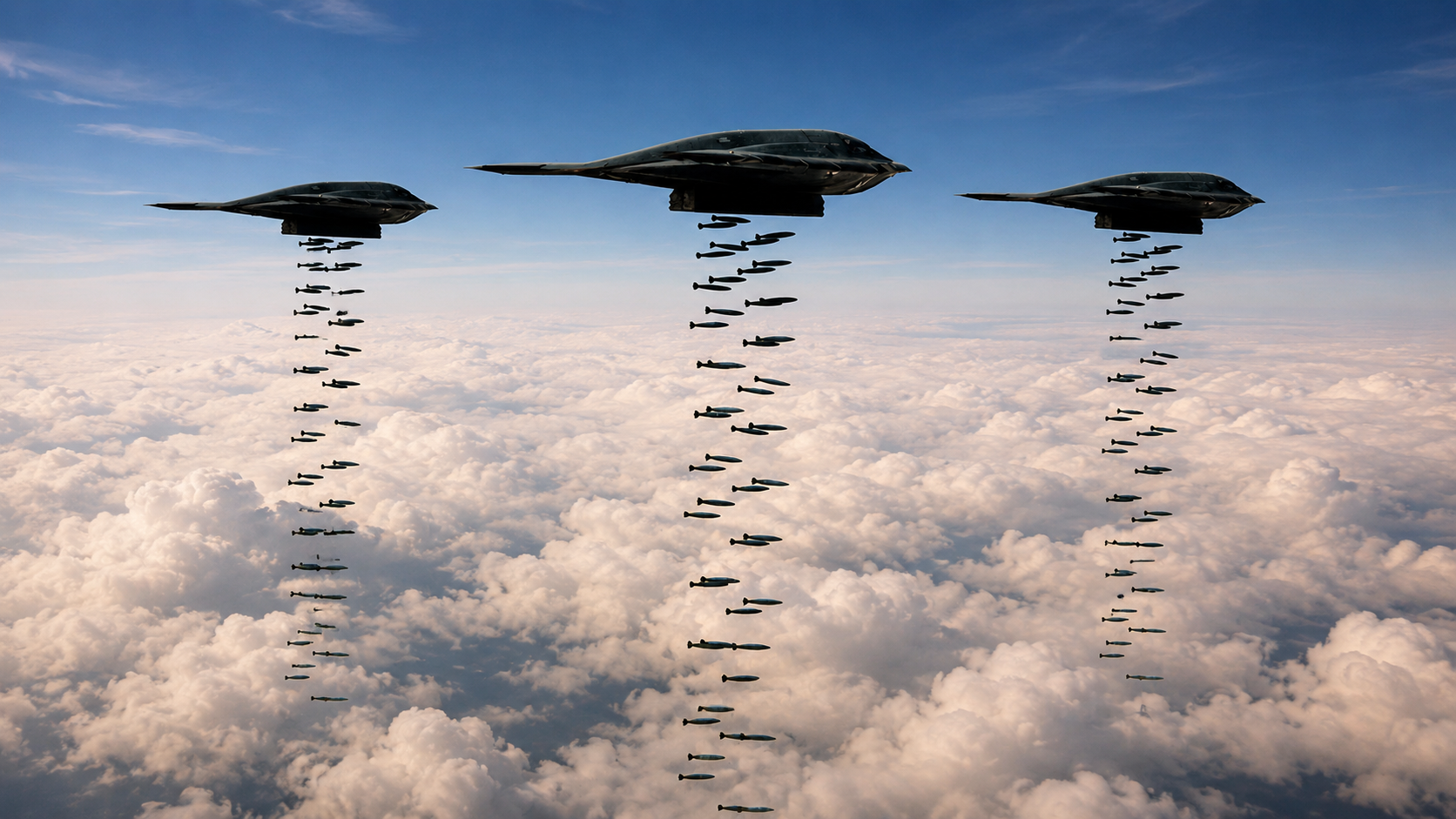
America’s Black Ghost in the Sky
There are aircraft that look powerful.
There are aircraft that sound terrifying.
And then there is the B-2 Spirit — a bomber so strange, silent, and futuristic that it does not look like a normal machine of war. It looks like a shadow cut out of the night sky.
For more than three decades, the B-2 Spirit has remained one of the most feared aircraft ever built. It is not feared because it is the fastest bomber. It is not feared because it makes the loudest entrance. It is feared because of something far more dangerous:
You May Also Like


By the time an enemy realizes it is there, the mission may already be over.
The B-2 is considered one of the most terrifying bombers in the world because it combines three devastating qualities into one aircraft: intercontinental range, massive payload capacity, and advanced stealth technology. Many aircraft can fly far. Some aircraft can carry heavy weapons. A few aircraft are built for stealth. But the B-2 Spirit brought all of those capabilities together in a single flying-wing platform.
That is what makes it different.
It can take off from the United States, cross oceans, enter some of the most heavily defended airspace on Earth, deliver precision weapons against critical targets, and return home. It is designed to strike command centers, radar sites, hardened bunkers, air-defense networks, and strategic targets that an enemy believes are protected.
The B-2 does not need to scream across the sky to be terrifying.
Its greatest weapon is silence.
A Bomber Built to Break the Enemy’s Confidence
The purpose of the B-2 Spirit is not only to destroy targets. It is also designed to destroy confidence.
Every military power depends on protected command centers, radar stations, missile sites, underground bunkers, air-defense systems, and leadership facilities. These are the places an enemy believes will survive the first night of war. They are the hardened nodes that make a country feel secure.
The B-2 was built to challenge that sense of security.
Its mission is simple but frightening: reach targets that are supposed to be unreachable.
That is why the B-2 is often associated with the first wave of a major conflict. Before conventional aircraft can safely operate, an enemy’s radar and command systems must be weakened. Before large air campaigns can begin, the most dangerous defenses must be confused, damaged, or destroyed.
The B-2 is the kind of aircraft commanders can send when the target is deep, heavily protected, and politically important.
It is not just a bomber.
It is a message.
That message says: distance will not save you, concrete will not always protect you, and radar may not see what is coming.
The Flying Wing That Looks Like the Future
The first thing people notice about the B-2 Spirit is its shape.
It has no traditional tail. Its body and wings blend into one smooth form. From above, it looks like a black boomerang or a giant wing sliding through the sky. This flying-wing design is one of the reasons the aircraft has become so iconic.
But the shape is not for beauty.
It is for survival.
Traditional aircraft have tails, vertical surfaces, engine openings, and sharp structures that can reflect radar signals. The B-2’s smooth flying-wing body is designed to reduce those reflections and make detection more difficult. Its shape works together with special materials, coatings, and classified low-observable technologies to help the bomber operate in hostile environments.
Many of the B-2’s stealth details remain classified, and that mystery only adds to its fearsome reputation. The public sees the aircraft. The enemy sees the result. But the full science behind its low-observable design remains hidden.
That secrecy is part of the power.
The B-2 is terrifying not because everyone knows exactly what it can do, but because no one outside its program fully knows what it can survive.
Invisible Does Not Mean Magic — It Means Hard to Find
People often call the B-2 “invisible to radar.” That phrase is dramatic, but the more accurate term is low observable.
Stealth does not mean an aircraft becomes magic. It does not mean radar completely stops working. It means the aircraft is designed to make detection, tracking, targeting, and engagement far more difficult.
That difference matters.
Modern air-defense systems do not simply need to “see” an aircraft for one second. They need to detect it, track it, identify it, lock onto it, guide weapons toward it, and keep tracking long enough to hit it. The B-2 is designed to disrupt that chain.
Its stealth design reduces multiple signatures, including radar, visual, infrared, acoustic, and electromagnetic signatures. The goal is not only to avoid being seen. The goal is to make the enemy uncertain.
Where is it?
How many are coming?
What direction did it enter from?
What target is it heading toward?
Is it already gone?
In war, uncertainty is deadly.
A defender who cannot trust his radar picture cannot respond with confidence. A commander who does not know where the bomber is cannot protect every critical site at once. An air-defense system that reacts too late may only discover the B-2 after its weapons have already been released.
That is the nightmare the B-2 creates.
Range: The Ability to Strike Across the World
One of the B-2 Spirit’s most important features is its long range.
A bomber is not only dangerous because of the weapons it carries. It is dangerous because of where it can go. The B-2 can fly thousands of miles without refueling, and with aerial refueling, it can reach targets across the globe.
This means the bomber does not always need to be based near a conflict zone. It can launch from secure bases such as Whiteman Air Force Base in Missouri and fly across continents and oceans to reach distant targets.
That global reach gives the United States a major strategic advantage.
An enemy cannot simply look at nearby air bases and assume it is safe. The B-2 can come from far away. It can cross long distances. It can approach from unexpected directions. It can remain part of a mission even when regional basing is politically difficult or militarily risky.
This is one of the reasons the B-2 is so respected by military planners.
It allows power to travel.
A single aircraft can carry strategic consequences across the planet.
Payload: The Silent Bomber With a Heavy Fist
Stealth alone would not make the B-2 terrifying if it could not deliver serious firepower.
But the B-2 can carry a large payload of precision weapons. Public Air Force information lists its payload at up to 40,000 pounds. That means the aircraft can carry a mix of conventional and nuclear weapons, depending on the mission.
This combination is what separates the B-2 from many other stealth aircraft.
Some stealth aircraft are designed for tactical missions. They may destroy radar sites, attack air-defense systems, or support battlefield operations. The B-2 operates at a strategic level. It can reach deep targets and deliver heavy weapons against facilities that may shape the outcome of a war.
Its payload can include precision-guided bombs used to strike military infrastructure, command facilities, hardened targets, and underground locations. One of the weapons often associated with the B-2 is the Massive Ordnance Penetrator, a huge bunker-busting weapon designed for deeply buried and heavily protected facilities.
That is why the B-2 carries such a fearsome reputation.
It does not only sneak in.
It can hit hard.
The Massive Ordnance Penetrator: Built for Buried Targets
The Massive Ordnance Penetrator, also known as the MOP, represents one of the most intimidating conventional weapons in the American arsenal.
It is designed for a specific kind of target: a target hidden underground, protected by concrete, rock, and reinforced structures. These are the kinds of facilities that ordinary bombs may not be able to destroy.
Underground bunkers are often used to protect command centers, weapons programs, leadership sites, and high-value military infrastructure. They are built with the belief that depth equals safety.
The MOP challenges that belief.
Its massive weight and penetrating design allow it to attack deeply protected facilities. When paired with the B-2 Spirit, it creates one of the most powerful non-nuclear strike options available to the United States.
That pairing is what makes the B-2 especially frightening to adversaries.
A stealth bomber can reach the area.
A bunker-busting weapon can attack the target.
The result is a strike package designed for places enemies thought were untouchable.
“Night One” Power: The Bomber Sent Before the Door Opens
In a major conflict, the first hours are often the most important.
Before fighter jets, tankers, surveillance aircraft, and other forces can operate safely, the enemy’s air defenses must be weakened. Radar sites, command centers, missile batteries, communication nodes, and hardened facilities become top-priority targets.
This is where the B-2’s reputation as a “Night One” aircraft comes from.
It is the kind of bomber that can be used early in a campaign, when enemy defenses are still dangerous and fully alert. Its stealth, range, and payload make it useful for opening the door for other forces.
The B-2 can help create a path through defended airspace.
It can attack key nodes that allow an enemy to coordinate defense. It can strike radar networks that help track incoming aircraft. It can hit leadership or command facilities that control military operations.
By damaging those targets early, the B-2 can change the battlefield before the wider fight begins.
That is why it is not just a weapon of destruction. It is a weapon of access.
It helps make the impossible mission possible.
Psychological Warfare in Aircraft Form
The B-2 Spirit does not only affect military targets. It affects the minds of enemy leaders.
Imagine being a commander responsible for defending a country. You have radar stations, missile batteries, underground bunkers, and command posts. You believe your most important sites are protected. Then you learn that an aircraft based thousands of miles away may be able to enter your airspace without being clearly tracked.
That creates fear.
It forces difficult decisions. Should you move leadership locations? Should you keep radar systems active and risk them being targeted? Should you hide weapons deeper underground? Should you spend billions building defenses that may still not stop the threat?
The B-2 forces enemies to prepare for a weapon they may not see.
That is one of its greatest strengths.
A visible weapon can be counted. A loud weapon can be heard. A predictable weapon can be planned against.
But a stealth bomber creates doubt.
And in military strategy, doubt can be as powerful as firepower.
Why the B-2 Still Matters in the Age of New Technology
The B-2 Spirit was developed during the Cold War, but it remains important today because the world has become more dangerous, not less.
Modern enemies are building stronger air defenses, deeper bunkers, longer-range missiles, and more complex command networks. Countries are investing in sensors, radars, cyber systems, drones, and anti-access weapons designed to keep American forces away.
That is exactly the kind of environment the B-2 was designed to challenge.
Even as the newer B-21 Raider begins to represent the future of American stealth bombing, the B-2 remains a symbol of strategic reach. It reminds the world that a bomber does not have to be close to be dangerous. It does not have to be loud to be powerful. It does not have to be seen to change the outcome of a crisis.
The B-2 is expensive, rare, and difficult to maintain. But its value is not measured only by how many aircraft exist. Its value is measured by what it can make an enemy fear.
One B-2 mission can send a message across the world.
The Cost of Building a Ghost
The B-2 Spirit is one of the most advanced aircraft ever built, but that power comes with enormous cost.
It is famous for being expensive to produce, operate, and maintain. Its stealth coatings and specialized systems require careful maintenance. Its fleet is small. Every aircraft is valuable.
But that is also part of the B-2’s identity.
It was never meant to be a mass-produced bomber like older aircraft. It was designed as a strategic tool for missions that demand the highest level of reach, stealth, and precision.
In other words, the B-2 is not used for every problem.
It is saved for the problems that few other aircraft can solve.
That is why its appearance in any crisis immediately attracts attention. When the B-2 moves, the world notices. When it deploys, analysts pay attention. When it flies over public events, people look up in silence.
The aircraft has become more than metal and engines.
It has become a symbol of American air power.
A Shape That Changed Military Aviation
The B-2’s flying-wing shape is now one of the most recognizable silhouettes in the world. But its influence goes beyond appearance.
It helped prove that stealth and long-range bombing could be combined into a single platform. It showed that strategic bombers did not need to look like traditional aircraft. It demonstrated that the future of air warfare would depend not only on speed and altitude, but also on signature management, precision weapons, and information dominance.
The B-2 changed how people think about bombers.
Older bombers were often judged by how fast they could fly, how high they could climb, or how many bombs they could drop. The B-2 introduced a different question:
Can the enemy even stop it before it reaches the target?
That question is why the aircraft remains terrifying.
The Human Side Behind the Machine
Behind the B-2’s mysterious shape are the people who keep it alive.
Pilots train for extremely demanding missions that can last many hours. Maintenance crews work with sensitive stealth materials and complex systems. Weapons specialists prepare precision payloads. Mission planners study routes, defenses, timing, weather, tanker support, and target requirements.
The aircraft may look silent and effortless in the sky, but every mission depends on thousands of hours of preparation.
That is often forgotten when people talk about advanced technology. A bomber does not become powerful only because of its design. It becomes powerful because trained people know how to use it.
The B-2 is a machine of strategy, but it is operated by humans under pressure.
That human skill is part of what makes the aircraft so effective.
Why Enemies Fear It
The B-2 Spirit is feared because it attacks the strongest parts of an enemy’s defense.
It does not need to fight like a normal aircraft. It does not rely on dogfighting. It does not need to dominate the sky through speed alone. Its advantage is entering the battlespace in a way that makes defense extremely difficult.
An enemy fears the B-2 because it threatens what they value most:
Their command centers.
Their radar networks.
Their underground bunkers.
Their strategic weapons sites.
Their leadership facilities.
Their confidence.
The bomber’s power is not just in the bombs it carries. It is in the uncertainty it creates before those bombs ever fall.
That is why the B-2 is often described as terrifying.
Not because it is unstoppable.
But because stopping it is one of the hardest problems an enemy can face.
Final Thought: The Bomber That Turns Darkness Into a Weapon
The B-2 Spirit remains one of the most frightening aircraft in the world because it represents a rare combination of reach, stealth, precision, and destructive power.
It can fly across continents.
It can carry heavy weapons.
It can attack deeply protected targets.
It can operate where many aircraft would face extreme danger.
And it can do all of this while forcing the enemy to wonder whether it was ever truly seen.
That is the true terror of the B-2.
It is not the roar of engines.
It is not the flash of speed.
It is not the image of a bomber filling the sky.
It is the quiet thought in an enemy command bunker:
What if it is already here?
The B-2 Spirit is not just a bomber. It is a warning written in the shape of a black wing — a reminder that in modern warfare, the most dangerous weapon is not always the one you can see coming.
Sometimes, the most terrifying aircraft in the world is the one that arrives as a shadow.