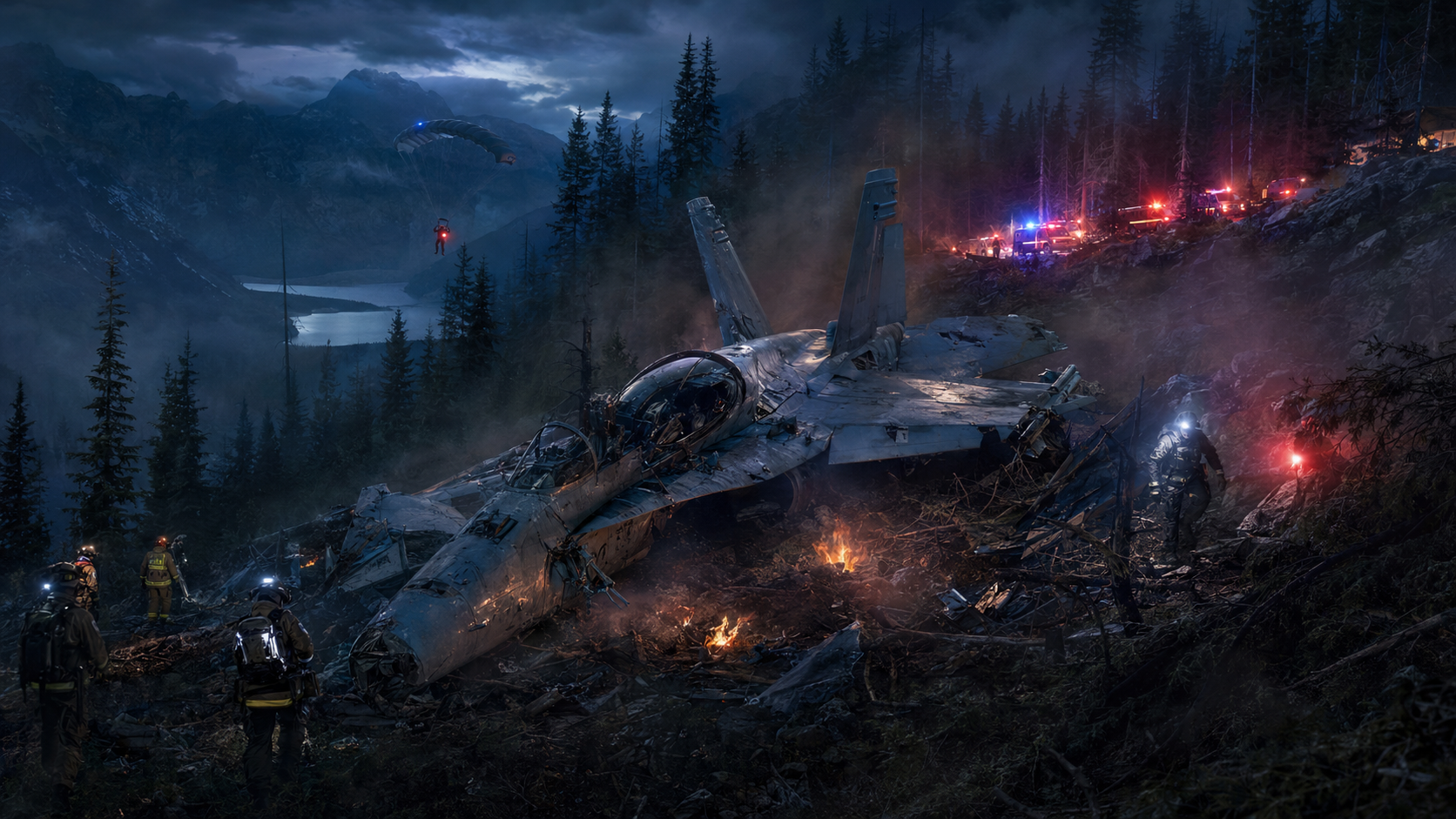
A Marine pilot walked away from a fireball in the mountains of Washington — but the crash of an F/A-18 Hornet has reopened a hard truth about military aviation: even routine training can turn deadly in seconds.
A United States Marine Corps F/A-18 Hornet crashed near Rimrock Lake in Washington state during a routine training mission, sending smoke into the mountain air, igniting a wildfire, and triggering a major emergency response across the rugged forested terrain.
The crash happened around midday on Saturday, June 13, 2026, in a mountainous area of Yakima County, southeast of Mount Rainier. The fighter jet, assigned to Marine Aircraft Group 11, 3rd Marine Aircraft Wing, was operating on a routine training flight when it went down. The pilot ejected before impact, survived the crash, and was later located by local authorities.
Officials described the incident as a non-fatal aviation mishap.
You May Also Like
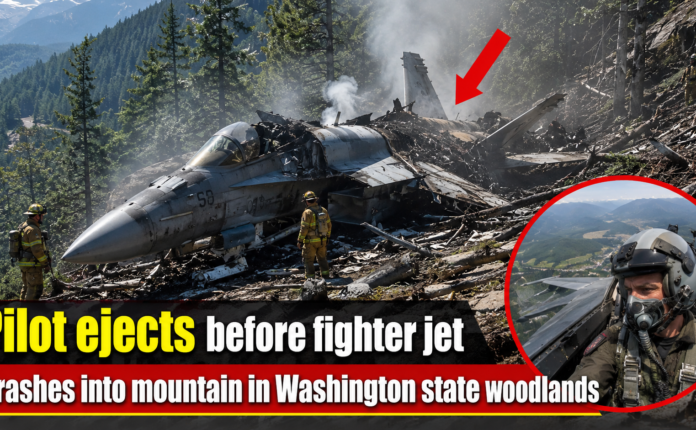

That phrase may sound calm and technical, but the scene on the ground was anything but ordinary.
A military fighter jet had fallen into the mountains. Wreckage had sparked flames. Fire crews rushed toward the crash zone. Local authorities moved quickly to locate the pilot. The U.S. Forest Service and local emergency responders joined the effort as smoke rose from the area near Rimrock Lake, a scenic region surrounded by forest, cabins, campsites, and steep terrain.
The pilot suffered minor injuries and was transported for medical treatment. No other injuries were reported.
For the Marine Corps, the survival of the pilot was the most important outcome. For the surrounding community, the urgent concern became the fire. The crash ignited dry vegetation and created a fast-moving emergency in a region where terrain can complicate every rescue and firefighting effort. Responders worked to protect nearby cabins in the Bear Creek area while crews focused on containing the blaze and securing the crash site.
The Naches Fire Department said crews completed structure protection near Bear Creek cabins, while additional resources remained in the area to support mop-up operations. Firefighters and emergency personnel treated the situation as both an aviation accident and a wildfire threat.
That combination made the response especially difficult.
Canada to join GCAP fighter jet program as an observer
A military aircraft crash is already dangerous. Wreckage can contain fuel, sharp debris, possible explosive materials, and sensitive equipment. Add fire, forest terrain, and nearby structures, and the challenge becomes even more serious. Responders had to move quickly, but carefully. They had to protect lives, prevent the fire from spreading, and preserve the crash site for investigators.
The cause of the crash remains under investigation. Marine officials have said the inquiry could take months. That is normal in military aviation accidents, where investigators must examine the aircraft, pilot actions, maintenance records, weather conditions, flight data, communications, terrain, and possible mechanical or system failures.
At this stage, there is no confirmed public explanation for why the F/A-18 went down.
But the incident is already drawing attention because of what it represents.
The F/A-18 Hornet is one of the most recognizable combat aircraft in American military history. Designed as a multi-role fighter, it has served in air-to-air combat, strike missions, close air support, reconnaissance, fleet defense, and training operations. It has flown from aircraft carriers, deployed with Marine squadrons, and supported American military operations for decades.
It is fast, rugged, and proven.
But even proven aircraft carry risk.
The crash in Washington is a reminder that the danger of military aviation does not only exist in combat zones. It also exists in training. Every fighter pilot must practice the skills required for war long before a real war begins. They fly low. They fly fast. They train through mountains, deserts, oceans, and complex airspace. They practice emergency procedures, tactical maneuvers, navigation, communication, and mission execution under pressure.
Training is how pilots survive combat.
But training itself can be unforgiving.
A fighter jet moving at high speed leaves little room for error. A small technical problem, sudden weather change, engine issue, bird strike, spatial disorientation, terrain factor, or unexpected system malfunction can become a crisis in seconds. That is why ejection seats exist. That is why emergency procedures are drilled again and again. That is why pilots are trained to make life-or-death decisions almost instantly.
In this case, the pilot made it out.
Has Iran Hit America’s “Unkillable” F-35? The Incident That Could Shake the Future of Stealth Warfare
That single fact changed the story from tragedy to survival.
The image is dramatic: a Marine aviator ejecting from a doomed fighter jet, descending into the Washington wilderness, injured but alive, while the aircraft crashes into the mountains and fire crews race toward the smoke. It is the kind of scene that reminds people that behind every military aircraft is a human being strapped into a machine built for extreme conditions.
The aircraft may be metal, fuel, sensors, and weapons systems.
But the mission is human.
The pilot has a family. The pilot has a squadron. The pilot has fellow Marines who understand exactly how dangerous that moment was. In military aviation, a successful ejection is never treated casually. It is a violent event. The body experiences extreme forces. The pilot may face injuries from the ejection, landing, terrain, or exposure after reaching the ground. Survival is a victory, but it is not easy.
That is why reports that the pilot sustained only minor injuries are so significant.
A fighter jet was lost. A wildfire was sparked. A major response was needed. But the pilot lived.
For the Marine Corps, the next step is investigation and accountability. Aviation mishap investigations are not about quick blame. They are about finding facts. Investigators will want to know exactly what happened from takeoff to crash. They will study the route, altitude, speed, mission profile, aircraft condition, and pilot communications. They will examine maintenance history and any available data. They will look at whether environmental factors played a role.
The goal is not only to explain one crash.
The goal is to prevent the next one.
Every aviation accident becomes part of a larger safety picture. Lessons learned from one crash can lead to changes in training, maintenance, procedures, flight restrictions, equipment checks, or emergency protocols. In military aviation, safety improvements are often written in the hard language of past accidents.
That is what makes this Washington crash important beyond the immediate headlines.
It is not just about one jet. It is about the constant pressure facing military aviation units as they maintain readiness, train pilots, preserve aging aircraft, and prepare for possible real-world missions.
The F/A-18 Hornet, especially the older legacy variants, has served for decades. While still capable, older aircraft require intense maintenance and careful management. The Marines have operated the Hornet for years while transitioning portions of their tactical aviation fleet toward newer platforms like the F-35. Yet the F/A-18 remains deeply connected to Marine aviation culture — a symbol of speed, flexibility, and combat service.
For many Marines, the Hornet is not just an aircraft. It is a workhorse.
It has launched from carriers. It has supported troops on the ground. It has flown in dangerous skies. It has trained generations of pilots. It has carried American power into the air for decades. That history gives the aircraft a legendary place in U.S. military aviation.
But history does not remove risk.
The U.S. Air Force’s B-1B bombers are loading hundreds of JDAM bombs for the Middle East.
The Washington crash shows how quickly a training mission can become a full-scale emergency. In one moment, a jet is flying a planned route. In the next, a pilot is ejecting, a mountain is burning, deputies are searching, firefighters are deploying, and military officials are preparing an investigation.
For local residents near Rimrock Lake and Bear Creek, the event was not an abstract military story. It was close, loud, dangerous, and real. Emergency responders had to protect homes and cabins. Campers and nearby residents had to stay alert. Fire crews had to move through terrain where wildfire can grow quickly if conditions allow.
The crash also raises a broader public question: how does the military balance the need for intense training with the risks that come with flying powerful aircraft over remote regions?
The answer is complicated.
The United States military needs pilots who can operate in difficult terrain. Mountain training, low-level routes, and complex flight environments help prepare aviators for real missions. Pilots cannot learn everything in simulators. They need real air, real weather, real geography, and real decision-making under pressure.
But those missions are never risk-free.
That is why the military uses designated training routes, safety protocols, aircraft inspections, communication systems, and emergency response planning. Even then, accidents can happen. When they do, military leaders, local authorities, and communities must respond together.
In Washington, that response appears to have worked. The pilot was located. The fire response began quickly. Nearby structures were protected. No civilian injuries were reported. The event could have been far worse.
Still, the loss of a fighter jet is serious.
The F/A-18 is not only expensive; it is also a valuable military asset. Each aircraft represents years of engineering, maintenance, training, and operational planning. A crash affects the squadron, the maintenance crews, the pilots, and the broader aviation community. It also creates questions about whether the incident was isolated or part of a larger pattern that needs attention.
Until the investigation is complete, those questions cannot be answered responsibly.|
One Mission, One Secret, One Hero: The Story of Captain Elias Vance –
That is important. In the age of viral videos and instant social media speculation, aircraft crashes often lead to rumors. People may claim mechanical failure, pilot error, weather problems, or dramatic theories before investigators even reach the wreckage. But aviation investigations require evidence, not assumptions.
The responsible conclusion right now is simple: an F/A-18 Hornet crashed during a routine training mission; the pilot ejected and survived with minor injuries; the crash sparked a wildfire; emergency crews responded; the cause is under investigation.
Everything beyond that must wait for facts.
But the emotional power of the story is already clear.
A Marine pilot faced a catastrophic moment in the air and survived. Firefighters and deputies moved into action. A mountain community was protected from a potentially dangerous blaze. A military squadron lost an aircraft but did not lose its aviator. In a profession where every flight carries risk, that matters deeply.
The crash is also a reminder of the hidden cost of readiness.
When people think of military power, they often picture aircraft carriers, fighter jets, missiles, and dramatic combat operations. But behind that power are thousands of training flights, maintenance hours, safety briefings, emergency drills, and ordinary days that can suddenly become extraordinary.
America’s fighter pilots do not become ready by waiting for war.
They become ready by training.
They climb into cockpits knowing that the aircraft is powerful, the mission is demanding, and the margin for error can be thin. They trust their training, their crews, their machines, and their instincts. Most flights end quietly. A few do not.
Saturday’s crash was one of those moments when routine became danger.
For the pilot, it was a personal fight for survival. For the fire crews, it became a race against flames. For the Marine Corps, it became a serious aviation mishap requiring careful investigation. For the public, it became a reminder that the courage of military service is not limited to battlefields overseas.
Sometimes it is seen in a training mission over American mountains.
Sometimes it is seen in a pilot pulling the ejection handle at the last possible moment.
Sometimes it is seen in firefighters moving toward smoke and wreckage while others move away.
And sometimes it is seen in the quiet discipline of investigators who must rebuild the final moments of a flight so future pilots have a better chance of coming home.
The F/A-18 Hornet crash near Rimrock Lake did not end in the worst possible way. That is the mercy in this story. The pilot survived. No other injuries were reported. Emergency crews responded quickly. Nearby properties were protected.
But it still stands as a powerful warning.
Boeing F-47: America’s Sixth-Generation Fighter Rises to Redefine Air Dominance
Military aviation is dangerous even on routine days. Training missions are not symbolic. They are real. The aircraft are real. The speed is real. The terrain is real. The consequences are real.
The Marine Corps will now search for answers. Investigators will study every detail. The community will recover from the fire response. The squadron will absorb the loss of the jet. And the pilot, thankfully, will have the chance to heal.
In the end, this crash is not only a story about a fighter jet going down.
It is a story about survival, risk, readiness, and the human cost behind military power.
A Hornet fell from the sky in Washington.
A pilot came home alive.
And once again, America was reminded that the price of preparedness is paid long before the first shot of war is ever fired.