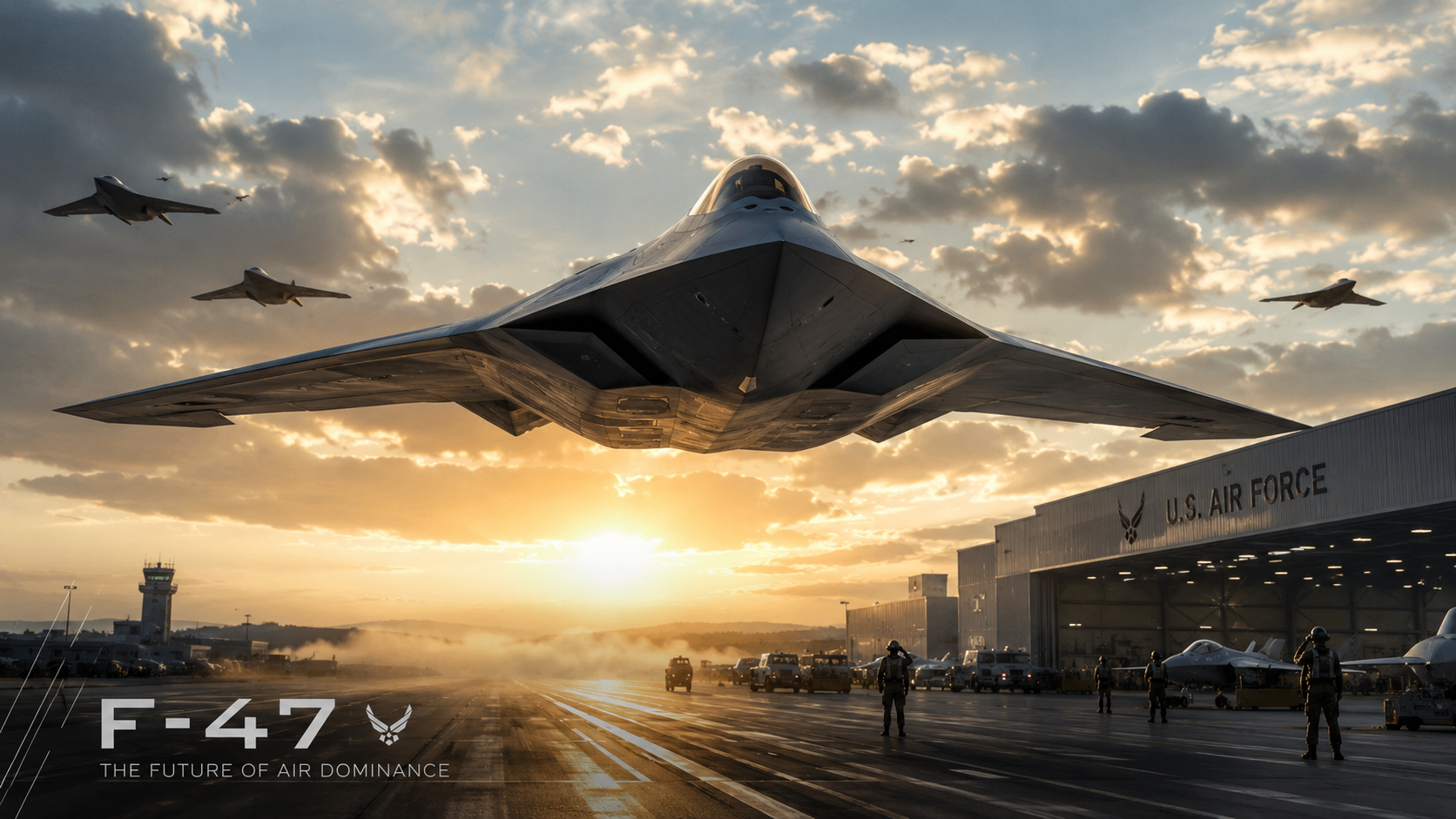
America’s next fighter jet is not just being built to replace the F-22 — it is being built to redefine air dominance for the next generation of war.
In a world where the skies are becoming more dangerous, more contested, and more technologically advanced than ever before, the United States Air Force has stepped into a new era with one name: F-47.
This is not simply another fighter jet. This is not just a faster aircraft, a stealthier machine, or a more expensive military project. The Boeing F-47 represents something far greater — a bold attempt to secure America’s control of the skies in an age where traditional air power is being challenged by advanced missiles, artificial intelligence, drone swarms, electronic warfare, and rival sixth-generation aircraft.
The F-47 is being developed by Boeing under the U.S. Air Force’s Next Generation Air Dominance program, known as NGAD. Its mission is clear and historic: to become the successor to the legendary F-22 Raptor, one of the most feared air-superiority fighters ever created.
You May Also Like


But the F-47 is not being designed merely to follow the Raptor’s path. It is being designed to go beyond it.
Publicly released details remain limited because much of the program is classified. But what has already been revealed is enough to show why this aircraft is being watched so closely by military analysts around the world. The F-47 is expected to fly faster than Mach 2, reach a combat radius of more than 1,000 nautical miles, and operate as the centerpiece of a much larger “family of systems” that may include advanced drones flying beside it.
That means the F-47 may not fight alone.
It could enter future battles with robotic wingmen, sensor aircraft, electronic warfare systems, and unmanned platforms working together as one connected force. In other words, the F-47 is not just a fighter. It is being shaped as the command center of future air combat.
The story took a major turn on March 21, 2025, when the Department of the Air Force announced that Boeing had been awarded the engineering and manufacturing development contract for the NGAD platform. That decision gave Boeing the responsibility of developing what the Air Force describes as the world’s first sixth-generation fighter aircraft.
For Boeing, the contract is more than a major defense win. It is a chance to restore strength to its military aviation legacy, especially its fighter production base in St. Louis, Missouri. For the Air Force, it is a strategic bet on the future of American air superiority.
The F-47 arrives at a time when the global balance of air power is changing quickly. Rival nations are investing heavily in stealth aircraft, long-range missiles, advanced radar, and integrated air-defense networks. The battles of tomorrow may not allow fighters to operate close to enemy territory without being detected, tracked, or threatened.
That is why range matters.
A fighter with a combat radius of more than 1,000 nautical miles would give the Air Force the ability to operate across vast distances, especially in regions like the Pacific where air bases and targets may be separated by enormous stretches of ocean. This kind of reach could allow pilots to strike, defend, and dominate without depending as heavily on vulnerable forward bases.
Speed also matters.
With a reported top speed above Mach 2, the F-47 is expected to move with the urgency required for future combat: intercepting threats, repositioning across large battle spaces, and surviving in high-pressure environments where seconds can decide the outcome of a mission.
But the most powerful part of the F-47 may be what the public still cannot see.
The aircraft’s stealth, sensors, data systems, weapons integration, and electronic warfare capabilities are mostly hidden behind classification. That secrecy is not accidental. In modern warfare, the advantage often belongs to the side that can see first, decide first, shoot first, and disappear before the enemy can respond.
The F-47 is being built for that kind of fight.
Hormuz Ultimatum: U.S. Navy Warships Rush Elite Troops and M1 Abrams Tanks Into Kuwait as Middle East Tensions Explode
Air Force leaders have said the aircraft will be more advanced, more adaptable, more sustainable, and easier to support than previous fifth-generation fighters. That is a major statement. The F-22 and F-35 already represent some of the most advanced combat aircraft ever fielded. For the F-47 to surpass them, it must not only be powerful — it must be smarter.
This is where the sixth-generation concept becomes important.
A sixth-generation fighter is expected to do more than fly fast and remain stealthy. It must connect with drones, command networks, satellites, sensors, and other aircraft. It must gather information, process it quickly, and help the pilot make faster decisions in chaos. It must survive not only missiles and enemy fighters, but cyber threats, radar traps, electronic attacks, and battles fought across multiple domains at once.
The F-47 is being built for a battlefield where the sky itself becomes a digital war zone.
Its expected partnership with collaborative combat aircraft could change how fighter pilots fight. Instead of one pilot facing danger alone, the F-47 could direct unmanned aircraft to scout ahead, carry extra weapons, jam enemy radar, or draw fire away from the crewed aircraft. This would increase reach, survivability, and battlefield flexibility.
That is why the F-47 is not just a replacement for the F-22. It is a new way of thinking.
The F-22 was built to dominate the sky through stealth, speed, and unmatched air-to-air performance. The F-47 is being built for a broader and more complex mission: to dominate the sky through networks, range, stealth, speed, sensors, and teamwork between human pilots and autonomous systems.
The name itself carries symbolism. The number “47” has been linked to multiple layers of meaning, including the legacy of the World War II P-47 Thunderbolt, the founding year of the U.S. Air Force in 1947, and the political moment surrounding the program’s announcement.
There has even been public interest around an early design concept patch reportedly connected to the F-47 System Management Office. The patch included the possible name “Phoenix,” a powerful symbol of rebirth, survival, and rising from the ashes.
Whether “Phoenix” becomes the aircraft’s final name or remains only an early concept, the symbolism fits the moment.
The F-47 is rising at a time when America’s air dominance can no longer be taken for granted. For decades, the United States has relied on unmatched air power to protect forces, support allies, and deter enemies. But future conflicts may test that dominance in ways the world has never seen before.
They Laughed at the Poor Mechanic Who Questioned a $400,000 F-35 Helmet—Then the Truth Made the Entire Air Base Go Silent
That is why the F-47 matters.
It is a message to America’s adversaries that the race for air superiority is not over. It is a signal to allies that the United States intends to remain at the front of military aviation. And it is a reminder that the future of warfare will not be won only by numbers, but by technology, speed, adaptation, and strategic vision.
Still, the program faces serious challenges.
A sixth-generation fighter will not be cheap. It will require years of testing, development, manufacturing, and integration with other systems. It must prove that it can deliver real combat value in a world where drones, missiles, and air defenses are evolving quickly. It must justify its cost. It must arrive on time. And it must do what no fighter before it has done: lead a new generation of air combat.
The Air Force has indicated that experimental testing connected to the program began years before the public announcement. First flight is expected later in the decade, with broader fielding planned in the years that follow. If those goals hold, the F-47 could become one of the most important aircraft of the 2030s.
But even before it takes to the skies publicly, the F-47 has already changed the conversation.
The B-2 Spirit Was Worth $2 Billion—But the Truth Hidden Inside It Cost Even More
It has forced the world to ask what comes after the F-22. It has pushed the idea of human-machine teamwork deeper into air combat strategy. It has placed Boeing back at the center of America’s fighter future. And it has reminded every rival power that the United States is preparing not for yesterday’s war, but for tomorrow’s.
The F-47 is still surrounded by mystery. Its full shape, its weapons, its cockpit, its engines, and its deepest capabilities remain hidden. But perhaps that is exactly what makes it so powerful.
The world knows enough to understand its purpose.
The F-47 is being built to fly farther, strike faster, hide better, think smarter, and fight as part of a connected force unlike anything before it.
It is not just a fighter jet.
It is America’s declaration that the future of air dominance has begun.




One Comment on “Boeing F-47: America’s Sixth-Generation Fighter Rises to Redefine Air Dominance”