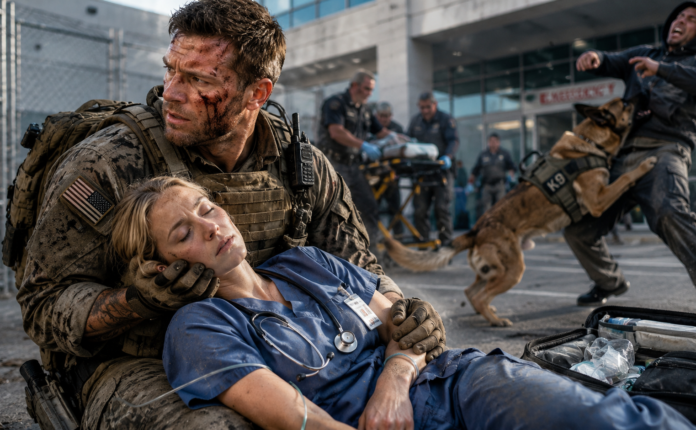
“You’re a petty officer first class.” she said. “You can’t order me to do anything.” “I’m senior.” “Not to me.” She checked the tourniquet on his leg. The pressure was still good. “You’ve got another 4 hours in this thing before we need to loosen it. Don’t touch it.” “Maya.” “Carver.” “I’m serious.” “So am I. Stop talking.
You’re burning calories.” He was quiet for a moment. Then quietly he said, “Rook hasn’t left your side.” “He never does.” “Even now?” “Even like this.” She looked at the dog. Rook was watching the ridge line, his posture alert and easy, his breathing slow. He glanced at her when he felt her attention, held her gaze for exactly 1 second and looked back at the ridge.
“Especially like this.” she said. She stood up and started moving again. The gate of FOB Nightingale came into view in the middle of the afternoon, shimmering in the heat at the far end of a flat stretch of open ground that felt after 32 km of mountain terrain like the most merciless piece of land she had ever crossed.
The watchtower saw her first. She knew the moment they spotted her because the radio traffic she could hear faintly through Webb’s earpiece, which she had kept plugged in and turned low, suddenly spiked with confused, overlapping voices. She did not stop. She did not slow down. She did not raise a hand or signal or call out.
You May Also Like

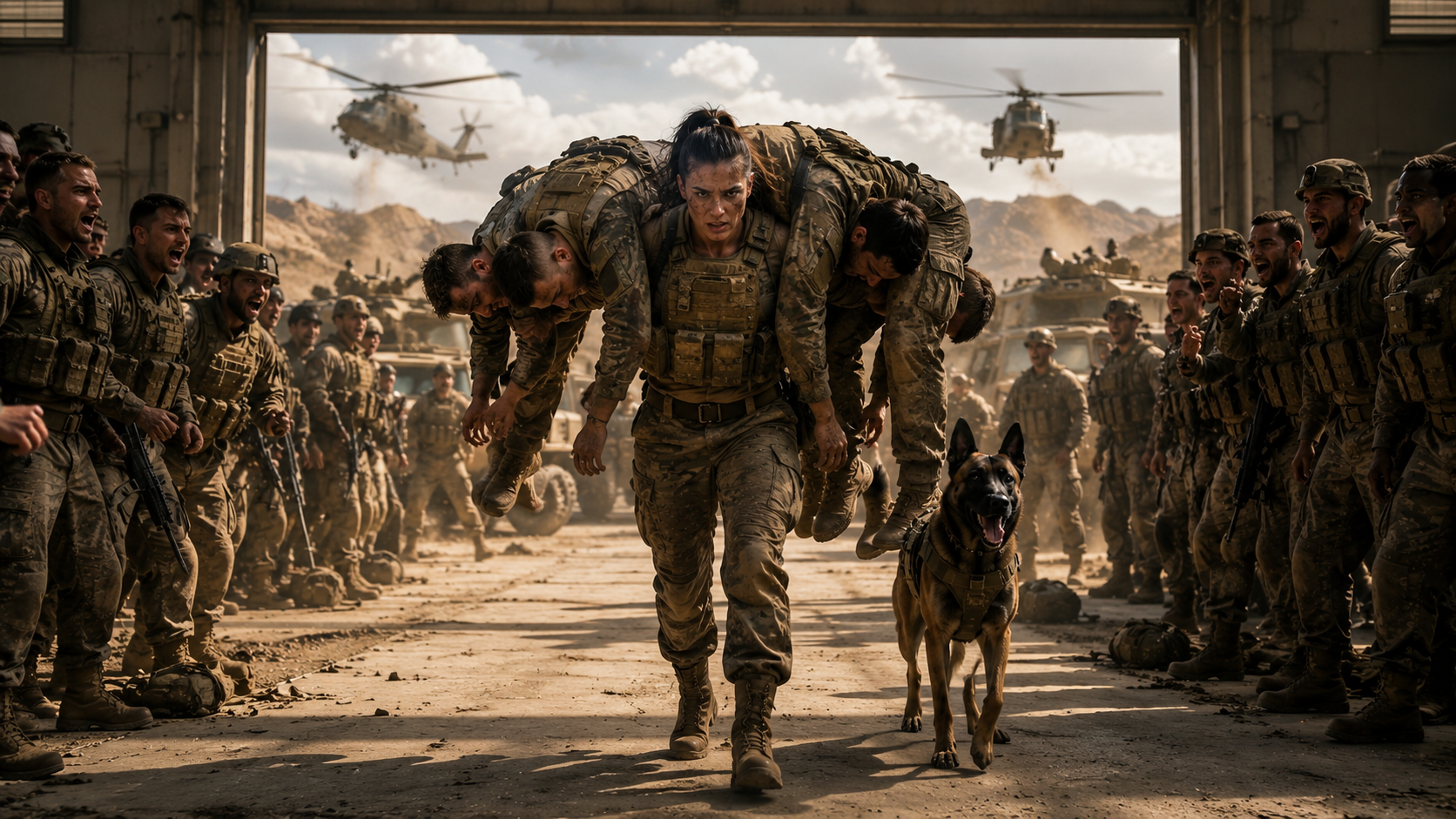
She simply kept walking, her long, dark brown hair hanging lank and filthy across her shoulders. Her white sports bra soaked through and dark with sweat and blood. And 12 hours of Afghanistan ground into the fabric. Her camouflage pants torn at both knees from a fall she had taken on the last mountain descent when her left leg briefly decided it was done.
Rook walked beside her left leg. She could hear the base coming alive around her. The alarm, the scramble, the thunder of boots on hardpack as the reaction force assembled. She heard the medics before she saw them. She heard the crowd forming at the gate. She heard the whispers, the questions, the disbelief. She heard the captain before she reached the gate. His name was Thorn.
She would learn that later. In the moment, he was simply a voice loud and sharp and carrying the kind of authority that is constructed entirely from the outside rather than earned from within. “Hold it right there.” he called out. “Identify yourself. What unit are you? Where is your commanding officer?” She reached the gate and stopped.
She began with the same careful, methodical precision she had applied to everything for the last 14 hours to lower Carver and Hollis to the ground. She had to do it in a specific sequence to keep from dropping either of them, and it required her full concentration, which meant Captain Thorn’s voice was in that moment irrelevant information.
He did not appreciate that. “I’m talking to you.” he said, his voice rising as he stepped closer. “Look at me.” “You walk onto my base looking like that dragging in three of our operators.” “No identification, non-regulation gear, and you can’t even acknowledge a direct question from an officer.” Rook turned his head and looked at the captain.
Just looked at him. His amber eyes were calm and completely flat, and something in that look made two of the soldiers standing behind Thorn take a small, involuntary step backward. Maya finished lowering her people. She checked Carver’s tourniquet one more time. She checked Hollis’s chest. She checked Webb’s dressings.
Only when she was satisfied that all three of them were stable did she push herself to her feet and turned to face the captain. She was 22 years old. She was 5 ft 6 in tall. She weighed in full kit approximately 143 lb. She was covered in blood and filth and the specific, bone-deep exhaustion that comes from doing something for 14 hours that would have broken most people in the first two.
And Captain Thorn looked at her and saw none of that. “A deserter.” he said. The word landed in the silence like a stone into water. “That is what I’m looking at.” “A soldier who ran from a firefight and left her unit to die in the field.” The crowd went absolutely still. Maya looked at him.
Her eyes were dark brown, the same color as her hair, and in that moment they held an expression that was not anger and was not contempt and was not exhaustion. It was something quieter and more terrible than any of those things. It was the look of someone who has already been through the worst thing imaginable and has come out the other side and who therefore has no more room in them for anything as small as offense.
She said nothing. Rook sat down beside her left leg and rested his chin on her thigh. His amber eyes moving slowly across the assembled crowd with an expression that looked uncannily like patience. Thorn took that silence as an invitation to keep going. And somewhere in the back of the crowd, an old sergeant major who had been in the army for 23 years looked at the woman standing at the gate.
Looked at the three men on the ground behind her. Looked at the dog sitting calm at her side. And felt something shift in his chest that he would later describe privately as the closest thing to witnessing a religious experience he had ever encountered in uniform. He had seen operators come through gates before.
He had seen men come back from things that should have killed them. But he had never seen anything come through a gate the way she had carrying what she had carried from where she had come from and then just stand there. Stand there quietly. Let a fool talk. The sergeant major’s jaw tightened. He looked at Captain Thorn. He started moving through the crowd.
Orchestrated seamless narrative continuation adhering to Vietnamese storytelling specifications. Orchestrated seamless narrative continuation adhering to Vietnamese storytelling specifications. Sergeant Major Dale Pruitt had spent 23 years learning how to read a room. He had been in firefights and courtrooms and command briefings and hospital wards, and he had developed a kind of instinct that does not come from training but from accumulated exposure to moments where human beings reveal exactly what they are made of.
He could read a room the way other men read a clock. One glance and he knew what time it was. He knew what time it was right now. He moved through the assembled soldiers with a deliberateness that parted the crowd without a word. His boots making no sound on the hardpack. His expression carrying the specific, contained fury of a man who is choosing very carefully not to say the first thing that comes to mind.
He stopped 4 ft behind Captain Thorn and stood there, and the soldiers nearest to him instinctively created space because 23 years of that kind of presence is something the body recognizes before the brain catches up. Thorn had not noticed him yet. Thorn was still talking. “You have 30 seconds to identify yourself and hand over that weapon before I have the security element place you in restraints.
” “I don’t care what happened out there.” “I don’t care what story you’ve constructed.” “What I see is an unidentified individual in non-regulation gear who walked onto a forward operating base without clearance and is refusing to cooperate with lawful authority.” He paused, clearly waiting for a reaction. He got none.
“20 seconds.” he said. Maya looked at him. She had not moved. Her breathing was slow and measured, the breathing of someone running on an internal system so stripped down and efficient that emotion had become a luxury she had simply stopped purchasing. Rook had not moved, either. The dog was still sitting beside her left leg.
His chin no longer on her thigh. His head now raised, ears forward, watching Thorn with an attention that was precise and completely without aggression. He was not threatening the captain. He was studying him. There was something about that distinction that was in its own way more unsettling than a growl. “10 seconds.” A voice came from behind him.
Quiet, flat with the texture of gravel on iron. “Captain Thorn.” Thorn turned. He saw Pruitt and something flickered across his face, a brief recalibration quickly suppressed. “Sergeant Major, I have the situation under control.” “No, sir.” Pruitt said. “You do not.” The flatness in his voice was not disrespect.
It was the simple, unvarnished delivery of a factual statement by someone who has stopped worrying about how facts land. Thorn’s jaw tightened. “This is my post.” Thorn said. “This individual has failed to identify herself, has refused to comply with direct orders, and is carrying a non-regulation weapon.” “She walked in here with three casualties and no explanation, and you want me to stand down.
” “I want you to look.” Pruitt said. “I am looking.” “No, sir. You are not.” Pruitt stepped forward until he was standing Thorne and turned to face the same direction the captain was facing so that they were both looking at Maya at the same angle from the same distance. He made a small gesture with two fingers toward Carver on the ground.
Look at that tourniquet. Thorne looked. His expression did not change. Applied within the last 14 hours, Pruitt said. High and tight on the upper thigh, femoral bleed. You can see by the saturation on the bandage below it that it was applied early within minutes of the injury. You are looking at the reason that man still has a leg attached to his body.
He paused. Now look at the chest dressing on the one in the middle. Thorne said nothing. Needle decompression scar, right side second intercostal space. Pruitt’s voice did not waver. Whoever did that performed a field thoracotomy procedure on an active casualty under fire. Without that intervention, he would have been dead in under 20 minutes from a tension pneumothorax.
He turned his head slowly and looked at Thorne. Now, I want you to look at her and tell me again what you see. A long silence. One of the medics crouched over Hollis looked up from his work. His name was Staff Sergeant Riley and he had 12 years in the medical field and had treated more combat trauma than he could specifically remember.
He had been listening to Pruitt and Thorne’s exchange while his hands moved automatically over his patient and now he stopped moving entirely and stared at the chest dressing he had just removed to replace. Sergeant Major, Riley said. His voice had a quality in it that nobody in the crowd could quite name. This decompression, it was done in the dark. You can see by the entry angle.
Whoever placed this needle was working without direct light. He paused. And they hit the space on the first attempt. The crowd absorbed this. On the first attempt, Riley said again because he felt it needed to be said twice. Thorne’s composure was beginning to show its seams. He turned back to Maya.
When he spoke again, his voice was still hard but there was something underneath it now, something that had not been there before. A hairline fracture running through the certainty. I need your name and unit designation, he said. That’s all. Give me that and we can proceed from there. Maya looked at him for a moment. Then, for the first time since she had walked through the gate, she opened her mouth and spoke to him directly.
Her voice was low and rough with dehydration but it carried without effort. My name and unit are classified above your clearance level, Captain. What I can tell you is that all three of your operators are stable. Carver needs surgical intervention within 6 hours. Hollis needs a chest tube and monitoring. Webb can wait.
She paused. I need water. The directness of it stunned the crowd into a fresh silence. She had not argued with him. She had not defended herself. She had simply stated what was factual and then stated what she needed in that order as if the two things were roughly equivalent in importance. Rook made a sound, not a bark, something lower, briefer.
He stood up from his sitting position and turned his head toward the far side of the assembly, his ears pivoting. A command vehicle was coming. Everyone heard it before they saw it. The particular sound of a Humvee driven at a speed that suggests whoever is inside has been told something urgent. It came through the secondary gate and crossed the motor pool and stopped 30 feet from where they were standing and the door opened before the vehicle had fully stopped.
General Marcus Holt was 57 years old, two star, and had the kind of face that is not born but built, built by decades of decisions that had consequences measured in human lives. He had commanded forces in three different conflicts and had the specific permanent tiredness of someone who has been responsible for other people for so long that he no longer remembers what it felt like not to be.
He was not a man given to visible emotion. His aide had once said privately that the general’s face had three settings, thinking, decided, and somewhere between the two. He stepped out of the vehicle and his eyes moved across the scene with a speed and economy that took in everything at once, the casualties, the medics, the assembled crowd, Thorne, Pruitt, and finally Maya.
He looked at her for exactly 2 seconds and something crossed his face that was not one of his three settings. Something that was older than any of them and considerably less controlled. He walked directly to her. He walked past Thorne as if the captain were a piece of furniture. He stopped 4 feet from Maya and Rook and for a moment he simply looked at the dog who looked back at him with amber eyes that were utterly unimpressed by stars or rank.
Report, Holt said. Maya gave it to him. 22 seconds. Every essential fact, no word wasted. The ambush, the grid, the timing, the casualties, the distance, the hours. She delivered it with the emotional effect of someone reading coordinates from a map. And when she finished, there was a silence that felt different from every other silence that had fallen over that motor pool in the last hour.
It was the silence of people doing arithmetic and arriving at numbers that do not fit any category they have previously needed. 32 kilometers, 14 hours, three men. That’s not possible, said a voice in the crowd, a young specialist barely 20 who had not yet learned which things you say out loud and which things you keep to yourself.
Several of the older soldiers around him closed their eyes briefly. Holt did not look at the specialist. He kept his eyes on Maya. You did this alone. Rook helped, she said. The general looked at the dog again. Rook met his gaze and held it with a patience that was almost philosophical. Holt made a sound that was not quite a laugh, not quite the opposite.
Thorne had recovered enough of himself to step forward. Sir, with respect, I have not been able to verify this individual’s identity or unit affiliation. She is carrying non-regulation equipment and has been uncooperative with lawful directives from the officer of the day. Protocol requires that before any debriefing, we establish Captain, Holt said without looking at him.
Sir? When did you last sleep? The question was so unexpected that Thorne stopped mid-sentence. Sir, it’s a simple question. I Last night, sir, 6 hours approximately. And in those 6 hours in a bed on this base with food and water and a roof over your head, what did you accomplish? Thorne’s face went very still.
He understood suddenly where this was going and he did not want to go there but there was no road that led anywhere else. That’s what I thought, Holt said. He turned to his aide, a sharp-faced major named Chen who had been standing two steps back with a tablet in his hands since the vehicle stopped. Major, the file.
Chen stepped forward and handed over the tablet without a word. His face, normally as neutral as his general’s, had a quality in it that the watching soldiers could not quite read. He had already seen what was on the screen. Holt looked at the tablet. He looked at it for several seconds. Then he handed it back to Chen and said, “Read it out loud.
” Chen looked at the tablet. He cleared his throat. There was a pause of approximately 3 seconds that felt much longer than that. Reeves, Maya Catherine. Master Sergeant. Unit designation classified under statute 9 Delta. Service record partially redacted. Primary specializations, special operations combat medicine, advanced K9 integration, long-range reconnaissance, unconventional warfare.
Secondary specialization, counterintelligence. Chen paused, swallowed. Call sign Ghost actual. K9 partner, Rook Belgian Malinois German Shepherd cross dual certified in patrol and medical detection. Another pause. Deployed continuously for 31 months across four theaters. Decorated, Distinguished Service Cross, Silver Star, Bronze Star with V device three awards, Purple Heart four awards.
Thorne had not moved. His face looked like something that had been frozen mid-expression and left there. She’s 22 years old. Someone in the crowd said very quietly. It was Pruitt. He was not saying it as an accusation. He was saying it the way you say something when you need to hear it spoken aloud to confirm that it is real. Chen continued.
Notes from former commanding officer Colonel Richard Staves Reeves, operates at a level I have never witnessed in 30 years of service. Her medical instincts are extraordinary. Her tactical instincts are something else entirely, something I lack the framework to adequately describe. She does not function like an operator.
She functions like a fact of nature. You do not send her to win a fight. You send her when the fight is already over and you need someone to carry the survivors home. The silence after those words was absolute. Rook made a low sound, not a growl, a hum, and pressed his flank against Maya’s leg.
She reached down without looking and rested her hand on top of his head. Her fingers finding the exact spot behind his left ear, that she always found the spot that made his eyes go briefly soft before his attention returned to the perimeter. Hollis from the stretcher spoke. His voice was thin, but audible. She did the needle thing with one hand.
He said to nobody in particular. She was returning fire with the other. I watched her do it. I thought I was hallucinating. You might have been, Webb said from the stretcher beside him. I was hallucinating and I still saw the same thing. Carver said nothing. Carver was looking at Maya with an expression that had gone past gratitude into something that did not have a name in standard emotional vocabulary.
He had a daughter at home. 14 months old. He had a photograph of her in his kit the same way Garrison had kept one because that was what they did because you kept the thing you most needed to come back to somewhere close to your heart. He was looking at Maya the way you look at something that reached into the space between you and the worst ending imaginable and pulled you back without asking for anything in return.
General Holt turned to face Captain Thorne. He did not raise his voice. He never raised his voice. That was in its way the most frightening thing about him. Captain Thorne, he said, you are relieved as officer of the day effective immediately. You will report to my aids office at 0800 tomorrow morning. You will not speak to Master Sergeant Reeves or any of the casualties between now and then.
You will not speak about this incident to anyone between now and then. Do you understand me? Thorne’s face had gone a color that was not quite white and not quite gray. Yes, sir. Good. Dismissed. Thorne turned and walked away. His back was straight and his stride was measured and controlled because 20 years of conditioning does not abandon you just because the ground has dropped out from under you.
But every person watching him go could feel the distance between how he looked and how he was and it was a considerable distance. Pruitt watched him go. Then he turned and looked at Maya who had not moved through any of it. Had not shown satisfaction. Had not shown relief. Had not shown anything that suggested she had been paying particular attention to the unraveling of the man who had called her a deserter 14 minutes ago.
She was looking at Carver. Checking his color. Monitoring his consciousness level with the automatic continuous attention of someone for whom caring for her people is not a choice, but a function as built-in and involuntary as breathing. Master Sergeant, Pruitt said. His voice was different now than it had been all day.
Something in it that was not quite soft, but was the closest thing to it that a voice shaped by 23 years of hard use could manage. When did you last eat? She thought about it. Genuinely thought about it as if the answer required retrieval from a significant distance. Yesterday morning, she said. Before the mission. And water. I had half a canteen.
I gave the rest to Carver at the third rest stop. She paused. Rook hasn’t had water since the valley. Pruitt turned to the nearest soldier without hesitation. Get water, food. Two bowls for the dog. Move. The soldier moved. Holt was still standing in front of Maya. He had not left. He was looking at her with the expression that was not one of his three settings.
The older one, the less controlled one and when he spoke, his voice was quiet enough that only the people immediately around them could hear. We had you listed as missing, he said. When Predator 4 went dark, we assumed the worst for the entire element. We had notification letters queued. He stopped. Your mother was going to get one of those letters tomorrow.
Maya’s expression did not change, but her hand still resting on Rook’s head pressed down a little more firmly and the dog leaned into it. I need to send a message, she said. To my mother. We’ll get you to a secure line. And Lieutenant Garrison, she said. He has a daughter, 6 weeks old. She should know that he knew about her, that he had her picture.
She looked at the general. Someone should tell her that specifically. Not just that he was killed. That he had her picture. Holt looked at her for a long moment. I’ll make sure of it, he said. Rook sat down again beside her left leg. The soldier came back at a run with water and two metal bowls and something wrapped in paper that turned out to be three protein bars and a cold piece of flatbread from the chow hall.
Maya opened a bowl, filled it from a canteen and set it on the ground in front of Rook before she touched anything herself. The dog drank without urgency with the same measured composure he had displayed through everything and when he finished, he lifted his head and looked at Maya and then at the food in her hands with an expression that was patient and attentive and faintly expectant.
She broke off a piece of the flatbread and gave it to him. Then she ate the rest of it herself standing there in the middle of the motor pool covered in blood and dust and 14 hours of the valley of death and nobody spoke. The crowd had thinned, but it had not dispersed. The people who remained stood at a respectful distance and watched not out of voyeurism, not out of spectacle, but because they were in the presence of something they did not have adequate language for and they were reluctant to leave until they had at least tried to
understand what it was. Riley finished stabilizing Hollis and stood up. He walked to Pruitt and spoke quietly. Sergeant Major, the tourniquet on Carver, the tension in it is textbook. Exactly textbook. The angle, the placement, everything. He shook his head slowly. She did that in the dark under fire in less than 30 seconds.
He looked at Maya. I have been doing this for 12 years and I would not have trusted myself to get that right in those conditions. Pruitt said nothing. He just nodded. The afternoon was moving toward evening, the heat beginning to break in the way that Afghan heat breaks suddenly and completely like a decision being made.
Somewhere on the base, a radio crackled with routine traffic. Somewhere a generator hummed its indifferent hum. The world moved forward the way it always does without pausing for any particular human moment, however large, but this moment was not finished yet. Because Carver from his stretcher had reached out a hand.
Not toward Pruitt. Not toward Riley. Toward Maya. His arm was extended toward her with the particular reaching quality of someone who needs to confirm that something is real. She walked to him. She crouched beside the stretcher. She took his hand. My daughter, he said. His voice broke on the second word. Just the one break, one fault line.
I have a daughter at home. I know, Maya said. She’s 14 months. She just started walking. He stopped, started again. I just need you to know that I Carver, she said. Yeah. You’re going home to her. He looked at her. His eyes were red at the rims, but he did not let go of the one break in his voice. He held it.
He held himself together with the discipline of someone who learned a long time ago that falling apart is a luxury with a very high price. How do you know? She looked at him. Her dark brown eyes were steady and direct and completely without qualification. Because I carried you 32 kilometers. She said. And I don’t do things I don’t finish.
His hand tightened on hers. Just for a second. Then he released it and turned his head away and breathed carefully, deliberately, the way you breathe when you are managing something that is larger than the container you have available for it. Rook moved to the edge of the stretcher and rested his chin on the metal frame. Just rested it there.
Still, warm, present. Carver reached out with his other hand, his eyes still turned away and his fingers found the dog’s head. Neither of them moved for a long time and Sergeant Major Pruitt watching from 6 feet away thought that in 23 years he had never seen anything that looked more like what courage actually was.
Not the version you see in recruitment posters. The real version. The version that is quiet and exhausted and asks for nothing and keeps going anyway all the way to the end all the three days after Maya Reeves walked out of the Korengal Valley, the man who had tried to have her thrown in the brig came to find her.
She was on the firing range at 0530 alone. Except for Rook running controlled pairs at 200 meters with the M14 she had carried through 32 kilometers of hell and never once put down. She had cleaned it the night she arrived and then again the morning after and every morning since. Not because it needed it, but because the routine was an anchor.
Something she could do with her hands while her mind worked through the thing she had not yet been able to say out loud in any of the four debrief sessions she had sat through in the past 72 hours. She had heard the ambush before it started. Not the sounds of it. The shape of it. Something in the way the valley had gone quiet in the 30 seconds before the first RPG hit that was not natural silence, but constructed silence.
The silence of a large number of people holding their breath in coordinated restraint. She had felt it the way Rook felt a threat before it materialized as a shift in atmospheric pressure rather than a specific sensory input and she had been turning to say something to Lieutenant Garrison when the first round came in, and the turning became irrelevant.
She had not told the debrief team that part yet. She had been waiting. Waiting for a specific question that nobody had asked, which told her something important about who was asking the questions and what they already knew. She heard Thorne’s footsteps before she saw him. He walked differently than he had 3 days ago, quieter, more careful about where he put his feet. She kept shooting.
She put six rounds into the target at 200 m, two into the chest, two into the head, two into the chest again, and only when the magazine was empty did she lower the rifle and turn. He stopped 10 ft away. He looked like a man who had not slept well, which was accurate. He looked like a man who had rehearsed whatever he was about to say several times and was no longer confident in any of the versions.
“Master Sergeant,” he said. “Captain, I wanted to” He stopped, started again. “What I said at the gate, the things I assumed, I have been trying to find a way to” “I owe you an apology, and I’m aware that whatever I say is going to be inadequate to the situation, but I needed to say it anyway.” Maya looked at him.
She set the rifle against the support post beside her and began reloading the magazine, pressing rounds in one at a time with a steady, methodical rhythm, her eyes on him. “Why?” she said. “Because it was wrong, what I did.” “That’s not what I asked.” He paused. “Because I need to understand why I was so certain,” he said.
“I looked at you and I made a complete determination within 30 seconds, and I was completely wrong, and I want to know how that happened. Because if I can do it to you, I can do it to anyone.” Something in Maya’s expression shifted. Not warmly exactly, but the way a door shifts when someone pushes it correctly for the first time.
“Your apology is irrelevant to me,” she said. “But that question isn’t.” She pressed the last round into the magazine. “You saw what you expected to see. You had a framework for what a soldier looks like and what a deserter looks like, and you applied it without examining it. Most people do that. Most people never figure out that they’re doing it.
” She looked at him directly. “The problem with your framework is that it was built entirely from the outside. Uniform, rank, gender, size. You didn’t look at what was actually in front of you.” Thorne was quiet for a moment. “The three men on the ground,” he said. “I looked at them and I saw casualties. I didn’t see what had been done for them.
” “You didn’t want to see it,” she said. “There’s a difference.” He absorbed that. “Fair,” he said after a moment. Rook had been watching Thorne since he arrived with a calm, appraising attention that was not hostile, but was not welcoming. Now he walked forward three steps and sat down in front of the captain and looked up at him.
Thorne looked at the dog with the expression of a man who does not know the protocol for this interaction. “Hold out your hand,” Maya said. “Palm down.” Thorne extended his hand palm down with the careful compliance of a man who has recently learned to be more careful. Rook sniffed his knuckles, considered, then sat back.
“Okay,” Maya said. “What does that mean?” “It means you passed.” Thorne looked at the dog, then at Maya. “Your dog evaluates people constantly,” she said. “He’s almost never wrong.” Thorne was quiet for a moment. Then carefully he said, “Master Sergeant, I’ve been hearing things since the incident, about the ambush, about the intelligence that placed your team on that route.
” He paused. “I’m not part of any official investigation. I’m aware of that, but I was the officer of the day when you came in, and certain things passed through my desk in the hours after, and I noticed something.” Maya went very still. It was not the stillness of surprise. It was the stillness of recognition.
“What did you notice?” she said. “The route your team was assigned, it was changed 6 hours before insertion. Late update came through an encrypted channel signed off by an intelligence officer whose name I didn’t recognize.” He looked at her steadily. “I tried to pull the original authorization this morning.
The record has been modified. The original version no longer exists.” The range was very quiet. Somewhere past the perimeter wire, a vehicle moved along a road, its engine note rising and falling. Rook tracked it without moving his body, ears rotating, then dismissed it. “Who knows you looked at that record?” Maya said.
“No one.” “I accessed it through a terminal I was legitimately authorized to use.” “Don’t access it again,” she said. “Don’t talk to anyone about what you found. Not your commanding officer, not anyone you consider a friend, not anyone.” She held his gaze. “Do you understand what I’m telling you?” He understood.
She could see it in the way his face settled, the way the quality of his attention shifted from concerned to something more careful and more frightened. “You already knew,” he said. “I knew something,” she said. “You’ve just told me which something.” He was quiet for a long moment. Then he said, “What are you going to do?” “What I was already doing,” she said.
She picked up the M14. “Go back to your quarters, Captain. Act normal. Eat in the chow hall. Do your job. If anyone asks what you’ve been doing this morning, you came to the range to get some air.” “And Rook passed me,” he said. “And Rook passed you,” she said. He looked at her one more time, the look of a man cataloging something he wants to remember accurately, and then he turned and walked away.
His footsteps going back across the hardpack had a different quality than the ones coming in, less rehearsed, more real. Rook watched him go and then turned and looked at Maya. “I know,” she said. She had been building the picture since the first debrief, building it the way she built everything quietly, without announcing the process, assembling pieces in a structure that would hold weight before she showed it to anyone.
The route change 6 hours before insertion was one piece. The jammed communications, which the signals team had attributed to terrain interference, but which Maya knew from the specific frequency pattern was an active electronic countermeasure deployed by someone who knew their comms architecture was another piece.
The third piece was the firing positions. Three elevated positions perfectly triangulated for the kill box, pre-sited and pre-registered, which meant the people who occupied them had known that specific piece of ground was going to be crossed at that specific time. You do not pre-register a firing position on terrain selected at random.
You pre-register it when you have information. Someone had given them the information. The question she had been turning over for 72 hours was not whether there was a leak. The question was where in the chain the leak existed, and the answer to that question was going to determine who was still in danger and who had already been removed from the board.
Garrison was dead. Garrison, who had been the team leader, who had made the final call on route selection, who had been in the briefing when the route change came down. She thought about the photograph in his pocket. She thought about the 6-week-old daughter and the 31-year-old father who had carried her face over his heart into the valley.
She picked up her rifle and walked back toward the main base with Rook at her left knee, and she was halfway across the open ground between the range and the command building when General Holt’s aide came toward her at a pace that was not quite running, but was faster than walking, his face carrying the specific tight quality of someone managing urgent information.
“Master Sergeant,” Chen said. “The general needs you. Now.” “What happened?” “The investigation team from Bagram landed 20 minutes ago.” He paused. “They brought someone with them.” The room where they had set up was a conference space in the command building that smelled of stale coffee and old paper and the particular tension of a space that has recently been converted from ordinary use into something higher stakes.
There were four people from the investigative team, all of them in clean uniforms with the particular crispness that distinguishes people who arrived by aircraft from people who live in the field. There was Chen. There was General Holt at the head of the table, and there was a man in civilian clothes sitting in the corner chair with a cup of coffee and an expression of carefully managed neutrality that Maya recognized instantly because she had been trained by people who wore that expression professionally.
He was Defense Intelligence Agency. She did not need to see credentials. “Master Sergeant Reeves,” Holt said. “Sit down.” She sat. Rook positioned himself beside her chair with the automatic, practiced quality of a dog who has been in too many rooms like this one to need instruction. The lead investigator, a colonel named Ferris with close-cropped gray hair and the eyes of a woman who has built a career on watching what people do when they think they are not being watched, opened a folder in front of her. She did
not look at it. She looked at Maya. “Your debrief indicated that communications were jammed from the first second of the ambush,” Ferris said. You described the jamming as immediate and total. Yes. Our signals assessment team has attributed that to terrain interference. Your signals assessment team is wrong, Maya said. The room shifted.
Not dramatically. A small shift. A slight alteration in the quality of attention. The way a room shifts when someone says the thing that other people in the room have been thinking but not saying. Ferris did not react to it. What makes you certain? The frequency signature, Maya said. Terrain interference degrades signal quality progressively.
It does not eliminate multiple independent frequencies simultaneously at the point of initiation. What I heard in those first seconds was a clean cut across all bands. That’s an active countermeasure. A jammer deployed at distance, pre-positioned on a specific vector relative to our location. She looked at Ferris steadily.
Pre-positioned means foreknowledge. Someone knew exactly where we were going to be. Silence. The DIA man in the corner set down his coffee cup. The route changed, Maya said. She watched Ferris’s face. Watched it very carefully. Six hours before insertion. Late update through an encrypted channel. I’d like to know who originated that change and what their current location is.
Ferris looked at her for a long moment. What makes you think the route change is relevant? Because Predator 4’s original route avoided the specific terrain where the firing positions were pre-registered, Maya said. The original route would have put us in the valley at a different grid, at a different approach angle, and the triangulated kill box that was set up would not have been effective.
She paused. The original route was selected by Lieutenant Garrison based on his own reconnaissance assessment. The changed route was selected by someone else. And Lieutenant Garrison is dead. The air in the room had changed quality. It was not the tension of conflict. It was the tension of a tightly wound thing encountering a point of no return.
Holt said, Maya. He never used her first name. She heard it land and registered what it meant. He was not managing her. He was warning her. She understood why a second later. Ferris closed the folder. Master Sergeant Reeves, the intelligence officer who originated the route change, is currently under protective custody at Bagram.
She came forward 48 hours ago and provided a voluntary statement. She paused. She was coerced. Her family in the States was threatened. She made the change under duress, and she has been cooperating fully with the investigation since the moment she had an opportunity to do so safely. Maya did not move. Who coerced her? That is the active and ongoing question, Ferris said.
And that is why you are in this room. The DIA man spoke for the first time. His voice was quiet and had the flat American Midwest quality of someone who has spent a long time eliminating accent as a form of identification. You operated in this theater for 14 months before this mission, Master Sergeant.
You have contact networks and source relationships that are not fully documented in your official record. That’s accurate, Maya said. In that time, you identified a pattern of operational security failures that you flagged through your unit’s internal channels. She looked at him. Three separate instances, she said. Three missions where the enemy demonstrated foreknowledge of our approach.
I filed reports on all three. Those reports were not elevated, he said. I know. Do you know why? She held his gaze. I have a theory. Tell us, Ferris said. Maya took a slow breath. Rook shifted beside her chair, pressing his shoulder against her calf. A contact so familiar and automatic that she no longer consciously registered it except as a kind of steady weight that helped her think clearly.
The reports were filed through the intelligence coordination office, she said. The same office that processed the route change. The same office that would have had access to the communications architecture used to deploy the jammer. She looked at Ferris. I don’t think the intelligence officer who made the route change is your leak.
I think she’s your evidence. Someone in that office has been running this for longer than one mission. And when I started filing reports, they became a problem to be solved. Ferris looked at her. You think Predator 4 was sent into that valley to silence your reports? I think Predator 4 was sent into that valley to eliminate everyone who could corroborate what I had observed, Maya said.
Which means I was on the target list before the mission was ever assigned. The room was absolutely silent. Holt had his hands flat on the table, and he was looking at them with the expression of a man doing math he does not want to arrive at. Chen had his tablet in his hands and was not looking at it. The four investigators had gone very still in the way of people who have been building toward a revelation and have just arrived at its exact shape.
The DIA man said, You understand what you’re describing. Yes, Maya said. You’re describing an asset inside the intelligence coordination structure at the regional level who has been running active interference against special operations oversight for an indeterminate period. You’re describing deliberate fratricide.
Yes, she said again. Rook stood up from beside her chair. He walked to the center of the room and sat down and looked at each person in turn with the methodical attention of a dog who is determining the nature of a space and the people in it. It was such a precise, purposeful movement that two of the investigators turned to watch him without quite knowing why.
He does that when the stakes go up, Maya said. He’s been trained to clear a room. He’s clearing the room. Ferris stared at the dog. Is he indicating a threat? He’s indicating importance, Maya said. There’s a difference. He knows something significant is happening. He wants everyone to be paying attention. She looked at the investigators.
So do I. It was Chen who spoke next. He had been quiet through the entire exchange processing, and when he finally spoke, it was with the careful precision of someone who has been waiting to introduce the piece of information that changes the shape of everything. General, he said. There’s something else. He put the tablet on the table and slid it to Holt.
The name on the route change authorization. When Master Sergeant Reeves’s debrief triggered an automatic flag in the system 3 hours ago, the authorization record was accessed from a terminal inside this base. He paused. Inside this building, while we were all at the debrief. Holt looked at the tablet. He looked at it for 3 seconds. His face went through something that was not one of his three settings and was not the older expression, either.
It was something new. Something that had the quality of a man who has just discovered that the ground he has been standing on is not what he believed it to be. This terminal, he said. His voice was controlled but barely. Where is it? Intelligence coordination liaison office, Chen said. Second floor.
Who has access? 14 people on this base hold the authorization level. Chen paused. One of them arrived on the same flight from Bagram as the investigation team. Everyone in the room turned to Ferris. Ferris was already on her radio. Rook turned his head toward the door at the same moment Ferris keyed her handset, and the sound he made was low and brief and was not a bark and was not a growl, but was something between the two that Maya had only heard from him on four previous occasions, all of them in the seconds immediately before something
happened. Lock down the building, Maya said. She was already on her feet. She said it the way she said everything. Flat calm and with the absolute weight of someone who does not say things for practice. Holt looked at her for exactly 1 second. Then he turned to Chen. Lock it down. Chen moved. Ferris was talking into her radio.
The four investigators were on their feet. The DIA man had produced a phone from his jacket and was dialing a number he clearly had memorized, and Rook was already moving toward the door. Not running. Moving with the specific, controlled urgency that Maya had come to understand meant that whatever was coming was not yet here, but was close, and that the window between close and here was narrowing by the second.
Maya put her hand on the door handle. She looked back at General Holt. He was standing at the head of the table with his hands at his sides and his face arranged into the expression of a man who has made a decision and is not going to revisit it. Maya, he said, for the second time. Sir. Don’t get shot.
The hallway was empty in the way that hallways are empty when something has just passed through them. Rook moved 4 ft ahead of Maya and slightly left his nose working the air in short, rapid pulls. His body language carrying the specific forward lean of a dog following something recent and warm. He was not searching. He was tracking.
There was a difference, and Maya had learned to read it in his first month of training. The way his weight shifted forward onto his front legs when the trail was fresh, the way his ears pressed flat and forward simultaneously when the target was close. The target was close. Second floor, Intelligence Coordination Liaison Office.
14 people with authorization. One who arrived from Bagram on the same flight as the investigation team. Maya ran the math as she moved running it the way she ran everything fast and without sentimentality. Someone had known the investigation was coming. Someone had known because the investigation was not a surprise to the people who had initiated it, which meant the coordination had been internal.
Which meant the person on that flight had not arrived to escape scrutiny. They had arrived to control what the scrutiny found. Rook stopped at the base of the stairwell and turned his head back to her. One look. She read it instantly. Above them. She took the stairs without sound weight on the outer edges of each step.
Rifle up moving with the compressed efficiency of someone who has done this in the dark. In the rain and terrain considerably more hostile than a command building hallway. Rook matched her pace. His nails silent on the concrete, his breathing steady and even. The second floor was not empty. A man was moving fast toward the far end of the corridor away from the Liaison Office toward the building’s secondary exit.
He was wearing civilian clothes and carrying a laptop case over one shoulder. And he had the specific controlled urgency of a man who has decided that the window for a particular action has opened and is closing and is not going to open again. He had not heard them on the stairs. He had not heard them because Maya did not make sound when she moved and Rook did not make sound when he moved and together they were the reason the call sign Ghost Actual had stopped being a joke.
She recognized him from the conference room. One of the four investigators. He had been seated at the far left of the table had not spoken, had kept his face carefully neutral through the entire exchange and she had cataloged him the way she cataloged everything automatically and without apparent effort filing the details in the part of her mind that does not show on her face.
“Stop.” She said. Her voice was not loud. It did not need to be. It carried the same quality it always carried, the quality of a statement rather than a request. The quality of someone for whom the difference between saying a thing and meaning a thing has collapsed entirely. He stopped.
His body registered the command before his mind had finished processing it. Then his mind caught up and he turned and what crossed his face in that half second was not fear exactly but it’s functional equivalent, the expression of a man watching the specific outcome he has spent a significant amount of effort trying to prevent arrive anyway.
He looked at Maya. He looked at Rook. He made a calculation. “I’m a federal investigator.” He said. “You’re pointing a weapon at a federal investigator.” “I’m aware of what you are.” Maya said. “Put the case down.” “You have no authority to detain me.” “Rook.” She said. The dog moved forward four steps and sat.
He sat directly between the man and the exit door with the geometric precision of an animal that has done this before and understands exactly what it means. His amber eyes were fixed on the man’s hands with an attention so focused it had a physical quality like pressure. The man looked at the dog. The dog did not blink.
“The case.” Maya said. “On the floor now.” He set it down. He did it slowly with the careful deliberateness of someone buying time and when he straightened he said, “Whatever you think you know, you’re operating on incomplete information.” “I know you accessed the authorization record from a terminal in that office while we were in the debrief.” She said.
“I know you were on the Bagram flight and I know you were not on the original manifest.” She watched his face. “I know you’ve been running this for 14 months because that is how long I have been filing reports that went nowhere.” She paused. “I know Lieutenant Garrison is dead.” Something moved through his expression at Garrison’s name.
It moved quickly and it was gone before she could fully read it but she saw it and what she saw was not guilt. It was something more complicated than guilt. It was the expression of a person who has convinced themselves that individual costs are acceptable in the context of a larger arithmetic and who is in this moment being confronted with the specific human weight of one of those costs and finding that the arithmetic does not hold as cleanly as it did in the planning stage.
“You don’t understand the scope of what you’re interfering with.” He said. “Tell me.” She said. He looked at her. He was deciding. She could see him deciding running his own arithmetic calculating what she knew against what she didn’t calculating the laptop case on the floor and whether it was now a liability or a leverage point calculating Rook at the exit and whether the dog’s presence was the determinative variable or merely a complication.
“This wasn’t about you.” He said. “Or your unit. The operation runs deeper than one team.” “There are relationships in this theater that took years to build and your reports were going to collapse them because you saw a pattern that wasn’t supposed to be visible and you wouldn’t stop filing.
” “So you sent us into a kill box.” She said. Her voice did not change. It carried the same flat controlled quality it had carried in the conference room on the range at the gate three days ago. “You modified the route. You pre-positioned the jammers. You handed our coordinates to people who used them to kill a 31-year-old man with a 6-week-old daughter.
” “Collateral outcomes in a strategic operation are” “Don’t.” She said. The word hit like a door closing. He stopped. “Don’t use that language to me.” She said. “Not today. Not in this building.” Her dark brown eyes were steady and completely without heat, which was somehow more frightening than anger would have been.
“I carried his teammates out of that valley on my back. I carried them 32 km. I know what the cost of your strategic operation looks like when it’s breathing on a stretcher. Don’t explain it to me with vocabulary.” He was silent. Boots on the stairs. Multiple sets moving fast. Ferris came through the stairwell door with two security personnel and the DIA man behind her.
And she took in the scene in exactly the way a person with 30 years of field experience takes in a scene. All of it instantly without having to compose it piece by piece. Her eyes went to the laptop case on the floor then to the man in civilian clothes then to Maya then to Rook still sitting at the exit still watching the man’s hands.
“Step back Master Sergeant.” Ferris said. Maya stepped back. She lowered the rifle as she did it one smooth motion and she put herself against the corridor wall with the automatic practiced quality of someone who knows how to clear the working space for the people who are supposed to be doing this part. This part was not hers.
She had gotten them here. That was her part. Rook did not move from the exit until Ferris nodded at him. At which point he looked at Maya, received a single hand signal and stepped aside with the composed dignity of a dog who has done the work and knows it. The man in civilian clothes was taken into custody without a word from anyone.
He did not resist. He had the look of a person who has reached the end of a road they have been on for a long time and who is if not relieved exactly at least finished with the particular exhaustion of maintaining a thing that has been getting heavier at every step. The laptop case contained 14 months of documentation.
Financial records, communication logs, operational files that had been systematically removed from official channels and stored in a format designed for extraction. It was the DIA man said later both the most damaging piece of evidence he had ever seen and the most complete. The man had been meticulous. He had documented everything.
It was the habit of someone who does not entirely trust the people they are working with and who maintains records as a form of self-insurance. And that habit in the end was the most complete accounting of his own culpability that any investigator could have asked for. It took 6 hours to secure the building and another four to complete the initial analysis of the case contents.
Maya spent most of those 10 hours in a chair outside the conference room with Rook’s head in her lap, her hand moving absently through the fur behind his left ear, her eyes open and looking at nothing in particular. Pruitt brought her coffee twice and food once and sat with her for a while without speaking, which was the right thing to do and which she recognized as such.
At some point Thorn appeared at the end of the hallway. He stood there for a moment reading the situation and then he turned and left without asking any of the questions that were visibly sitting in his expression. That was also the right thing to do. She noted it. When Ferris came out of the conference room and sat down across from her, her face was tired in the deep-seated way of someone who has just finished something large. It was past midnight.
“The intelligence officer who was coerced.” Maya said. “She’s protected.” “She’s protected.” Ferris said. “Her family is being secured as of 2 hours ago. She’ll be debriefed under immunity. Her cooperation has been exemplary.” “And the network he was running, the contact relationships?” “Being rolled up.” Ferris said.
“It’ll take time, but we have the thread now. She paused. You gave us the thread. Maya looked down at Rook. The dog was asleep, his breathing slow and even, his legs twitching faintly with whatever dogs dream about. She thought it was probably running. She hoped it was somewhere flat and cool with nothing chasing him.
Garrison’s daughter, she said. It’s been handled, Ferris said. Per your request. The specific detail about the photograph was included in the notification. She paused. His mother called the base. She asked who carried him out of the valley. Maya was quiet. We told her his team got him out, Ferris said. Which is true in the way that matters.
Maya nodded once slowly. In the way that matters, yes. That was right. That was how it should be told. General Holt came out 20 minutes later. He was the last person out of the conference room, which was where he always was the last one, the one who closes the door and checks that it’s closed before he walks away.
He stopped in front of Maya’s chair and looked at her and Rook with the expression she was beginning to understand was specifically reserved for her, the one that was not one of his three settings, the older one. You should have been included in this investigation from the day you filed your first report, he said.
I want you to know that I understand that and that the failure to include you is something that contributed directly to what happened in the valley. Yes, she said. It did. He did not flinch from it. She respected that. I’m recommending a full review of the intelligence coordination structure at the regional level.
You’ll be asked to provide testimony. I’ll provide it. And after that, he paused. After that, Master Sergeant, what do you need? She thought about it. She looked at Rook asleep in her lap. She thought about Carver in the surgical ward 3 days out from an operation on a femur that the surgeon said he had a strong chance of walking on again without a limp.
She thought about Hollis who had sent her a handwritten note that morning via Pruitt, four lines in handwriting so bad she’d had to read it three times that said only, You hit a nerve decompression in the dark with one hand while shooting with the other. I have been trying to figure out how to say thank you for that and I have concluded there is no word for it.
So, instead, I will just say it anyway. Thank you. She thought about Webb, who had started physical therapy and who was reportedly arguing with his therapist about the timeline for return to duty with the specific unreasonable optimism of a 24-year-old who has survived something that should have killed him.
She thought about Garrison. She thought about him last, the way you save the weight you can least afford to put down for the end when you’re closer to being able to set it somewhere safe. I need 2 weeks, she said. For Rook, somewhere he can run. Holt looked at the sleeping dog. Done, he said. What else? After the 2 weeks, she said.
I need to go back to work. He held her gaze for a long moment. The reports you filed, the three instances before Predator 4. We’re reopening all of them. I know, she said. I’ll need access to the original mission files. You’ll have it. She nodded. She looked down at Rook one more time and she felt him stir beneath her hand, felt him surface slowly from the dream of running, felt his breathing shift as he came back to the room and to her and to the present moment.
He lifted his head and looked at her with amber eyes that were soft with sleep and then sharpened gradually into their usual precision. He looked at her face. He assessed it the way he always assessed her face, reading her the way she read him, looking for what she needed, looking for what was wrong, looking for what he could do.
She scratched the spot behind his left ear. He leaned into it. We’re okay, she told him. It’s done. He looked at her for another second. Then he stood up, stretched with the full-body unselfconscious commitment that only dogs achieve, and sat back down beside her left leg. His amber eyes moved to the corridor. His ears moved to the sounds of the building.
He began quietly and without ceremony the business of watching the perimeter. He was back at work. She would be, too. That was who they were. That was what they did. Not for recognition, not for record, not for any of the things that other people needed attached to sacrifice to make it feel worth the cost. They did it because they were built for it and because the work was real and because somewhere in the space between what was asked and what they gave there was an answer to a question that most people never thought to ask about
themselves. Sergeant Major Pruitt found her there an hour later, still in the chair Rook at her side, both of them quiet and watchful in the particular way of creatures that are never fully off duty, that carry the work with them, not as a burden, but as a nature, as the simple unchangeable fact of what they are.
He sat down beside her. He did not bring coffee this time. He just sat. After a while, he said, You know they’re going to write this up. The walk, the ambush, all of it. It’s going to be on paper somewhere. I know, she said. Doesn’t bother you having it documented? She thought about it honestly. What’s on the paper isn’t what happened, she said.
What happened is Carver still has a leg. Hollis is breathing. Webb is arguing with his physical therapist. She paused. That’s what happened. The paper is just the paper. Pruitt was quiet for a moment. Then he said, For what it’s worth, Master Sergeant, in 23 years, he stopped, started again. I’ve never seen anything like it, not once.
She looked at him. She did not deflect it or minimize it the way she deflected most things. She let it land. She let it mean what he meant it to mean because he had earned the right to mean it and because some things offered in genuine honesty by a good person deserve to be received the same way.
Thank you, Sergeant Major, she said. He nodded. He stood up. He put a hand briefly on the top of Rook’s head, which the dog accepted with dignified tolerance and the faint suggestion of approval. Then he walked away down the corridor, back toward the work that was always waiting, and Maya watched him go. Rook pressed his flank against her leg.
She rested her hand on his back. Outside the building, somewhere past the wire, the Korengal Valley sat in the dark, the way it always sat patient and indifferent and unchanged, the valley of death that had given back what it took for once, for one night, because she had refused to let it keep what belonged to her.
She had walked out of that valley because she had to. She had carried three men because they were hers to carry. She had come back to this building and followed the thread and pulled it and found what was at the end of it because that was the job, because the job did not stop at the gate, because quiet professionals do not stop. They never stop.
They simply move to whatever is next, whatever needs to be done, whoever needs to be carried. They do it without announcement, without ceremony, without waiting for the world to notice. They do it because they are the ones who can and because they have long since made peace with the fact that being the one who can means there is no option but to do.
Maya Reeves and Rook sat together in the quiet hallway of FOB Nightingale and they were ready and they were enough and that had always been exactly true.
THE END.