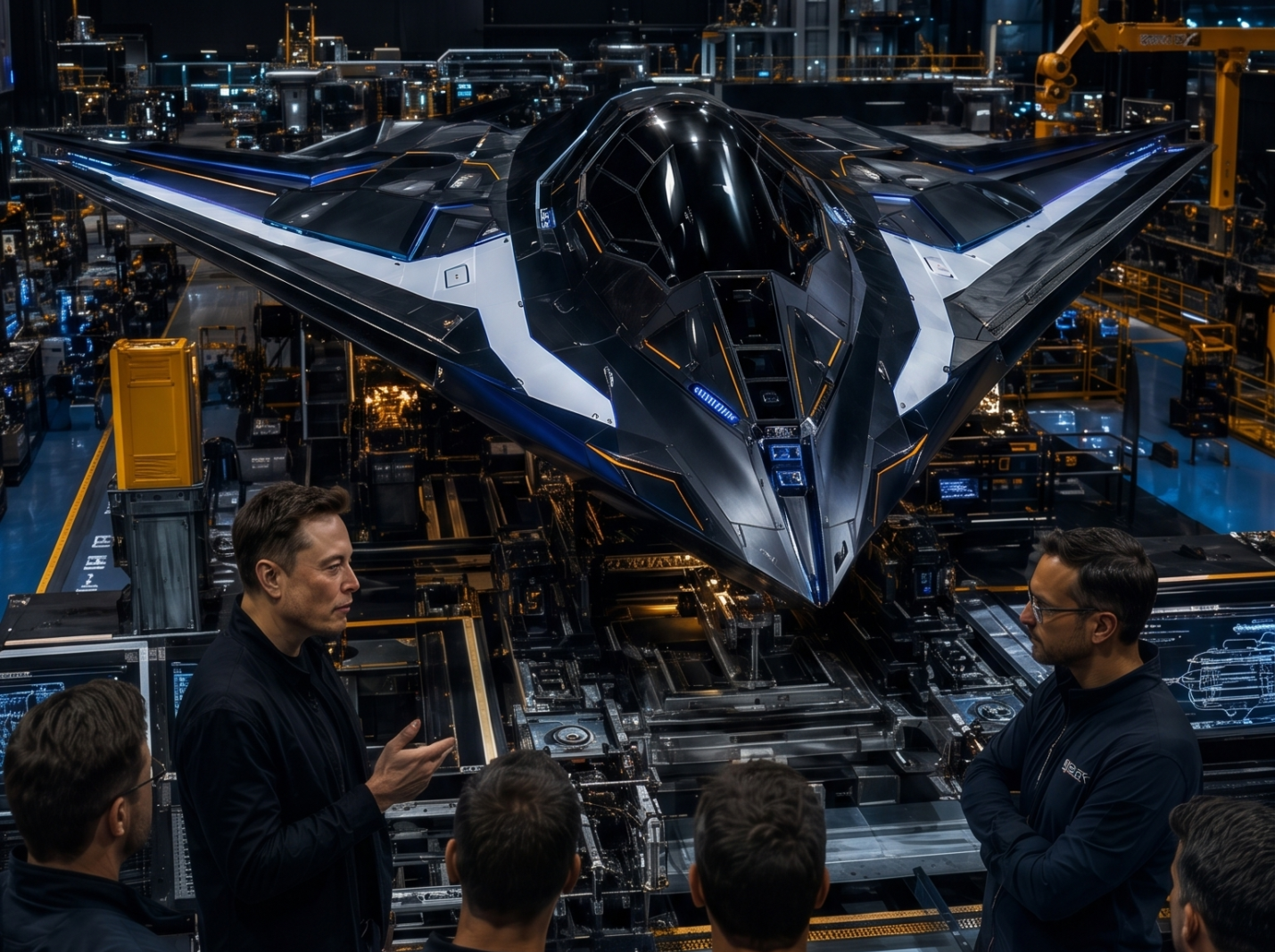
The Grand Hall of the International Institute for Future Warfare had never been so full.
Every seat was taken. People stood along the walls. Students sat on the steps with notebooks open. Military officers in dark uniforms whispered quietly. Engineers from aircraft companies leaned forward with guarded expressions. Journalists held their recorders high. Behind them, on the giant screen, one sentence burned in white letters:
“HAS THE FIGHTER JET ERA PASSED?”
You May Also Like


Below it was a smaller subtitle:
“Autonomous Drones, Artificial Intelligence, and the Future of Air Combat.”
The question had been haunting military circles since Elon Musk’s famous statement in February 2020:
“The fighter jet era has passed.”
For many, the statement sounded arrogant. For others, prophetic. For pilots, it sounded like an insult. For AI scientists, it sounded like a warning. For historians, it sounded like something they had heard before—before horses disappeared from battlefields, before battleships lost their crown, before satellites replaced spy planes, before drones changed modern war.
At the center of the stage sat seven experts.
Professor Elias Hartmann, a military historian, was old enough to have taught generals who were now retired. His voice was soft, but his sentences landed like artillery.
Dr. Maya Voss, an artificial intelligence scientist, had spent fifteen years building autonomous decision systems. She believed that machines would soon outthink humans in the air.
Professor Adrian Keller, an aerospace engineer, had worked on advanced fighter aircraft and unmanned combat platforms. He trusted machines, but he trusted physics more.
Dr. Leena Rao, a philosopher of war and ethics, was famous for asking the questions governments preferred to avoid.
Colonel Marcus Vale, a retired fighter pilot, had flown combat missions over hostile territory. His hands were steady, his eyes sharp, and his pride unmistakable.
Dr. Samuel Okoye, a robotics scientist, specialized in swarm intelligence. He believed one aircraft was old thinking. The future, he said, belonged to hundreds.
And finally, Professor Naomi Chen, the moderator, stood at the podium.
She looked at the crowd.
“Tonight,” she began, “we are not here to ask whether drones are useful. That question has already been answered. We are not here to ask whether artificial intelligence will enter warfare. It already has. Tonight, we ask something far more uncomfortable.”
She paused.
“Is the human fighter pilot becoming history?”
The hall fell silent.
Professor Chen turned toward the panel.
“Professor Hartmann, let us begin with history. When Elon Musk said, ‘The fighter jet era has passed,’ did he sound like a visionary or a man speaking too soon?”
1. THE HISTORIAN OPENS THE WAR OF IDEAS
Professor Hartmann leaned toward the microphone.
“He sounded like every disruptive voice in history,” he said. “Half right, half early, and completely irritating to the institutions he criticized.”
A few people laughed.
Hartmann continued.
“When the machine gun appeared, old cavalry officers did not disappear overnight. They argued. They adjusted. They charged again. And many died learning that courage cannot outrun technology.”
Colonel Vale’s jaw tightened.
Hartmann saw it and nodded respectfully.
“I do not say this to insult pilots. Quite the opposite. The bravest people in history are often the last to realize that bravery alone cannot save an outdated doctrine.”
Vale leaned forward.
“Are you calling fighter pilots outdated?”
“No,” Hartmann replied. “I am saying that every military role eventually changes. The knight did not stop being brave when gunpowder arrived. The battleship captain did not become foolish when aircraft carriers rose. The horse cavalry officer did not lack courage when tanks crossed the battlefield.”
He turned to the audience.
“The tragedy is that institutions often confuse honor with permanence.”
Dr. Maya Voss smiled slightly.
“That may be the most dangerous confusion in military history.”
Vale responded at once.
“And scientists often confuse possibility with readiness.”
The audience reacted with a low murmur.
Professor Chen raised her hand.
“Good. Then let us begin there. Dr. Voss, are autonomous drones truly ready to replace fighter jets?”
2. THE AI SCIENTIST MAKES HER CASE
Dr. Maya Voss sat straight, calm and composed.
“Not all fighter jets. Not tomorrow. But the direction is clear.”
She touched a remote. The screen changed to an image of a human pilot in a cockpit, wearing a helmet, oxygen mask, and pressure suit.
“This,” Maya said, “is one of the most extraordinary warriors humanity has ever produced: the modern fighter pilot. Trained for years. Physically exceptional. Mentally disciplined. Capable of operating one of the most complex machines ever built.”
Then she changed the slide. It showed the human body under G-force stress.
“But this is also the problem.”
She pointed to the diagram.
“The body has limits. Blood leaves the brain. Vision narrows. Consciousness can disappear. Reaction time slows under fatigue. Fear changes perception. Stress affects memory. Even the best pilot remains biological.”
Colonel Vale smiled coldly.
“You make biology sound like a design flaw.”
Maya turned to him.
“In air combat, sometimes it is.”
The hall became quiet.
Maya continued.
“A drone does not need a cockpit. It does not need oxygen. It does not need an ejection seat. It does not fear death. It can pull maneuvers no human body can survive. It can be smaller, cheaper, and more replaceable. It can be upgraded through software. And most importantly, it can operate in groups larger than human pilots can mentally coordinate.”
Dr. Okoye nodded.
“Exactly. The future is not one drone replacing one fighter. The future is one human commander directing fifty intelligent systems.”
Vale looked at him.
“And when those fifty systems misunderstand the battlefield?”
Okoye answered calmly.
“Then we improve them.”
Vale leaned closer.
“After they fire?”
The silence returned.
Maya interrupted.
“Colonel, human pilots have also misidentified targets. Human pilots have bombed the wrong locations. Human pilots have made tragic decisions under pressure.”
Vale’s expression hardened.
“Yes. And we investigate them, train them, hold them accountable, and learn from them.”
Dr. Rao spoke for the first time.
“And that, Dr. Voss, is where the machine problem begins. When a human makes a mistake, we can ask why. When an AI system makes a mistake, the answer may be hidden inside data, code, probability weights, sensor errors, or conditions no designer predicted.”
Maya nodded.
“That is true. But opacity is not destiny. We can build better verification, better testing, better explainability.”
Rao replied, “Can we build remorse?”
No one laughed.
3. THE PILOT STRIKES BACK
Professor Chen turned to Colonel Vale.
“Colonel, you have heard the argument: drones are faster, cheaper, more maneuverable, and not limited by biology. Why should fighter pilots remain central?”
Vale took a breath.
“Because combat is not a laboratory demonstration.”
He looked into the audience, not at the other panelists.
“In a laboratory, the environment is controlled. In combat, everything lies to you. Radar lies. Weather lies. Intelligence reports lie. The enemy definitely lies. Your own fear lies. Your instruments may be damaged. Your communications may be jammed. Your orders may be outdated before you receive them.”
He leaned back.
“A pilot is not just a body controlling an aircraft. A pilot is a judgment system.”
Maya raised an eyebrow.
“A biological judgment system.”
“Yes,” Vale said. “And sometimes biology is exactly what gives judgment meaning.”
Rao nodded slowly.
Vale continued.
“You speak of drones without fear. That sounds useful. But fear is not always weakness. Fear tells you that what you are doing matters. Fear reminds you that there is a human cost. A machine can calculate a strike. A human has to live with it.”
Okoye replied, “But should we design war around emotional burden? If a drone can save pilots’ lives, should we reject it because it does not feel guilt?”
Vale answered immediately.
“No. Use drones where they make sense. Send them into air defenses. Use them as scouts. Use them to jam radar. Use them to protect pilots. But do not pretend that removing humans from the aircraft removes humans from the consequences.”
Professor Hartmann smiled.
“That is a historian’s sentence, Colonel.”
Vale looked at him.
“I’ll take that as a compliment.”
4. THE ENGINEER TALKS ABOUT THE F-35
Professor Chen turned to Professor Keller.
“Professor Keller, many people compare drones to the F-35. Some call the F-35 too expensive, too complex, and too vulnerable in a drone-dominated future. Is that fair?”
Keller sighed.
“It is partly fair and partly lazy.”
The audience chuckled.
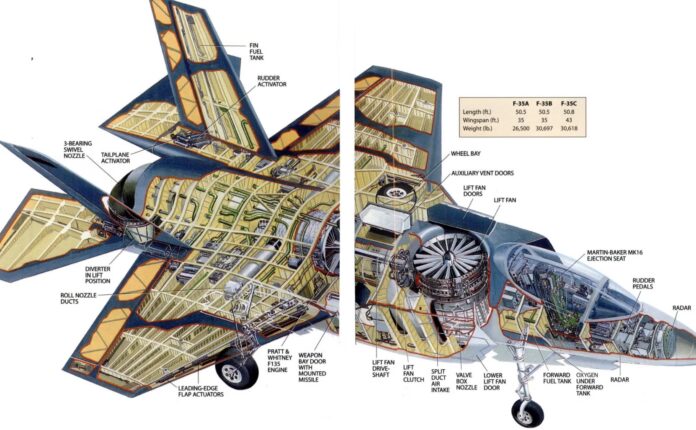
“The F-35 is not merely a fighter jet,” Keller said. “People imagine air combat as two aircraft chasing each other through clouds like in old war films. That is not modern air warfare. The F-35 is a stealth aircraft, a sensor platform, a data-fusion system, a communications node, and a flying command center.”
Maya nodded.
“I agree. Its greatest weapon may be information.”
“Exactly,” Keller said. “The F-35 sees, processes, shares, and coordinates. It is not just a sword. It is also an eye and a brain.”
Hartmann added, “But expensive eyes can be dangerous if commanders become afraid to risk them.”
Keller pointed at him.
“That is the real issue. Modern fighter aircraft are magnificent but extremely costly. If losing one aircraft is a national embarrassment, a strategic loss, and a financial disaster, then commanders may hesitate to use them aggressively.”
Okoye leaned in.
“That is why attritable systems matter.”
A student raised his hand.
Professor Chen nodded.
The student asked, “What does attritable mean in simple language?”
Okoye answered.
“It means a weapon is valuable, but not too precious to lose. Imagine a drone that is capable enough to matter but cheap enough that losing it does not cripple your force.”
Keller added, “That changes tactics. If you have five exquisite aircraft, you protect them. If you have five hundred intelligent drones, you can overwhelm, confuse, sacrifice, probe, and adapt.”
Vale responded sharply.
“That sounds like sending machines to die because machines are cheap.”
Rao turned to him.
“Is that morally worse than sending humans?”
Vale looked at her.
“No. But it may make war easier to start.”
The room grew still.
5. THE ETHICIST ASKS THE DARKEST QUESTION
Professor Chen faced Dr. Rao.
“You have warned for years that autonomous weapons may change not only how wars are fought, but why wars are begun. Explain.”
Rao folded her hands.
“War is restrained not only by law, but by cost. Political cost. Human cost. Emotional cost. If leaders can attack without risking pilots, they may feel less hesitation. A drone war may seem clean to the country using the drones, while remaining terrifying to the people beneath them.”
Maya responded.
“But if drones can reduce casualties among soldiers, is that not morally important?”
“Of course,” Rao said. “That is why this problem is so difficult. A drone can save one life and make another death easier to order.”
Okoye added, “But all weapons create distance. The spear created distance. The bow created more distance. The rifle created more. The missile created even more. Drones are part of a long trend.”
Rao looked at him.
“Yes, but autonomy is different. A spear does not choose. A bow does not classify a target. A missile may follow guidance, but it does not interpret a battlefield in the way modern AI systems may.”
Maya interrupted.
“Modern AI does not ‘choose’ in the human sense. It processes inputs and follows designed objectives.”
Rao replied, “That may comfort engineers. It does not comfort philosophers.”
Hartmann added, “Nor historians. Many disasters began with systems doing exactly what they were designed to do under conditions their designers did not imagine.”
Keller nodded.
“That is true in engineering as well. Complex systems fail in complex ways.”
Vale said quietly.
“And war is the most complex system humans have ever created.”
6. THE SKYBORG QUESTION
The screen changed again. This time it showed a manned fighter flying alongside several unmanned aircraft.
Professor Chen said, “Let us discuss the loyal wingman concept. Programs like Skyborg explore autonomous systems that can fly with human pilots, take risks, carry sensors, jam enemy defenses, and extend mission reach. Is this the compromise?”
Keller answered first.
“Yes. The near future is not humans versus drones. It is humans with drones.”
Maya agreed.
“A human pilot might command a formation of autonomous wingmen. One drone flies ahead to detect radar. Another carries weapons. Another jams communication. Another acts as a decoy. Another watches for missiles. The pilot becomes a mission commander.”
Vale nodded.
“That part I accept. I would have welcomed loyal wingmen in combat.”
Rao looked surprised.
“You would?”
“Of course,” Vale said. “I am not against technology. No pilot wants to fly blind into enemy defenses if a machine can scout ahead. No pilot wants to die proving that humans are still necessary.”
Maya smiled.
“Then we agree more than you admit.”
Vale pointed at her.
“We agree until you remove the human from authority.”
Okoye asked, “What does authority mean when missiles move faster than human decision-making?”
Vale answered, “It means humans define the rules before the fight.”
Maya said, “That is not enough. The system must adapt inside the fight.”
Vale replied, “Adaptation without judgment is dangerous.”
Okoye countered, “Judgment without speed is dead.”
The audience erupted in murmurs.
Professor Chen raised her hand again.
“This is the heart of tonight’s debate. Speed versus judgment. Scale versus control. Autonomy versus accountability.”
Hartmann leaned toward the microphone.
“And history suggests that in war, speed often wins first, and wisdom arrives later to count the bodies.”
7. THE SWARM SCIENTIST REVEALS THE NEW BATTLEFIELD
Professor Chen turned to Dr. Okoye.
“Dr. Okoye, you argue that the future is not merely drones, but swarms. Explain why that matters.”
Okoye’s face brightened. This was his battlefield.
“A single drone is an aircraft. A swarm is a living tactic.”
He stood and walked toward the screen.
“Imagine one hundred autonomous drones entering contested airspace. Some are decoys. Some carry sensors. Some map radar emissions. Some jam. Some attack air defense systems. Some relay communications. Some sacrifice themselves to reveal enemy positions.”
He turned.
“No human pilot can personally control one hundred aircraft second by second. But swarm intelligence allows distributed coordination. Each unit follows local rules. Together, they create complex behavior.”
Hartmann said, “Like insects.”
“Like ants,” Okoye replied. “Like bees. Like schools of fish. Like immune systems. Intelligence does not always need to sit in one brain.”
Vale crossed his arms.
“And who gives the swarm permission to kill?”
Okoye paused.
“That depends on doctrine.”
Rao said, “Doctrine is often written in calm rooms by people imagining orderly wars.”
Keller added, “And then the enemy gets a vote.”
Maya nodded.
“Still, swarms are coming. The military advantage is too powerful to ignore.”
Vale looked at her.
“That sentence has justified almost every dangerous weapon ever built.”
Maya replied, “And ignoring dangerous weapons has rarely made them disappear.”
Hartmann smiled sadly.
“The old arms race problem. If one side builds it, the other side feels forced to build it. If both build it, everyone becomes less safe while claiming to be more secure.”
Rao said, “That is the tragedy of strategic competition.”
Okoye responded, “But refusing to develop defense against swarms would be irresponsible.”
Rao replied, “I agree. I am not asking humanity to be naive. I am asking it not to be hypnotized.”
8. THE FIRST GREAT AUDIENCE QUESTION
A young woman in the audience stood. She introduced herself as a PhD student in aerospace systems.
“My question is for everyone. Are we overestimating AI because it performs well in controlled environments? What happens when the enemy deliberately tricks it?”
Keller pointed toward her.
“Excellent question.”
Maya answered first.
“AI systems are vulnerable to deception. Adversarial inputs, spoofed signals, electronic warfare, false targets, corrupted data—these are serious problems.”
Vale said, “In plain language: the enemy lies.”
Maya nodded.
“Yes. The enemy lies.”
The audience laughed softly.
She continued.
“That is why autonomous systems must be trained and tested under hostile conditions, not perfect ones. They must understand uncertainty. They must know when confidence is low. They must defer when necessary.”
Rao leaned forward.
“Can a machine truly know when it does not know?”
Maya answered, “It can estimate uncertainty.”
Rao replied, “That is not the same thing.”
Okoye said, “Humans also overestimate their certainty.”
Vale nodded.
“True. But a trained pilot can smell a trap.”
Maya smiled.
“Can you define ‘smell’ mathematically?”
Vale smiled back.
“No. That is why you still need us.”
The hall applauded.
9. THE GHOST OF THE DOGFIGHT
Professor Chen changed the slide to an old black-and-white photo of World War I pilots standing beside fragile aircraft.
“Air combat began with pilots carrying pistols and dropping bombs by hand. Then came machine guns, radar, missiles, stealth, and networked warfare. Is the dogfight dead?”
Keller answered.
“The traditional dogfight has been declared dead many times. Missiles were supposed to end it. Beyond-visual-range combat was supposed to end it. Stealth was supposed to end it. Yet close-range combat never fully disappeared.”
Vale nodded.
“Because plans fail. Missiles miss. Rules of engagement matter. Identification matters. Weather matters. Confusion matters.”
Maya said, “But if a drone dogfighter can survive maneuvers that would kill a human pilot, then close combat may become one of the first areas where machines dominate.”
Vale replied, “Only if the machine understands the fight.”
Maya asked, “What does a human pilot understand that an AI cannot learn?”
Vale answered, “Intent.”
Maya said, “Intent can be inferred from behavior.”
Vale replied, “Sometimes. But sometimes the enemy wants you to infer the wrong thing.”
Hartmann added, “Deception is ancient because it works.”
Okoye said, “AI can deceive too.”
Rao said sharply, “And that should frighten us.”
Okoye turned to her.
“Why? Human pilots deceive. Armies deceive. Decoys, camouflage, false radio traffic—deception is normal in war.”
Rao replied, “Because machine deception may scale faster than human trust can survive.”
The sentence hung in the air.
10. THE F-35 DEFENDER IN THE AUDIENCE
A man in the audience stood. He wore a dark suit and spoke with the careful tone of someone from the defense industry.
“I think this panel is being unfair to manned fighters. The F-35 is not a dinosaur. It is a networked platform. It already integrates sensors, allies, weapons, and data. Isn’t the smarter view that aircraft like the F-35 will command drones, not be replaced by them?”
Keller nodded.
“That is a strong argument. Manned fighters may become command nodes for unmanned systems.”
Maya responded.
“For a period, yes.”
The man frowned.
“For a period?”
Maya said, “Yes. Because once drones can sense, decide, coordinate, and survive without needing a nearby manned controller, the manned platform becomes optional.”
Vale said, “Optional does not mean useless.”
“Correct,” Maya replied. “But optional is the beginning of decline.”
Hartmann raised a finger.
“Historically, when a prestigious platform becomes a command node for cheaper platforms, the question eventually becomes: why not move the commander farther back?”
Keller said, “But distance creates communication vulnerability. In contested environments, a forward human commander may still be valuable.”
Okoye replied, “Unless the forward commander is the most expensive and vulnerable part of the network.”
Vale said, “Or the most responsible.”
Rao added, “Or the last meaningful moral checkpoint.”
Maya said, “That assumes moral judgment requires physical presence.”
Rao answered, “No. It requires genuine authority. Physical presence is only one form of it.”
11. THE MORALITY OF “HUMAN IN THE LOOP”
Professor Chen asked, “Let us clarify a phrase we hear often: human in the loop. Is it real control or comforting language?”
Rao answered immediately.
“It depends on the speed and complexity of the system.”
She turned to the audience.
“If a human receives a recommendation and has ten minutes to review it, that is meaningful. If a human receives forty target recommendations in three seconds and merely presses approve, that may be theater.”
Maya nodded reluctantly.
“That is a valid concern.”
Rao continued.
“There is a difference between control and permission. A human who rubber-stamps machine decisions is not controlling the machine. The machine is controlling the tempo.”
Vale said, “In combat aviation, tempo matters. If your system demands instant approval faster than a human can think, then the human is not in command.”
Okoye replied, “But if the human slows everything down, the system may lose.”
Rao looked at him.
“Then perhaps we are building systems whose moral demands exceed human capacity.”
Maya responded.
“Or perhaps we must design new forms of human-machine teaming.”
Keller added, “This is the engineering challenge: not replacing humans, not worshiping humans, but allocating tasks intelligently.”
Hartmann smiled.
“Humanity has always struggled with that. We invent tools, then reorganize ourselves around them, then pretend we planned it.”
12. THE SECOND GREAT AUDIENCE QUESTION
A journalist stood.
“My question is simple. If autonomous drones are cheaper and more effective, will countries with smaller budgets suddenly become more powerful?”
Okoye answered.
“Yes, potentially. That is one of the most disruptive parts of this shift.”
Keller agreed.
“Traditional air power requires enormous investment: aircraft, pilots, bases, tankers, maintenance crews, logistics, training pipelines. Autonomous drones could lower the entry barrier for some forms of air power.”
Hartmann added.
“This is similar to how missiles, cyber weapons, and cheap drones have allowed weaker actors to challenge stronger ones.”
Vale warned, “But high-end autonomous warfare will still be expensive. Sensors, secure communications, AI models, electronic warfare resistance, manufacturing quality—none of that is cheap.”
Maya said, “True, but the curve may still favor faster adopters over traditional powers.”
Rao asked, “And what happens when non-state actors gain access to increasingly autonomous systems?”
The journalist sat down slowly.
No one rushed to answer.
Finally, Hartmann spoke.
“Then air power stops being the exclusive language of states.”
13. THE NIGHTMARE SCENARIO
Professor Chen looked at Dr. Rao.
“You have warned privately about a machine-speed crisis. Please describe it.”
Rao exhaled.
“Imagine two rival nations in a tense region. Both deploy autonomous air systems. Both fear surprise attack. Both give their systems authority to respond quickly to perceived threats. Then something ambiguous happens: a radar reflection, a spoofed signal, a drone crossing a boundary, a communication failure.”
She paused.
“One system interprets danger. It maneuvers aggressively. The other system interprets that maneuver as hostile. It launches countermeasures. A third system detects the launch and escalates. Human commanders see fragments, not the full picture. By the time they understand, the machines have already created a battle.”
The hall was motionless.
Rao continued.
“My nightmare is not killer robots becoming evil. My nightmare is obedient machines acting quickly inside a situation humans no longer understand.”
Maya replied softly.
“That is why command architecture matters.”
Rao said, “Yes. But architecture is tested most severely when everything breaks.”
Vale added, “And in war, everything breaks.”
Keller said, “Communications break. Sensors break. Assumptions break.”
Hartmann finished, “And sometimes nations break with them.”
14. THE QUESTION OF TRUST
Professor Chen asked, “What would it take for militaries to truly trust autonomous combat drones?”
Keller said, “Testing. Repetition. Simulation. Field trials. Red-team attacks. Hardware reliability. Clear limits.”
Maya added, “Also explainability, uncertainty estimation, secure software, and mission-level constraints.”
Vale said, “Trust is not built in a lab. It is built when the system performs under pressure.”
Okoye nodded.
“And autonomous systems can be tested in millions of simulated battles.”
Vale responded, “Simulations are only as good as what they include. The enemy always brings something you forgot to model.”
Hartmann said, “That is the ancient truth of war. No plan survives contact with the enemy. Perhaps no algorithm does either.”
Maya replied.
“Then the algorithm must adapt.”
Rao said, “And we return again to the same question: adapt toward what objective?”
Maya answered, “Mission success within legal and ethical constraints.”
Rao asked, “Whose ethics? Which law? What happens when the legal target is strategically foolish? What happens when the ethical choice risks mission failure?”
Vale said, “That is command judgment.”
Okoye replied, “Which can be encoded as rules.”
Rao shook her head.
“Rules are not wisdom.”
15. A CADET ASKS ABOUT THE FUTURE OF PILOTS
A young military cadet stood near the back. His voice was steady, but emotional.
“Colonel Vale, I came here wanting to become a fighter pilot. After listening to this, I feel like I am training for a future that may not exist. Should young people still dream of flying?”
Vale’s face softened.
“Yes,” he said. “But understand what the dream is becoming.”
The cadet waited.
Vale continued.
“The pilot of the future may not be only a person who flies fast and turns hard. They may command drones, manage AI systems, interpret sensor fusion, make ethical decisions, coordinate with satellites, and understand electronic warfare.”
Maya added, “They will need to understand algorithms.”
Keller said, “They will need to understand systems engineering.”
Rao said, “They will need moral courage, not just physical courage.”
Hartmann said, “They will need historical humility.”
Okoye said, “And they will need to think in networks, not single aircraft.”
Vale looked directly at the cadet.
“So no, your dream is not dead. But the cockpit may not always be where the pilot sits.”
The cadet nodded slowly.
The audience applauded, not loudly, but with feeling.
16. THE GREAT CLASH: SHOULD MACHINES BE ALLOWED TO KILL?
Professor Chen’s voice became more serious.
“Let us ask the question directly. Should an autonomous drone ever be allowed to select and attack a target without immediate human approval?”
The room tightened.
Maya answered first.
“In limited defensive contexts, yes. For example, intercepting incoming missiles or responding to immediate threats where human reaction time is too slow.”
Vale nodded reluctantly.
“I can accept defensive automation. Ships and aircraft already use automated defensive systems in certain situations.”
Rao asked, “What about offensive targeting?”
Maya paused.
“That is more difficult.”
Okoye said, “In a communications-denied environment, a drone may need authority to complete a mission.”
Rao turned to him.
“Even if that mission involves lethal force?”
Okoye replied, “If the alternative is mission failure and human deaths, yes, possibly.”
Vale’s eyes narrowed.
“That word ‘possibly’ is where people die.”
Okoye looked back.
“And hesitation is also where people die.”
Keller stepped in.
“We need categories. Not all autonomy is the same. Navigation autonomy is not targeting autonomy. Defensive autonomy is not offensive autonomy. Surveillance autonomy is not lethal autonomy.”
Rao nodded.
“Good. Precision in language matters because vague language hides moral transfer.”
Hartmann said, “In war, euphemisms are often the first camouflage.”
Maya said, “Then let us be precise: I do not support careless autonomy. I support bounded autonomy under human-defined rules.”
Rao replied.
“And I worry that every boundary becomes negotiable under pressure.”
17. THE HISTORIAN’S BATTLESHIP WARNING
Hartmann rose from his chair.
“Let me return to the battleship.”
The screen showed an image of massive steel warships.
“In the early twentieth century, battleships symbolized national strength. They were expensive, prestigious, and politically powerful. Then aircraft changed naval warfare. The battleship did not become instantly useless. But it became vulnerable to a system that extended reach and altered the logic of combat.”
He turned to Colonel Vale.
“This does not mean fighter jets are battleships. Analogies are never perfect. But the warning is useful. A platform can remain impressive while becoming less decisive.”
Vale replied.
“And aircraft carriers did not eliminate ships. They reorganized fleets.”
“Exactly,” Hartmann said. “And drones may not eliminate fighter jets. They may reorganize air power.”
Keller nodded.
“The manned fighter may become the aircraft carrier of the sky, launching and coordinating unmanned systems.”
Maya replied.
“Or it may become the battleship—powerful, admired, expensive, and increasingly protected by the cheaper systems that actually take the risks.”
Vale looked at her.
“That is the most elegant insult I have heard tonight.”
Maya smiled.
“I meant it as a strategic possibility.”
“Of course you did,” Vale said.
The room laughed.
18. THE PROFESSOR WHO CHANGED SIDES
An older professor in the audience stood. His name was Dr. Raymond Sato, a retired aircraft designer.
“I spent my career building manned aircraft,” he said. “For many years, I dismissed unmanned combat systems as secondary tools. But tonight I must admit something. The strongest argument for drones is not that they are better aircraft. It is that they allow different tactics.”
Keller pointed at him.
“Yes. That is exactly right.”
Sato continued.
“A fighter jet is designed around the pilot. Remove the pilot, and you do not simply get the same aircraft without a cockpit. You get a different design philosophy. Smaller shapes. Different maneuver limits. Different risk tolerance. Different manufacturing assumptions.”
Maya added.
“And different upgrade cycles.”
Sato nodded.
“Yes. Aircraft development is slow. Software development is faster. That changes competition.”
Vale replied.
“But physical reality still matters. Engines, range, payload, stealth, heat, weather, maintenance—software does not erase physics.”
Keller said, “No, but software increasingly decides how physics is used.”
Hartmann smiled.
“That may be the sentence of the engineering century.”
19. THE QUESTION OF BEAUTY AND LOSS
A literature professor unexpectedly stood.
“I know this is a technical debate, but I want to ask something human. Is there sadness in losing the fighter pilot as a cultural figure? The ace, the cockpit, the courage, the romance of flight?”
The question changed the atmosphere.
Vale answered quietly.
“Yes.”
No one interrupted.
“The fighter pilot has always represented something powerful,” Vale said. “Speed. Skill. Loneliness. Danger. Mastery. A human being strapped to an engine, flying into uncertainty. There is beauty in that.”
Maya’s expression softened.
“There is beauty in it,” she admitted.
Vale continued.
“But war is not a museum for beautiful dangers. If machines can take the risk instead of young pilots, we should consider that seriously.”
Rao said, “There is grief in technological progress. Sometimes we lose not only tools, but identities.”
Hartmann added.
“The knight did not merely lose battlefield relevance. He lost a whole mythology.”
Keller said, “And yet humans created new myths. Test pilots. Astronauts. Drone commanders may one day have their own mythology.”
Vale smiled faintly.
“Perhaps. But I hope they are taught humility before they are taught power.”
20. THE FINAL FIRE ROUND
Professor Chen looked at the panel.
“We will end with a rapid exchange. I will ask questions. Answer honestly.”
She turned to Maya.
“Will autonomous drones outperform manned fighters in some missions?”
Maya: “Yes. Inevitably.”
She turned to Vale.
“Will fighter pilots disappear?”
Vale: “No. They will evolve.”
To Keller:
“Is the F-35 obsolete?”
Keller: “No. But no aircraft is immune to history.”
To Rao:
“Can autonomous weapons be ethical?”
Rao: “Only if humans remain meaningfully responsible.”
To Okoye:
“Will swarms change war?”
Okoye: “Completely.”
To Hartmann:
“Have we seen this kind of transition before?”
Hartmann: “Many times. And each time, people insisted their era was different.”
Professor Chen continued.
“Will humans trust AI with lethal force?”
Maya: “In limited roles, yes.”
Vale: “Under pressure, perhaps too quickly.”
Rao: “That is exactly what worries me.”
Keller: “Trust will be engineered, tested, and still imperfect.”
Okoye: “Trust will grow when systems prove themselves.”
Hartmann: “And collapse when one fails publicly.”
Professor Chen asked the final question.
“Is Elon Musk right?”
The panel went silent.
Then Hartmann spoke.
“He is right if he means the age of the fighter jet as the unquestioned center of air power is ending.”
Keller said, “He is wrong if he means fighter jets are suddenly useless.”
Maya said, “He is right about the direction of technology.”
Vale said, “He is wrong if he forgets that war is a human act.”
Rao said, “He is dangerous if people hear only the technological excitement and not the moral burden.”
Okoye said, “He is early. But early warnings often sound foolish until they become obvious.”
Professor Chen looked at the audience.
“And there is our answer: not yes, not no, but a warning.”
21. AFTER THE DEBATE: THE PRIVATE CONVERSATION
The audience slowly emptied, but the panelists remained on stage. The lights dimmed. The giant screen still displayed the question:
“HAS THE FIGHTER JET ERA PASSED?”
Colonel Vale stood near the edge of the stage, looking at the image of a drone beside a fighter.
Maya approached him.
“You think I want to erase pilots,” she said.
Vale glanced at her.
“Don’t you?”
“No,” she replied. “I want fewer pilots to die.”
Vale studied her face.
“That is a better answer.”
She smiled faintly.
“And you think I underestimate war.”
“You do,” Vale said.
Maya accepted it.
“Probably. And you underestimate machines.”
“Probably,” Vale replied.
Hartmann joined them.
“That is why civilization needs debates before doctrines become funerals.”
Rao closed her notebook.
“And before machines make decisions faster than conscience can follow.”
Keller looked up at the screen.
“The aircraft of the future may not be the most important thing.”
Okoye asked, “Then what is?”
Keller answered.
“The architecture. The network. The command structure. The rules. The software. The human-machine relationship.”
Vale added.
“And the person responsible when it all goes wrong.”
Maya turned to him.
“There will always be a person responsible.”
Rao said quietly.
“History shows that powerful institutions are very good at making responsibility disappear.”
No one answered.
Outside the glass wall of the institute, lights moved across the night sky. Some were passenger aircraft. Some were satellites. Perhaps one was a military aircraft. Perhaps one day, lights like those would belong to machines flying without pilots, making decisions in silence, guided by code written by people far away.
Hartmann looked upward.
“For thousands of years,” he said, “humans dreamed of taking the sky.”
Vale followed his gaze.
“And now?”
Hartmann replied.
“Now we must decide what kind of mind we place there.”
Maya looked at the sky too.
“Human minds are flawed.”
Rao answered.
“Yes. But they can be ashamed.”
Okoye said, “Machines can be constrained.”
Rao replied, “Only by humans who refuse to surrender judgment.”
Keller smiled sadly.
“So the future of air combat is not simply drones or jets.”
Professor Chen, who had been listening quietly, gave the final words.
“No,” she said. “The future of air combat is a test of human wisdom.”
The others turned toward her.
She continued.
“We built wings to escape the ground. We built jets to conquer the sky. Now we are building machines that may think and fight above us. The question is not whether they will be powerful. They will be. The question is whether we will be wise enough to remain their masters.”
The hall was empty now.
The debate had ended.
But the argument had only begun.
22. EPILOGUE: THE LAST PILOT’S LETTER
Three weeks after the debate, Colonel Marcus Vale wrote a letter to the young cadet who had asked whether becoming a fighter pilot was still worth it.
The letter read:
Cadet,
You asked me whether your dream is outdated.
I have thought about your question every day since the debate.
Here is my honest answer.
The sky you will inherit will not be the sky I flew in. You may not fight alone. You may not always sit inside the machine you command. Your wingmen may be algorithms. Your scouts may be drones. Your enemy may move at machine speed. Your cockpit may become a command center, or it may become a room on the ground.
But do not believe anyone who tells you courage is obsolete.
Courage is not the act of sitting inside a fighter jet.
Courage is accepting responsibility when fear, confusion, technology, and violence meet.
The pilot of the future must be more than fast.
The pilot of the future must be wise.
Learn aerodynamics. Learn artificial intelligence. Learn strategy. Learn history. Learn ethics. Learn the limits of machines and the limits of yourself.
One day, you may command aircraft without pilots.
But remember this:
A machine may win a battle.
Only humans can decide whether the battle should be fought.
— Colonel Marcus Vale
The cadet read the letter many times.
Years later, when he became commander of an experimental squadron of manned fighters and autonomous wingmen, he kept the letter folded inside his flight jacket.
On the first day of testing, an engineer asked him what he wanted to name the program.
The cadet, now older, looked at the drones lined beside the fighter aircraft.
He thought of Musk’s warning.
He thought of Professor Hartmann’s history.
He thought of Maya’s machines.
He thought of Rao’s ethics.
He thought of Keller’s systems.
He thought of Okoye’s swarms.
And he thought of Colonel Vale’s final sentence.
Then he answered:
“Call it Human Judgment.”
The engineer looked confused.
“That does not sound like a weapons program.”
The commander smiled.
“Exactly.”
Above them, the aircraft waited.
Some had cockpits.
Some did not.
The future had arrived.
And for the first time in history, humanity had to ask not only who would fly into war—
but whether the mind in the sky would still understand the meaning of peace.