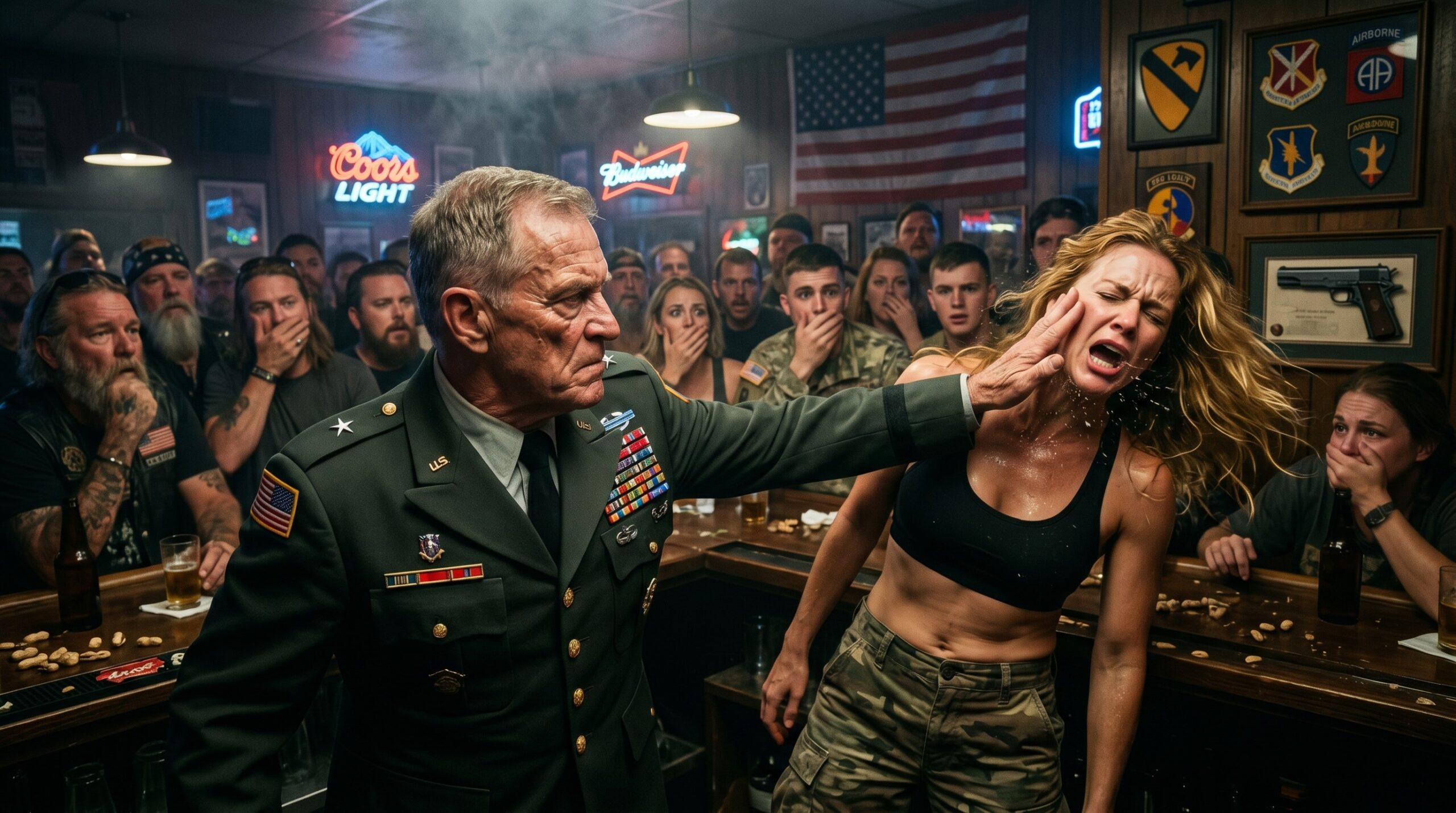
The man who slapped me thought I was just some lonely woman drinking water in a military bar.
He thought my silence meant weakness.
He thought the hoodie, the tired eyes, and the small bruise-colored shadows under my cheekbones meant I had come there to be invisible.
He was wrong about all of it.
You May Also Like
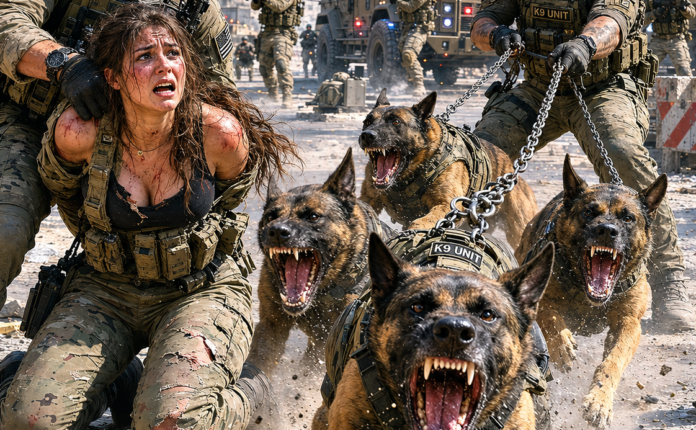
By midnight, three Rangers were on the floor, one bartender was calling an old Marine buddy, and a classified challenge coin sat on the counter like a loaded confession.
By sunrise, the Army would know my name.
By the end of the week, Washington would wis
h they had never tried to bury it.
“Nurse Stabbed 5 Times Protecting a Veteran’s K9 — 24 Hours Later, 200 Navy SEALs Arrived”
Part 1
He slapped me so hard the whole bar went silent, and I tasted blood before I even turned my head back.
Nobody moved.
Not the bartender.
Not the off-duty Marines near the pool table.
Not the six loud Rangers in the back booth who had been laughing at me ten seconds earlier.
The jukebox kept playing some old country song about regret, and rain hammered the windows of Delaney’s Bar and Grill, two miles outside Camp Pendleton, like the sky itself wanted inside.
I pressed two fingers to the corner of my mouth.
Blood.
Fresh, warm, real.
Then I looked at Staff Sergeant Tyler Mason.
He didn’t know I knew his rank. He didn’t know I knew his unit. He didn’t know that the way he stood, the way his shoulders squared, the way he kept his weight slightly forward told me more about him than his own friends probably knew.
He only knew one thing.
A woman had told him no in front of his men.
And his pride couldn’t survive it.
“You done?” I asked.
His eyes flickered.
That was the first crack.
Men like Tyler expected screaming. Crying. A panic call to the police. A woman clutching her face and begging someone else to save her.
I gave him none of it.
I had spent seventeen years in places where panic got people killed. I had learned how to breathe through pain, through blood, through gunfire, through grief so heavy it felt like a second skeleton.
A drunk soldier’s slap did not get to break me.
Tyler laughed, but it came out thin.
“Lady, you need to watch your mouth.”
I leaned one elbow on the bar and looked past him at his men. Two were grinning. One was embarrassed. One was too drunk to understand what had just changed.
The biggest one, Sergeant First Class Dominic Hail, wasn’t smiling at all.
Smart man.
“You get one chance,” I said.
Tyler blinked. “Excuse me?”
“Take your people. Walk out the door. This ends here.”
Behind the bar, Cobb, the retired Marine who owned Delaney’s, had one hand near the phone. His face was hard, but he didn’t interrupt.
Cobb knew something Tyler didn’t.
Sometimes the most dangerous person in a room is the one not raising her voice.
Tyler leaned closer, breath sour with whiskey and ego.
“You think you scare me?”
“No,” I said. “That’s the problem.”
His hand moved again.
This time I caught his wrist before it reached me.
Not hard.
Precisely.
There is a difference.
I turned his wrist half an inch in the wrong direction, dropped my weight, and watched his knees forget every speech his pride had prepared. He hit the floor with a choked sound that made every man in that room understand one thing at the same time.
This was not a bar fight.
This was an education.
One of his younger Rangers charged me from the left, all shoulders and alcohol, reaching like he thought I would freeze. I stepped aside, guided his momentum, and let the edge of the bar meet his face.
Another one moved.
I drove one elbow into his ribs with enough control to stop him, not ruin him.
He folded like a chair.
Dominic Hail took one step forward.
I looked at him.
“Don’t.”
He stopped.
Good instincts keep people alive.
Bad pride puts them in coffins.
Tyler was still on one knee, holding his wrist, sweat showing at his hairline now. His face had gone from arrogance to confusion to something close to fear.
“Who the hell are you?” he whispered.
I reached into the front pocket of my hoodie and took out a coin.
Not shiny. Not decorative.
Heavy.
Matte black.
An eagle. An anchor. A crossed rifle and pistol. A designation most people were not cleared to read and fewer were cleared to understand.
I placed it on the bar.
The sound was soft.
The effect was not.
Cobb saw it and went still.
Dominic Hail saw it and lost color.
Tyler, still kneeling, stared like I had placed a live grenade between us.
I finished my water, set a twenty under the glass, and pulled my hood back over my head.
“What do I owe you, Cobb?”
“Nothing,” he said quietly.
“I always pay my debts.”
Then I walked out into the rain.
Nobody followed.
In my truck, I sat behind the wheel and breathed in through my nose, held it, then let it out slowly.
My lip throbbed.
My hands were steady.
That bothered me more than the blood.
Three weeks earlier, I had separated from the Navy after seventeen years. The paperwork said retired. The file said honorably separated. The quiet apartment in Oceanside said something else.
It said I had survived too much and returned to too little.
No kitchen noise. No boots by the door. No radio chatter. No one asking if I wanted coffee. No one cursing over bad maps. No Daniel Reeves making terrible jokes over worse instant coffee.
Just me.
A coffee mug in the sink.
A stack of unopened VA hospital letters on the counter.
A folded American flag in a wooden case on my bookshelf that did not belong to me but had somehow become mine to carry.
I had gone to Delaney’s because it was supposed to be simple.
Water. Noise. Rain. A room full of strangers.
Then Tyler Mason put his hand on me.
And men like that never stop with the first woman they humiliate.
I started the truck.
As I pulled out of the parking lot, I saw blue-red lights reflected in my mirror.
Cobb had called the police after all.
Good.
Delaney’s had cameras.
Even better.
By morning, Tyler Mason would learn that violence leaves evidence.
But that coin on the bar would teach him something worse.
It would teach him that he had slapped the wrong woman.
A Sergeant Humiliated Her in the Mess Hall —Then Her Navy SEAL Dragon Tattoo Froze the Military Base…

Part 2
At 6:17 the next morning, Tyler Mason was ordered into a classified training facility — and my name was waiting for him on the screen.
I stood behind the briefing room door in full tactical gear, listening to seven Rangers settle into metal chairs.
They were quieter than men like that usually were.
Good.
Silence means the lesson has already started.
Commander Briggs stood at the front.
“Mandatory combat readiness assessment,” he said. “Five days. Joint force integration. Urban simulation. Psychological endurance evaluation.”
A chair creaked.
Somebody whispered, “Who’s the instructor?”
Briggs clicked the projector.
Lieutenant Commander Rachel Kaine, USN Retired.
Special Operations Combat Instructor.
The room went dead.
I waited three seconds before walking in.
Timing matters.
So does fear.
Tyler’s face changed when he saw me. His wrist was wrapped. His eyes were red. The bruise at the corner of my mouth was still visible, which meant he had to look at the consequence of his own hand while sitting in a room where everyone knew exactly what he had done.
I didn’t smile.
I didn’t mention the bar.
Not yet.
I stood in front of them and let the silence press down.
“Yesterday,” I said, “some of you made a mistake about what kind of woman I was.”
No one moved.
“That is your first lesson. Assumptions get people killed.”
Tyler swallowed.
I saw it.
I see everything.
“I have seventeen years of Naval Special Warfare experience. I have operated in seven countries, four of which I cannot name in this room. I have carried men out of places they were never supposed to survive. I have also buried men because someone, somewhere, got lazy with certainty.”
My eyes moved across the room.
Fowler, the young one I had put into the bar.
Castellano, jaw clenched.
Park, alert and careful.
Hail, watching me like a man trying to read a map with half the grid missing.
Then Tyler.
“Staff Sergeant Mason,” I said.
His spine straightened.
“Yes, ma’am.”
“Do you understand why you’re here?”
His mouth tightened.
“No, ma’am.”
“Good,” I said. “If you thought you did, we would have a bigger problem.”
The first exercise was simple.
On paper.
Seven Rangers. One mock city. Three objectives. Twenty minutes.
They failed all three in twelve.
I waited at the exit with a stopwatch.
Nobody liked the look on my face, mostly because there wasn’t one.
“Where did it fail?” I asked.
Hail answered. “Third intersection. Route conflict.”
“How long did you argue?”
“Forty-five seconds.”
“In forty-five seconds,” I said, “a real enemy changes position, spots your weakness, and kills the person you promised to bring home.”
Nobody spoke.
“Again.”
They went again.
They failed again.
“Again.”
By the fifth run, sweat soaked their shirts and their pride had started leaking out with it.
That was when men became useful.
Not when they were confident.
When they were honest.
At lunch, I sat alone near the window with bottled water and my old field notebook. Across the cafeteria, Tyler sat apart from his team, staring at his tray.
Hail sat across from him.
I didn’t look up, but I heard every word.
“She’s better than us,” Tyler said quietly.
“In some things,” Hail said.
“In most things,” Tyler corrected.
Then, after a pause, Tyler said something I did not expect.
“I owe her something.”
Hail answered, “You owe her a lot.”
I wrote one line in my notebook.
Mason: possible.
Not good.
Not redeemed.
Possible.
There is a difference.
That afternoon, Commander Briggs called me into his office.
He closed the door.
I hated closed doors.
“Washington called,” he said.
I kept my face still. “About what?”
“The Reeves file.”
For one second, the room changed shape.
Daniel Reeves had been my spotter. My partner. The man who could sleep anywhere in under four minutes and made coffee so bad it should have violated military law.
He had died in Syria four years ago.
I had carried him four kilometers through darkness with his blood drying against my back and his silence screaming louder than gunfire.
“What do they want?” I asked.
“A formal statement.”
“They have my statement.”
“They want a different one.”
There it was.
Politics.
The ugliest battlefield.
Briggs looked tired. “Someone is claiming the decision window wasn’t real-time. They’re suggesting Reeves was placed deliberately.”
I stared at him.
“They’re saying I used him as bait.”
Briggs did not answer.
He didn’t have to.
Something cold moved through me, deeper than anger.
“They’re going to use a dead man to rewrite a mission they were too cowardly to understand.”
“I’m sorry, Rachel.”
“No,” I said. “They will be.”
That night, I drove back to my apartment and didn’t turn the lights on.
The kitchen was small and too clean. A VA hospital appointment card sat under a magnet shaped like Tennessee, a gift from Reeves’ daughter after his funeral.
On the counter lay an envelope from a military lawyer in San Diego.
I had ignored it for three weeks.
This time, I opened it.
Inside was a copy of an old sealed addendum from the Syria file.
Daniel’s final recorded transmission.
It had been withheld from me.
My hands went still.
Then my phone buzzed.
Unknown number.
I answered.
A woman’s voice whispered, “Commander Kaine, they lied about Reeves.”
Then the line went dead.
And for the first time in four years, grief did not feel like a wound.
It felt like evidence.
“Nurse Stabbed 5 Times Protecting a Veteran’s K9 — 24 Hours Later, 200 Navy SEALs Arrived”
Part 3
The hidden recording of Daniel’s last minute proved I hadn’t betrayed him — but it also proved someone in Washington had.
I did not sleep.
At 4:30 a.m., I was at the training facility with coffee I didn’t drink, a locked folder under my arm, and a decision already made.
The Rangers were waiting in the briefing room.
Tyler looked different.
Not better-looking. Not softer.
Different in the way a man looks when the mirror finally stops flattering him.
I placed the folder on the table.
“Today’s exercise has changed,” I said.
Fowler shifted. “Changed how?”
“You are no longer the rescue team. You are the compromised asset.”
Nobody liked that.
Good.
Comfort is where arrogance grows.
“You will be hunted by an outside SEAL element. Real operators. Real pressure. No live rounds. Everything else is fair.”
Castellano raised a hand. “And you, ma’am?”
“I’m coordinating both sides.”
Park frowned. “That sounds unfair.”
“It is,” I said. “So is war.”
They had fifteen minutes to prepare.
By sunrise, four of them had been captured.
By 7:22, Tyler and Park were pinned in a warehouse simulation with two SEALs north, three east, and no clean exit.
Tyler’s radio clicked.
I said, “Mason, don’t move.”
He froze.
Good.
“There are two operators north of you. They think you’ll avoid the building. They’ve built their plan around your fear.”
Tyler breathed once.
“Then we go through it,” he said.
Park stared at him.
Tyler didn’t explain twice.
He moved.
No ego. No show. No wasted motion.
They entered through the thing they were supposed to fear and came out behind the trap.
It was not perfect.
It was smart.
That mattered more.
When the exercise ended, Lieutenant Commander Watts from the SEAL element looked at Tyler and said, “I’ve run this scenario forty times. Nobody has gone through the building.”
Tyler looked at me.
I closed my notebook.
“He changed the frame.”
For a second, Tyler looked like he might say thank you.
He didn’t.
Good.
Gratitude is cheap when work is still unpaid.
That evening, he found me outside near the concrete steps behind the facility.
The California sky was purple over the training compound. Somewhere beyond the fence, traffic moved toward Oceanside, families headed home to kitchens and dinner tables and ordinary arguments about groceries.
I sat with my notebook closed in my lap.
Tyler stood six feet away.
“I’m sorry,” he said.
I looked at the tree line.
“For the training?”
“No, ma’am. For the bar.”
I said nothing.
He kept going.
“What I did was wrong. Not because I got caught. Not because you turned out to be someone important. It was wrong when I thought you were nobody.”
That was the first honest thing he had said to me.
I looked at him then.
“Why did you do it?”
His jaw worked.
“Because you made me feel small,” he said. “And I tried to make you smaller.”
There it was.
The disease under the behavior.
I nodded once.
“Remember that sentence,” I said. “That is the sentence that tells you where the rot starts.”
His eyes lowered.
“I filed my statement with the police this morning,” he said.
That surprised me.
“Cobb gave them the security footage. I told them not to soften it.”
“Why?”
“Because if I need punishment to become honest, then I’m not honest yet.”
I studied him.
Possible, I thought again.
Still not forgiven.
But possible.
At 9:10 p.m., Commander Briggs called me into a secure room.
A deposition team from Washington had arrived early.
Three suits. One military legal officer. One woman from an intelligence oversight office whose face had the polished blankness of someone trained never to look guilty.
And behind them stood Major Harlan Pike.
My stomach turned before my face did.
Pike had been mission command during Syria.
He had also been the man who ordered Daniel and me into a compromised observation position, then denied that order existed after Daniel died.
“Commander Kaine,” Pike said, smiling like a knife. “Good to see you.”
“You too, Major.”
He glanced at my bruised mouth.
“I heard you had an unfortunate civilian incident.”
Tyler’s slap.
Of course.
That was why they came early.
They were going to use the bar footage to paint me as unstable, violent, emotionally compromised.
Pike sat down, opened a folder, and slid a document toward me.
“This inquiry is about pattern behavior,” he said. “Excessive force. Poor judgment. Emotional instability after Reeves’ death.”
I stared at the paper.
A recommendation to suspend my instructor contract and reopen my Syria testimony under disciplinary review.
There was Tyler’s name.
There was Delaney’s Bar.
There was the phrase “unprovoked escalation by former operator Rachel Kaine.”
I almost laughed.
Not because it was funny.
Because men like Pike always made the same mistake.
They thought paperwork was truth.
They forgot cameras existed.
They forgot witnesses existed.
They forgot dead men sometimes left recordings.
I placed my locked folder on the table.
“What is that?” Pike asked.
“Your problem.”
The oversight woman leaned forward.
“Commander Kaine, do you have supplemental evidence?”
“Yes.”
Pike’s smile faded.
I opened the folder and removed three items.
A copy of Delaney’s security footage, timestamped and authenticated by police.
A sworn statement from Cobb, retired Marine and bar owner.
And a sealed audio transcript labeled Reeves Final Transmission — Syria Window.
Pike went white.
Not pale.
White.
The legal officer sat up. “Where did you get that?”
“From the military lawyer Daniel Reeves hired two weeks before the mission.”
Nobody moved.
I looked at Pike.
“You didn’t know he had one, did you?”
His mouth opened.
Nothing came out.
I pressed play.
Daniel’s voice filled the room.
Calm. Low. Alive.
“Command moved the window. Pike knows the ridge is hot. Rachel does not. Repeat, Rachel does not have full intel. If this goes bad, tell Clare I wasn’t scared. Tell Kaine she made the right call with what she had.”
The recording ended.
The room was silent.
I had heard Daniel’s last words for the first time alone in my kitchen twelve hours earlier.
I had already broken where no one could see.
Now I was done breaking.
The oversight woman slowly turned to Pike.
“Major,” she said, “why was this recording omitted from the original file?”
Pike stood too fast.
“That audio is unverified.”
“No,” Briggs said from the doorway.
We all turned.
He stepped into the room holding another folder.
“It’s verified.”
Behind him stood Dominic Hail, Tyler Mason, and Cobb.
Cobb wore his old Marine jacket.
Tyler wore his uniform.
His face was hard and ashamed.
Briggs placed his file on the table.
“Security footage from Delaney’s confirms Staff Sergeant Mason initiated physical contact. His sworn statement confirms Commander Kaine used controlled defensive force. The bar incident is not evidence against her.”
Tyler looked at Pike.
“It’s evidence against men who think power means they get to rewrite what happened.”
Pike’s eyes flashed. “You don’t know what you’re talking about, Staff Sergeant.”
Tyler’s voice stayed steady.
“No, sir. That was my problem too.”
Then Cobb stepped forward.
“I’ve seen cowards before,” he said. “Most of them wear nice shoes when they lie.”
Pike snapped, “This is absurd.”
The oversight woman did not blink.
“No, Major. This is now a criminal referral.”
For the first time all week, I let myself breathe.
But the door had not finished opening.
Because then the lawyer played the second file.
And Daniel Reeves spoke again.
They Thought She Was Dead – Until She And K9 Walked Onto Base Carrying 3 Wounded SEALs
Part 4
Daniel’s second recording destroyed Major Pike in twelve seconds.
It was not a goodbye.
It was not a confession.
It was a trap.
Daniel had recorded Pike in the command tent three hours before the Syria mission went bad.
Pike’s voice came through the speaker, clear enough to cut glass.
“If Kaine adapts, let her. She’s useful under pressure. Reeves is acceptable loss if the secondary objective holds.”
Nobody breathed.
The oversight woman closed her eyes for half a second.
Briggs looked like he wanted to put Pike through the wall.
Tyler stared at the table, and I watched his hands curl into fists.
I didn’t move.
I had imagined Daniel’s death a thousand ways.
I had blamed myself in eighty-three versions.
I had replayed every second until memory became a cage.
But I had never imagined this.
Acceptable loss.
Two words.
That was what Daniel had been to Pike.
Not a father.
Not a partner.
Not a man who made terrible coffee and read Civil War books and wrote letters to his daughter in pencil because he said ink made words feel too permanent.
Acceptable loss.
Pike tried to speak.
The legal officer cut him off.
“Major Harlan Pike, you are relieved of advisory authority pending formal investigation.”
The oversight woman added, “You will surrender your device and credentials now.”
Pike looked at me.
There it was again.
The arrogance.
Even cornered, he needed someone smaller beneath him.
“You think this makes you clean?” he said. “You still made the call. Reeves still died.”
The room changed.
Tyler stepped forward.
So did Hail.
I lifted one hand.
They stopped.
This was mine.
I walked around the table until I stood close enough to see the sweat at Pike’s temple.
“You’re right about one thing,” I said. “I made the call.”
His mouth twitched, like he thought he had found a crack.
“I made the only call available with the information I had. Daniel knew that. You knew that. And then you spent four years hoping grief would keep me quiet.”
I leaned closer.
“Grief doesn’t make women quiet forever, Major. Sometimes it teaches us where to dig.”
His face tightened.
Two military police officers entered the room.
Pike looked at them, then at the oversight woman.
“You can’t arrest me.”
“No,” she said. “But we can detain you pending federal review.”
They took his access badge first.
Then his phone.
Then his sidearm.
Men like Pike always look smaller without the things they hide behind.
As they escorted him out, his shoulder brushed mine.
He whispered, “You’ll never get your career back.”
I looked at him.
“I don’t want my old career back.”
Then I said the part that finally broke his face.
“I want Daniel’s daughter to get the truth.”
By Friday morning, the story had spread through channels it was never supposed to touch.
Not publicly.
Not yet.
But inside the military world, reputations move faster than official memos.
Major Pike was suspended.
His consulting contract was frozen.
His pension was under review.
Two command officers tied to the missing Reeves audio were placed on administrative leave.
And Tyler Mason?
He walked into Commander Briggs’ office at 0800 and accepted formal disciplinary action for the assault at Delaney’s.
No excuses.
No lawyer tricks.
No blaming alcohol.
The police report remained open, but I declined to push for jail time after Cobb and I spoke privately on the porch behind Delaney’s, where a faded American flag snapped in the clean morning wind.
“Your call,” Cobb said.
“I don’t want him locked in a cell,” I said. “I want him useful and ashamed long enough to change.”
Cobb studied me.
“That mercy?”
“No,” I said. “Strategy.”
Tyler lost his team lead position.
He lost a promotion recommendation.
He lost the easy respect of men who had once laughed when he walked toward me.
Good.
Easy respect is dangerous.
Earned respect is different.
On the final day of training, I put the seven Rangers through one last night exercise.
No tricks.
No humiliation.
Just pressure.
They moved through the mock city under rain machines and low visibility, extracting a simulated asset from a building rigged with false intel, blocked exits, and radio interference.
Halfway through, Fowler panicked at a dark stairwell.
Tyler saw it.
The old Tyler would have barked at him.
The new Tyler stopped, touched Fowler’s shoulder, and said, “Breathe. Find the next move.”
They made it out in nineteen minutes.
Not perfect.
Alive.
I stood at the extraction point, stopwatch in hand.
Hail looked at me.
“Well?”
I checked the time.
“You passed.”
The relief on their faces was almost funny.
Almost.
Then Tyler stepped forward.
In front of everyone, he removed something from his pocket.
My challenge coin.
The one I had left at Delaney’s.
He placed it in my palm.
“I didn’t earn the right to hold this,” he said.
“No,” I said. “You didn’t.”
He nodded.
Then I handed him a different coin.
Plain brass. Training unit. Nothing classified.
His eyes flicked up.
“You earned this one,” I said. “Barely.”
A few men laughed.
Even Fowler.
Tyler closed his fist around it like it weighed more than it did.
“Thank you, ma’am.”
“Don’t thank me. Be better.”
“Yes, ma’am.”
Three weeks later, I stood in a small-town diner outside Nashville with Daniel Reeves’ daughter, Clare, and her grandmother.
Clare was nine now.
She had his eyes.
That was unfair of the universe.
I gave her a copy of the truth I was legally allowed to give. Not everything. Never everything.
But enough.
Enough to know her father had not been abandoned.
Enough to know he had spoken her name.
Enough to know he had protected me even in his last minutes.
Clare read the first page twice.
Then she looked at me and asked, “Did my dad know you loved him?”
The question went through me clean.
I looked out the diner window at the wet parking lot, the American flag above the post office across the street, the normal world Daniel had died protecting.
“Yes,” I said. “He knew.”
Clare nodded like that mattered.
It did.
That night, I drove back toward California with Daniel’s truth in the world behind me and no weight on my chest for the first time in four years.
Not gone.
Lighter.
There’s a difference.
Two months later, I returned to Delaney’s.
Same cracked stools.
Same old jukebox.
Same faded military photos on the wall.
Cobb saw me walk in and placed a glass of water at the far end of the bar.
“On the house?” he asked.
I put a twenty down.
“Never.”
He smiled.
There was a new framed photo by the register.
Daniel Reeves in uniform.
Beside it, a small brass plate:
STRENGTH WITHOUT HONOR IS JUST NOISE.
I sat down.
The bar was loud.
Rain tapped softly against the windows.
A young soldier at the pool table glanced my way like he might say something stupid, then thought better of it.
Good.
Learning spreads.
My phone buzzed.
A message from Briggs.
Pike indicted. Reeves file corrected. Official record amended.
I read it once.
Then I put the phone face down.
For seventeen years, I had been a weapon, a ghost, a name people whispered around classified doors.
Now I was something else.
A woman sitting at a bar with a glass of water.
A woman who had been slapped and did not shatter.
A woman who had buried the dead, exposed the liar, trained the arrogant, and walked away with the truth.
Cobb nodded toward my lip.
“No scar.”
I touched the place Tyler had hit me.
“No,” I said. “Not from him.”
Outside, the rain stopped.
And this time, when the room went quiet, it wasn’t because someone had hurt me.
It was because every man there finally understood who had survived.

One Comment on “They Slapped the Wrong Woman in a Bar — She Was the Navy SEAL Legend Nobody Knew…”