How the Most Advanced Fighter Helmet Ever Built Turned Pilots Into Human Supercomputers
The modern fighter pilot no longer fights with eyesight alone.
Today, pilots fight with data, sensors, artificial intelligence, and machines capable of processing information faster than the human brain can react.
And nowhere is that transformation more extraordinary than inside the cockpit of the Lockheed Martin F-35 Lightning II.
This aircraft is already one of the most technologically advanced weapons systems ever created. But its most astonishing innovation is not hidden in its engines, stealth coating, or missiles.
It is sitting directly on the pilot’s head.
You May Also Like



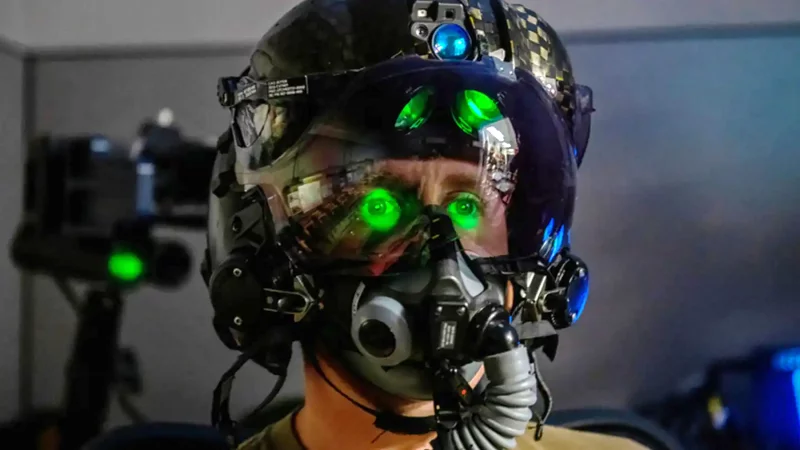
The F-35’s futuristic $400,000 helmet — officially known as the Generation III Helmet Mounted Display System (HMDS) — does something that once belonged only in science fiction:
It makes the fighter jet appear transparent.
A Fighter Jet Built Like a Flying Supercomputer


The Lockheed Martin F-35 Lightning II was designed to dominate future warfare.
With development and operational costs estimated in the trillions over the lifetime of the program, the F-35 is among the most ambitious military aviation projects in history. The aircraft combines stealth technology, sensor fusion, electronic warfare systems, and supersonic performance into a single platform.
The jet can fly faster than Mach 1.6, carry thousands of pounds of internal weapons, jam enemy radar, gather intelligence, and coordinate with nearby aircraft and drones simultaneously.
But engineers quickly realized something important:
A traditional fighter cockpit was becoming obsolete.
Older aircraft relied heavily on physical gauges and Heads-Up Displays (HUDs) projected onto cockpit glass. Pilots had to constantly look between instruments, radar screens, and the outside world during combat.
In modern warfare, even a one-second delay can mean death.
The F-35 needed a completely different approach.
So engineers decided to remove the traditional HUD entirely and place the entire battlefield directly inside the pilot’s helmet.
The Helmet That Lets Pilots See Through the Aircraft


The Generation III HMDS was developed by Collins Aerospace after nearly a decade of engineering and testing.
The result is one of the most advanced wearable combat systems ever built.
Mounted around the F-35 are six high-resolution infrared cameras known as the Distributed Aperture System (DAS). These cameras continuously watch every angle around the aircraft — above, below, behind, and to both sides.
The helmet combines all six camera feeds into a single seamless live image projected directly onto the pilot’s visor.
The effect is astonishing.
When the pilot looks down, the floor of the aircraft visually disappears. Instead of seeing metal, controls, or the cockpit itself, the pilot sees the ground beneath the aircraft in real time.
Turn your head backward, and you can see behind the jet without turning the aircraft.
Look upward, and you can track incoming threats instantly.
The fighter effectively becomes transparent.
This gives the pilot full 360-degree situational awareness — something no previous fighter aircraft could achieve.
It is not just a helmet.
It is an extension of the aircraft itself.
The End of Traditional Dogfighting


The HMDS completely changes how air combat works.
In older fighter jets, pilots needed to physically point the aircraft toward an enemy before firing weapons effectively. The F-35 changes that equation dramatically.
Using the helmet’s advanced targeting system, pilots can lock onto enemy aircraft simply by looking at them.
The helmet tracks eye movement and head position with extreme precision, allowing missiles and sensors to follow the pilot’s gaze.
This creates an entirely new kind of combat awareness.
The pilot is no longer separated from the aircraft’s systems.
Pilot and machine operate almost as one.
The helmet also overlays critical information directly onto the visor using augmented reality technology. Altitude, speed, radar tracks, threat warnings, navigation data, targeting information, and battlefield intelligence appear instantly in front of the pilot’s eyes.
There is no need to look down at cockpit instruments.
Everything important appears exactly where the pilot needs it.
In a high-speed battle where decisions happen in fractions of a second, this advantage can be decisive.
Seeing in Complete Darkness


Night operations are often among the most dangerous missions a pilot can face.
Traditionally, pilots used bulky night-vision goggles mounted over their helmets. But the F-35 eliminated the need for separate night-vision equipment entirely.
The Gen III HMDS integrates night vision directly into the visor.
Infrared sensors mounted around the aircraft allow pilots to see terrain, enemy vehicles, missiles, and aircraft even in complete darkness.
This capability gives the F-35 a major operational advantage during night missions, low-visibility combat, and difficult weather conditions.
In many ways, the pilot experiences the battlefield more like a machine than a human being.
Why the Helmet Costs $400,000
At first glance, spending $400,000 on a single helmet sounds absurd.
But this is not mass-produced equipment.
Each helmet is individually custom-built for a specific pilot.
Before receiving one, pilots undergo detailed 3D head scans and precision measurements. Engineers calculate the exact distance between the pilot’s eyes and visor to ensure a perfectly aligned image.
Even tiny errors could create double vision or distort targeting information during flight.
The foam liner inside the helmet is laser-cut to fit the pilot’s head exactly. Every adjustment matters.
Incredibly, significant weight gain, facial changes, or even a new hairstyle can affect the helmet’s fit enough to require recalibration.
The helmet also has to survive one of the most violent experiences imaginable: pilot ejection.
At speeds exceeding 600 miles per hour, the system must protect the pilot while maintaining structural integrity during emergency escape procedures.
Packing all of this technology into a helmet weighing roughly five pounds is a remarkable engineering achievement.
More Than a Helmet — A Glimpse Into the Future


The F-35 helmet represents something much bigger than military technology.
It shows how warfare itself is changing.
Future battles will not simply be won by speed, altitude, or firepower alone. They will be won by information — by who can see first, process faster, and react instantly.
The Generation III HMDS transforms the pilot from a human operator into part of an intelligent combat network.
This is no longer just aviation.
It is human-machine integration at the edge of modern science.
What once sounded impossible — seeing through an aircraft, targeting enemies with your eyes, flying through darkness using augmented reality — is now operational reality.
And as extraordinary as the F-35 helmet already is, it may only be the beginning of what future fighter pilots will wear.
The next generation may not just see through aircraft.
They may command entire drone swarms, battlefield AI systems, and autonomous weapons directly from inside their helmets.
The age of the digital warrior has already arrived.