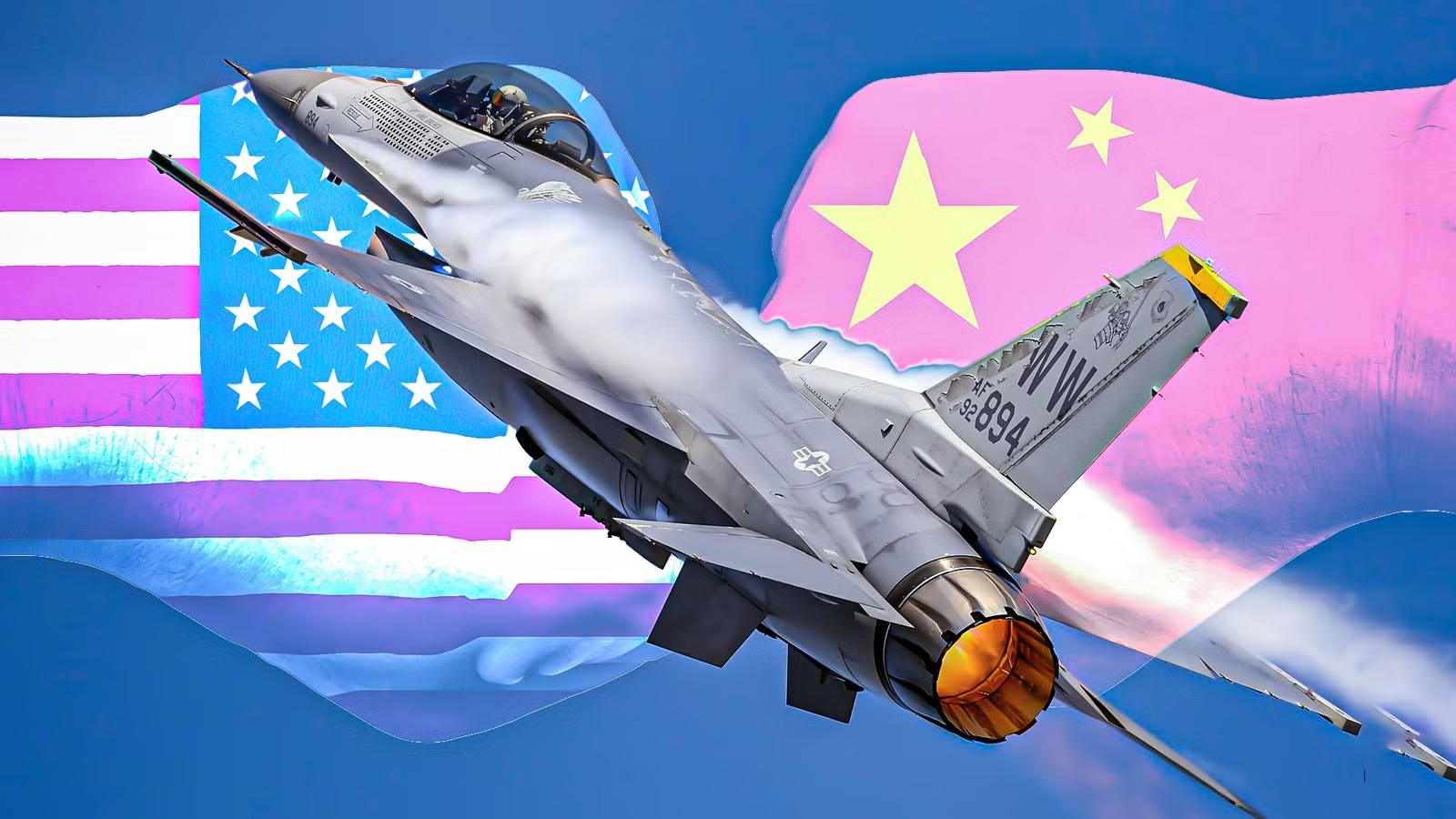
China’s Shadow Air Force: 5 American Fighter Jets Beijing Copied To Challenge US Air Power
For decades, the United States dominated the skies with the world’s most advanced military aircraft. From the legendary General Dynamics F-16 Fighting Falcon to the stealth supremacy of the Lockheed Martin F-22 Raptor, American air power represented technological superiority unmatched anywhere on Earth.
But while the West celebrated its aerospace dominance, another nation was quietly studying it.
Inside military laboratories, intelligence programs, and aerospace factories across China, engineers and military strategists spent decades dissecting foreign aircraft technology. Through reverse engineering, espionage allegations, cyber theft accusations, foreign partnerships, captured designs, and aggressive industrial development, China transformed itself from a technologically dependent nation into one of the world’s most dangerous aerospace powers.
Today, China fields stealth fighters, advanced electronic warfare aircraft, and multi-role combat jets that bear striking similarities to some of America’s most iconic warplanes. Many military analysts believe China dramatically accelerated its military aviation progress by studying — and in some cases allegedly copying — US fighter jet technology.
You May Also Like
The rise of China’s modern air force has fundamentally reshaped global military balance. What once took the United States generations of research, testing, and trillions of dollars to achieve, China compressed into a few decades through rapid adaptation and technological imitation.
Now, the People’s Liberation Army Air Force (PLAAF) is no longer simply defending Chinese airspace. It is preparing to compete directly with American air dominance across the Indo-Pacific region and beyond.
Here are five of the most significant American military aircraft that China allegedly copied in its quest to build a world-class air force.
1. Chengdu J-10 — China’s F-16 Clone
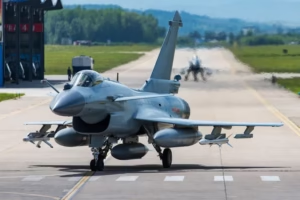
The Chengdu J-10 is widely considered China’s closest equivalent to the American General Dynamics F-16 Fighting Falcon.
At first glance, the similarities are unmistakable. Both aircraft feature a single-engine layout, streamlined fuselage, advanced maneuverability, and multi-role combat capabilities designed for both air superiority and ground attack missions.
The origins of the J-10 remain deeply controversial.
During the 1980s, the United States and Israel collaborated on an advanced fighter known as the Lavi program. The aircraft itself drew heavily from F-16 technology and aerodynamic principles. However, escalating costs eventually forced the United States to withdraw support, leaving the project unfinished.
According to numerous defense analysts and intelligence reports, elements of the Lavi’s design and technical research later found their way to China.
China used those concepts to help develop the J-10 — a fighter personally authorized under the modernization campaigns of Deng Xiaoping.
When the aircraft officially emerged in the 2000s, many Western analysts immediately noticed its similarities to the F-16 platform.
But China did not merely replicate the aircraft. It evolved it.
Modern variants such as the J-10C now feature advanced AESA radar systems, digital cockpits, modern electronic warfare systems, and long-range Chinese air-to-air missiles capable of threatening rival aircraft at increasingly dangerous distances.
Today, more than 700 J-10 fighters have reportedly been produced, making it one of the backbone aircraft of China’s growing air power.
2. JF-17 Thunder — The Affordable F-16 Alternative
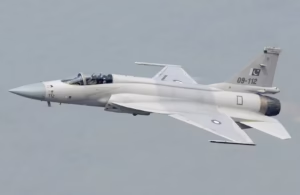
The CAC/PAC JF-17 Thunder was designed as a cheaper but highly capable alternative to the F-16.
Developed jointly by China and Pakistan, the JF-17 combines multiple foreign influences into a single affordable combat platform.
Its aerodynamic profile strongly resembles the F-16, particularly around the nose structure, air intake design, and tail section. However, the aircraft also incorporates technology derived from Soviet-era fighters like the Mikoyan-Gurevich MiG-21.
Military experts believe China combined lessons from both aircraft families to rapidly create a low-cost export fighter capable of competing on the global arms market.
The result was a fighter that appealed strongly to developing nations seeking modern combat capabilities without the enormous costs associated with Western aircraft.
Modern JF-17 variants now include:
- AESA radar systems
- Beyond-visual-range missile capability
- Air-to-air refueling systems
- Composite stealth-enhancing materials
- Fly-by-wire flight controls
- Modern Chinese electronic warfare systems
While the JF-17 may not equal advanced American fighters in raw capability, it has become an extremely important geopolitical tool for China, expanding Beijing’s military influence through arms exports and defense partnerships.
The aircraft symbolizes China’s growing ability not only to imitate Western technology, but to mass-produce and globally market it.
3. Chengdu J-20 — China’s Answer To The F-22 Raptor
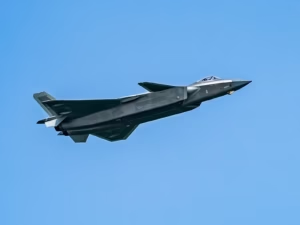
If one aircraft symbolizes China’s military ambitions most clearly, it is the Chengdu J-20.
The J-20 is China’s first operational fifth-generation stealth fighter — and one of the most controversial aircraft in modern military aviation.
To many observers, the aircraft’s resemblance to the Lockheed Martin F-22 Raptor is impossible to ignore.
Its stealth-oriented fuselage, internal weapons bays, angular airframe geometry, and advanced sensor integration reflect many principles pioneered by America’s F-22 and F-35 programs.
Western intelligence officials and cybersecurity experts have long accused China of obtaining sensitive information related to American stealth programs through cyber espionage and industrial theft operations. While China officially denies such accusations, debates surrounding the origins of the J-20 continue to intensify.
The aircraft first flew in 2011 and officially entered military service in 2017.
Its mission profile focuses on:
- Air superiority
- Long-range interception
- Precision strikes
- Advanced sensor warfare
- Beyond-visual-range combat
China has reportedly produced around 300 J-20 fighters already, with mass production continuing aggressively.
The aircraft represents a major psychological shift in global air power.
For decades, stealth technology remained one of America’s most protected military advantages. Now, China fields its own stealth fighter fleet capable of challenging US operations in the Pacific.
However, experts remain divided over the aircraft’s true stealth capabilities. Critics argue that China still struggles with radar-absorbing materials, advanced engines, and overall low-observable engineering compared to the F-22.
Even so, the existence of the J-20 alone signals that China has entered the elite club of stealth fighter nations.
4. Shenyang J-31 — China’s Rival To The F-35
The Shenyang FC-31 Gyrfalcon, also known as the J-31 or J-35, is widely viewed as China’s attempt to compete directly with the American Lockheed Martin F-35 Lightning II.
The similarities are immediately noticeable.
Twin canted tail fins, stealth shaping, internal weapons compartments, and compact stealth architecture all mirror concepts seen in American fifth-generation aircraft.
The J-31 first appeared publicly in 2011, stunning aviation observers worldwide. Many experts described it as a hybrid between the F-22 and F-35.
China’s long-term strategy for the aircraft appears highly ambitious.
The fighter is reportedly being developed in multiple variants, including:
- Carrier-based naval fighters
- Export-oriented stealth fighters
- Land-based multi-role combat versions
This would allow China to challenge the F-35 not only militarily but commercially across the global defense market.
The aircraft is intended to operate with stealth capabilities, advanced sensors, network-centric warfare systems, and modern electronic combat technologies.
However, China still faces major engineering challenges.
Stealth aircraft require extraordinary precision in materials science, heat management, radar absorption, and engine performance. Experts argue that China continues struggling to fully match the stealth sophistication achieved by American aerospace giants.
Nevertheless, the J-31 demonstrates how rapidly China has closed the technological gap that once separated it from the West.
5. J-16D “Hidden Dragon” — China’s Electronic Warfare Growler
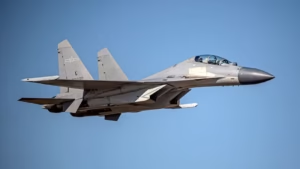
Unlike previous examples focused on direct airframe similarities, the Shenyang J-16D was designed to imitate a mission role rather than fully copy a physical design.
Its closest American counterpart is the Boeing EA-18G Growler — one of the world’s most advanced airborne electronic attack platforms.
Electronic warfare has become one of the most important elements of modern combat.
Instead of relying solely on missiles and guns, aircraft like the EA-18G and J-16D wage invisible wars using radar jamming, electronic disruption, cyber attacks, and suppression of enemy air defenses.
The J-16D was specifically developed to neutralize enemy radar systems, disrupt missile guidance networks, and blind advanced defense systems during combat operations.
Its origins trace back to China’s long-standing efforts to modernize Russian-derived aircraft technology, particularly from the Sukhoi Su-27 family.
China gradually evolved these designs into increasingly indigenous platforms like the J-11 and eventually the J-16 series.
The J-16D now represents one of China’s most advanced electronic warfare aircraft.
Its capabilities reportedly include:
- Radar jamming
- Electronic attack systems
- Anti-radiation missile deployment
- Air defense suppression
- Battlefield signal disruption
- Advanced electronic intelligence gathering
In modern warfare, electronic dominance can be just as important as air superiority itself.
Aircraft like the J-16D are designed to disable enemy systems before traditional combat even begins.
The Bigger Picture: China’s Aerospace Revolution
China’s military aviation rise did not happen overnight.
In the aftermath of the Korean War, China relied heavily on Soviet assistance to establish its aviation industry. Early aircraft production focused mainly on licensed copies of Soviet fighters like the MiG-15, MiG-17, and MiG-19.
But the collapse of Sino-Soviet cooperation during the 1960s forced China to become increasingly self-reliant.
What followed was decades of determined industrial expansion.
China studied foreign aircraft relentlessly. It analyzed captured technology, monitored global aerospace trends, and invested enormous resources into reverse engineering programs.
By combining foreign designs with domestic innovation, China compressed decades of aerospace development into an astonishingly short period of time.
Today, the PLAAF is no longer viewed as a secondary regional force.
It is rapidly becoming one of the most powerful air forces on Earth.
The skies over the Pacific are now entering a new era — one where American pilots may increasingly face aircraft inspired by the very technologies the United States once believed only it could master.