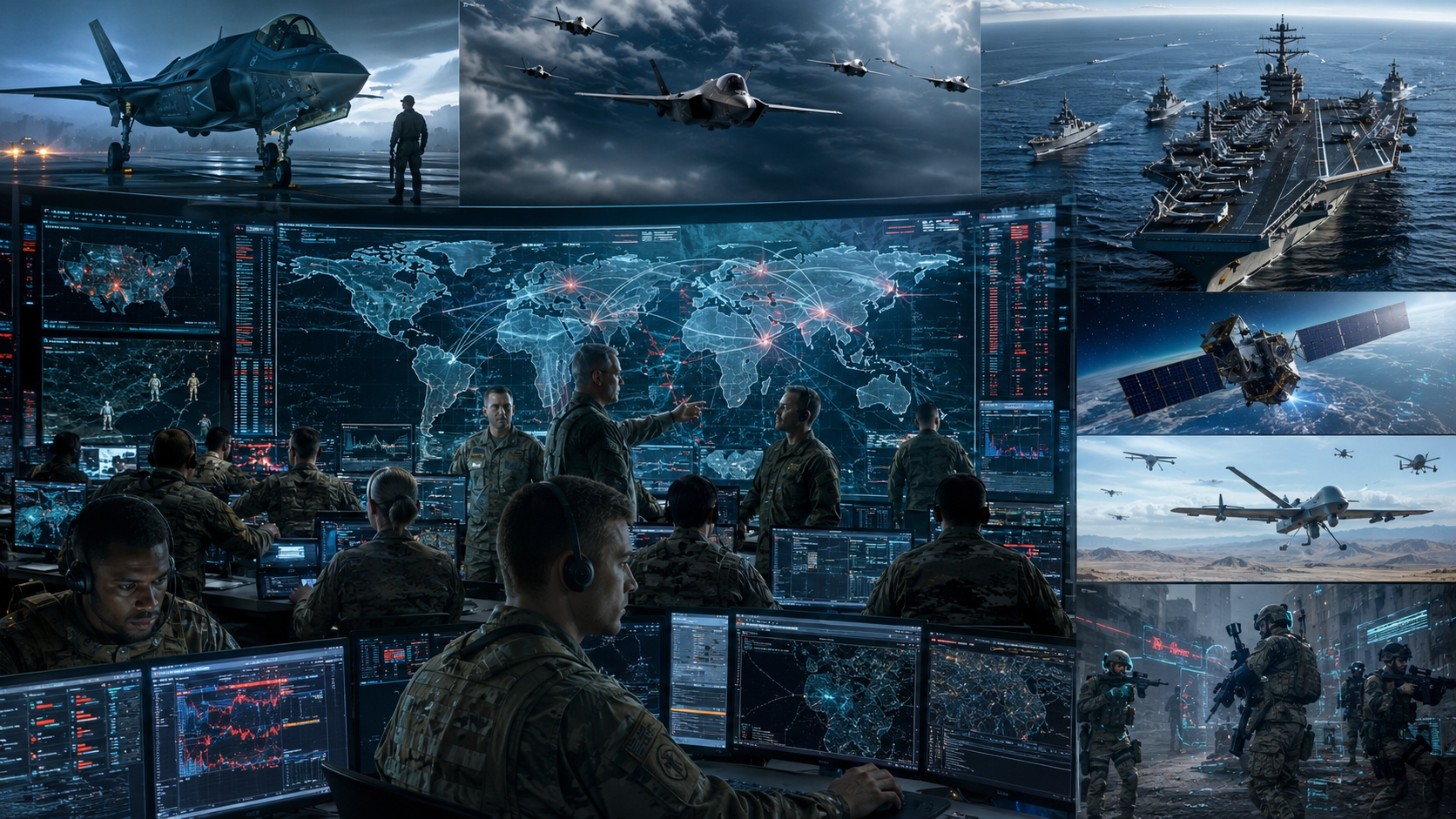
For thousands of years, warfare was shaped by the limits of the human body.
Kings conquered with swords because swords were the most advanced tools their civilizations could build. Empires rose behind walls of shields, cavalry charges, naval fleets, and formations of soldiers moving across battlefields at the speed of human communication. Even during the industrial age, despite tanks, aircraft, submarines, and missiles transforming warfare forever, one truth still remained constant:
Human beings remained at the center of every military decision.
A commander analyzed information.
You May Also Like



A pilot identified a target.
A soldier pulled a trigger.
A general coordinated armies.
Human reaction time defined the battlefield itself.
But humanity is now entering a transformation unlike anything in military history.
For the first time, the speed of war is beginning to exceed the speed of human thought.
And standing at the center of that transformation is the United States Department of Defense.
The Pentagon’s declaration that the United States military will become an “AI-first fighting force” may ultimately be remembered as one of the most historically significant moments of the 21st century — not merely because of military technology, but because it signals the beginning of a completely new era of civilization itself.
An era where artificial intelligence no longer simply assists human warfare.
It increasingly becomes part of the decision-making architecture behind it.
The Pentagon recently formalized expanded agreements with some of the most powerful technology organizations on Earth, including Google, OpenAI, Amazon Web Services, Microsoft, SpaceX, Oracle, NVIDIA, and the AI startup Reflection AI.
These agreements were not minor software partnerships.
They represent the fusion of America’s military infrastructure with the most advanced artificial intelligence ecosystem ever assembled by a nation in human history.
The Pentagon stated clearly that these agreements would accelerate the transformation of the United States military into an “AI-first fighting force.”
Scientifically and historically, that sentence carries enormous significance.
Because warfare has always evolved around information.
The Roman Empire depended on messengers and road systems.
Medieval kingdoms relied on visual communication and cavalry scouts.
Industrial powers depended on telegraphs, radio systems, and radar.
20th-century superpowers mastered satellites, nuclear command systems, and computerized targeting.
But artificial intelligence changes warfare at a far deeper level.
AI does not merely move information faster.
It processes information faster than humans themselves.
That difference changes everything.
Modern warfare already generates impossible amounts of data.
Satellites monitor planetary movement continuously.
Drones stream live surveillance feeds across multiple continents simultaneously.
Cybersecurity systems detect millions of digital intrusion attempts constantly.
Radar arrays scan enormous regions of airspace every second.
Missile defense systems analyze trajectories in real time.
Electronic warfare platforms process electromagnetic signatures across vast frequencies.
Human beings alone cannot fully manage this level of information complexity anymore.
Artificial intelligence therefore becomes not simply useful — but necessary.
The Pentagon revealed that over one million personnel across the defense department have already used military AI systems since their deployment last year. According to officials, tasks that once required months of analysis can now be completed in days.
That is not a small improvement.
It is a revolution in military operational speed.
And in warfare, speed often determines survival.
The military implications are staggering.
AI systems can analyze reconnaissance imagery at superhuman rates.
Machine-learning algorithms can detect hidden patterns in battlefield movement invisible to human analysts.
Predictive systems may anticipate enemy logistics, missile launches, or cyberattacks before commanders fully recognize them.
AI-assisted targeting systems can coordinate drone operations across enormous distances simultaneously.
Autonomous battlefield networks may eventually synchronize satellites, aircraft, submarines, naval fleets, cyber defenses, and missile systems into unified machine-speed ecosystems.
In previous centuries, military superiority depended largely on industrial production and manpower.
In the 21st century, superiority increasingly depends on computational intelligence.
And the United States currently possesses the most powerful AI ecosystem on Earth.
That advantage did not emerge accidentally.
America dominates artificial intelligence largely because it already dominates the industries powering modern computation itself.
Semiconductors.
Cloud infrastructure.
Advanced GPUs.
Software ecosystems.
Machine-learning research.
Quantum computing development.
Global data processing infrastructure.
The world’s leading AI companies are overwhelmingly American.
OpenAI helped redefine large language models and generative AI systems globally.
NVIDIA produces the advanced graphics processing units powering modern AI computation worldwide.
Google DeepMind remains one of the most influential AI research organizations on Earth.
Microsoft controls massive cloud and enterprise AI infrastructure.
Amazon Web Services operates some of the largest cloud computing systems in existence.
And now, increasingly, these companies are integrating directly into America’s defense architecture.
Historically, this relationship between technological innovation and military power is not new.
The United States military has repeatedly acted as a catalyst for technologies that later transformed civilian civilization itself.
The internet began through defense research networks.
GPS emerged from military satellite systems.
Advanced aerospace engineering accelerated through Cold War defense competition.
Even modern semiconductor advancement was heavily shaped by defense-related computational demands.
Artificial intelligence may become the next and greatest example of this pattern.
But AI introduces something fundamentally different from every previous military technology.
It introduces synthetic cognition.
Previous technologies amplified physical power.
AI amplifies decision-making itself.
That distinction is historically unprecedented.
For example, consider modern air combat.
A human pilot may already face information overload during high-speed operations involving radar data, missile threats, electronic warfare signals, satellite intelligence, fuel management, communications, and tactical coordination.
Now imagine AI systems processing all those information streams simultaneously while identifying hidden patterns, prioritizing threats, recommending tactical responses, predicting enemy movement, and coordinating autonomous support drones in real time.
The pilot increasingly becomes less an isolated operator and more the human supervisor of an intelligent combat ecosystem.
The same transformation is occurring across every branch of military operations.
Naval warfare.
Cyberwarfare.
Missile defense.
Space operations.
Logistics.
Intelligence gathering.
Electronic warfare.
Submarine detection.
Battlefield medicine.
Strategic planning.
The future battlefield is becoming algorithmic.
And that reality has created enormous ethical fear even inside the technology industry itself.
One of the most controversial dimensions of the Pentagon’s AI expansion involves the absence of Anthropic from the Pentagon’s new agreements.
Anthropic, creator of the Claude AI system, reportedly resisted contract language allowing its AI tools for “any lawful operational use.” Company leadership publicly expressed concern that advanced AI systems could eventually enable mass domestic surveillance or fully autonomous weapons systems operating with minimal human oversight.
This disagreement escalated dramatically.
Anthropic chief executive Dario Amodei publicly warned about the dangers of uncontrolled military AI deployment. Shortly afterward, U.S. Defense Secretary Pete Hegseth reportedly labeled the company a “supply chain risk,” leading to an escalating legal battle now expected to move through the courts.
This conflict reveals something profound about the future of AI warfare:
Even the people building artificial intelligence are increasingly uncertain about where the technology may lead.
Because AI in warfare creates ethical dilemmas humanity has never faced before.
Can autonomous systems make lethal decisions?
Should AI control drone swarms?
Can machine-learning systems distinguish civilians from combatants reliably?
How much battlefield authority should humans surrender to algorithms?
What happens if AI systems are hacked, manipulated, or behave unpredictably during conflict?
Could AI-driven surveillance threaten civil liberties domestically?
These questions are no longer theoretical.
They are becoming operational realities.
And yet military competition ensures development continues regardless of ethical uncertainty.
Because no major power can afford to fall behind in artificial intelligence.
China is investing massively in AI-assisted warfare systems.
Russia continues expanding autonomous weapons research.
Nations across Europe, Asia, and the Middle East are accelerating AI military integration programs.
The global AI arms race has already begun.
But the United States possesses one overwhelming advantage:
Scale.
America combines the world’s most powerful technology corporations with unmatched defense infrastructure, advanced semiconductor access, elite research universities, cloud computing ecosystems, aerospace industries, satellite networks, and decades of military operational experience.
No rival nation currently integrates all these systems at equivalent global scale simultaneously.
That is why the Pentagon emphasized avoiding “vendor lock” by partnering with multiple AI companies rather than depending on one provider.
Strategically, this creates resilience.
Different AI models possess different strengths.
Some specialize in language processing.
Others excel in predictive analytics.
Others optimize logistics, battlefield mapping, autonomous coordination, cybersecurity detection, or satellite intelligence interpretation.
By integrating diverse AI systems together, the Pentagon is effectively building an ecosystem of machine intelligence rather than relying on a single platform.
Scientifically, this approach mirrors biological evolution itself.
Complex ecosystems survive better than monocultures.
Redundancy creates resilience.
Distributed intelligence improves adaptability.
Future military AI systems may therefore operate less like isolated software programs and more like interconnected digital organisms cooperating across enormous defense infrastructures.
The implications extend far beyond warfare.
Military AI development will almost certainly reshape civilian civilization exactly as previous defense technologies did.
Autonomous logistics systems may revolutionize transportation.
Advanced AI cybersecurity may protect global infrastructure.
Military robotics could influence industrial automation.
AI-assisted medical systems developed for battlefield care may transform emergency healthcare worldwide.
Predictive analysis systems may improve disaster response, climate monitoring, and resource coordination.
Throughout history, technologies born from defense research repeatedly spill into civilian life.
The internet.
GPS.
Satellite communications.
Jet engines.
Nuclear energy.
Artificial intelligence may become the most transformative of them all.
And perhaps that is why the Pentagon’s announcement matters far beyond military circles.
Because humanity may be witnessing the beginning of a civilization-scale transformation.
The transition from industrial warfare to intelligent warfare.
The moment where algorithms began standing beside soldiers.
The moment where military power became increasingly defined not merely by firepower, but by computational supremacy.
For thousands of years, wars were fought at the speed of horses, ships, telegraphs, engines, and eventually aircraft.
Now wars may increasingly be fought at the speed of machine cognition itself.
And in that emerging reality, the United States is positioning itself not simply as a military superpower —
But as the world’s first true AI superpower.