A Poor Woman Begged Me for Work Outside My Hotel — Then She Looked Up, and I Saw My Missing Wife Holding Our Baby
My Mother Buried My Wife Two Years Ago — But Outside My Hotel, a Starving Woman Looked Up With My Baby in Her Arms
“Sir, do you need a maid? I can do anything. My daughter is starving.”
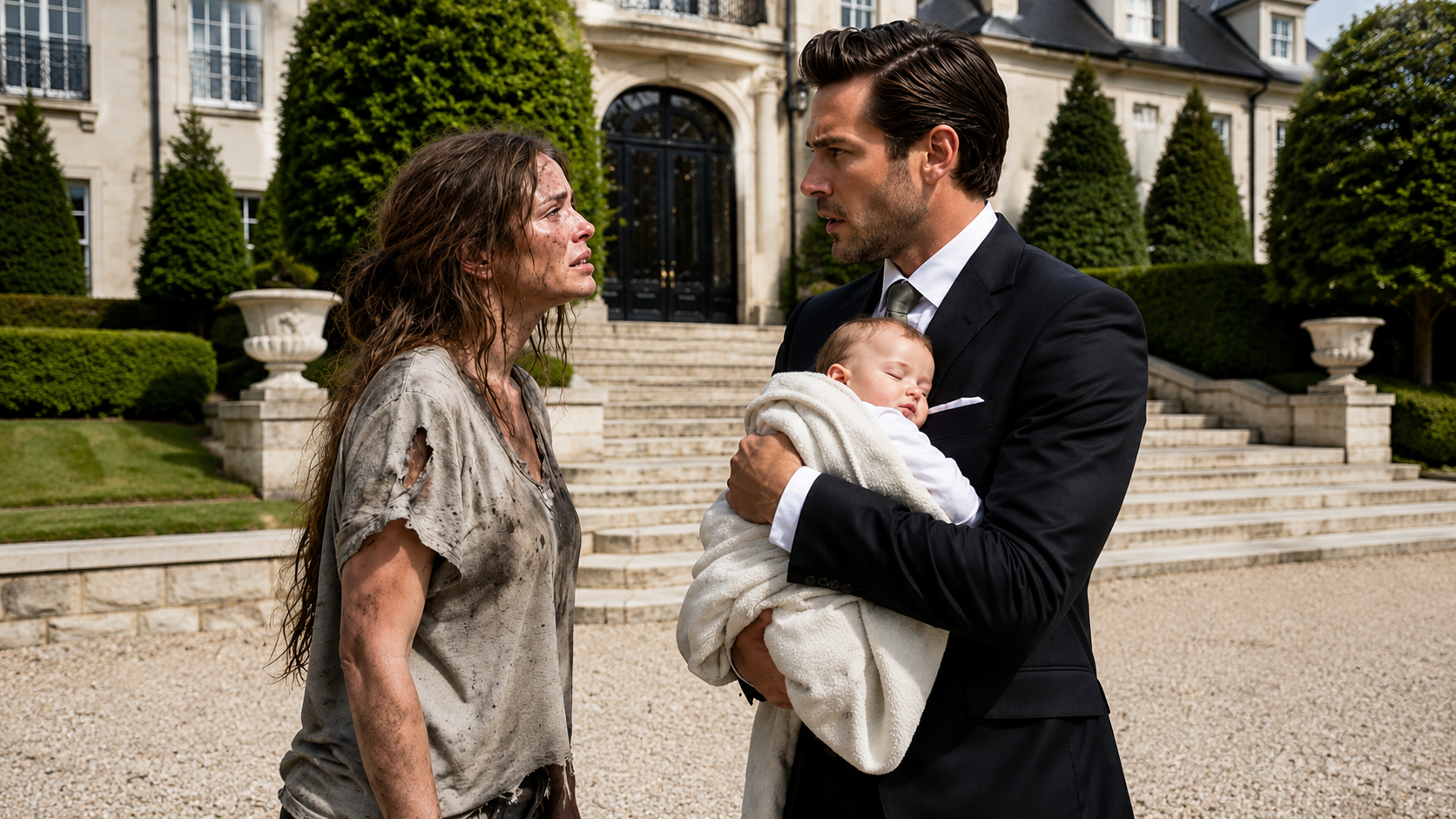
The woman stood under the hotel awning, soaked from the rain, holding a sleeping baby against her chest.
You May Also Like




I almost walked past.
Then she looked up.
And my whole world stopped.
“Lena?”
Her lips trembled.
A bruise darkened one side of her face.
Her hair had been cut unevenly.
The woman my family buried two years ago was standing alive in front of me.
Then she whispered:
“Daniel, don’t react. Your mother is watching.”
The baby shifted in her arms.
My baby.
A daughter I never knew existed.
For two years, my mother let me mourn a woman she had never buried.
That night, I brought my “dead” wife into my hotel suite, placed our daughter in my arms, and sent one message to the investigators I had hired in secret:
She is alive. Begin phase two.
By midnight, my mother was smiling in the Ashford ballroom, waiting for me to sign away my company.
But she did not know one thing.
The grieving son she thought she had broken had been building her prison for two years.
The Story
“Sir, do you need a maid? I can do anything. My daughter is starving.”
The rain was falling so hard it bounced off the sidewalk like broken glass.
I stood beneath the golden awning of the Ashford Grand Hotel with one hand on my phone and the other holding my coat closed against the wind.
Behind me, the hotel lobby glowed with warm light, marble floors, crystal chandeliers, and guests dressed for a private board dinner upstairs.
Outside, the city was wet, cold, and gray.
The woman who spoke to me stood near the edge of the awning, close enough to stay out of the rain but far enough not to disturb the wealthy guests passing through the doors.
Her clothes were soaked.
Her shoes were worn thin.
A sleeping baby was pressed tightly against her chest under a faded blanket.
She did not look directly at me at first.
Her head stayed bowed.
Her voice was soft.
Almost ashamed.
“Please, sir,” she whispered. “I can clean rooms. Wash dishes. Anything. My child hasn’t eaten.”
I almost walked past.
Not because I did not care.
Because my life had become a machine of meetings, signatures, and grief.
For two years, I had walked through the world like a man still alive only because his body had not received the news.
My wife had been declared dead.
My child, I had been told, never existed.
My mother had buried my heart with a closed coffin, a false report, and enough tears to fool every person in the room.
Then the woman under the awning raised her face.
And the whole world stopped.
“Lena?”
Her lips trembled.
The baby stirred in her arms.
For one second, I forgot how to breathe.
It was impossible.
Lena Ashford.
My wife.
The woman I had loved since I was twenty-five.
The woman who had vanished two years ago after leaving our home for a prenatal appointment I never knew she had.
The woman police told me had died in a burned car outside the city.
The woman my mother had held me over while I cried into her shoulder.
The woman I had buried.
She stood in front of me with rain dripping from her hair, a bruise across one cheek, and a baby sleeping against her chest.
“Daniel,” she whispered.
I stepped forward.
She flinched.
Not from me.
From fear.
That broke something inside me.
I lowered my voice.
“Lena, what happened?”
Her eyes moved past me.
Toward the hotel entrance.
Toward the black security camera above the door.
Toward the tinted SUV across the street.
Then back to me.
“Don’t react,” she whispered. “Your mother is watching.”
My blood turned cold.
The baby shifted again.
A tiny hand slipped from beneath the blanket.
Small.
Soft.
Real.
My eyes dropped to her.
“How old is she?” I whispered.
Lena’s lips parted.
“One.”
The word hit me harder than any weapon ever could.
One.
Which meant Lena had been pregnant when she disappeared.
Which meant this child was mine.
My daughter.
A daughter who had existed for a year while I mourned a lie.
My hand shook.
“What’s her name?”
Lena looked down at the baby.
“Grace.”
Grace.
I nearly fell to my knees right there on the wet sidewalk.
But Lena’s warning held me still.
Your mother is watching.
I turned slightly, keeping my face calm.
The doorman, Marcus, looked at me from inside the glass doors.
He had worked for my family for fifteen years.
Trusted me.
Trusted my father before me.
I opened the hotel door and spoke loudly enough for anyone watching to hear.
“We might need help in the kitchen tonight,” I said. “Come inside. You and the baby can warm up.”
Lena’s eyes filled with tears.
She understood.
I guided her inside without touching her, even though every instinct in my body screamed to pull her into my arms and never let go.
The lobby smelled like polished wood, expensive perfume, and fresh flowers.
Guests turned slightly as we entered.
A few stared.
A woman in diamonds frowned at Lena’s wet shoes.
I wanted to tell them all to look away.
Instead, I kept walking.
“Marcus,” I said to the doorman, “no one follows us.”
He saw my face.
Not the public face.
The real one.
His jaw tightened.
“Yes, Mr. Ashford.”
I took Lena and Grace through the service elevator to my private suite on the twelfth floor.
The moment the doors closed, Lena pressed her back to the wall and began shaking.
“Daniel,” she whispered. “I’m sorry.”
I stared at her.
“Sorry?”
The elevator rose silently.
She held Grace closer.
“I tried to get back to you.”
My throat closed.
“Lena.”
“I tried.”
When the elevator opened, I led her into the suite, locked the door, secured the second latch, and closed every curtain.
Then I dropped to my knees in front of her.
Not because I was weak.
Because my legs could no longer hold the weight of seeing her alive.
Lena slowly placed the baby in my arms.
“Her name is Grace,” she whispered again. “Grace Elena Ashford.”
Grace’s eyes opened.
Dark.
Wide.
Sleepy.
Lena’s eyes.
My mouth.
My father’s dimple in her chin.
My daughter stared at me as if I was only another stranger in a world that had not been kind to her yet.
I began to cry.
Not elegantly.
Not quietly.
I cried like a man who had been dead for two years and suddenly realized someone had been calling his name from the other side of a wall.
“Hi,” I whispered to her. “Hi, baby.”
Grace blinked.
Then reached one tiny hand toward my tie.
Lena covered her mouth and sobbed.
“I wanted you to hold her when she was born.”
I looked up at my wife.
“What did they do to you?”
Her face changed.
Fear returned.
Then anger.
Then exhaustion.
“Your mother abducted me.”
The room went still.
I had suspected my mother’s lies.
I had found inconsistencies.
I had hired investigators.
But hearing Lena say it with Grace in my arms made the truth feel like a blade pushed slowly between my ribs.
“Say it again,” I whispered.
Lena swallowed.
“Evelyn took me.”
My mother, Evelyn Ashford, had always loved control more than love.
She called it discipline.
She called it legacy.
She called it family loyalty.
But it was control.
After my father died, she became the queen of Ashford Holdings in everything except legal title.
My father had left me majority control.
But he had also written one clause my mother hated.
If anything happened to me, control of my shares would pass to my spouse.
Not my mother.
Not the board.
Not Victor Hale, our CFO and my mother’s most loyal shadow.
My wife.
Lena.
At the time, I thought it was romantic.
A sign that my father trusted the woman I loved.
Now I understood why my mother had gone cold the day the will was read.
Lena sat on the sofa with a blanket around her shoulders while Grace slept against my chest.
Her hands trembled around a cup of tea.
“She came to the house the day you left for Singapore,” Lena said.
I remembered that trip.
A three-day investor meeting.
Mother had insisted I go.
“You told me you wanted to come,” I said.
Lena nodded.
“I did. I was going to tell you that night.”
“Tell me what?”
Her eyes filled.
“That I was pregnant.”
I closed my eyes.
The grief hit fresh.
“You never got the chance.”
“No.”
She looked down.
“Your mother came after your car left. She had two men with her. One was Dr. Mercer.”
“Dr. Mercer?”
“Our family physician,” she said. “The one your mother trusted more than any hospital.”
My stomach turned.
“She said she knew,” Lena continued. “She said the baby would complicate everything. She said I had poisoned you against your bloodline.”
I held Grace tighter.
“What did she do?”
Lena’s voice became small.
“She said she only wanted to talk. I didn’t trust her, so I tried to leave. One of the men grabbed me. Mercer injected me with something.”
I stood abruptly.
Grace stirred.
I forced myself to sit again.
Lena watched me.
“I woke up in a room I didn’t recognize. No windows. No phone. Camera in the corner. A woman named Mrs. Vale brought food. She said if I behaved, the baby would survive.”
My voice came out rough.
“The burned car.”
Lena nodded.
“I heard about it weeks later from the caretaker. She said your mother had staged it. A body from another case. Dental records switched. Dr. Mercer handled the identification.”
For two years, I had dreamed of that burned car.
I had hated myself for not driving her that day.
I had stood beside a closed coffin because Mother said there was nothing left to see.
“She made me bury someone else,” I whispered.
Lena’s tears fell silently.
“She buried a lie.”
I looked at her bruise.
“Who hit you?”
She looked away.
“Victor’s men came when I escaped the first time.”
Victor.
The CFO.
My father’s former protégé.
The man who sat at my mother’s right hand and looked at me with quiet contempt at every board meeting.
“What did he have to do with this?”
Lena’s laugh was bitter.
“Everything.”
My phone rang.
The screen lit up.
Mother.
Lena froze.
Grace stirred in my arms.
I answered calmly.
“Mother.”
“Daniel, where are you?” Evelyn asked. “The board dinner starts soon.”
“I’ll arrive.”
“You sound strange.”
“I’m tired.”
“You are always tired lately. Grief has made you weak.”
I looked at Lena.
The wife my mother buried alive.
The daughter she tried to erase.
“No,” I said quietly. “Grief has made me patient.”
“What?”
“I said I’m on my way.”
I ended the call.
Lena grabbed my arm.
“She will know.”
“No,” I said.
I crossed the suite and opened a hidden compartment inside my briefcase.
Inside was a secure device linked to the investigators I had hired eighteen months earlier after noticing inconsistencies in Lena’s supposed death.
For two years, they believed grief had destroyed me.
In reality, grief had taught me to wait.
I kissed Grace’s forehead while Lena watched fearfully.
I wanted revenge immediately.
I wanted to storm downstairs, drag my mother into the ballroom, and make her confess beneath every crystal light.
But rage was predictable.
Evidence would ruin her more completely.
I sent one message.
SHE IS ALIVE. BEGIN PHASE TWO.
Then I turned to Lena.
“Tonight, my mother learns the cost of burying the living.”
I left Lena and Grace under the protection of two retired federal agents who had worked private security for me in secret.
Lena did not want me to go.
“I just found you,” she whispered.
I touched her face carefully, avoiding the bruise.
“And I just found you. That’s why I have to finish this now.”
“She controls everyone in that room.”
“She thinks she does.”
“Daniel.”
I looked at Grace sleeping in the agent’s arms.
Then back at my wife.
“For two years, she made me mourn you. For one year, she kept my daughter hungry and hidden. I will not give her another sunrise to prepare.”
Lena’s eyes filled.
“Be careful.”
I kissed her forehead.
“Always.”
She almost smiled.
“You were never careful.”
“I learned.”
Then I went downstairs.
The Ashford ballroom glittered like a jewel box.
Crystal lights.
White tablecloths.
Gold-rimmed plates.
Board members, investors, and executives murmuring over wine.
My mother stood near the head table in black silk, diamonds at her throat, smiling like grief had become part of her wardrobe.
Victor Hale stood beside her.
Tall.
Silver-haired.
Cold.
His hand rested near the restructuring documents waiting on the table.
When Mother saw me, her smile sharpened.
“There is my grieving son,” she announced. “Late again.”
A few board members laughed politely.
I smiled faintly.
“Sorry, Mother.”
Victor leaned close enough for only us to hear.
“You look worse every month.”
“I sleep poorly.”
“Guilt does that,” he said.
I looked at him.
“So does truth.”
His smile faltered.
Mother took my arm and guided me toward the head table.
“We have business before dinner.”
“Of course.”
She slid the documents toward me.
“Sign the restructuring papers. Victor and I will take operational control. You will remain chairman in name until you recover.”
“In name.”
“It’s for your protection.”
Victor leaned forward.
“You were never built for this, Daniel. Your father protected you from that reality.”
I spun the pen slowly between my fingers.
“Perhaps not.”
Mother’s eyes narrowed slightly.
She knew me well enough to hear something wrong in my obedience, but not well enough to understand it.
My phone vibrated once.
Mara Chen, my lead investigator.
LENA CONFIRMED. SAFE. RAID TEAM AT PROPERTY. CARETAKER COOPERATING. RESTRAINTS, SEDATIVES, SURVEILLANCE, FORGED RECORDS FOUND. HIDDEN NURSERY CONFIRMED.
For a second, the ballroom blurred.
Hidden nursery.
My daughter had learned to breathe behind locked walls.
I placed the phone face down.
Mother tapped the paper.
“Stop embarrassing yourself. Sign.”
I looked at her.
“What happened to Lena’s ring?”
A tiny silence opened.
Victor answered too quickly.
“It was destroyed in the fire.”
I looked at him.
“Odd. Police found no jewelry.”
Mother’s jaw tightened.
“That case was closed.”
“Was it?”
“You buried your wife, Daniel.”
I leaned back.
“I buried what I was told was my wife.”
Her eyes flashed.
A waiter approached with a silver tray.
On it sat one white envelope.
“For Mr. Ashford,” he said.
Mother stared at it.
Victor went pale.
I opened it.
Inside were photographs.
Bank transfers.
A payment from Evelyn Ashford to Dr. Tobias Mercer two days before Lena disappeared.
A second transfer after the dental identification.
A photograph of Dr. Mercer entering the Ashford private estate three hours after Lena vanished.
A photograph of Victor meeting with a private security contractor outside the same estate.
I slid the photos across the table.
“Do you recognize him?”
Mother did not touch them.
“No.”
Victor loosened his tie.
The ballroom doors opened.
Dr. Tobias Mercer entered flanked by two police officers.
His face was gray.
His hands shook.
“You said I’d be protected,” he shouted toward Mother.
The ballroom froze.
Mother stood.
“I don’t know this man.”
Mercer laughed bitterly.
“You paid me to fake her death.”
Gasps rippled through the room.
Victor stepped back.
I stood.
Mother hissed, “Sit down.”
For the first time in my life, I looked at Evelyn Ashford and felt nothing she could use.
“No.”
Her face changed.
Not fear yet.
Uncertainty.
That was new.
Mara Chen’s voice came through my earpiece.
“Recordings confirmed. Victor’s role confirmed. Boardroom audio is live. Police entering now.”
Mother finally understood.
This was not a dinner.
It was judgment.
The side doors opened.
Police entered calmly.
Not with chaos.
Not with sirens.
With authority.
Victor turned toward the rear exit.
Marcus, the doorman, stepped into his path.
“Leaving already, Mr. Hale?”
Victor’s face twisted.
“Move.”
Marcus did not.
Two officers took Victor by the arms.
He tried to pull away.
“I’m CFO of this company!”
Mara Chen walked in behind them wearing a dark suit and no expression.
“Not anymore,” she said.
Mother looked around the ballroom.
At board members.
Investors.
Police.
Dr. Mercer.
Me.
For once, she did not know where to place her command.
Then the main doors opened again.
The room turned.
Lena walked in holding Grace.
My wife.
Alive.
Thin.
Bruised.
Terrified.
But standing.
The ballroom inhaled as one body.
Someone dropped a glass.
It shattered against the marble.
Mother’s face went completely white.
“No,” she whispered.
Lena’s eyes found mine.
I moved toward her instantly.
Mother shouted, “That is not Lena!”
The room froze again.
Mother pointed one shaking finger.
“She is an impostor! This is a sick performance! My daughter-in-law is dead!”
Lena looked at her.
Her voice was quiet.
“You told me Daniel stopped searching.”
Mother’s lips parted.
“You told me he signed the papers and moved on,” Lena continued. “You told me my daughter would never know his name.”
Grace began to fuss.
Lena kissed her forehead.
Mother looked at the baby as if Grace herself were evidence.
She was.
My daughter turned her head and rested it against Lena’s shoulder.
The entire board saw her face.
My mouth.
Lena’s eyes.
Ashford blood in a child my mother had tried to starve out of existence.
Lena placed a small recorder on the table.
Mara nodded to a technician.
The recording played through the ballroom speakers.
Evelyn’s voice filled the room.
“Keep her contained until the transfer is complete. If the child survives, we decide whether she is useful. If not, complications happen.”
A woman at the board table gasped.
Then Victor’s voice:
“Daniel suspects inconsistencies.”
Mother’s recorded reply:
“Then we make him unstable. Grief is useful when properly managed.”
I looked at her.
For two years, she had called me fragile.
Broken.
Unfit.
She had turned my mourning into a weapon against me.
The recording continued.
Lena’s voice.
Weak.
Furious.
“You can keep me locked up, but Daniel will find the truth.”
Mother laughed on the recording.
“Daniel will believe what I teach him to believe. He always has.”
I closed my eyes.
Because once, that had been true.
Mother lunged toward Lena.
I stepped between them before she got close.
“Don’t touch my wife.”
Mother glared up at me.
“You betrayed this family.”
“No,” I said. “You did when you chose control over truth.”
She slapped me.
The sound cracked through the ballroom.
No one moved.
I slowly turned back to her.
She had done that my whole life.
When words failed.
When control slipped.
When obedience needed reminding.
But I was not ten years old anymore.
I was a husband standing between my mother and the woman she had buried alive.
I was a father standing between my mother and the child she had called a complication.
Mara stepped forward.
“Evelyn Ashford, you are under arrest for kidnapping, conspiracy, fraud, falsification of records, unlawful imprisonment, and suspected murder conspiracy.”
Mother laughed.
A brittle, ugly sound.
“I control everyone.”
Mara held up the warrant.
“Not anymore.”
Victor started talking before they even reached the door.
Cowards do not wait long.
“I’ll cooperate,” he said. “I have files. Evelyn ordered everything. I can show accounts.”
Mother turned on him.
“You pathetic little rat.”
Victor looked at her.
“You built the maze. I’m not dying in it.”
Police led him out.
Then Dr. Mercer.
Then my mother.
As they cuffed her, she looked at me one last time.
“Daniel,” she said, voice softening. “I am your mother.”
I held Grace.
Lena stood beside me.
The ballroom waited.
I answered calmly.
“And Lena is my wife.”
Then I turned away.
The investigation uncovered more than I expected.
More than even Mara expected.
The private property where Lena had been held was registered under a shell company controlled by Victor.
Inside, police found restraints, sedatives, surveillance equipment, forged medical records, burned clothing, and a hidden nursery behind a locked interior door.
There were baby bottles.
Tiny socks.
A cracked plastic rattle.
A notebook where Lena had written dates.
Feeding times.
Escape attempts.
Grace’s first smile.
Grace’s first tooth.
Grace’s first word.
A whole year of motherhood stolen and recorded in pencil because paper was the only witness my wife had.
Mara brought me the notebook in an evidence bag.
I held it like scripture.
The first page read:
If I die here, Daniel, her name is Grace. She likes humming. She smiles when it rains. She is yours. Please find her.
I could not read past that line for an hour.
Then came the final horror.
The burned car.
The remains identified as Lena.
Police reopened the case.
The dental records had been falsified by Mercer.
The body was eventually identified as Nora Bell, an Ashford Holdings compliance employee who had vanished shortly before Lena’s staged death.
Nora had discovered irregular payments tied to Victor and Evelyn.
She had tried to report them.
Instead, they used her death to bury Lena’s life.
When I learned that, Lena sat beside me on the hospital balcony where Grace was being monitored.
The city stretched below us.
For a long time, neither of us spoke.
Then Lena whispered, “Someone else died so they could hide me.”
I took her hand.
“That is not on you.”
“It feels like it is.”
“I know.”
“She had a family?”
“A sister.”
Lena cried silently.
“We need to help her.”
“We will.”
And we did.
Nora’s sister later became one of the first board members of the foundation Lena and I built.
But that came later.
First came healing.
And healing was not beautiful at the beginning.
It was hospital lights.
Police statements.
Nightmares.
Grace waking up screaming if a door closed too loudly.
Lena flinching when someone moved behind her.
Me standing in hallways unable to sleep because every closed door felt like a threat.
It was not a reunion like movies promise.
It was not crying once and then becoming whole.
Lena had been imprisoned.
I had been deceived.
Grace had been born into captivity.
Love survived.
But survival is not the same as ease.
For months, Lena slept with the lights on.
At first, she apologized.
“I’m sorry,” she whispered on the third night home, when I found her sitting upright in bed, Grace asleep in the crib beside her.
“For what?”
“The lamp. I know you can’t sleep.”
I sat beside her.
“Then I won’t sleep.”
“Daniel.”
“You lived in darkness for two years. We can afford a lamp.”
Her eyes filled.
“I don’t know how to be home.”
That broke me more than anything.
Not the ballroom.
Not the arrests.
Not the documents.
That sentence.
I don’t know how to be home.
I took her hand carefully.
“Then we learn together.”
“I’m not the same.”
“I know.”
“I’m angry.”
“You should be.”
“I’m scared all the time.”
“I know.”
“I hate your mother.”
“So do I.”
She looked at me then.
Not surprised.
Relieved.
“I thought you would tell me not to say that.”
“No.”
“She stole Grace’s first year from you.”
“She stole it from all of us.”
Lena’s voice shook.
“She told me you stopped loving me.”
I closed my eyes.
“She told me you were dead.”
“I wanted to believe you’d come.”
“I wanted to believe I should stop looking.”
We sat in that painful honesty.
Then Lena said, “Did you stop?”
I looked at her.
“No.”
She cried then.
Quietly.
Deeply.
I held her only after she reached for me first.
That was one of the first rules I learned.
Love after captivity must ask permission.
Every time.
The trials came in pieces.
Mercer pleaded first.
He claimed Evelyn threatened his career.
Then his finances.
Then his family.
But recordings showed he had taken payment long before any threat.
He received prison time and lost his medical license forever.
Victor tried to cooperate his way into mercy.
He exposed shell companies, forged board documents, illegal transfers, surveillance payments, and the entire plan to make me look mentally unfit.
He testified that my mother wanted full operational control over Ashford Holdings and planned to use my grief as grounds to restructure the company under Victor’s management.
He also admitted that if Lena had died in captivity, he and Evelyn had prepared documents to identify Grace as “unknown dependent property” and move her into a private adoption pipeline outside the state.
When I heard that, I had to leave the courtroom.
I stood in the bathroom gripping the sink, trying not to smash the mirror.
Mara found me there.
“She didn’t get to,” she said.
I looked at her.
“She planned it.”
“Yes.”
“My daughter was a line item.”
Mara’s voice softened.
“She is not anymore.”
I breathed.
Once.
Twice.
Then I went back in.
Because Lena was still sitting there.
Because Grace would one day ask what happened.
Because I needed to be able to say I did not run from the truth once it became ugly.
My mother went last.
Evelyn Ashford entered court like a queen forced to visit a village.
Pearls.
Black suit.
Perfect hair.
No remorse.
She did not deny everything.
That would have been impossible.
Instead, she reframed it.
“I was protecting my son’s legacy,” she said from the stand.
The prosecutor asked, “By abducting his wife?”
“She was unstable.”
“By staging her death?”
“She was a threat.”
“By hiding his child?”
“The child complicated a corporate succession crisis.”
A juror’s face twisted.
Even my mother’s attorney looked exhausted.
The prosecutor stepped closer.
“Mrs. Ashford, did you ever consider that Lena was not a threat, but a person?”
Mother’s eyes moved to Lena.
Then to Grace.
Then to me.
Her answer came cold.
“People become threats when they stand in the way of duty.”
That sentence convicted her more than any confession could.
When Lena testified, the courtroom changed.
She walked to the stand slowly.
Grace was not there.
We had decided together she should never be used as a symbol in that room.
Lena wore a blue dress.
Not because she wanted drama.
Because she said blue reminded her of sky, and for two years she had not seen enough of it.
The prosecutor asked her to describe the room where she was kept.
Lena’s voice shook at first.
“No windows. White walls. Camera in the corner. A bed bolted to the floor. A locked bathroom. A clock that stopped working after three months.”
“Did anyone tell you why you were there?”
“Evelyn said I had infected the Ashford bloodline with weakness.”
Mother looked bored.
That was when I understood she would never be sorry.
Not truly.
Lena continued.
“When I was pregnant, she said if I behaved, the baby might survive.”
A woman in the jury wiped her eyes.
The prosecutor asked, “Why did you not escape earlier?”
Lena looked down at her hands.
“I tried.”
“How many times?”
“Four.”
“What happened?”
“The first time, they sedated me. The second time, they moved me to another room. The third time, Victor’s men caught me outside the property gate.”
Her voice broke.
“The fourth time, I had Grace with me. I waited until it rained because the cameras blurred in heavy water. We crawled through drainage brush. I walked for two days.”
I closed my eyes.
Two days.
With a baby.
Hungry.
Bruised.
Terrified.
Looking for me.
The prosecutor softened his voice.
“Where did you go?”
“To the city.”
“Why the Ashford Grand Hotel?”
Lena looked at me.
“Because Daniel used to say if I was ever lost, I should go somewhere with his name on the building and demand to see him.”
The courtroom fell silent.
I remembered saying that years ago, laughing, after she got lost driving downtown.
“If you ever get lost, find something with Ashford on it and tell them you belong to me.”
She had rolled her eyes and said, “I belong to myself.”
She did.
She always had.
My mother tried to make her property.
She failed.
The verdict came after nine hours.
Guilty.
Kidnapping.
Conspiracy.
Fraud.
Falsification of records.
Unlawful imprisonment.
Conspiracy connected to Nora Bell’s death.
Multiple financial crimes.
My mother received a life sentence.
Victor received thirty-one years after cooperation.
Mercer received eighteen.
Several private security contractors and caretakers received lesser sentences, but none walked away clean.
At sentencing, my mother asked to speak.
The judge allowed it.
She stood and looked at me.
“My son was never strong enough for the burden his father left him.”
Lena’s hand tightened around mine.
Mother continued.
“I did what was necessary to protect the company.”
I stood.
The judge nodded for me to speak after her statement.
I walked to the podium.
For years, I had feared my mother’s voice.
Then I had obeyed it.
Then I had mourned beneath it.
Now I looked at her and felt only distance.
“You protected nothing,” I said. “You confused control with love and called cruelty duty.”
Her face hardened.
“You buried my wife alive in the world while making me mourn her death. You let my daughter go hungry in hiding while you sat under chandeliers talking about legacy.”
My voice did not shake.
“The company was never the legacy. People were. My father knew that. Lena knows that. Grace will know that. You never did.”
Mother looked away.
I turned to the judge.
“She has no place in our lives anymore.”
The judge sentenced her to life.
When deputies led her away, she did not cry.
Neither did I.
I restored control of Ashford Holdings slowly.
Not with a grand speech.
With audits.
Resignations.
New directors.
Employee protections.
A full investigation into every account Victor had touched.
I transferred half of my voting shares to Lena.
The board was shocked.
I was not.
The clause my father wrote had always seen her clearly.
It had simply taken me two years of darkness to understand why.
At the first board meeting after the trials, Lena sat beside me.
Some older directors looked uncomfortable.
One of them, Martin Graves, cleared his throat.
“Mrs. Ashford, with respect, do you feel prepared to participate in corporate governance after everything you’ve endured?”
Lena looked at him.
“I survived being imprisoned by the former controlling family of this company because I paid attention to patterns, memorized schedules, tracked resources, read people carefully, and escaped under surveillance with a child in my arms.”
The room went silent.
She continued.
“So yes, Martin. I believe I can read a quarterly report.”
I nearly smiled.
Martin turned red.
“No further questions.”
That was the first time I saw the board understand who Lena really was.
Not a victim placed in a chair for sympathy.
A woman who had survived a private war and learned strategy from captivity.
Together, we created the Nora Bell and Lena Ashford Foundation for Missing Women’s Families.
Nora’s sister, Elise, helped shape it.
The foundation funded independent investigators, legal support, forensic identification reviews, and emergency safe housing for families whose loved ones had “disappeared” under suspicious circumstances.
At the opening ceremony, Lena stood beside Elise.
“We were both told the official story was enough,” Lena said. “It wasn’t. Families deserve truth, even when powerful people are comfortable with silence.”
Elise held her hand.
I stood in the back holding Grace, who was trying to eat a program booklet.
Life, somehow, had begun making sound again.
Grace’s second birthday was held in our garden.
Not at the hotel.
Not in a ballroom.
Not beneath the chandelier where my mother was arrested.
In our garden.
Sunlight poured over the grass.
There were yellow balloons, a small cake with uneven frosting, and a tiny pink dress Lena had chosen because Grace loved spinning in it.
Grace ran across the lawn laughing, cake on her cheeks, curls bouncing.
Every time she looked back to make sure we were watching, my heart broke and healed at the same time.
Lena stood beside me.
“She looks happy,” she whispered.
“She is.”
“She won’t remember.”
I knew what she meant.
The locked room.
The hunger.
The rain.
The hotel awning.
I took Lena’s hand.
“No,” I said. “But her body may remember safety now.”
Lena leaned into my shoulder.
Some days, that was still hard for her.
Touch.
Rest.
Being held without fear.
But that day, she leaned.
And I stood still, letting her decide how much closeness felt safe.
Grace ran toward us holding a fistful of cake.
“For Daddy!” she shouted.
Then smashed it against my pants.
Lena laughed.
A real laugh.
Bright.
Unplanned.
Alive.
I looked at her.
She caught me staring.
“What?”
“I missed that sound.”
Her smile trembled.
“I missed making it.”
Later that evening, after guests left and Grace slept with frosting still somehow in her hair, Lena and I sat on the terrace.
A letter lay on the table between us.
Prison return address.
Evelyn Ashford.
Lena picked it up.
“Do you want to read it?”
I looked at the envelope.
For years, my mother’s words had shaped my life.
Then destroyed it.
Now they sat folded inside paper, waiting for permission.
I took the envelope.
Held it over the candle.
Then lowered one corner into the flame.
The paper curled.
Blackened.
Burned.
“No,” I said. “She has no place in our lives anymore.”
Lena watched the ash fall into the tray.
Then reached for my hand.
For the first time in two years, she did not tremble.
Healing was slow.
Some nights, fear still returned.
Lena woke gasping if rain hit the windows too hard.
Grace cried if a door locked too loudly.
I sometimes woke from dreams where I saw Lena under the awning but could not reach her before she disappeared into the crowd.
We went to therapy.
Separately.
Together.
As a family when Grace was old enough to understand feelings had names.
We learned not to rush peace.
We learned that survival can make ordinary things feel dangerous.
We learned that love after trauma is less about grand promises and more about small repeated proof.
Unlocked doors.
Answered questions.
Soft voices.
Clear plans.
No secrets.
No sudden disappearances.
No one using the word family as a weapon.
Five years after I found Lena under the hotel awning, Grace asked about her grandmother.
We were in the garden, planting lavender.
Grace had dirt on her nose and a serious expression.
“Daddy,” she asked, “do I have a grandma?”
Lena froze.
I looked at her.
She nodded slowly.
I knelt beside Grace.
“Yes,” I said. “You had one named Evelyn.”
“Where is she?”
“She lives somewhere she cannot hurt people.”
Grace frowned.
“Did she hurt us?”
Lena’s eyes filled.
I answered carefully.
“Yes. She hurt Mommy. She kept us apart. She made very bad choices.”
Grace looked at Lena.
“Did Mommy run away?”
Lena knelt too.
“Yes,” she said softly. “I ran to find Daddy and keep you safe.”
Grace thought about that.
Then wrapped her little arms around Lena’s neck.
“You’re brave.”
Lena closed her eyes.
Tears slid down her face.
“I was scared.”
Grace pulled back.
“You can be scared and brave. My teacher said.”
I laughed through tears.
“She’s right.”
Grace nodded.
Then went back to digging like she had just resolved a legal case.
Lena looked at me.
“She’ll know?”
I touched her hand.
“She’ll know enough. And she’ll know you came back.”
Lena smiled softly.
“I did.”
Years passed.
Grace grew into a girl who loved storms.
That surprised all of us.
When rain came, she pressed her face to the window and shouted, “The sky is dancing!”
Lena would flinch at first.
Then smile.
One night, during a thunderstorm, Grace dragged blankets into the living room and declared we were having a “rain picnic.”
We sat on the floor eating popcorn while thunder rolled over the house.
Lena leaned against the sofa, Grace curled in her lap.
I watched them from the kitchen doorway.
For years, rain had meant escape.
Fear.
Hunger.
The hotel awning.
Now rain meant popcorn.
Blankets.
A child laughing.
That is how healing works sometimes.
It does not erase the old meaning.
It adds a new one beside it.
On Grace’s seventh birthday, she asked for one thing.
“To see the hotel where Daddy found us.”
Lena and I looked at each other.
We had avoided taking her there.
Not because it was shameful.
Because some places hold too much.
But Grace was stubborn.
Lena said she got that from me.
I said she got it from both of us and possibly from justice itself.
So we took her.
The Ashford Grand Hotel still stood beneath gold lights and polished stone.
Marcus, older now, opened the door for us.
When he saw Grace, his eyes filled.
“Miss Grace,” he said, bowing slightly. “Welcome home.”
Grace giggled.
“I’m not a princess.”
Marcus smiled.
“No. Something better.”
“What?”
“A survivor.”
She did not fully understand.
One day, she would.
We stood beneath the awning where Lena had once asked me for work.
For a long moment, none of us spoke.
Then Lena took a breath.
“This is where I found your father,” she said.
Grace looked up.
“You were hungry?”
“Yes.”
“And Daddy helped?”
I looked at Lena.
She smiled.
“Yes. Daddy helped.”
Grace took my hand with one hand and Lena’s with the other.
“Then this is a good place and a sad place.”
My throat tightened.
Lena whispered, “Yes.”
Grace nodded.
“Can we make it more good?”
That became her way of seeing the world.
Not pretending sad places were never sad.
Just adding good until sadness no longer stood alone.
That year, we opened a family support office inside the Ashford Grand Hotel.
Free meals.
Emergency rooms for women escaping violence.
Legal contacts.
Private security transport.
A wall with Nora Bell’s name on it.
And one line beneath:
Truth deserves shelter.
People sometimes ask what I felt when I realized the starving woman under the hotel awning was my wife.
There is no simple answer.
Joy.
Horror.
Rage.
Guilt.
Relief so sharp it almost felt like pain.
But mostly, I felt shame.
Because Lena had been alive in the world for two years while I lived inside the story my mother wrote for me.
I had known something was wrong.
I had noticed details.
The dental records too quick.
The fire too complete.
The closed coffin.
The missing jewelry.
The way my mother rushed grief like paperwork.
But I had also been tired.
Broken.
Easy to manage.
That is what controlling people do.
They do not only lie.
They weaken the part of you that questions the lie.
My mother thought she had turned us into ghosts.
Lena hidden.
Grace unnamed.
Me grieving.
Nora buried under a false identity.
But ghosts have a way of haunting the guilty.
A hotel awning.
A baby’s hungry cry.
A doctor who finally confessed.
A CFO who betrayed the betrayer.
A wife who refused to disappear even after two years of darkness.
A daughter named Grace.
In the end, my mother lost everything she tried to control.
The company.
The family.
The name.
The son.
The story.
And Lena gained the one thing Evelyn had tried hardest to steal:
Her own life back.
Not the same life.
Not untouched.
But hers.
Ours.
Alive.
The night I found Lena under the hotel awning, she said:
“Don’t react. Your mother is watching.”
So I did not react.
I planned.
I protected.
I waited one last hour.
Then I brought the truth into the ballroom and watched every lie collapse under the weight of a woman my mother had called dead.
Now, when Grace asks how our family began, I tell her this:
“Your mother walked through rain to find me. You were sleeping in her arms. And when I saw you both, I learned that love can be buried under lies, locked behind doors, starved, chased, and declared dead—but if it survives, it comes back stronger than the people who tried to kill it.”
Grace always smiles at that.
Then asks if there was cake.
There is cake now.
There is sunlight.
There is rain that sounds like dancing.
There is a garden where Lena laughs.
There is a hotel office where frightened women find help.
There is a life beyond the awning.
And every night, before Grace sleeps, I kiss her forehead and thank God for the sentence that brought my wife back to me:
“Sir, do you need a maid?”
She had asked for work.
But what she gave me was my family.
My mother thought she had buried my wife behind a fake death, a burned car, and a closed coffin. But two years later, Lena stood outside my hotel in the rain, starving and holding the daughter I never knew existed. Evelyn turned us into ghosts, but that night, truth walked into the ballroom alive—and took everything back.