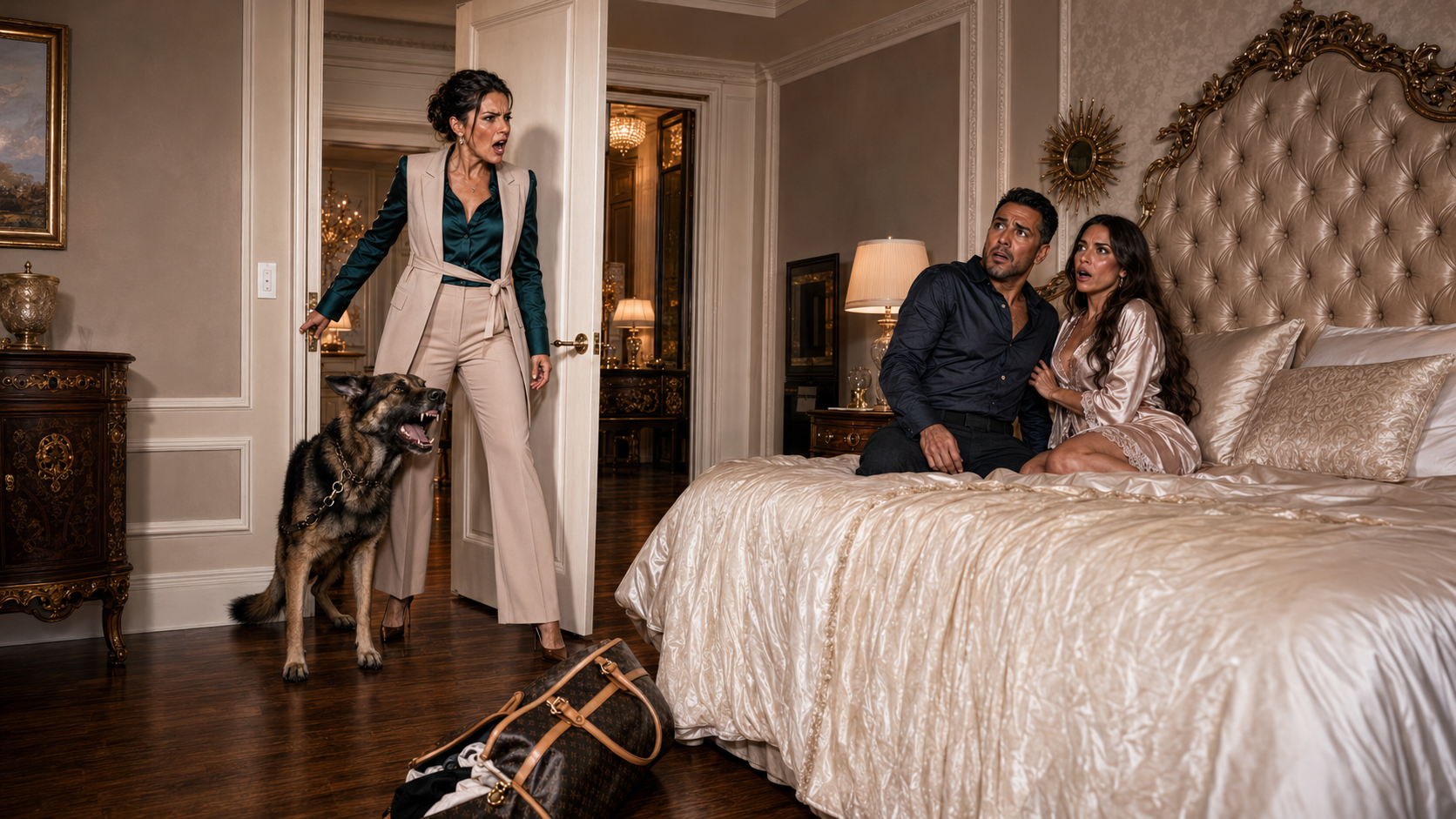
After 22 Years in the Army, I Came Home Early to Surprise My Husband—But One Lie Made My Own Family Lock Me Out
My name is Mara Whitaker.
For twenty-two years, I served in the United States Army.
I had slept in deserts where the night air tasted like dust and metal. I had crossed hostile roads with fuel convoys. I had delivered medicine through places where one wrong turn could become a funeral. I had learned how to stay calm when men twice my size panicked, how to make decisions with a broken radio, half a map, and people’s lives depending on me.
By the time I retired, people called me strong.
Disciplined.
Unshakable.
But no one tells you that the hardest battle may not be fought overseas.
Sometimes it waits inside your own house.
Sometimes it wears your husband’s face.
I came home three days early from my final assignment because I wanted to surprise Blake.
Twenty-two years in uniform had taken a lot from us. Missed birthdays. Missed anniversaries. Missed Christmas mornings where I watched through a video call while Blake opened gifts alone. So when my retirement paperwork cleared earlier than expected, I changed my flight and told no one.
Not my parents.
Not my sister.
Not even Blake.
I wanted one perfect moment.
I imagined walking into our bedroom in Ohio, setting my duffel down, and watching his face light up.
I imagined him saying, “Mara? You’re home?”
I imagined him pulling me into his arms.
I imagined finally feeling like I had made it back to the life I had been fighting to protect.
My retired military shepherd, Atlas, sat in the passenger seat of my truck as we turned onto our street. His muzzle had gone gray, his hips were slower now, but his eyes were still sharp. He had served beside me for years, trained to notice what humans tried to hide.
“Almost home, boy,” I whispered.
Atlas lifted his head.
The porch light was on.
Blake’s black SUV was in the driveway.
So was a red car I didn’t recognize.
At first, I told myself it was nothing.
A neighbor.
A friend.
A work thing.
But Atlas gave a low sound in his throat before I even touched the front door.
I unlocked it quietly.
The house smelled different.
Not bad.
Not unfamiliar.
Just wrong.
A perfume that wasn’t mine floated through the hallway.
Laughter came from upstairs.
A woman’s laugh.
Then Blake’s voice.
Soft.
Lazy.
Intimate.
My hand tightened around the strap of my duffel.
Atlas stepped ahead of me.
I walked up the stairs without making a sound.
Every step felt heavier than the last.
The bedroom door was half open.
I pushed it wider.
And there he was.
My husband.
In our bed.
With a woman I had seen at three Christmas parties.
For three seconds, no one moved.
The woman gasped and grabbed the sheet.
Blake sat up, his face white with shock.
“Mara?”
I stared at him.
The room spun, but my voice stayed calm.
“You weren’t expecting me.”
Blake jumped out of bed, pulling on his pants.
“You weren’t supposed to be back until Friday.”
Those words did more damage than any apology could have repaired.
Not “I’m sorry.”
Not “Please let me explain.”
Not even shame.
Just anger that I had ruined his schedule.
The woman whispered, “Blake, who is this?”
I looked at her.
“I’m his wife.”
Her face crumbled.
Blake snapped, “Mara, don’t start.”
I almost laughed.
“Don’t start?”
He stepped toward me. “You need to calm down.”
“I am calm.”
“That’s what scares people about you,” he hissed. “You stand there like a machine.”
Atlas moved between us.
Blake looked down at him with disgust.
“Get that dog away from me.”
I turned toward the closet.
Blake grabbed my wrist.
Hard.
So hard I felt the bones grind.
“Where do you think you’re going?”
I looked down at his hand, then back at his face.
“Let go.”
“Mara, listen to me.”
“Let go.”
He leaned closer, his voice dropping into something ugly.
“You don’t get to come home like some hero and destroy my life.”
I pulled my wrist free.
“You did that yourself.”
The woman in the bed began crying.
Blake pointed at me. “Don’t you dare play victim. You’ve been gone for years. You know what that does to a marriage?”
I opened the closet and pulled out one duffel.
“I know what betrayal does.”
“You’re unstable,” he said.
That made me stop.
Slowly, I turned.
“What did you say?”
His eyes shifted.
Not guilt.
Calculation.
“You heard me.”
The air changed.
I had seen that look before in interrogations, in negotiations, in men who had already decided what lie they were going to live inside.
Blake raised his voice.
“You’re unstable, Mara. You always have been. The Army broke something in you.”
The woman stopped crying.
Even she knew he had crossed a line.
I packed fast.
Service records.
Laptop.
Passport.
A lockbox of documents.
Atlas’s leash.
Blake followed me down the hall, shouting.
“You think people don’t see it? You think your family doesn’t worry about you? You come home cold, controlling, with that dog always watching everyone.”
I said nothing.
That made him angrier.
He blocked the front door.
“You walk out now, and I swear, you’ll regret it.”
I looked him in the eyes.
“I already regret marrying you.”
For one second, his face twisted so violently I thought he would hit me.
Atlas growled.
Low.
Deep.
Blake stepped aside.
I walked out.
I did not scream.
I did not throw anything.
I did not call names.
I drove away with my hands steady on the wheel and my heart breaking so quietly that only Atlas heard it.
The first place I went was my parents’ house.
Because no matter how old you are, when your life falls apart, some wounded part of you still wants your mother to open the door.
It was almost midnight when I pulled into their driveway.
My father, Arthur, opened the curtain before I even reached the porch.
I knocked.
“Dad?”
He didn’t open.
Behind the glass, I saw my mother crying into a dish towel. My sister Kelsey stood beside her with folded arms. My brother Ryan was near the hallway, looking at the floor.
My father cracked the door only an inch.
“Mara,” he said, “step away from the porch.”
I blinked.
“What?”
“Blake called.”
My stomach dropped.
“Dad, whatever he told you—”
“He said you threatened him.”
I stared at him.
“He what?”
My mother sobbed behind him.
“He said you came home in a rage,” my father continued. “He said you were armed. He said you were talking nonsense.”
“I am not armed.”
“He said you’re having episodes.”
“Episodes?” My voice cracked. “Dad, he was in bed with another woman.”
Kelsey stepped forward.
“Oh, Mara. Of course that’s what you’re saying.”
I looked at my sister.
“You don’t believe me?”
“You always make everything a mission,” she said. “Everything has to be controlled. Everyone has to follow your command.”
I felt like I had been punched.
Ryan finally looked up.
“Mara, did you threaten him?”
“No.”
“Did you touch him?”
“No. He grabbed me.”
I raised my wrist, showing the red marks.
My mother looked at it.
For one second, I thought she saw me.
Then my father stepped in front of her.
“Mara, you need help.”
I whispered, “I need my family.”
Silence.
Cold.
Complete.
I pressed my hand against the glass.
“Mom, please. Look at me.”
She looked.
Then she looked away.
That hurt more than finding Blake in bed with another woman.
My father opened the door wider.
For one foolish second, hope rose inside me.
Then Ryan picked up my duffel from the porch and shoved it back into my chest.
The bag knocked the breath from me.
Atlas barked sharply.
My father shouted, “Control that dog!”
“He’s calmer than all of you,” I said.
Kelsey’s face hardened.
“You bring chaos everywhere you go.”
I looked at her for a long moment.
Then I heard the sound.
Sirens.
Blue and red lights washed across my father’s white porch columns.
Two police cars pulled into the driveway.
My mouth went dry.
Blake had called them too.
The officers stepped out with their hands near their belts.
One of them said, “Ma’am, keep your hands where we can see them.”
I raised my hands slowly.
Behind them, Blake’s SUV rolled to the curb.
He stepped out wearing a clean shirt and the calm face he used at church fundraisers.
“Officers,” he called, voice trembling perfectly, “please be careful. She has combat trauma. She can be unpredictable.”
I looked at him.
In that moment, I understood something terrifying.
He wasn’t panicking.
He was executing a plan.
“My name is Lieutenant Colonel Mara Whitaker, retired,” I said clearly. “My military ID is in my right jacket pocket. I am not armed. My husband assaulted me, and he is lying.”
Blake gave a wounded sigh.
“You see?” he said softly to the officers. “She sounds calm, but this is how it starts.”
One officer approached.
“Ma’am, we need you to sit down on the curb.”
“No.”
My father snapped from the doorway, “Mara, don’t make this worse.”
I turned toward him.
“My husband is standing there after cheating on me, lying about me, and you are telling me not to make it worse?”
He said nothing.
The younger officer reached toward my arm.
Atlas growled.
I gave one command.
“Down.”
Atlas obeyed immediately, lowering himself to the ground.
The officer paused.
His eyes moved to Atlas’s old service-dog tag.
“You military?” he asked.
“Twenty-two years.”
That shifted something.
Not enough to save me.
But enough to slow them down.
I showed them my ID.
I showed them my wrist.
I told them to check our doorbell camera because Blake had grabbed me near the hallway.
Blake immediately said, “The camera stopped working last week.”
Of course it did.
The officers did not arrest me.
But they did not protect me either.
They told me to find somewhere else for the night while things cooled down.
My family stood in the doorway and watched as I carried my duffel back to the truck.
My mother took one step forward.
My father held her arm and pulled her back.
That was when something inside me went quiet.
Not broken.
Quiet.
The begging part of me died on that porch.
At 2:17 a.m., I parked behind a closed laundromat and slept upright in the driver’s seat with Atlas’s head in my lap.
The next morning, I woke to sunlight on dirty glass and pain in my wrist.
I checked our joint bank account.
$143.22.
Six months earlier, it held almost $80,000.
I stared at the number.
Then I checked our savings.
Empty.
Credit cards.
Maxed.
A loan I didn’t recognize.
Another credit card in my name.
Another.
My breathing slowed.
Not because I was calm.
Because the Army had trained me to become most useful when everything around me turned dangerous.
I took out a notebook.
On the first page, I wrote:
Track the movement.
Then I called the only person who had never mistaken my calmness for coldness.
Colonel Denise Harlan.
My former commander.
She answered on the second ring.
“Mara?”
I didn’t know what to say.
So I said the truth.
“I came home and found Blake with another woman. He told my family I’m unstable. Police were called. Our money is gone.”
There was silence.
Then Harlan said, “Are you safe?”
“I’m in my truck behind a laundromat.”
“Is Atlas with you?”
“Yes.”
“Good. Listen to me. Stop thinking like a wife. Start thinking like a logistics officer.”
I closed my eyes.
She continued, “Money leaves tracks. Lies leave patterns. People like Blake depend on emotion making you sloppy. Don’t get sloppy.”
I opened my notebook again.
“Yes, ma’am.”
“First, freeze what you can. Second, download every statement. Third, find shelter. Fourth, attorney. Fifth, do not speak to him alone again.”
I almost smiled.
“Still giving orders?”
“Still saving your stubborn life.”
By noon, I had frozen two cards I had never opened, downloaded four sets of bank statements, printed loan documents, and discovered a company called BKW Consulting.
BKW.
Blake K. Whitaker.
Money had moved there in small amounts at first.
Then larger ones.
Hotel charges.
Jewelry stores.
Restaurants.
A storage unit in Kentucky.
Then I saw a loan guarantee.
$40,000.
Co-signed by Ryan.
My brother.
The same brother who had shoved my duffel into my chest.
I called him.
No answer.
I sent one text:
Ask Blake about the loan with your signature.
Ryan called back forty seconds later.
“What did you do?” he demanded.
“I found what Blake did.”
His breathing was ragged.
“He said it was for your treatment.”
My hand froze.
“What treatment?”
Ryan’s voice broke.
“He said you were too proud to ask for help. He said you needed a private facility after retirement. He said the Army recommended it, but you refused.”
I closed my eyes.
There it was.
The deeper betrayal.
Blake had not only stolen my money.
He had turned my family’s fear into a weapon.
“Ryan,” I said quietly, “there is no treatment.”
“He showed me papers.”
“Fake papers.”
“He said you’d deny it.”
“Of course he did.”
Ryan said nothing.
Then, barely above a whisper, he asked, “What did I sign?”
“A guarantee on a loan he used to steal from us.”
“No.”
“Yes.”
A long silence followed.
Then Ryan said, “Mara… I’m sorry.”
I wanted to forgive him instantly.
I wanted to because he sounded like my little brother again.
But I remembered the porch.
I remembered the duffel hitting my chest.
So I said, “Sorry won’t fix this. Evidence might.”
Colonel Harlan found me a temporary veterans’ apartment attached to a rehabilitation center outside Columbus. It wasn’t fancy, but it had a bed, a lock, coffee in the lobby, and people who understood silence.
Atlas slept against the door the first night like he was guarding a bunker.
I started volunteering in the service dog kennel because I needed something alive to need me without asking questions.
Within two weeks, I had reorganized the supply room.
Within a month, I had rebuilt the donor tracking system.
Within six weeks, I was coordinating medical rides, food deliveries, dog training schedules, and veteran intake paperwork.
Linda, the center director, stood in my office doorway one afternoon and said, “You know, Mara, most people volunteer by walking dogs.”
I looked up from a spreadsheet.
“You had a broken inventory system.”
She smiled.
“You invaded my nonprofit with military-grade organization.”
“It was vulnerable.”
“It was a closet.”
“It was an unsecured logistical failure.”
She laughed for the first time since I’d met her.
Two months later, she offered me the job of operations manager.
I almost said no.
Not because I didn’t want it.
Because I had spent so long being someone’s wife, someone’s officer, someone’s problem, someone’s warning sign, that I had forgotten I could simply be useful and valued without defending my existence.
Linda slid the offer letter across the desk.
“You don’t have to decide today.”
I picked it up.
“I already did.”
Meanwhile, Blake unraveled.
My attorney, Sandra Pike, was not warm.
She was better than warm.
She was precise.
The first time I met her, she looked through my documents for twenty minutes without speaking.
Then she closed the folder and said, “Your husband is either very stupid or very arrogant.”
“Which one helps me more?”
“Both.”
She built the case binder by binder.
Bank transfers.
Forged signatures.
Hidden accounts.
Hotel receipts.
Credit cards.
Loan documents.
A neighbor’s security footage showing Blake grabbing my wrist as I left the house.
A text from Blake to the woman from our bedroom that read:
She comes home Friday. We’ll be fine.
Then Sandra found something worse.
My service records were missing from the safe I had kept in my home office.
Not the copies.
The originals.
Commendations.
Retirement evaluation.
Medical clearance.
Letters of recommendation.
All gone.
Blake had taken my name, my money, and now my proof of who I was.
But lies rot from the inside.
And eventually, they smell.
Three months after I slept behind that laundromat, my family came to the rehabilitation center unannounced.
I saw them through the lobby windows before they entered.
My mother looked pale.
Ryan had red eyes and a swollen jaw.
Kelsey clutched a folder against her chest.
My father looked smaller than I remembered.
He stepped inside first.
Atlas rose beside me.
My father stopped.
“Mara,” he said.
I waited.
He swallowed.
“We need to talk.”
Before I could answer, the front doors burst open again.
Blake stormed in behind them.
“Mara!” he shouted. “Tell them this is all a misunderstanding.”
Every veteran in the lobby turned.
A Marine with one prosthetic leg lowered his newspaper.
An old Vietnam veteran in a wheelchair looked up from his coffee.
Linda stepped out of her office.
I stood behind the front desk with Atlas at my side.
“This is a veterans’ rehabilitation center,” I said. “You need to leave.”
Blake laughed too loudly.
“Now you’re hiding behind broken soldiers and dogs?”
The room went silent.
That was the mistake that finished him.
The Marine stood.
The Vietnam veteran rolled forward.
Linda’s voice went cold.
“Sir, leave now.”
Blake pointed at me.
“She’s manipulating all of you. That’s what she does.”
My father stepped forward.
“Blake.”
Blake turned quickly.
“Arthur, thank God. Tell her. Tell her this has gone far enough.”
My father’s face crumpled.
“No,” he said.
Blake blinked.
“What?”
“You lied.”
Blake’s smile twitched.
“No. She got to you.”
My mother began crying.
Kelsey opened the folder in her hands.
Inside were my missing service records.
My original retirement evaluation.
My medical clearance.
Letters from Colonel Harlan.
And something else.
A draft letter.
Blake’s letter.
To a private psychiatric facility.
Sandra, who had arrived behind them, took the document and read aloud:
“My wife, Mara Whitaker, recently retired from the military and has displayed signs of dangerous instability. Her family is prepared to confirm my concerns. I am requesting guidance on involuntary admission options…”
The lobby went cold.
I looked at Blake.
He stared at the floor.
Then Ryan spoke.
“He was going to have you committed.”
My mother covered her mouth.
My father whispered, “Dear God.”
Blake snapped, “That was a precaution!”
I stepped around the desk.
“A precaution?”
“You were out of control.”
“I walked away from you.”
“You destroyed our marriage!”
“You did that in our bed.”
A few people in the lobby murmured.
Blake’s face reddened.
He lunged toward Kelsey’s folder.
Ryan grabbed his shoulder.
“Don’t touch that.”
Blake swung.
His fist clipped Ryan across the jaw.
Ryan stumbled into a chair.
Atlas barked once.
Sharp.
Commanding.
I stepped forward, and my voice snapped across the lobby like a battlefield order.
“Back away.”
Blake froze.
For the first time, he looked afraid of me.
Not because I was dangerous.
Because I was no longer isolated.
Security rushed in and pinned him against the wall.
Nine minutes later, police arrived.
This time, Blake was the one told to keep his hands where they could see them.
This time, my family watched him being led away.
Not me.
The criminal case moved faster than the divorce.
Fraud.
Forgery.
Identity theft.
Assault.
False reporting.
Attempted unlawful commitment.
Financial exploitation.
Blake’s hidden accounts tied everything together.
The woman from our bedroom vanished the moment subpoenas reached her workplace. His consulting company fired him. His church friends stopped answering his calls. The calm face he had worn for years finally cracked in public.
At the hearing, Sandra placed three binders on the table.
One for the money.
One for the documents.
One for the lies.
Ryan testified first.
His voice shook.
“Blake told me Mara needed psychiatric care. He said she was too proud to accept help. He said the loan was for treatment.”
The attorney asked, “Did you verify this with Mara?”
Ryan looked at me.
“No.”
“Why not?”
He swallowed.
“Because I believed him before I believed my sister.”
Kelsey testified next.
“I found Mara’s records hidden in Blake’s garage after Ryan confronted him. He had used parts of her deployment paperwork to make fake documents.”
My mother cried through most of it.
My father sat like stone.
Then Colonel Harlan took the stand.
She wore a dark suit and carried herself like command had never left her bones.
The opposing attorney tried to suggest that combat had made me unstable.
Harlan leaned toward the microphone.
“Lieutenant Colonel Mara Whitaker was one of the most disciplined officers I ever served with. She managed chaos better than most people manage breakfast.”
The courtroom went quiet.
The attorney tried again.
“Is it possible she hid emotional instability from command?”
Harlan’s eyes narrowed.
“Anything is possible. But I am telling you what is true.”
When it was my turn, Blake finally looked at me.
Not with love.
Not with guilt.
With anger.
As if I had betrayed him by surviving the trap he built.
I told the judge everything.
I told him about the bedroom.
The wrist.
The porch.
The police lights.
The laundromat.
The bank account.
The fake treatment story.
The stolen service records.
The letter.
I did not raise my voice once.
When I finished, the courtroom stayed silent.
The judge looked over the documents for a long time.
Then he looked at Blake.
“Mr. Whitaker, you attempted to bury your wife under a false identity of instability so you could steal from her, discredit her, and silence her.”
Blake’s attorney stood.
“Your Honor—”
The judge raised a hand.
“I am not finished.”
The room went still.
The judge continued, “This court has seen betrayal. But using a veteran’s honorable service as a weapon against her credibility is a particularly shameful act.”
Blake stared at the table.
The ruling did not give me back everything.
No court can return the night you slept in a truck because your family chose a lie.
No judge can erase the sound of your mother crying behind a locked door but refusing to open it.
No sentence can give back the version of you who believed love automatically meant loyalty.
But the court gave me back my name.
The fraudulent debts were removed from my responsibility.
The stolen funds were traced.
The house was sold.
Blake was ordered to pay restitution.
The forged documents were referred for prosecution.
And when the divorce was finalized, Sandra handed me the decree and said, “You’re free.”
I looked at the paper.
Then at Atlas sleeping beside my chair.
Free.
Such a small word for something that cost so much.
Healing did not happen quickly.
My parents asked to visit every Sunday.
I said no for three months.
Not because I hated them.
Because forgiveness given too quickly can become another way of betraying yourself.
Ryan came first.
He showed up at the center one afternoon with two coffees and a bruise fading yellow across his jaw.
“I should have opened the door,” he said.
I took the coffee.
“Yes.”
He looked down.
“I should have believed you.”
“Yes.”
“I’m sorry.”
“I know.”
We sat outside while Atlas slept in the sun.
For a long time, neither of us spoke.
Then Ryan whispered, “When he said you were broken, I think part of me wanted an explanation for why you always seemed stronger than the rest of us.”
I looked at him.
“I was not stronger. I was trained.”
He nodded.
“And tired?”
I smiled sadly.
“Very tired.”
That was the beginning.
Kelsey came next.
She arrived with no makeup, no sharp words, no folded arms.
Just a small box of old photographs.
She sat across from me in the kennel office and said, “I was jealous of you.”
I said nothing.
She continued, “You left home and became someone important. I stayed and felt ordinary. When Blake said you had fallen apart, I believed it because it made you less impossible to compare myself to.”
“That’s honest,” I said.
“It’s ugly.”
“Both can be true.”
Her eyes filled with tears.
“I chose the lie because it made me feel better.”
“Yes,” I said.
“I’m sorry.”
I looked through the glass wall at Atlas, who was sleeping beside a young service dog in training.
“I’m not ready to trust you.”
Kelsey nodded.
“I know.”
“But I’m willing to see if you become someone trustworthy.”
She cried then.
Quietly.
That was also a beginning.
My parents took the longest.
The first Sunday I agreed to dinner, my mother cooked pot roast like she had when we were kids.
The table was set perfectly.
Too perfectly.
Everyone was afraid to move.
Halfway through dinner, my father stood.
His hands trembled.
“Mara,” he said, “I failed you.”
My mother started crying.
He looked at her and said gently, “No. Let me say it.”
Then he looked back at me.
“You came to my door with nowhere to go, and I closed it. I believed a man’s panic over my daughter’s lifetime of character. I let fear make me cruel.”
My throat tightened.
He continued, “I don’t deserve quick forgiveness.”
I appreciated that.
Because he was right.
I set down my fork.
“I am not ready to forget.”
He nodded.
“But I am ready to try.”
My mother covered her face.
For once, no one asked me to comfort them.
And strangely, that helped.
A year after Blake called me unstable, I became director of operations at the rehabilitation center.
Linda retired and said, “Try not to reorganize the entire universe.”
I told her, “No promises.”
Atlas grew slower that year.
His hips hurt more in the cold. His muzzle turned almost white. But he still walked the halls like a general inspecting troops. He helped train two younger service dogs before arthritis forced him into a quieter life.
Veterans came through our doors angry, ashamed, silent, and afraid.
Some had lost limbs.
Some had lost marriages.
Some had lost the ability to sleep without checking every window.
Some had families who did not understand why coming home did not feel like coming back.
I understood them.
Not completely.
No one understands another person completely.
But enough.
One afternoon, a young veteran named Caleb sat outside my office refusing to enter. His service dog, a nervous golden retriever, rested beside him.
“They think I’m dangerous,” he said.
“Who?”
“My family.”
I looked at him.
“Are you?”
He shook his head.
“No. I’m just tired.”
I sat beside him.
“Sometimes people who don’t understand pain call it danger.”
He looked at me.
“What do you do when they believe the wrong person?”
I thought of the porch.
The glass.
My father’s voice.
Blake’s SUV.
Atlas growling beside me.
“You stop begging them to know you,” I said. “You build a life so full of truth that the lie has nowhere left to stand.”
Years later, people sometimes asked me if I got revenge.
They expected me to say yes because Blake went to prison.
Because he lost the house.
Because his lies became public.
Because his name, the one he protected so carefully, became attached to fraud and disgrace.
But that was not revenge.
That was consequence.
My revenge was quieter.
It was waking up in a small house filled with morning light.
It was drinking coffee on the porch while Atlas slept at my feet.
It was signing payroll checks for a center that helped people rebuild.
It was watching my father learn to knock gently instead of command.
It was hearing my mother say, “I believe you,” even when all I told her was that I was tired.
It was Ryan calling before making decisions because he had learned the cost of not asking.
It was Kelsey becoming softer, slower to judge, quicker to listen.
It was looking in the mirror and no longer seeing the woman Blake tried to invent.
Unstable.
Dangerous.
Broken.
No.
I saw Mara Whitaker.
Retired lieutenant colonel.
Daughter.
Sister.
Survivor.
Leader.
Woman.
Whole.
One evening, just before sunset, I took Atlas to the rehabilitation center courtyard. He moved slowly, his old paws careful on the path.
We sat beneath the flagpole.
The sky was orange and purple, the kind of sky soldiers stare at overseas when they wonder if home still remembers them.
My father sat beside me.
For a while, we said nothing.
Then he asked, “Do you think you’ll ever fully forgive me?”
I watched Atlas lower his head onto his paws.
“I don’t know.”
He nodded.
“I deserve that.”
I looked at him.
“But I don’t want to live inside that night forever.”
His eyes filled.
“Neither do I.”
I reached over and placed my hand over his.
It was not a perfect ending.
Perfect endings are usually lies.
It was better than perfect.
It was honest.
Blake thought he could destroy me by telling my story first.
He thought if he called me unstable loudly enough, no one would hear the truth.
He thought a locked door would finish me.
But he forgot who I was before I was his wife.
I was the woman who could move supplies through a war zone with half a map.
I was the woman who knew how to track movement.
I was the woman who understood that every lie leaves a trail.
And I was the woman who walked out of betrayal without screaming because somewhere deep inside, I already knew:
Silence is not weakness.
Calm is not surrender.
And a woman who stops begging to be believed becomes very dangerous to the people who built their power on her doubt.
They locked the door on me that night.
So I built a life with doors wide enough for others to walk through.
And that was how I won.
Disclaimer: This story is a work of fiction created for entertainment purposes. Any resemblance to real persons, events, or places is purely coincidental.