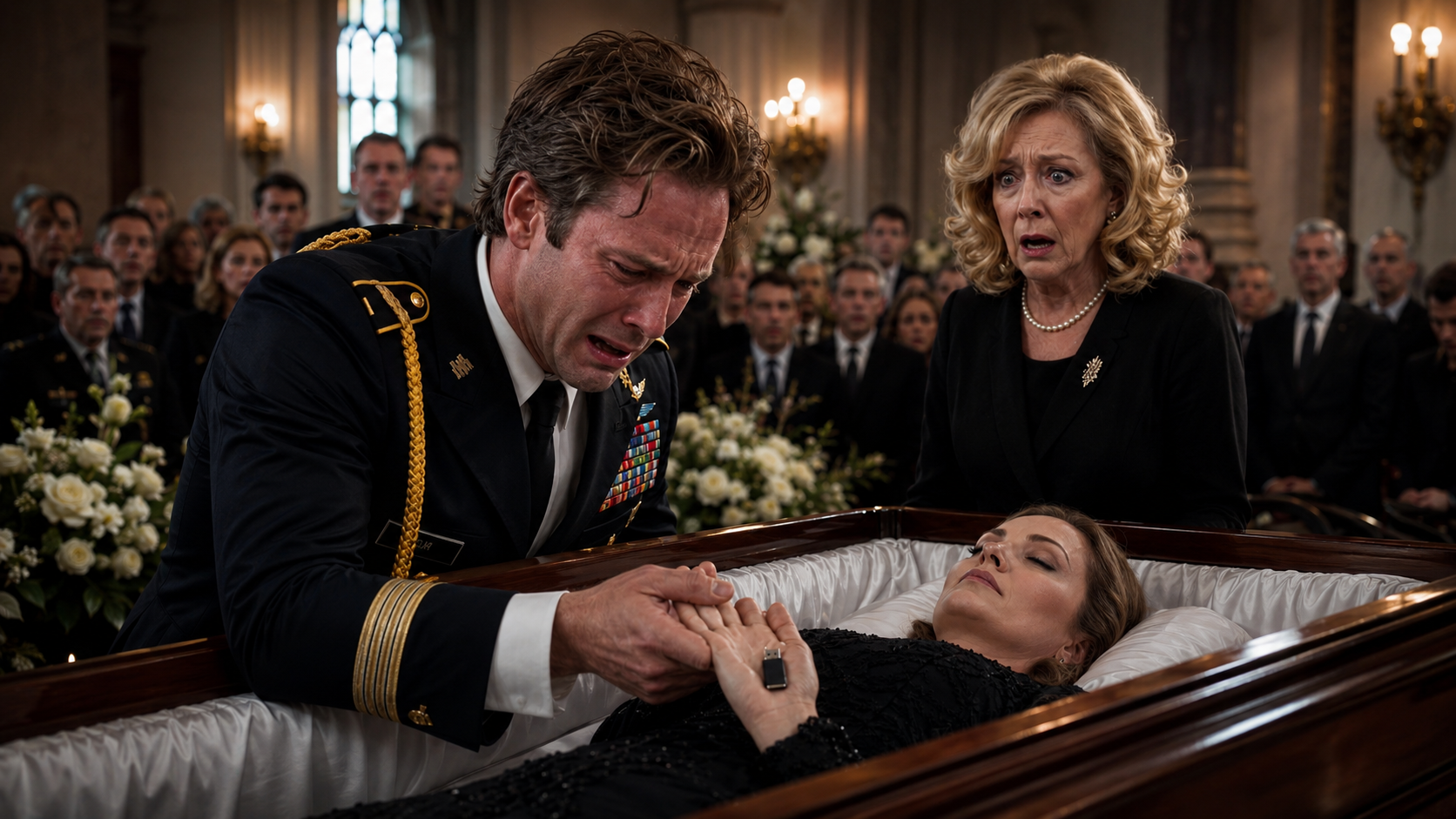
I Returned From Military Service and Found My Wife in a Coffin — Then Her Hand Revealed the Truth My Mother Tried to Bury
My Mother Said My Wife Died in Childbirth While I Was Deployed — But the Memory Card in Her Hand Exposed a Crime No One Expected
I returned home from military service hoping to see my wife’s smile.
Instead, I found a coffin in the middle of my living room.
You May Also Like



My mother stood beside it without one tear and said:
“We lost her in childbirth, Daniel.”
Before I could even breathe, I heard my newborn son crying weakly upstairs.
I walked toward the coffin to see my wife one last time.
That was when I noticed her hand.
Stiff.
Closed tight.
Clutching something.
My mother turned pale when I reached for it.
“Leave her dignity intact,” she snapped.
But I had spent eleven months in military intelligence learning one thing:
When someone tries too hard to stop you from seeing something, that thing matters.
So I opened my wife’s hand.
A tiny black memory card fell into my palm.
And by midnight, the woman who raised me was in handcuffs beside the coffin she had used to hide the truth.
The Story
The coffin was waiting in my living room before I had even taken off my uniform.
For a moment, I thought I had walked into the wrong house.
The front door stood half open.
The porch light flickered in the cold evening wind.
My duffel bag hung from my shoulder, heavy with desert dust, folded letters, and the blue baby blanket I had carried across two countries because I wanted to bring it home to my son.
I had imagined this moment a thousand times.
Emily running toward me.
Her arms around my neck.
Her laugh breaking into tears.
Our newborn son sleeping against her chest.
I had imagined kissing her forehead and whispering, “I’m home.”
But my wife was not waiting by the door.
She was lying in a coffin in the middle of our living room.
Open.
Still.
Dressed in the blue dress she had chosen for my homecoming.
My mother stood beside the coffin without a single tear.
“Your wife died giving birth, Daniel,” she said.
For three seconds, the world made no sound.
Then I heard it.
A weak cry.
A newborn cry.
Somewhere upstairs.
Small.
Thin.
Tired.
My duffel bag slipped from my shoulder and hit the floor.
I looked at my mother.
“Where is my son?”
Margaret Hale did not flinch.
“He survived,” she said. “Barely. Emily was careless.”
My younger brother, Caleb, leaned against the fireplace with a glass of whiskey in his hand.
“She always was dramatic,” he muttered.
I stared at him.
He stared back like a man testing whether grief had made me weak.
I had spent eleven months overseas as an intelligence warrant officer.
I had walked roads where one wrong patch of disturbed dirt could become a coffin.
I had learned to notice wires thinner than hair.
A shadow in the wrong place.
A footprint where none should be.
A man smiling too calmly near a locked gate.
Training had taught me that death leaves details behind.
And everything in that room felt staged.
No hospital bracelet on Emily’s wrist.
No flowers from the clinic.
No doctor waiting to explain what had happened.
No paperwork visible.
No nurse.
No ambulance scent.
No exhausted grief in my mother’s eyes.
Only her.
Caleb.
And my wife arranged too carefully, like someone had prepared her not for mourning, but for display.
I took one step toward the coffin.
My mother moved slightly.
Too quickly.
As if blocking me.
“Daniel,” she said, softening her voice. “You should sit first.”
I kept walking.
“I want to see my wife.”
“You are exhausted.”
“I want to see my wife.”
Caleb lifted his glass.
“Don’t make this harder than it has to be.”
I turned my head slowly.
“What did you say?”
He swallowed.
My mother spoke quickly.
“He means we have all suffered enough.”
I looked back at Emily.
My Emily.
Her dark hair had been arranged around her face.
Someone had placed her hands near her waist.
But her right hand was clenched against her hip.
Tight.
Too tight.
I stared at it.
“What is she holding?”
My mother’s face changed.
It lasted less than a second.
But I saw it.
“Nothing,” she said sharply. “Leave her dignity intact.”
I bent over the coffin.
Mother grabbed my arm.
“Daniel, stop.”
I looked at her hand on my uniform sleeve.
Then at her eyes.
“Take your hand off me.”
For the first time since I was a child, she obeyed immediately.
Emily’s fingers were stiff, but not impossible to move.
Beneath her nails were tiny crescent cuts, as though she had fought to keep her fist closed.
My throat tightened.
“Em,” I whispered.
I worked her thumb loose gently.
Then her fingers.
Something small and black slid into my palm.
A memory card.
My mother went white.
Caleb’s glass stopped halfway to his mouth.
“What is that?” he demanded.
I closed my fist around it.
“You tell me.”
Mother recovered first.
“Probably something from her phone,” she said. “She was obsessed with recording everything. Pregnancy made her paranoid.”
Upstairs, the baby cried again.
This time, weaker.
That sound cut through the room like a knife.
I slipped the card into the hidden pocket inside my uniform.
Then I looked at my mother and said, “Tell me exactly how my wife died.”
Her mouth tightened.
“Daniel, this is not the time.”
“It is exactly the time.”
Caleb stepped away from the fireplace.
“You just got home. You’re not thinking clearly.”
I looked at him.
“You should hope I’m not thinking clearly.”
He stopped moving.
Mother placed a hand over her chest.
“Your wife went into labor suddenly this morning. We tried to help her.”
“Where?”
“Here.”
“She gave birth here?”
“Yes.”
“Why wasn’t she at the hospital?”
“She refused.”
I stared at her.
“Emily refused medical help?”
Mother lifted her chin.
“She was stubborn.”
I looked at the coffin.
Emily had once made me drive twenty minutes back to a restaurant because she thought she had forgotten to tip enough.
She called the doctor when she had heartburn during pregnancy because she did not want to risk anything with the baby.
She wrote down every appointment, every vitamin, every question.
Emily did not refuse help.
“Which doctor pronounced her dead?” I asked.
Mother’s eyes flickered.
“A private physician.”
“Name.”
“I don’t remember.”
“You don’t remember the name of the doctor who declared my wife dead?”
Caleb slammed down his glass.
“Why are you interrogating us?”
I looked at Emily.
“Because someone should.”
Mother softened her voice.
“Go meet your son. We will handle the burial tomorrow.”
Tomorrow.
Less than twenty-four hours after my return.
Less than one day to bury the woman I had promised to love until death.
And they had the coffin ready before I even came through the door.
I walked toward the stairs.
Mother reached for me again.
“Daniel—”
I stopped.
“If you touch me one more time, I will forget you are my mother.”
She stepped back.
I climbed the stairs with my heart beating like a warning drum.
The nursery door was half open.
Inside, a small lamp glowed beside the crib.
The room smelled wrong.
Sour milk.
Powder.
Something medicinal.
My son lay inside the crib wrapped in a gray blanket I had never seen before.
Not the blue one Emily picked.
Not the soft white one her mother had knitted before she passed.
A gray blanket.
Thin.
Scratchy.
His crying had faded into weak little gasps.
I moved fast.
“Hey, little man,” I whispered, lifting him carefully. “Daddy’s here.”
His skin felt too warm.
His lips were dry.
His tiny hands barely curled against my finger.
Beside the crib sat a bottle half full of cloudy liquid.
I picked it up and smelled it.
Sweet.
Chemical.
Wrong.
I photographed it with my phone, sealed it inside a clean storage bag from the diaper station, and tucked it into my duffel.
Then I carried my son into the bathroom and locked the door.
My hands shook as I lowered the toilet lid and sat down, holding him against my chest.
“What happened here?” I whispered.
He made a tiny sound.
My son.
My son.
I did not even know his name.
That realization almost broke me.
I had missed the birth.
I had missed Emily holding him.
I had missed her first look at him.
And now she was downstairs in a coffin while my mother waited for me to sign away the truth.
I pulled out my hardened field laptop from my duffel.
I had used it overseas for secure analysis work.
Now I used it on my bathroom floor.
I copied the memory card without altering its metadata.
My hands moved from training, not emotion.
Create image.
Preserve source.
Hash file.
Duplicate to encrypted vault.
Confirm timestamp.
Confirm camera ID.
Six video files appeared.
All from a nursery camera.
Emily had hidden it in the bookshelf.
Of course she had.
Before deployment, I had transferred the house into a military family trust that only I could authorize.
I had also given Emily access to my encrypted evidence vault because she feared my mother was stealing from us.
I had thought she was being overly cautious.
Another mistake I would carry forever.
I opened the first video.
My mother stood in the nursery, rifling through our financial files while Emily was downstairs.
She removed documents from a folder marked Trust — Daniel/Emily/Baby.
The second video showed Caleb at the desk, practicing my signature.
Again.
And again.
And again.
The third video shattered whatever remained of my heart.
Emily stood near the crib, heavily pregnant, one hand on her back, breathing through pain.
My mother held papers against her chest.
“Sign the trust amendment,” Mother ordered. “Daniel may not come home, and this family will not be controlled by you.”
Emily’s voice was tired but firm.
“It belongs to Daniel, me, and our baby.”
“You are not family.”
Emily laughed softly.
“I’m his wife.”
“You are a mistake he made before deployment.”
Emily’s hand tightened around the crib rail.
“I already sent copies of your forged transfers to his secure vault.”
My mother froze.
Caleb entered the room.
“What did she say?”
Emily stepped back.
“Give me my phone.”
Caleb grabbed it from the changing table.
Emily reached for it.
“Caleb, don’t.”
He shoved her.
She stumbled backward and hit the edge of the small table near the bookshelf.
The video shook slightly from the impact.
Emily gasped.
Her hand flew to her stomach.
For several seconds, no one moved.
Then her face changed.
Pain.
Fear.
Labor.
“Call an ambulance,” she gasped.
Mother crouched beside her.
“Sign first.”
I stopped the video.
My son made a small sound against my chest.
I pressed my lips to his forehead.
“I’m sorry,” I whispered. “I’m so sorry.”
Then I forced myself to continue.
The next recording lasted forty-three minutes.
Forty-three minutes of my wife begging for help.
Forty-three minutes of my mother controlling the front door.
Forty-three minutes of Caleb disconnecting the landline.
Forty-three minutes of Emily trying to crawl toward the phone while my mother stood over her with papers in her hand.
“You will sign,” Mother said, “or both of you can die stubborn.”
Emily cried out.
“Please. The baby.”
“The baby will belong where he should have belonged from the beginning,” Mother said. “With blood family.”
Emily’s voice broke.
“Daniel is his father.”
“And I am Daniel’s mother.”
The room spun.
I paused again, breathing hard.
There are sounds a man never forgets.
Explosions.
Incoming fire.
A friend screaming your name.
But nothing from war prepared me for the sound of my wife pleading with my mother to save our child.
The last video showed Emily on the floor, pale and sweating, clutching the memory card she had removed from the hidden camera.
Caleb’s voice shook.
“Mom, we need to call. This is bad.”
My mother snapped, “Not until she signs.”
“She can barely hold the pen.”
“Then hold her hand.”
Emily looked toward the camera.
It was only one second.
But in that second, it felt like she saw me.
Across time.
Across death.
Across all the lies waiting in that living room.
Her lips moved.
I turned up the audio.
“Daniel,” she whispered. “Noah. Protect Noah.”
My son’s name.
Noah.
Caleb finally called emergency services when it was nearly too late.
The last audio captured my mother’s voice.
“Tell them she refused help.”
Then the video ended.
I sat on the bathroom floor holding my son while grief moved through me like fire.
Not wild.
Focused.
Rage is useful only when controlled.
I uploaded everything into the encrypted military vault Emily had mentioned.
The automatic audit log preserved the files, timestamps, camera source, and chain of custody.
Then I made three calls.
One to Detective Lena Ortiz, a county homicide investigator I had worked with during a joint explosives case.
One to my military legal counsel.
One to Dr. Arjun Shah, a pediatric emergency physician who owed me nothing but had once told me, “If you ever need medical truth fast, call me.”
Detective Ortiz answered on the second ring.
“Hale?”
“Lena,” I said. “My wife is dead in my living room. My mother says childbirth. I have video evidence showing obstruction of medical care, possible assault, forgery, and a newborn who may have been drugged.”
Silence.
Then her voice changed.
“Where are you?”
“My house.”
“Are suspects present?”
“My mother and brother.”
“Are you armed?”
“Yes.”
“Are you calm?”
I looked at Noah.
“No.”
“Can you act calm?”
“Yes.”
“Good. I’m coming.”
Dr. Shah arrived through the side entrance forty minutes later.
He wore a plain jacket and carried a medical bag.
Detective Ortiz came with him, disguised as his assistant.
I let them in through the garage while Mother and Caleb were downstairs.
Dr. Shah examined Noah in the nursery.
His face tightened almost immediately.
“He needs a hospital.”
“I know.”
He checked the bottle I had bagged.
His expression darkened.
“There may be something unusual in this.”
“Sedative?”
“Possibly. I need lab confirmation.”
I closed my eyes.
Mother had not only delayed help for Emily.
She may have drugged my son to keep him quiet.
Detective Ortiz watched my face carefully.
“Daniel.”
I looked at her.
“I’m here.”
“We need them speaking. Can you keep them talking?”
“Yes.”
“If the baby declines, we move immediately.”
Dr. Shah nodded.
“He is stable for minutes, not hours.”
Minutes.
That was all I needed.
Downstairs, Mother called my name.
“Daniel? Come down. We need to discuss arrangements.”
Arrangements.
Not grief.
Not medical questions.
Arrangements.
Detective Ortiz touched the recorder under my jacket.
“It’s active,” she whispered.
I carried Noah downstairs.
Mother was waiting at the dining table with a pen and a stack of documents.
Caleb stood behind her.
The coffin remained in the living room.
My wife’s face visible from the dining room through the open archway.
The sight nearly destroyed me.
But I sat.
“What am I signing?” I asked.
Mother pushed the first page toward me.
“Authority over the house, trust, and baby. You are unstable from combat and grief. Caleb and I will protect what remains.”
Caleb smirked.
“You were always better at following orders than understanding money.”
That was the mistake people made.
They confused silence with surrender.
I looked down at the document.
Temporary guardianship.
Trust amendment.
Medical authority.
Property control.
All drafted before Emily was even cold.
I placed one hand over Noah’s back.
“Why would you need guardianship?”
Mother sighed.
“Because you are grieving. You just returned from deployment. You are not in a position to make choices for an infant.”
“My infant.”
“Our blood,” she said.
I looked up.
“Our?”
Mother leaned forward.
“You know what I mean.”
“No,” I said. “Say it.”
Caleb shifted.
Mother’s mouth tightened.
“Emily tried to take you from your real family. She tried to lock us out of what your father built.”
“My father built nothing in this house. I bought it.”
“With family values I gave you.”
I almost laughed.
“What does that mean?”
“It means you owe us loyalty.”
“My wife was my loyalty.”
Mother’s eyes flashed.
“She was a gold digger.”
I looked toward the coffin.
Emily, who clipped coupons even after I told her she did not need to.
Emily, who cried when I bought her a new coat because she said the old one still had two good winters left.
Emily, who worked part-time at the library through pregnancy because she wanted Noah to have a college fund.
“She said you stole from us,” I said. “She had proof.”
Mother’s eyes flicked toward my pocket.
There it was again.
Fear.
“Emily lied constantly,” she said.
“What about the memory card?”
Caleb stepped closer.
“Hand it over.”
I looked at Mother.
“Did you refuse to call an ambulance until she signed?”
Mother’s composure cracked.
“She had no right to defy me,” she hissed. “That house should have been mine. Your deployment money should have supported your real family.”
“My wife was my real family.”
“She would still be alive if she had signed!”
Silence swallowed the room.
Mother realized what she had admitted.
Caleb lunged across the table.
But Detective Ortiz entered from the hallway with her weapon drawn.
“Hands where I can see them!”
Two deputies came through the front door.
Caleb froze.
Mother stared at me.
“You set me up.”
I stood slowly, holding Noah against my chest.
“No,” I said. “Emily did. I only stopped you from burying the truth with her.”
Caleb tried to run.
A deputy drove him against the wall and cuffed him beside the coffin.
Mother screamed.
“She provoked us! She did this! No jury will believe a dead woman!”
Detective Ortiz looked at her.
“Mrs. Hale, dead women can still leave evidence.”
Paramedics rushed upstairs with Dr. Shah’s instructions.
Then one came down and took Noah from me.
I did not want to let go.
Dr. Shah touched my shoulder.
“Daniel, he needs the hospital now.”
I kissed Noah’s forehead.
“Go,” I whispered. “Daddy is coming.”
As they carried my son out, my mother twisted in the deputy’s grip.
“Daniel! You can’t do this to me!”
I looked at her.
For thirty-four years, that voice had worked.
It had made me feel like a bad son when I said no.
It had made me send money.
Answer calls.
Apologize when she insulted Emily.
Stand silently when she demanded space in our life she had not earned.
But now my wife lay in a coffin because my mother believed motherhood gave her ownership over my life.
“You did this,” I said.
Then I followed my son out the door.
The hospital smelled like antiseptic, coffee, and fear.
Noah was rushed into emergency care.
I stood outside the room with Emily’s dried blood still under my fingernails from opening her hand.
Detective Ortiz arrived twenty minutes later.
Her face was grim.
“They’re both in custody.”
I nodded.
“Tell me when I can see my son.”
“Soon.”
“Tell me now.”
She softened.
“Daniel.”
I looked at her.
“Please.”
She nodded toward the room.
“Dr. Shah says Noah is responding. They are treating dehydration and monitoring for sedative exposure. You got him out in time.”
In time.
The same words that meant Emily had not been.
I leaned against the wall and slid down until I was sitting on the floor.
My uniform was still on.
My boots still dusty.
My medals still pinned.
I had survived war and come home too late to save the one person who waited for me.
Detective Ortiz sat beside me.
She did not speak for a while.
That helped.
Finally, she said, “You need to prepare yourself. This will become public.”
“I don’t care.”
“You will.”
I looked at her.
“My wife was murdered in my home.”
Her eyes held mine.
“Then let’s make sure we prove it right.”
The autopsy confirmed what the videos had already shown.
Emily had suffered injuries from the fall.
Prolonged labor.
Untreated hemorrhage.
Severe distress.
Delay of emergency care.
The medical examiner did not use emotional words.
Reports rarely do.
But every line felt like an accusation.
A timeline built from suffering.
Phone records showed the landline had been disconnected during the critical window.
Emergency services had not been called until forty-seven minutes after the first signs of serious distress on the nursery footage.
Toxicology confirmed Noah’s bottle contained a sedating antihistamine at a dangerous dose for a newborn.
Bank investigators uncovered forged transfers totaling $286,000.
My deployment pay.
Emily’s inheritance from her late aunt.
Emergency savings.
A military spousal benefit account.
All slowly redirected through accounts tied to Caleb.
The papers Mother wanted signed would have given her control of the trust, medical authority over Noah, and leverage over every asset Emily had tried to protect.
But that was not the final twist.
The final twist came from the funeral director.
His name was Alan Pierce.
He had arrived at the house before I came home.
He had prepared the coffin.
He had accepted Mother’s explanation.
At first, he claimed he had no idea anything was wrong.
Then Detective Ortiz found the text messages.
Mother had written:
He returns at 1800. I need her ready before he arrives. No questions. Extra fee.
Pierce replied:
Death certificate still missing.
Mother:
Private physician will handle. Just make it look peaceful.
There was no private physician.
The death certificate had not been properly filed.
Pierce had been paid to rush the appearance of finality.
When confronted, he folded fast.
He testified that Mother insisted the body be displayed at home before I arrived because, in her words:
“He needs to see grief before he starts asking soldier questions.”
Soldier questions.
She had known exactly what I would notice.
And still, she thought she could beat grief with shock.
She almost did.
If Emily had not held that memory card.
If her fingers had not fought even after death.
If I had listened when Mother told me to leave her dignity intact.
The truth might have gone into the ground with her.
The trial began nine months later.
By then, Noah was crawling.
He had Emily’s eyes.
Dark.
Curious.
Always searching.
I brought him to the courthouse only once, before testimony began, so he could sit in the witness waiting room with Dr. Shah’s wife while I gave my statement.
I did not want him near Margaret.
Not even through walls.
Mother entered the courtroom wearing black.
A widow’s color.
As if she had lost something.
Caleb entered separately, already thinner, already bargaining with the prosecution.
He looked at me once.
Then looked away.
Coward.
The first day was evidence.
Bank records.
Trust documents.
Phone logs.
The forged signatures.
The bottle.
The sedative test.
The funeral director’s messages.
The jury listened carefully.
Mother sat still.
Too still.
But when the prosecution played the nursery video, she finally changed.
Emily’s voice filled the courtroom.
“Call an ambulance.”
No one moved.
Then Mother’s recorded voice:
“Sign first.”
A juror covered her mouth.
Caleb lowered his head.
I stared straight ahead.
I had watched the video once.
Then never again.
Until court.
I owed Emily that much.
When the footage showed her crawling toward the bookshelf, reaching for the hidden camera, removing the memory card, the prosecutor paused the video.
“Ladies and gentlemen,” he said quietly, “Emily Hale was dying. She was in labor. She had been denied help. And still, she used the strength she had left to preserve the truth for her husband and son.”
Mother looked down.
The jury did not.
Then came my testimony.
The prosecutor asked, “Mr. Hale, what did you find when you returned home?”
I described the coffin.
The blue dress.
The baby crying upstairs.
The gray blanket.
The bottle.
The clenched hand.
My voice broke only once.
When he asked about the memory card.
“What did you believe when you saw your mother’s reaction?”
I looked at Margaret.
She looked smaller than I remembered.
But evil often looks smaller once it loses control of the room.
“I believed,” I said, “that my wife was still trying to tell me something.”
Mother’s attorney tried to suggest combat trauma had affected my judgment.
“Mr. Hale, you had just returned from a high-stress military environment, correct?”
“Yes.”
“You were exhausted?”
“Yes.”
“Grieving?”
“Yes.”
“Angry?”
“Yes.”
“Is it possible you interpreted innocent family concern as guilt?”
I looked at him.
“No.”
“You’re certain?”
“My mother admitted on recording that Emily would still be alive if she had signed.”
The attorney paused.
I continued.
“That is not concern. That is motive.”
He sat down.
Caleb took a plea deal before the defense rested.
No one was surprised.
He testified against Mother in exchange for reduced charges.
He admitted practicing my signature.
Admitted disconnecting the landline.
Admitted taking Emily’s phone.
Admitted moving money.
Admitted Mother told him that if Emily died, “Daniel would be too broken to fight.”
When asked why he helped, Caleb said, “Mom said Daniel owed us.”
That sentence followed me for years.
Daniel owed us.
As if love is a loan.
As if family is a debt collector.
As if my wife and child were assets to be reclaimed.
Mother refused to testify at first.
Then changed her mind.
Her lawyer looked terrified when she stood.
She wore pearls that day.
Emily had hated those pearls.
“They look like teeth,” she once whispered to me at Thanksgiving.
I nearly smiled at the memory.
Mother sat on the stand and told the jury she had only wanted to protect me.
“Emily was unstable,” she said. “She isolated Daniel. She filled his head with suspicion. She wanted to cut him off from his own blood.”
The prosecutor asked, “Did Emily ask for an ambulance?”
Mother’s mouth tightened.
“She was hysterical.”
“Did she ask for an ambulance?”
“Yes.”
“Did you call one immediately?”
“She was refusing to cooperate.”
“Did you call one immediately?”
“No.”
“Did you tell her to sign the trust amendment first?”
Mother’s eyes flashed.
“She had a responsibility to this family.”
The prosecutor paused.
“To sign away control of property while in labor?”
Mother looked toward me.
“She had turned him against us.”
The prosecutor stepped closer.
“Mrs. Hale, your daughter-in-law was bleeding, in labor, and begging for medical help. Your newborn grandson later tested positive for a sedating antihistamine. Your son had just returned from deployment. Your other son was practicing his signature. Your financial accounts received stolen money. And your defense is that Emily turned Daniel against you?”
Mother’s face hardened.
“She was never good enough for him.”
There it was.
The sentence behind all of it.
Not grief.
Not confusion.
Not panic.
Hatred.
The jury heard it.
So did I.
So did Emily, somewhere beyond the reach of courts.
The verdict came on a rainy Thursday.
Guilty.
Second-degree murder.
Unlawful imprisonment.
Child endangerment.
Fraud.
Forgery conspiracy.
Evidence tampering.
Mother did not cry.
Caleb did.
He had pleaded guilty to manslaughter, forgery, evidence tampering, and conspiracy.
He received fourteen years.
Mother received thirty-eight.
When the judge asked if she wanted to speak before sentencing, she stood.
For one second, I wondered if she would apologize.
Not to me.
To Emily.
To Noah.
To the truth.
Instead, she looked at me and said, “I raised you better than this.”
The courtroom went still.
I stood because I could not stay seated.
The judge allowed me to speak.
I walked to the podium.
My hands were steady.
“My wife raised herself better than you raised me,” I said.
Mother’s face changed.
I continued.
“Emily was alone in that house with people she should have been able to trust. She begged for help. She fought to protect our son. And when she knew she might not survive, she still saved the proof.”
My voice grew rough.
“You thought her hand was powerless because she was dead. But that hand held the evidence that destroyed every lie you told.”
Mother looked away.
Good.
I wanted those words to find her anyway.
I faced the judge.
“My son will grow up knowing his mother was not weak. She was not dramatic. She was not careless. She was brave. And he will know that the people who hurt her were held accountable.”
The judge sentenced Margaret Hale to thirty-eight years.
When deputies led her away, she did not look at me.
For the first time in my life, I was grateful for that.
After the trial, the house felt impossible to enter.
Every room had memory in it.
The nursery camera.
The living room coffin.
The dining table documents.
The staircase where I carried Noah down.
The bathroom floor where I watched Emily’s last fight.
People told me to sell it.
Start over.
Move somewhere without ghosts.
I almost did.
Then one night, Noah woke crying.
He was ten months old by then, round-cheeked and determined to grab everything breakable.
I carried him through the hallway.
He quieted when we reached Emily’s favorite window.
The one overlooking the maple tree.
She had loved that tree.
When we bought the house, she stood under it and said, “Our kid is going to climb that thing one day and scare us to death.”
I looked at Noah in my arms.
He pressed one tiny hand against the glass.
Outside, the maple leaves moved in the night wind.
I whispered, “Your mom loved that tree.”
Noah laid his head on my shoulder.
That was when I decided not to let my mother turn our home into a crime scene forever.
I renovated.
Not to erase.
To reclaim.
The living room was emptied completely.
The floor where the coffin had stood was replaced.
I burned the gray blanket.
I kept the blue one I had carried home from deployment.
The nursery bookshelf stayed.
So did the camera.
Not hidden anymore.
Mounted openly.
A witness.
A reminder.
I turned the dining room into a study where Emily’s photo sat on the desk beside the memory card, sealed in glass.
Not because I wanted to worship pain.
Because truth deserved a place of honor.
Eighteen months after Emily’s death, I left active duty.
I became an intelligence instructor.
I taught young soldiers to notice details.
Disturbed earth.
Strange wiring.
Missing paperwork.
Wrong smells.
Too much calm.
I never told them everything.
But sometimes, when teaching evidence preservation, I would pause and say:
“The smallest item in a room may be the thing someone died protecting. Treat it that way.”
They wrote it down.
They did not know the memory behind it.
At home, Noah learned to walk beneath Emily’s maple tree.
His first steps were crooked, determined, and angry.
He fell twice.
Then slapped the grass like it had insulted him.
I laughed so hard I cried.
Mrs. Alvarez, our neighbor, watched from her porch.
“He has her stubbornness,” she called.
“Yes,” I said, wiping my face. “Thank God.”
Noah grew with Emily everywhere.
Her photograph beside his crib.
Her recipes in the kitchen.
Her favorite blue dress folded carefully in a cedar box.
Her voice recordings saved on a private drive.
Not the terrible ones.
The good ones.
Her laughing when I burned pancakes.
Her singing off-key while painting the nursery.
Her whispering to my deployment video, “Come home safe, soldier. Someone here plans to meet you.”
Noah loved those recordings.
When he was two, he pointed at the speaker and said, “Mama?”
I froze.
Then I knelt beside him.
“Yes,” I whispered. “That’s Mama.”
He smiled.
“Mama sing.”
So I played it again.
And again.
And again.
Until I could hear her voice without breaking every time.
When Noah was four, he asked why Grandma Margaret was not in his life.
We were sitting under the maple tree.
He was holding a toy truck and wearing one rain boot because he had declared the other “too bossy.”
“Daddy,” he said, “do I have another grandma?”
I looked at the leaves overhead.
Truth must be shaped for a child, but never turned into a lie.
“Yes,” I said.
“Where is she?”
“She lives somewhere she cannot hurt people right now.”
He frowned.
“Did she hurt someone?”
I looked at him.
“She hurt your mama. And she hurt you when you were very tiny.”
His little face grew serious.
“Did Mama cry?”
I swallowed.
“Yes.”
“Did you stop her?”
The question pierced straight through me.
“No,” I said softly. “I came home too late to stop what happened. But I made sure the truth was told.”
Noah looked at his truck.
“Did Mama save truth?”
Tears filled my eyes.
“Yes. Mama saved the truth.”
He nodded like that made sense.
Then he placed his toy truck at the base of the tree.
“For Mama.”
I pulled him into my arms and held him until he squirmed.
“Daddy,” he complained, “too much hug.”
I laughed through tears and let him go.
Years later, I created the Emily Hale Trust for Military Families.
Not a charity for publicity.
A practical fund.
Emergency legal support for spouses during deployment.
Secure document storage.
Access to medical advocates.
Protection planning for families dealing with financial abuse from relatives.
A hotline staffed by people who knew that danger does not always wear a stranger’s face.
At the first small event, Detective Ortiz spoke.
Then Dr. Shah.
Then me.
I stood at the podium with Noah sitting in the front row, swinging his legs in a suit jacket too big for him.
He was six.
Old enough to know his mother was gone.
Too young to understand all the ways she had fought.
I looked at the room filled with military spouses, lawyers, nurses, investigators, and families.
“My wife once told me she felt safer when documents were backed up,” I said. “I teased her. I told her she was paranoid.”
My voice shook.
“I was wrong.”
The room went silent.
“She was not paranoid. She was prepared. And because she was prepared, our son is alive, the truth survived, and the people who harmed her could not hide behind family titles.”
I looked at Noah.
He smiled at me.
I nearly lost my place.
“This trust exists because no spouse should have to beg unsafe relatives for help during deployment. No mother should have her medical needs ignored because someone wants paperwork signed. No child should be treated like leverage.”
Afterward, a young woman came up to me holding a baby girl.
Her husband was deployed.
Her mother-in-law had been pressuring her to sign financial access documents.
She whispered, “I thought I was being dramatic.”
I shook my head.
“Dramatic is what people call you when your fear is inconvenient.”
She started crying.
I gave her the number for the legal team.
That night, when I got home, I stood by Emily’s photo.
“We helped someone today,” I whispered.
The house was quiet.
But for the first time in a long time, the quiet felt full.
On the tenth anniversary of Emily’s death, Noah and I visited her grave.
He was taller then.
Too tall for my heart.
He carried white flowers because he said they looked peaceful.
The cemetery sat on a hill outside town, where wind moved softly through the grass.
Noah knelt and placed the flowers against the stone.
Emily Rose Hale
Beloved Wife. Devoted Mother. Keeper of Truth.
He traced the letters with one finger.
“Dad?”
“Yeah?”
“Do you think she knew I lived?”
The question hit me harder than I expected.
I sat beside him.
“I think she believed with everything in her that you would.”
His eyes filled.
“I wish I knew her.”
I put my arm around him.
“Me too.”
“Do I look like her?”
I smiled.
“You have her eyes when you’re thinking. Her stubborn chin when you’re mad. Her terrible singing voice.”
He laughed.
“I sing fine.”
“You sing bravely.”
“That’s different.”
“Very.”
He leaned against me.
“Tell me the story again.”
I knew which story.
Not the courtroom.
Not the coffin.
Not the cruelty.
The story of Emily before all that.
So I told him.
How she spilled coffee on me the first time we met and blamed the cup.
How she read the last page of every book first because she said endings mattered.
How she danced in the kitchen.
How she cried over stray dogs.
How she painted the nursery clouds too dark and insisted they were “dramatic weather.”
How she chose the name Noah because it meant rest and new beginnings.
Noah smiled.
“She picked good.”
“Yes,” I said. “She did.”
The wind moved through the grass.
For the first time since coming home to that coffin, I felt no rage.
Only grief.
Only love.
Only justice that had done what justice could do, though it could never give back enough.
I touched Emily’s stone.
“They thought your hand was powerless,” I whispered. “But you held the evidence that destroyed them.”
Noah looked at me.
“What did you say?”
I smiled softly.
“I said your mother was brave.”
He nodded.
“I know.”
And somehow, that was enough.
People sometimes ask me what it felt like to come home from war and find a coffin in my living room.
There is no simple answer.
It felt like the floor disappearing.
It felt like every mile I traveled home had been too slow.
It felt like God had handed me a life I no longer recognized and asked me to keep breathing inside it.
But people ask the wrong question.
The real question is not what I found.
The real question is what Emily left.
She left a son.
A truth.
A memory card.
A warning.
A legacy no cruelty could bury.
My mother thought death would silence Emily.
Caleb thought forged signatures could replace my voice.
The funeral director thought a coffin could make questions disappear.
They all forgot something.
Emily had loved a soldier.
She knew I would look at details.
She knew I would notice what did not fit.
She knew I would never ignore something clenched in her hand.
And even in her final moments, she fought to send me home to the truth.
The coffin was waiting in my living room when I returned from military service.
My mother said, “We lost her in childbirth.”
But Emily’s hand told a different story.
And because I listened to that last message, my son lived, my wife was believed, and the people who tried to bury the truth beside her learned something too late:
A woman’s voice does not end just because her heart stops beating.
Sometimes it waits in a tiny black memory card.
Sometimes it waits in a baby’s weak cry upstairs.
Sometimes it waits in the hands of a husband who finally understands that grief is not weakness.
It is evidence that love had somewhere to live.
And mine still does.
In Noah.
In the maple tree.
In every family the Emily Hale Trust protects.
In the blue dress folded in cedar.
In the memory card sealed behind glass.
And in the promise I whisper every year at her grave:
“You fought until the end, Em. Now rest. I’ve got him.”
My mother thought placing my wife in a coffin before I came home would make me too broken to ask questions. But Emily’s hand was still holding the truth. That tiny memory card exposed the forged papers, the stolen money, the delayed ambulance, and the cruelty that took her life. They buried her body, but they could not bury her evidence.