I Found My Ex-Wife Sleeping on a Park Bench With Twins — Then One Baby Opened His Eyes, and My Whole Past Changed
My Ex-Wife Vanished After Our Divorce — A Year Later, I Found Her Homeless With Two Babies Who Looked Exactly Like Me
I thought my ex-wife had disappeared from my life forever.
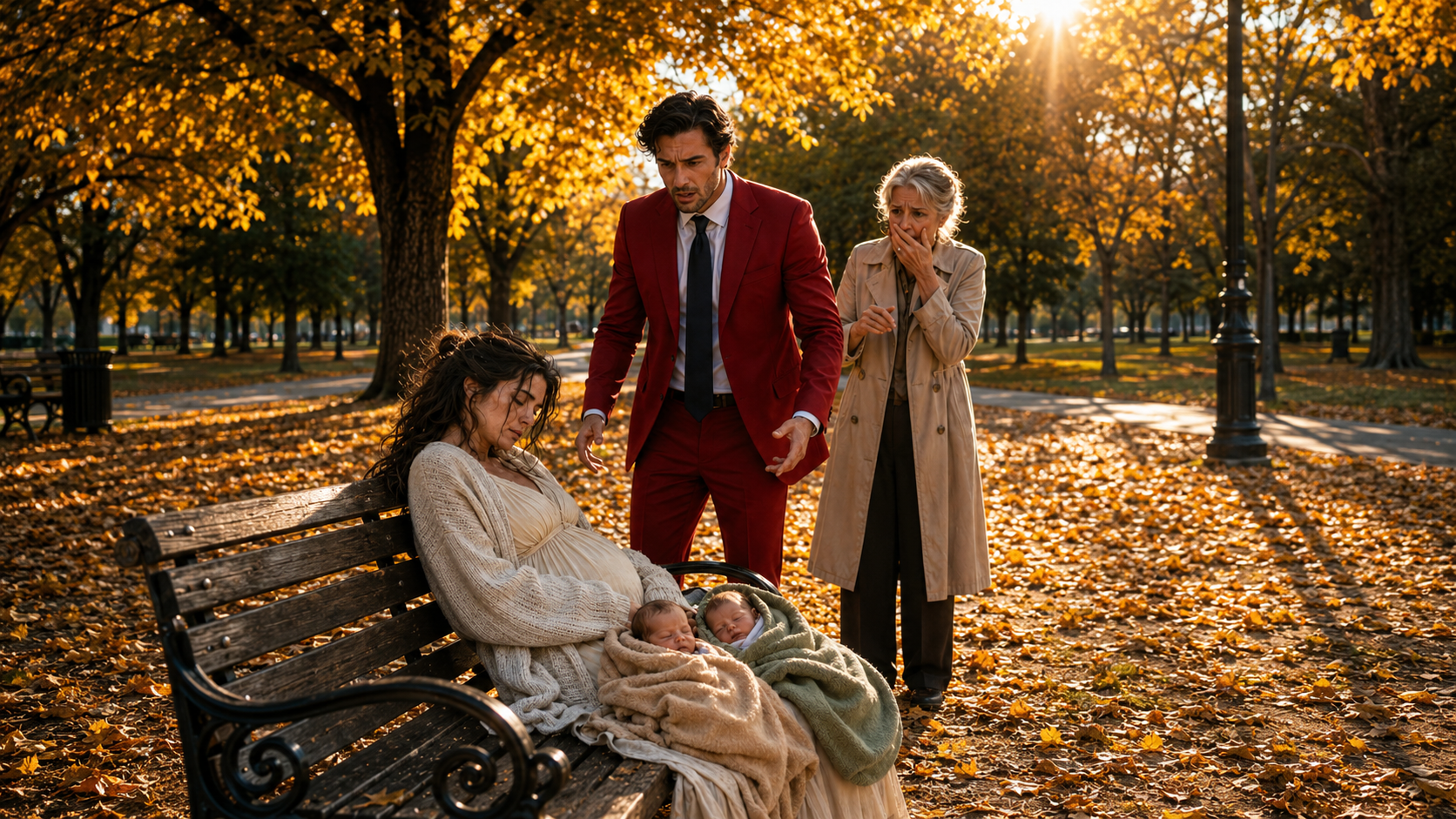
Then, on a quiet autumn afternoon, I found her asleep on a park bench with two infant babies beside her.
You May Also Like




One was wrapped in yellow.
The other in green.
They were tiny.
Cold.
Hungry.
And when one of them opened his eyes, I stopped breathing.
He had my eyes.
My mother saw it too.
Her hand flew to her mouth.
Claire looked away, and in that one second, I knew she had been carrying a secret alone for a very long time.
“Claire,” I whispered. “Tell me the truth.”
Her voice broke.
“I tried, Ethan.”
“Then why didn’t I know?”
She looked past me.
At my mother.
And said the sentence that destroyed everything I believed:
“Because she made sure you never found out.”
The Story
I thought my ex-wife had disappeared from my life forever.
Then, on a quiet autumn afternoon, I found her asleep on a park bench with two infant babies beside her.
And what I discovered in the next few minutes shattered every assumption I had made about the past year.
My name is Ethan Carter.
Until that day, I believed my life was finally under control.
Success had come quickly.
My business was thriving.
My investments were growing.
The small apartment where Claire and I had once struggled to pay rent had been replaced by a sprawling estate outside Cleveland, Ohio.
From the outside, everything looked perfect.
The house.
The cars.
The boardroom meetings.
The clients who shook my hand and called me brilliant.
But perfection has a way of hiding unfinished stories.
And mine was waiting for me on an old wooden bench in Riverton Park.
That afternoon, I was walking with my mother, Margaret Carter.
The air carried the crisp scent of fallen leaves. Golden sunlight filtered through thinning trees, casting long shadows across the winding paths. Joggers passed occasionally. Children played near a distant fountain. Somewhere nearby, a dog barked, and an old man tossed bread crumbs to pigeons.
It should have been peaceful.
Then I saw her.
At first, I thought I was mistaken.
The woman on the bench looked too thin.
Too tired.
Too broken by weather and worry to be the same woman who once danced barefoot in our kitchen while pasta boiled over on the stove.
But with every step, the truth became harder to deny.
It was Claire.
Claire Carter.
Claire Bennett now, I reminded myself.
My ex-wife.
The woman I had not seen in over a year.
The woman I once believed I would spend the rest of my life with.
I stopped walking.
My mother immediately noticed.
“Ethan?” she asked. “What’s wrong?”
I couldn’t answer.
All I could see was the bench.
Claire slept awkwardly against the backrest, her head tilted to one side. Strands of brown hair drifted across her face in the wind. Her jacket was far too thin for the October chill. One hand rested protectively over a worn diaper bag.
Something about the sight made my chest tighten.
Then I noticed the babies.
Two tiny bundles beside her.
One wrapped in a pale yellow blanket.
The other wrapped in soft green.
For a moment, my brain refused to process what I was seeing.
Two infants.
Sleeping peacefully.
Tiny faces flushed pink from the cool air.
Tiny hands peeking from beneath their blankets.
My heart began pounding.
Behind me, my mother whispered, “Oh my goodness.”
The sound stirred Claire.
She blinked slowly.
Disoriented at first.
Then her eyes found mine.
Everything in her expression changed.
Not shock.
Not exactly.
More like the fear of a woman whose hiding place had finally been discovered.
“Ethan.”
Her voice was quiet.
Tired.
But not surprised.
I swallowed hard.
“What are you doing here?”
The question came out sharper than I intended.
Then I glanced toward the babies.
“And whose children are those?”
Claire’s hand moved immediately to the baby in the yellow blanket.
Protective.
A mother’s reflex.
“They’re mine,” she said.
My stomach dropped.
The answer somehow felt heavier than I expected.
I stared at the infants.
At their tiny noses.
Their soft blond hair.
The curve of their mouths.
Something about them felt familiar.
Too familiar.
My mother stepped closer.
“Claire,” she said gently, “are you alright?”
Claire hesitated.
Then she offered a small smile that did not reach her eyes.
“We’re managing.”
Managing.
Not fine.
Not well.
Not safe.
Managing.
I remembered the woman who once dreamed of opening a bookstore.
The woman who laughed too loudly during movies.
The woman who believed every problem could be solved with enough patience, coffee, and a list written in blue ink.
Now she looked exhausted.
As if life had been asking more of her than she had left to give.
“Why are you sleeping here?” I asked.
Her gaze dropped.
“Sometimes the babies sleep better outside.”
The answer sounded rehearsed.
Incomplete.
And she knew it.
A long silence followed.
The wind rustled through the trees.
One of the babies shifted slightly beneath the blanket.
Then he opened his eyes.
Bright blue eyes.
My eyes.
I felt the ground disappear beneath me.
My mother noticed it too.
Her hand flew to her mouth.
Claire immediately looked away.
And suddenly every memory from the months before our divorce came rushing back.
The arguments.
The timing.
The unanswered messages.
The things that never quite made sense.
My pulse thundered in my ears.
Slowly, I looked back at Claire.
“Claire,” I said quietly.
She did not answer.
“Tell me the truth.”
For the first time, genuine fear appeared in her eyes.
Not fear of me hurting her.
Fear of what the truth would destroy.
I took one step closer.
“Are they mine?”
Claire closed her eyes.
My mother grabbed my arm.
“Ethan, don’t do this here.”
I pulled away from her.
“Claire.”
A tear slipped down Claire’s cheek.
“Yes,” she whispered.
The park seemed to go silent.
I looked at the babies again.
Two babies.
My babies.
My knees nearly gave out.
“How?” I asked, even though it was the stupidest question in the world.
Claire laughed once, broken and bitter.
“How?”
“You never told me.”
Her face changed.
Something painful moved behind her eyes.
“I tried.”
My mother went still beside me.
I turned slowly.
“What does that mean?”
Claire’s eyes moved to Margaret.
Then back to me.
“I tried to tell you, Ethan.”
My mother’s grip tightened around her handbag.
“Claire, this is not the place.”
Claire’s voice shook.
“No, Margaret. This is exactly the place. Because I have slept in shelters, laundromats, waiting rooms, and parks while your son believed I walked away from him.”
I stared at my mother.
“What is she talking about?”
Mother lifted her chin.
“She is emotional. Look at her, Ethan. Sleeping on a bench with children. Does this look like someone stable?”
Claire flinched.
Something inside me turned cold.
I looked at my ex-wife, then at the two babies.
My babies.
“Don’t speak about her like that,” I said.
Mother blinked.
“Ethan—”
I looked back at Claire.
“What are their names?”
Her lips trembled.
“Oliver and Emma.”
Oliver.
Emma.
Names I had never whispered into a nursery.
Names I had never written on birth certificates.
Names my children had carried without me.
The baby in the green blanket stirred and made a small sound.
Claire reached for her.
“She’s hungry,” Claire whispered.
“Where are you staying?”
She looked away.
“Claire.”
She swallowed.
“Nowhere permanent.”
My chest tightened.
“You’re homeless?”
She looked at the ground.
My mother said sharply, “Ethan, we should go. This is clearly a trap.”
I turned toward her.
“A trap?”
“Yes. She appears in a park with two babies who conveniently look like you after your company makes money.”
Claire’s face went white.
I had heard my mother speak cruelly before.
But never while two infants lay beside the woman she was attacking.
I looked at her like I was seeing her clearly for the first time.
“They’re freezing,” I said.
My mother’s mouth tightened.
“I am thinking of you.”
“No,” I said. “You’re thinking of control.”
Mother’s eyes widened.
Claire whispered, “Please don’t fight.”
I turned back to her.
“We’re not fighting here. We’re getting the babies warm.”
She shook her head.
“No.”
“No?”
Her eyes filled with panic.
“I can’t go with you.”
“Why not?”
She looked at my mother.
“Because last time I trusted your family, I lost everything.”
I took off my coat and wrapped it around Claire’s shoulders before she could refuse.
Then I lifted Oliver carefully.
The moment I held him, something broke open inside me.
He was warm, but not warm enough.
Light.
Too light.
His tiny hand brushed my shirt, and my throat closed.
My son.
My son had been alive in the world for months, and I had not known.
Claire watched me holding him.
Her face twisted with pain.
“You look angry,” she whispered.
“I am.”
She looked down.
“I knew you would be.”
“Not at you.”
Her eyes lifted.
I looked at Oliver.
“I’m angry that I missed this.”
My mother made a small sound behind me.
“Ethan, this is dangerous. You need a paternity test. A lawyer. A plan.”
I looked at her.
“I need a warm car and a pediatrician.”
Claire shook her head.
“I don’t want trouble.”
“You have two infants sleeping in the cold. We’re past avoiding trouble.”
She looked at Emma, then at me.
“Just take me to a clinic. Not your house.”
“My house has heat.”
“Your house has her.”
The words landed hard.
Mother’s face turned red.
“How dare you.”
Claire’s eyes flashed for the first time.
“How dare I? You came to my apartment when I was pregnant and told me if I loved Ethan, I would let him go.”
My blood went cold.
Mother said quickly, “That is not true.”
Claire sat straighter.
“You told me his business would collapse if I distracted him. You told me he had finally become the man he was meant to be, and I was the anchor pulling him back.”
I stared at my mother.
“You went to her apartment?”
Mother’s mouth tightened.
“I was trying to protect you.”
Claire laughed bitterly.
“You offered me money.”
My heart dropped.
“How much?”
Claire looked at me.
“Fifty thousand dollars to leave quietly and never contact you.”
I turned to my mother.
“Tell me she’s lying.”
Mother looked away.
That was enough.
Claire continued.
“I didn’t take it. I told her I was pregnant.”
My voice became barely audible.
“You knew?”
My mother’s eyes filled, but not with guilt.
With frustration at being cornered.
“She said she was pregnant. Women say things when they want to trap successful men.”
I took one step back.
The park blurred.
Claire’s voice shook.
“She asked for proof. I gave her the ultrasound photo. She put it in her purse.”
My lungs refused to work.
“Mom.”
“She was going to ruin you,” Margaret snapped. “You were finally building something. You had investors. Contracts. People believed in you. And she was always so needy. Always crying. Always asking for more time, more attention, more understanding.”
Claire lowered her head.
I saw her shoulders tremble beneath my coat.
I remembered the last months of our marriage.
Claire crying.
Me working late.
My mother telling me Claire was resentful of my success.
Messages from Claire that seemed cold and strange.
Signed divorce papers that arrived through an attorney.
No final conversation.
No explanation.
I looked at Claire.
“Why didn’t you call me after that?”
She wiped her face.
“I did.”
I froze.
“What?”
“I called. I emailed. I texted. Everything bounced back. Your number changed. Your assistant said you were unavailable. Your lawyer told mine all communication had to go through them.”
I turned to my mother.
Mother’s face went pale.
“What did you do?”
She lifted her chin.
“I did what you were too weak to do. I removed a distraction.”
For a moment, I could not speak.
Claire quietly said, “She didn’t just remove me, Ethan. She erased me.”
We took them to the hospital.
Claire resisted until Emma started crying harder.
Then she stopped fighting.
The emergency pediatric doctor checked both babies.
Mild dehydration.
Cold exposure.
Underweight.
No immediate life-threatening condition, thank God, but they needed care, nutrition, rest, and follow-up.
Claire sat in a chair, rocking Emma while I stood by the wall holding Oliver.
My mother was not allowed in the room.
I had told security she was not to be near Claire or the babies.
Saying those words felt like cutting through bone.
But I said them.
A nurse brought Claire soup and crackers.
Claire stared at the tray.
“When did you last eat?” the nurse asked.
Claire smiled weakly.
“This morning.”
The nurse looked at her.
“Something real?”
Claire did not answer.
The nurse said gently, “I’ll bring more.”
After she left, Claire whispered, “You don’t have to stay.”
I looked at her.
“Don’t say that.”
“It’s true.”
“No, Claire. Nothing about this is that simple.”
She stared at Emma.
“You have a life.”
“I have children.”
Her eyes closed.
“You say that now.”
I deserved that.
I sat carefully across from her.
“Tell me everything.”
She shook her head.
“You don’t want everything.”
“I need it.”
She looked at me.
“Fine.”
Her voice was quiet, but every word cut.
“The divorce papers came after your mother told me you didn’t want to see me. She said you had already moved on. She said you thought the baby was another manipulation.”
I swallowed.
“I never said that.”
“I know that now. But at the time, you had stopped answering.”
“I didn’t stop. I thought you did.”
Claire nodded.
“Your mother gave me an attorney’s card. He told me fighting would be expensive and humiliating. He said if I claimed pregnancy, your legal team would demand tests and accuse me of fraud.”
My hands tightened around Oliver’s blanket.
“I didn’t have a legal team.”
“You had a mother.”
That silenced me.
Claire continued.
“I was tired. Sick. Alone. My rent was late because I had missed work from the pregnancy. Then my boss let me go.”
“Why didn’t your family help?”
She looked down.
“My father had remarried and moved away. My mother died when I was twenty. You know that.”
I did.
And I had forgotten the weight of it.
Or maybe I had let success make me careless with other people’s loneliness.
“I went to a shelter when I was six months pregnant,” she said. “Then a church program helped me until the twins were born.”
“Twins,” I whispered.
She nodded, eyes filling.
“I found out at the second ultrasound. A boy and a girl.”
I looked at Oliver.
“What was that like?”
A tiny smile appeared through her exhaustion.
“Terrifying. Beautiful. I cried in the grocery store parking lot because I had two coupons for diapers and thought that was God being funny.”
I almost smiled.
Then she continued.
“They came early. Small, but strong. I named them Oliver and Emma because I wanted names that sounded like children who would one day sit in warm rooms and read books.”
That broke me.
Not loudly.
Quietly.
Deeply.
The woman I had loved had been naming our children with hope while I was signing contracts and believing lies.
I whispered, “I’m sorry.”
Claire looked at me.
“You didn’t know.”
“I should have.”
Her face hardened.
“Yes. You should have.”
I accepted it.
No defense.
No excuse.
Then the door opened.
A hospital social worker entered.
“Ms. Bennett? Mr. Carter? We need to discuss safe placement for the babies tonight.”
Claire’s body went rigid.
“No. Please don’t take them.”
The social worker softened.
“That is not what I said.”
Claire hugged Emma closer.
“I’m a good mother.”
“I can see that,” the woman said gently. “But you need a safe place to sleep tonight.”
Claire looked at me.
Then away.
I said, “They can stay with me.”
Claire shook her head immediately.
“No.”
I leaned forward.
“Claire—”
“No. I won’t have your mother anywhere near them.”
“She won’t be.”
“You can’t promise that.”
I looked her in the eyes.
“Yes, I can.”
She searched my face.
“You have never chosen me over her.”
There it was.
The truth I had earned.
I set Oliver gently in the bassinet and took out my phone.
“What are you doing?” Claire asked.
“Choosing.”
I called my mother.
She answered immediately.
“Ethan, finally. This woman is manipulating you. You need to come out here and—”
“Mother.”
She stopped.
I had never called her Mother in that tone before.
“You are not coming to my house. You are not contacting Claire. You are not contacting anyone about these children. You will send me every document, message, email, attorney contact, and payment record connected to Claire by tomorrow morning.”
Silence.
Then she laughed.
“You sound ridiculous.”
“I’m not finished.”
Claire stared at me.
I continued.
“If you approach Claire or the babies, I will file for a protective order. If you destroyed evidence, I will pursue it legally. If you interfered with my marriage, my divorce, or my knowledge of my children, I will make sure the truth is documented in court.”
My mother’s voice turned icy.
“After everything I sacrificed for you?”
“You sacrificed my family to keep control.”
“You don’t mean that.”
“I do.”
Her voice cracked then.
“You would choose her over your own mother?”
I looked at Claire.
At Emma.
At Oliver.
“No,” I said. “I’m choosing the truth over the lie you made me live.”
Then I ended the call.
Claire stared at me like she did not know whether to believe what she had just heard.
Neither did I.
But it was done.
The first door had closed.
That night, Claire and the twins stayed in a family suite arranged through the hospital’s emergency housing partner.
I offered my house again.
Claire refused again.
This time, I did not push.
Trust cannot be demanded just because truth arrives late.
I stayed in the hallway until the nurse told me visiting hours were over.
Before I left, I asked Claire, “Can I come back tomorrow?”
She looked tired.
Suspicious.
Sad.
“You can see them.”
“And you?”
She looked down.
“I don’t know.”
That answer hurt.
But it was honest.
“I’ll take it,” I said.
The next morning, I called my attorney.
Not the one my mother had used.
A new one.
Maya Ortiz.
Brilliant, blunt, and immune to rich men’s panic.
After I explained everything, she said, “First, do not try to solve this with money.”
“I wasn’t—”
“You were about to.”
I closed my mouth.
She continued.
“Claire has been homeless with infants. If you arrive with a mansion, a trust fund, and guilt, it may feel like help to you and pressure to her.”
I rubbed my forehead.
“What do I do?”
“Establish paternity properly. Offer support in writing. Secure independent counsel for her, paid through a neutral account, not controlled by you. Document your mother’s interference. Do not threaten. Do not perform. Do not turn this into a rescue fantasy.”
I almost laughed.
“You don’t soften anything.”
“That is why you called me.”
“What about my mother?”
“Preserve evidence. Cut access. Check whether she interfered with legal communications. Also check your divorce file.”
“My divorce file?”
“Yes. Men who get manipulated by mothers often miss paperwork.”
That sentence annoyed me.
Because it sounded true.
I ordered the file.
By noon, I understood why Maya had told me to check.
The divorce petition had included a statement I had never written.
A claim that I did not believe Claire’s pregnancy, if any, was mine.
My electronic signature was attached.
My stomach turned.
I called Maya.
“I didn’t sign this.”
“I thought you might say that.”
“My mother had access to my business e-signature at the time.”
“Then we have a problem.”
“No,” I said, looking at the file. “She does.”
My mother did not send the documents by morning.
Instead, she came to my house.
I saw her through the security camera.
She stood at the front door wearing pearls, a camel coat, and the wounded expression she had used my entire life whenever she wanted me to feel cruel for having boundaries.
I did not open the door.
I spoke through the intercom.
“You need to leave.”
She stared at the camera.
“This is humiliating.”
“Yes,” I said. “I imagine being locked out of someone’s life is unpleasant.”
Her face tightened.
“You think she’s innocent? You don’t know what Claire did.”
“What did she do?”
“She made you weak.”
“That is not a crime.”
“She would have taken everything.”
“She had nothing.”
“She had you.”
The honesty slipped out before my mother could dress it.
There it was.
Not concern.
Possession.
I stepped closer to the screen.
“Is that what this was? You couldn’t stand that I loved someone besides you?”
Mother’s eyes filled.
“I built you.”
“No,” I said. “You raised me. There’s a difference.”
She flinched.
“I gave up my life after your father died.”
“And I loved you for it. But you turned sacrifice into debt.”
She pressed one hand against the door.
“Ethan, let me in.”
“No.”
“I am your mother.”
“And Oliver and Emma are my children.”
She went still.
I continued.
“You knew they existed.”
Her mouth trembled.
“She could have lied.”
“You saw the ultrasound.”
“She could have—”
“Stop.”
She did.
For once.
“You will send the documents,” I said. “You will not contact Claire. You will not go to the hospital. You will not approach those babies.”
Her face hardened.
“You’ll regret this when she ruins you.”
I looked at her through the camera.
“She already lost everything and still kept my children alive. You had everything and used it to bury them. I know who I trust.”
Mother stepped back like I had slapped her.
Then she turned and left.
For the first time in my life, I watched her walk away without following.
The truth came out in pieces.
First, the emails.
My mother had contacted Claire’s employer during the divorce and implied Claire was unstable, distracted, and involved in a messy legal dispute.
Claire lost her job two weeks later.
Then the attorney records.
The lawyer who represented Claire had been recommended and quietly paid through a trust linked to my mother.
He had encouraged Claire to accept “no contest” terms and discouraged pregnancy claims unless she could afford litigation.
Then the phone records.
My number had been changed during a business security upgrade.
My mother had access to the transition.
Claire’s messages had gone to an old device in my mother’s office for eleven days before the line was shut down.
Then the letters.
Actual letters.
Claire had sent three.
One to my house.
One to my office.
One to my mother’s home, begging her to let me know about the pregnancy.
My mother had kept all three.
Maya found them in a scan attached to an email my mother sent her private advisor.
The subject line was:
Disposal of sensitive personal correspondence
I sat in Maya’s office holding copies of those letters, unable to breathe.
Claire’s handwriting was still the same.
Soft, slanted, careful.
Ethan, I know you are angry, but I need you to hear this from me. I am pregnant. I am not asking for anything except a conversation. If you want a test, I will agree. But please do not let this become another silence between us.
The second letter:
I had an ultrasound today. There are two babies. Twins. I cried in the parking lot because I wanted to tell you first. I don’t know what you believe about me anymore, but I loved you. I still don’t understand how we became strangers.
The third:
I am scared. Your mother came again. She said you told her I was trying to trap you. I don’t believe you said that, but I don’t know how to reach you. Please, Ethan. Please answer.
I bent over the table and sobbed.
Maya quietly closed the office door.
When I could speak, I said, “I need to show Claire.”
Maya nodded.
“Yes. But remember, your grief is not her responsibility.”
That stopped me.
She was right.
My pain was real.
But Claire had already carried too much of it.
I showed Claire the letters two days later.
We met in a private family room at the hospital housing center.
The twins slept in side-by-side bassinets.
Claire sat across from me with her arms folded.
She looked stronger than the first day in the park.
Still tired.
Still cautious.
But stronger.
I placed the copies on the table.
Her face changed as soon as she saw her own handwriting.
“Where did you get those?”
“Maya found them.”
She touched the first letter with shaking fingers.
“I thought you ignored them.”
“I never saw them.”
Her eyes filled.
“I begged you.”
“I know.”
“I wrote until I felt stupid.”
I swallowed.
“I know.”
She pressed her hand to her mouth.
“For a year, I thought you knew and didn’t care.”
“For a year, I thought you left because success made me unbearable.”
She looked at me.
“Did it?”
The question hit hard.
I deserved it.
“Some of it did,” I said.
Claire blinked.
I continued.
“I became proud. Busy. Too easily impressed with myself. I let my mother tell me ambition required distance from anyone who needed me emotionally. I didn’t protect our marriage.”
Her eyes searched mine.
“That’s the first honest thing you’ve said.”
“I’m trying to make it not the last.”
Claire looked down at the letters.
“Your mother did this.”
“Yes.”
“But you let her have the space to do it.”
I closed my eyes.
“Yes.”
She cried then.
Not loudly.
Just tears falling onto the letter she had written months pregnant and alone.
I wanted to hold her.
I did not.
Instead, I said, “What do you need from me?”
She laughed weakly.
“That question would have saved us a year ago.”
“I know.”
She wiped her face.
“I need safe housing. Not your mansion. Not your mother’s world. Something stable for the babies.”
“Done.”
“And don’t say done like you’re buying a car.”
I almost smiled.
“Okay.”
“I need a lawyer who is not secretly controlled by your family.”
“Maya arranged independent counsel. I’ll fund it through a neutral account. You choose whether to use it.”
She studied me.
“I need paternity done legally.”
“Yes.”
“I need you to understand that being their father doesn’t make you my husband again.”
That one hurt.
“I understand.”
“Do you?”
“I’m trying to.”
She nodded slowly.
“And I need time.”
“How much?”
Her eyes met mine.
“As much as I say.”
I nodded.
“Then that’s what you’ll have.”
Oliver stirred in his bassinet.
Claire stood immediately.
But I was closer.
I looked at her.
“May I?”
She hesitated.
Then nodded.
I lifted him carefully.
He made a tiny grunting sound, then settled against my chest.
Claire watched us.
Her face softened and broke at the same time.
“He likes heartbeat sounds,” she whispered.
I looked down at my son.
“Then I’ll stay steady.”
Paternity results came back exactly as everyone already knew.
Oliver and Emma were mine.
Seeing it in writing still changed me.
Not because I needed proof.
Because paper had been used to erase them, and now paper confirmed what my body knew the moment I saw Oliver’s eyes.
I began visiting every day.
At first, only in public spaces.
Then in Claire’s temporary apartment.
Then pediatric appointments.
Then grocery runs.
Then late-night pharmacy trips when Emma developed reflux and Claire cried because she thought she was failing.
“You’re not failing,” I said, standing in the pharmacy aisle holding three different bottles of infant medicine.
“She cries all night.”
“She’s a baby.”
“I should know what to do.”
“No one knows what to do at 2 a.m. with a screaming baby. That’s why pharmacies have fluorescent lighting and exhausted parents.”
Claire almost smiled.
“Was that a joke?”
“A weak one.”
“Very weak.”
“I’ll improve.”
“You should.”
Small things returned first.
Not love.
Not trust.
Small things.
A shared laugh.
A look over the twins’ heads.
A conversation that did not bleed.
One afternoon, I arrived to find Claire asleep on the couch, both babies finally sleeping in their bassinets.
For a moment, I just stood there.
Not in a park.
Not in the cold.
Not with fear crushing my chest.
A warm room.
Two safe babies.
Claire resting.
I covered her gently with a blanket and washed the bottles in the sink.
When she woke, she found me folding laundry.
Badly.
She leaned against the doorway.
“You fold like a man trying to apologize through fabric.”
I looked down at the tiny onesie in my hand.
“Is it working?”
“No.”
I nodded.
“Fair.”
She took the onesie and folded it properly.
Then handed me another.
“Try again.”
That felt like more than laundry.
So I did.
My mother fought back.
Of course she did.
She hired an attorney and claimed Claire was manipulating me for money.
She said I was emotionally compromised.
She said I was being isolated from family.
She said she had only been trying to protect me from fraud.
Then Maya filed the letters.
The altered divorce documents.
The payment records.
The attorney connection.
The phone interference.
The ultrasound photo my mother had kept.
The narrative shifted quickly.
My mother’s attorney stopped giving dramatic statements.
Then came the hearing over document fraud and interference.
I sat on one side of the courtroom.
Claire sat beside her attorney across the aisle.
Not beside me.
That mattered.
She was not there as my rescued ex-wife.
She was there as the woman my family had harmed.
Mother entered wearing navy and pearls.
She looked dignified.
Victimized.
Almost convincing.
When she saw me, her eyes filled with tears.
I looked away.
The judge reviewed the documents.
Maya spoke clearly.
“Margaret Carter knowingly interfered with communication between Ethan Carter and Claire Bennett during divorce proceedings, retained correspondence regarding a pregnancy, helped facilitate representation that discouraged Ms. Bennett’s claims, and appears to have used electronic access to attach Mr. Carter’s signature to a statement he denies authorizing.”
Mother’s attorney objected to half of it.
The judge allowed enough.
Then Claire testified.
My mother stared at her with cold hatred.
Claire did not look away.
“Mrs. Carter came to my apartment,” Claire said. “She told me Ethan didn’t want me anymore. She offered me money to disappear. When I said I was pregnant, she asked for proof. I gave her the ultrasound photo because I thought maybe she would tell him.”
Her voice shook.
“She told me babies do not fix failed marriages.”
Mother whispered, “That’s not what I meant.”
The judge warned her.
Claire continued.
“She said if I fought, Ethan would hate me. She said rich men always win custody battles eventually. I believed her because I had no money and no family nearby.”
I lowered my head.
Then it was my turn.
I testified that I had never seen the letters.
Never authorized the divorce statement.
Never knew about the pregnancy.
Never asked my mother to intervene.
My mother cried silently while I spoke.
For once, I did not rescue her from the consequences of her own behavior.
When the judge ordered further investigation, document preservation, and temporary restrictions preventing my mother from contacting Claire or the twins, Margaret finally turned to me.
“Ethan,” she whispered.
I looked at her.
“Please.”
The little boy in me heard it.
The man holding two infant hospital bracelets in his pocket did not move.
The twins grew stronger.
So did Claire.
She moved into a townhouse near Lakewood, close enough for me to visit, far enough from my mother’s world that she could breathe.
I helped with rent through a formal support agreement.
Not because Claire couldn’t manage.
Because they were my children too.
She reopened the dream slowly.
The bookstore.
At first, it sounded impossible.
Then she started volunteering at the library.
Then organizing donated books for shelters.
Then hosting a story hour for single mothers and children at a community center.
She called it Benchlight Stories.
I knew why.
She never explained it.
One evening, after story hour, I arrived to help pack chairs.
Emma slept against my shoulder.
Oliver was chewing on the corner of a board book.
Claire watched a little girl choose a picture book from the donation table.
“She reminds me of me,” Claire said.
“The little girl?”
“No. Her mother.”
I looked over.
A tired young woman stood near the door, counting coins in her palm before checking the bus schedule.
Claire walked over and handed her a transit card from the supply box.
The woman began to cry.
Claire hugged her.
When she came back, I said, “You’re good at this.”
She smiled sadly.
“I know what it feels like to need help but fear the price.”
I nodded.
“I’m sorry I made help feel dangerous.”
She looked at me.
“You did.”
“I know.”
“But you’re learning.”
That was more than I deserved.
I took it carefully.
A year after the park, Oliver and Emma turned one.
We held the birthday party in a small community hall.
Not my estate.
Claire refused that.
I understood.
There were balloons.
Cupcakes.
A banner that said:
Happy Birthday Oliver & Emma
Oliver destroyed his cupcake immediately.
Emma studied hers like she suspected it of fraud.
Claire laughed until tears formed.
I watched her from across the room.
This was the woman I had once lost.
Not because she disappeared.
Because I let other people narrate her absence.
My mother was not invited.
She sent gifts.
Claire did not open them.
I returned them with a note drafted by her attorney:
No contact means no contact.
After the party, when everyone left, Claire and I stayed behind cleaning frosting from the floor.
She looked tired but happy.
“You’re staring,” she said.
“Sorry.”
“What?”
“I was just thinking how different this could have been.”
She stacked paper plates.
“It was different.”
“I know.”
“We don’t get that year back, Ethan.”
The words were not cruel.
They were true.
I nodded.
“No, we don’t.”
She looked at the twins crawling under a table.
“But we get this one.”
I looked at her.
Something soft moved between us.
Not forgiveness fully.
Not love declared.
But the possibility of a future not entirely buried by the past.
I said, “I’ll be careful with it.”
She nodded.
“Good.”
Two years after the park, my mother pleaded guilty to document-related charges tied to the forged statement and legal interference.
The consequences were not as dramatic as some people expected.
No movie-style collapse.
No screaming in court.
But her reputation changed.
Her access to me ended.
Her control ended.
That mattered more.
At sentencing, she asked to speak.
The judge allowed it.
Mother stood, thinner now, no pearls.
She looked toward me.
“I loved my son,” she said.
My jaw tightened.
“I thought I was protecting him from a woman who would take him away from me.”
Claire sat beside her attorney across the aisle.
Still not beside me.
Still her own person.
Mother continued.
“I see now that I was wrong.”
For a moment, I almost believed she understood.
Then she added:
“But Claire could have handled things differently too.”
There it was.
The poison still alive under the apology.
I closed my eyes.
Claire did not react.
The judge did.
“Mrs. Carter,” he said, “this court is not here to evaluate how a pregnant woman with limited resources should have responded to your interference. It is here to address your actions.”
Mother’s face flushed.
I looked at Claire.
She was calm.
Later, outside the courthouse, I asked her, “Are you okay?”
She adjusted Emma on her hip.
“Yes.”
“That didn’t upset you?”
“It did.”
“You don’t look upset.”
She smiled faintly.
“I’m learning not every feeling needs to be handed to the person who caused it.”
I loved her in that moment.
Quietly.
Painfully.
But I did not say it.
Not yet.
Some words should wait until they are no longer asking for reward.
Three years after the park, Claire opened her bookstore.
Not big.
Not fancy.
A small corner shop with blue-painted shelves, a children’s rug, a coffee counter, and a little brass plaque near the door:
Benchlight Books — For stories that find us when we think we are lost.
Oliver and Emma cut the ribbon with safety scissors and enormous seriousness.
Claire wore a green dress.
Her hair was pinned back.
She looked beautiful.
Not because life had become easy.
Because she had become steady.
After the opening, when the crowd thinned, I found her standing near the front window.
“You did it,” I said.
She looked around the shop.
“We did a lot of it.”
“No,” I said gently. “You did this.”
She looked at me.
That mattered.
I could see it.
I had spent years letting my mother take over Claire’s story.
I would not take over her victory too.
She smiled.
“Thank you.”
Oliver ran past us shouting, “I own the dinosaur books!”
Emma shouted back, “No, we share!”
Claire laughed.
Then she looked at me.
“Do you ever think about the bench?”
“Every day.”
“Me too.”
“I hate that you were there.”
“I do too.”
“But if I hadn’t seen you…”
She nodded.
“I know.”
We stood quietly.
Then Claire said, “I was going to leave Cleveland that week.”
My heart stopped.
“What?”
“A church in Michigan had found me a shelter bed. I was going to take the twins and go.”
I could barely breathe.
“That afternoon…”
“Was almost goodbye,” she said.
I looked out the window.
At the street.
At the autumn leaves.
At the children we nearly let become strangers to their father.
“God,” I whispered.
Claire’s voice softened.
“Timing.”
I looked at her.
“I’m grateful for it.”
“So am I.”
Then, after a long pause, she said, “I’m not ready to remarry you.”
The sentence stunned me.
Not because it was a rejection.
Because it meant the thought existed somewhere in the room.
I said carefully, “I didn’t ask.”
“I know.”
“I won’t until you want me to.”
She looked at me.
“That’s new.”
“I’m trying to be.”
She smiled.
“I can see that.”
The long ending came slowly.
Not with one apology.
Not with one hearing.
Not with one birthday party or bookstore opening.
It came in everyday choices.
I showed up.
Not with drama.
With diapers.
Groceries.
School forms.
Doctor appointments.
Late-night fever checks.
Story time.
Laundry.
I learned the twins’ cries.
Oliver’s hungry cry was angry.
Emma’s tired cry sounded personally offended.
I learned Claire liked tea without sugar now.
I learned she hated being called strong when people meant “easy to neglect.”
I learned love was not the same as being needed.
I learned fatherhood was not a feeling that arrived with a paternity test.
It was repetition.
Presence.
Responsibility.
It was Emma falling asleep on my chest while Claire answered bookstore emails.
It was Oliver yelling “Daddy!” from across the playground and running toward me with leaves stuck in his hair.
The first time he did that, I cried in my car afterward.
Claire saw me.
She did not tease.
She just handed me a tissue through the open window.
“Big feelings?” she asked.
I laughed through tears.
“Apparently.”
“Good,” she said. “You missed a lot. Feeling it is fair.”
She was right.
I had missed the first kicks.
The ultrasound.
The births.
The first cries.
The first nights.
The first smiles.
The first thousand exhausted, holy moments that make a parent.
My mother stole some of them.
But I had to admit the harder truth:
I had left the door open for theft.
That truth kept me humble.
And humility, I learned, is where repair begins.
Five years after the park, Oliver and Emma started kindergarten.
Claire and I stood together outside the school while the twins marched in with backpacks bigger than their bodies.
Emma turned around and shouted, “Daddy, don’t cry!”
Oliver added, “Mommy already did!”
Claire gasped.
“I did not.”
Emma yelled, “You cried in the car!”
Claire covered her face.
I laughed.
The twins disappeared inside.
For a moment, we stood in the quiet.
Then Claire reached for my hand.
Fully.
Naturally.
I looked down.
Then at her.
She smiled.
“I think we did okay.”
“We?”
“Yes,” she said. “We.”
That word held more healing than a speech.
I squeezed her hand.
“We did.”
That evening, after school stories and dinner and the twins falling asleep mid-sentence, Claire and I sat on her bookstore floor surrounded by unshelved books.
She pulled an old envelope from a drawer.
“What’s that?” I asked.
“One of the letters. The second one. The twin ultrasound.”
My throat tightened.
She handed it to me.
“I kept the original.”
I touched the paper carefully.
“I’m sorry.”
“I know.”
She looked around the shop.
“For a long time, I thought this letter was proof you didn’t love us.”
I closed my eyes.
“And now?”
“Now I think it’s proof I tried.”
“You did.”
“And proof you didn’t know.”
“I didn’t.”
“And proof that silence can be manufactured.”
I nodded.
She leaned against the bookshelf.
“I don’t want manufactured silence in our life anymore.”
“Neither do I.”
“If we are angry, we say it.”
“Yes.”
“If we are scared, we say it.”
“Yes.”
“If your mother ever contacts you—”
“I tell you.”
She looked at me.
“You don’t hide it to protect my peace.”
“No.”
“You protect peace with truth.”
I smiled faintly.
“That sounds like something from one of your story hours.”
“It’s good, right?”
“It’s very good.”
She laughed softly.
Then the room went quiet.
Claire looked at me for a long time.
“Ethan.”
“Yes?”
“I’m ready for dinner.”
I blinked.
“Dinner?”
“With you.”
My heart began pounding.
“Like… with the kids?”
“No,” she said. “Like two people who used to be married, got destroyed by lies, rebuilt trust one grocery trip at a time, and might want to see what honest love feels like now.”
I stared at her.
She smiled.
“You can breathe.”
I exhaled.
“Yes.”
“Yes, breathe?”
“Yes, dinner.”
She laughed.
And for the first time in years, the sound did not feel like memory.
It felt like tomorrow.
People sometimes ask what happened to my mother.
The truth is simple.
She lives in another state now.
We do not speak.
Not because I hate her.
Hatred would still be a kind of attachment.
We do not speak because she has not become safe.
I send no photos.
No updates.
No school announcements.
No Christmas cards.
Some relatives think that is cruel.
They say, “She’s still your mother.”
I answer, “And Oliver and Emma are still my children.”
That ends most conversations.
Claire once asked me if I was at peace with it.
I thought for a long time.
Then said, “I’m at peace with protecting my family. The grief comes and goes.”
She nodded.
“That’s honest.”
I learned from her that honest is better than clean.
Clean stories hide too much.
Honest stories make room for scars.
And our story has scars.
A park bench.
Unsent letters.
Two babies sleeping in the cold.
A mother who mistook control for love.
A husband who believed the wrong voice.
A wife who carried twins, grief, and hope alone.
But our story also has light.
A baby opening his blue eyes.
A hospital room where truth began.
A townhouse with warm bottles.
A bookstore full of children.
Kindergarten backpacks.
A dinner invitation five years late.
Two people learning that love cannot return to what it was, but sometimes, if truth is strong enough, it can become something better.
I thought my ex-wife had disappeared from my life forever.
But she had not disappeared.
She had been pushed out.
Silenced.
Hidden behind forged documents, stolen letters, and my own pride.
The day I found her on that park bench, I thought I was discovering her secret.
I was wrong.
I was discovering mine.
The secret was not only that Oliver and Emma were my children.
The secret was that I had built a perfect life on an unfinished truth.
And God, in His mercy, let one baby open his eyes at the right moment so I could finally see what my success had made me blind to.
That day, I asked Claire whose children they were.
Now I know the better question.
Not whose blood.
Not whose eyes.
Not whose last name.
The better question is:
Who will show up now?
Every day since, I have tried to answer.
I thought my ex-wife had abandoned me and disappeared. But the day I found her sleeping on a park bench with two babies, I learned she had been erased by my own mother, silenced by stolen letters, and left to raise my twins alone. One baby opened his blue eyes, and in that moment, my perfect life cracked open so the truth could finally breathe.