I Left My Mother to Help My Wife and Newborn — Four Days Later, I Came Home and Found Them Barely Alive
My Mother Said My Wife Was “Exaggerating” After Giving Birth — But When the Doctor Saw the Bruises on Her Wrists, the Truth Destroyed My Family
I came home from a work trip expecting to find my newborn son sleeping safely beside my wife.
Instead, I found my baby burning with fever and my wife barely conscious under dirty blankets.
You May Also Like



My mother stood behind me and said coldly:
“She’s exaggerating.”
Then she added:
“If motherhood hurts her that much, maybe she doesn’t deserve a child.”
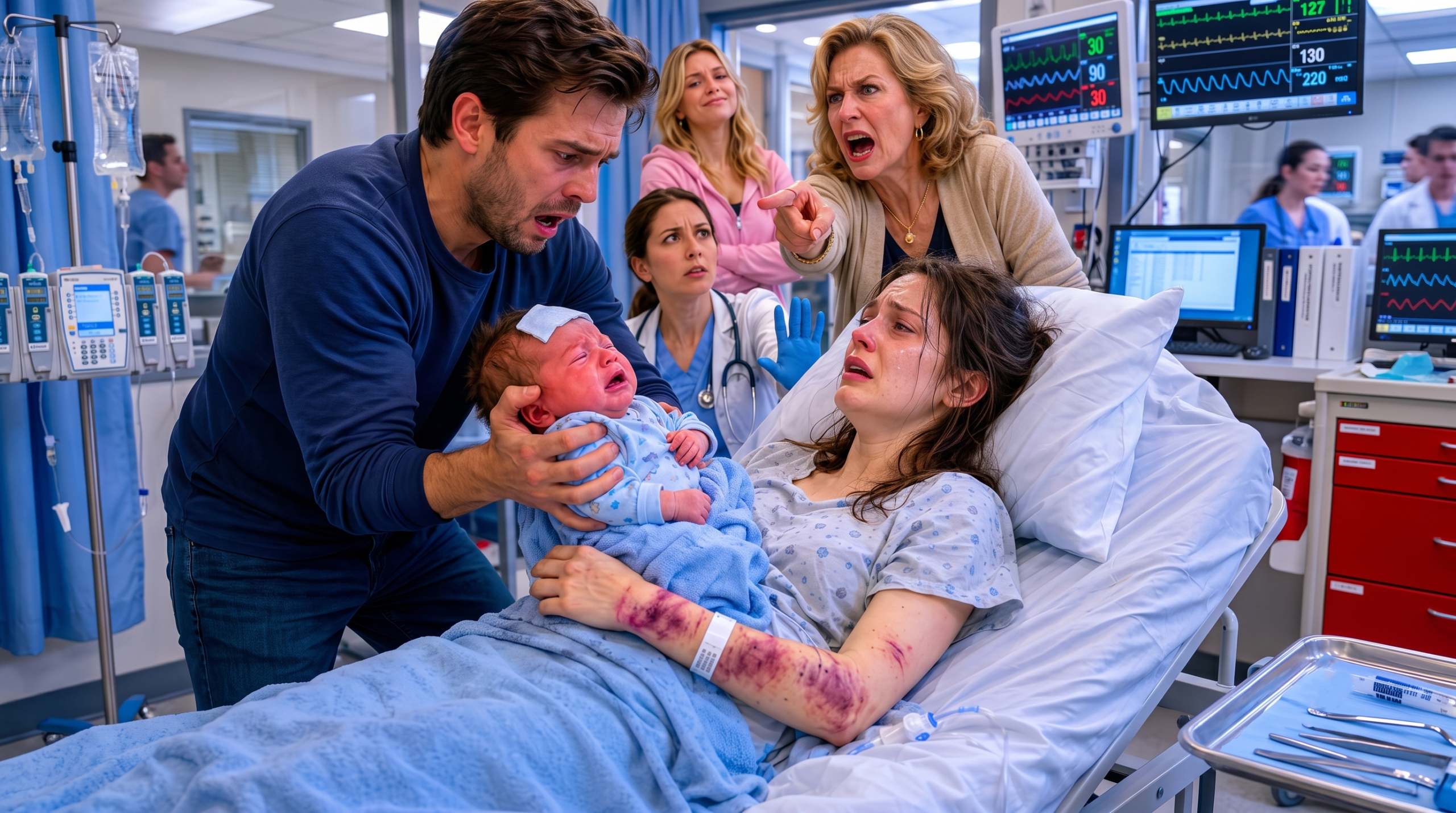
At the hospital, the doctor looked at my wife’s wrists and went silent.
Dark bruises circled both of them.
Then she pulled me aside and said five words that made my stomach drop:
“You need to call the police.”
That was the moment I realized the woman who raised me had almost destroyed the woman who loved me.
And the worst part?
My wife had warned me.
I just didn’t listen.
The Story
The first thing I heard when I opened the bedroom door was my mother’s voice behind me.
“If motherhood hurts her that much,” she scoffed, “then maybe she doesn’t deserve a child.”
I will never forget that sentence.
Not if I live to be a hundred.
Not because it was cruel.
Because she said it while my newborn son was burning with fever and my wife was barely conscious in the bed.
My name is Ethan Carter.
I live in Cedar Rapids, Iowa, and work as a transportation supervisor for a freight company.
Six days earlier, my wife, Hannah, had given birth to our first child.
A son.
Noah.
He was small, red-faced, perfect, and loud enough to make every nurse laugh.
When the doctor placed him on Hannah’s chest, she cried so hard she could barely speak.
“Hi, baby,” she whispered. “I’m your mommy.”
I cried too.
I remember thinking nothing in the world could ever be more important than protecting the two people in that hospital bed.
Then I failed them.
Hannah was still recovering.
Still walking slowly.
Still holding her stomach every time she stood.
Still wincing when she sat down.
Still exhausted in a way I had never understood before.
But she smiled through it.
She kept whispering, “I’m okay.”
She kept telling me, “Don’t worry.”
She kept looking at Noah like every pain in her body was worth it because he was here.
My mother, Diane Carter, hated Hannah from the beginning.
She never said it that simply.
People like my mother rarely do.
She dressed her cruelty in concern.
“Hannah is too emotional.”
“Hannah is controlling.”
“Hannah keeps you away from family.”
“Hannah acts weak because you baby her.”
“She’ll turn your child against us if you let her.”
My younger sister, Brittany, laughed at every insult like it was entertainment.
Every family dinner became a battlefield disguised as conversation.
Hannah would sit beside me, smiling politely while my mother corrected the way she cooked, the way she dressed, the way she spoke, the way she breathed.
And I would say nothing.
Or worse, I would say the sentence that now haunts me.
“Just ignore her. That’s how Mom is.”
That was my cowardice dressed as peace.
The real problem began months before Noah was born.
My mother wanted me to use our savings as a down payment on a house in her name.
“It’s for family,” she kept saying. “Your wife could leave tomorrow, but your mother is your mother forever.”
Hannah refused immediately.
“No,” she said after my mother left one night. “Absolutely not.”
I was tired from work and irritated from the argument.
“Babe, she’s just thinking about stability.”
Hannah stared at me.
“Ethan, she wants our baby’s savings in her name.”
“It would still be family property.”
“No. It would be Diane’s property.”
“She raised me alone.”
“And now she wants to be paid with our child’s future?”
I hated how accurate that sounded.
So instead of listening, I got defensive.
“She’s not some stranger, Hannah.”
Hannah’s eyes filled.
“She treats me like one.”
I sighed.
“Don’t make everything personal.”
She turned away from me then.
Quietly.
That silence should have scared me.
Instead, I told myself she was overreacting.
I still hate myself for that.
When Noah was born, I honestly believed things would improve.
My mother showed up at the hospital carrying flowers and acting like the perfect grandmother.
She kissed Noah’s forehead.
She cried when she held him.
She told the nurse, “That’s my grandson.”
Hannah looked nervous, but she didn’t say anything.
My mother looked at me and smiled.
“See? Family heals everything.”
I wanted to believe her.
Three days later, my boss sent me to Kansas City for an emergency fleet issue.
A major client had trucks down, drivers stranded, and paperwork collapsing.
I didn’t want to leave.
I stood beside Hannah’s hospital bed with my overnight bag in my hand, guilt twisting in my stomach.
“I can tell them no,” I said.
Hannah was pale.
Noah slept beside her in his bassinet.
She opened her mouth, but before she could speak, my mother stepped in.
“Go do your job,” Diane said confidently. “I raised children before. That girl needs to toughen up.”
Brittany stood beside her, scrolling through her phone.
“Stop acting whipped, Ethan. We’ve got this.”
I looked at Hannah.
She didn’t argue.
But her eyes begged me not to go.
I saw it.
I knew what it meant.
And still, I left.
For the next three days, every phone call felt strange.
My mother always answered first.
“She’s sleeping.”
“The baby’s fine.”
“She’s emotional. You know how women get after birth.”
“She cries over everything.”
“She won’t let me help properly.”
At first, I believed her.
Because believing her was easier than facing the fear that I had left my wife with someone who hated her.
Whenever Hannah finally got on the phone, her voice sounded weak and distant.
“Ethan?” she whispered once.
“Hey, babe. How are you? How’s Noah?”
There was a pause.
Too long.
“Please come home soon.”
My chest tightened.
“What’s wrong?”
Before she could answer, my mother’s voice cut in loudly.
“She’s fine, Ethan. Stop feeding the drama.”
“Mom, let me talk to my wife.”
“You are talking to your wife. She just wants attention.”
Hannah whispered something I couldn’t hear.
Then the line went dead.
I called back.
No answer.
I texted Hannah.
No answer.
Then my mother texted from Hannah’s phone:
She fell asleep. Stop worrying.
Something felt wrong.
But I told myself I was tired.
I told myself postpartum emotions were complicated.
I told myself my mother knew what she was doing.
Lies are easiest when they protect you from guilt.
On the fourth day, I finished work early and drove home without telling anyone.
I stopped at Hannah’s favorite bakery and bought cinnamon pastries.
I bought diapers.
A blue blanket for Noah.
A soft bottle of lotion the nurse had recommended.
I remember smiling at the checkout counter, thinking Hannah would be happy I came back early.
Then I reached our house.
The front door was unlocked.
That was the first warning.
Hannah always locked the door.
Inside, the house smelled like spoiled food, dirty laundry, and my mother’s heavy perfume.
The television blared in the living room.
My mother and Brittany were asleep on the couch.
Dirty dishes covered the coffee table.
Soda cans.
Fast-food bags.
Shopping bags from stores Hannah would never waste money on.
Brittany’s feet were on the baby blanket Hannah had washed before we left for the hospital.
Something in me went cold.
“Hannah?” I called.
My mother stirred.
“Oh,” she muttered. “You’re back.”
“Where are they?”
She yawned.
“Bedroom. She’s been dramatic all morning.”
I walked down the hall.
The bedroom door was closed.
My hand hesitated on the knob.
Then I pushed it open.
And my entire world collapsed.
Hannah lay beneath tangled blankets, pale and trembling.
Her lips were cracked.
Her hair stuck to her face.
Her nightgown was stained.
Beside her, Noah cried weakly.
Not the loud newborn cry I remembered from the hospital.
A thin, exhausted sound.
His diaper was filthy.
His skin was burning hot when I touched his forehead.
“Hannah!”
Her eyes barely opened.
For a second, she didn’t seem to know who I was.
Then she whispered:
“They took my phone.”
My mother appeared behind me with an irritated sigh.
“Oh, stop making this dramatic. She’s exhausted, not dying.”
Brittany crossed her arms in the doorway.
“Women give birth every day,” she muttered. “She’s not special.”
I picked up Noah.
His body was hot.
Too hot.
His little face was flushed and dry.
“Hannah, when did he last eat?”
She tried to answer.
Her lips moved, but no sound came out.
My mother scoffed.
“He’s been fed.”
“When?”
“Don’t interrogate me.”
“When, Mom?”
Her face hardened.
“You do not raise your voice at me in your own house.”
“My son is burning up!”
“He has a little fever. Babies get fevers.”
I turned toward Hannah.
“Babe, when did he last eat?”
A tear slipped from her eye.
“She wouldn’t bring him to me.”
Everything inside me stopped.
“What?”
My mother snapped, “That is not true.”
Hannah’s voice was barely a whisper.
“She said I was spoiling him. She said if I was too weak to get him, then I didn’t deserve to feed him.”
I looked at my mother.
She rolled her eyes.
“Postpartum women imagine things.”
Brittany smirked.
“She’s been playing victim since you left.”
Noah whimpered against my chest.
That sound saved my mother from what I almost said next.
I wrapped him in the blue blanket I had just bought and ran to the front door.
“Mr. Coleman!” I shouted toward our neighbor’s house. “Help me!”
Our neighbor, an older retired paramedic, came running from across the lawn before I even finished yelling.
He took one look at Noah and said, “Hospital. Now.”
I turned back.
“Hannah, can you stand?”
She tried.
Her knees buckled.
Mr. Coleman’s wife, Sandra, rushed in behind him.
“Oh my God,” she whispered when she saw Hannah.
My mother stood in the hallway.
“Everyone is overreacting.”
I looked at her.
For the first time in my life, my voice came out like someone I did not recognize.
“Do not speak.”
She blinked.
Brittany said, “Ethan—”
I turned on her.
“You either help or get out of my way.”
She stepped back.
That was the first time I saw fear in her eyes.
Not enough.
But some.
The emergency room became chaos almost immediately.
A nurse took one look at Noah and rushed him through the double doors.
Another nurse brought a wheelchair for Hannah.
I tried to follow Noah.
Then I tried to stay with Hannah.
Then I froze because both my wife and son needed me and I had no idea how to split myself in half.
A doctor in blue scrubs touched my arm.
“Mr. Carter?”
“Yes.”
“We need to assess both of them. Stay where staff directs you.”
“My son—”
“We’re helping him now.”
“My wife—”
“We’re helping her too.”
Helping.
That word broke me.
Because I should have been helping them days ago.
I sat in a plastic chair with my hands covered in Noah’s fever sweat and Hannah’s tears.
Mr. Coleman sat beside me.
He said nothing.
That kindness was worse than judgment.
Twenty minutes later, a doctor came out.
Dr. Elaine Morgan.
Her face was serious in the way doctors become serious when they are trying not to scare you before they must.
“Mr. Carter,” she said carefully, “your wife and son are severely dehydrated.”
My chest tightened painfully.
“How?”
She did not answer immediately.
“We are treating your son’s fever. He is receiving fluids and antibiotics while we determine the source of infection.”
I stood.
“Is he going to be okay?”
“He is very sick, but you got him here in time.”
In time.
Barely in time.
The words punched through me.
“And Hannah?”
“She is weak, dehydrated, showing signs of postpartum complications, and extremely distressed.”
“Can I see her?”
“Yes. But first, I need to ask you something.”
Her eyes moved toward the exam room.
“Did anyone restrain your wife?”
The question made no sense.
“What?”
Dr. Morgan’s face changed.
“Your wife has bruising around both wrists.”
My stomach dropped.
“Bruising?”
She led me into Hannah’s room.
Hannah lay on the bed with an IV in her arm. Her face was turned toward the wall.
The doctor gently lifted one of Hannah’s wrists.
Dark bruises circled it.
Finger marks.
Clear.
Cruel.
Not accidental.
My ears began ringing.
“Hannah,” I whispered.
She did not look at me.
Dr. Morgan’s voice was quiet.
“These injuries didn’t happen accidentally.”
At that exact moment, my mother walked into the room pretending to cry.
“I was only trying to help them,” she said.
Hannah’s entire body began shaking.
Not crying.
Not frustration.
Fear.
Pure fear.
The doctor noticed immediately.
Her expression hardened.
“Ma’am,” Dr. Morgan said sharply, “you need to step outside.”
My mother blinked.
“I’m his mother.”
“And she is my patient.”
“I have a right to—”
“No,” Dr. Morgan said. “You do not.”
Brittany appeared behind my mother.
“This is ridiculous. Hannah is manipulating everyone.”
Hannah made a small sound and curled inward.
Dr. Morgan turned to me.
“Mr. Carter, step into the hallway.”
I followed her, barely breathing.
She looked directly into my eyes and said five words that made my stomach drop.
“You need to call the police.”
I called them.
For the first time in my life, I called the police on my own mother.
My hand shook so badly I nearly dropped the phone.
When the dispatcher answered, I could barely speak.
“My wife and newborn were neglected while I was out of town,” I said. “My wife has bruises. My baby is in the emergency room with a fever. My mother was caring for them.”
The words sounded impossible.
Like something from another man’s life.
Not mine.
Not my mother.
Not Diane Carter, who taught Sunday school when I was ten.
Not the woman who packed my lunches and worked double shifts after my father left.
But love does not erase what someone is capable of.
That was the first lesson of that night.
Two officers arrived at the hospital within fifteen minutes.
Dr. Morgan spoke to them first.
Then Hannah.
Then me.
My mother demanded to be included.
The officers refused.
That made her furious.
“You people have no idea what she’s like,” Diane said loudly in the waiting area. “She plays helpless. She wanted me to wait on her hand and foot.”
Officer Grant looked at her calmly.
“Ma’am, you’ll have a chance to make a statement.”
“I am making one now.”
“No,” he said. “You are interrupting an investigation.”
Brittany jumped in.
“My mom did nothing wrong. Hannah is unstable. She probably hurt herself.”
I turned toward my sister.
“Brittany.”
She rolled her eyes.
“What? Someone has to say it.”
“She has bruises on both wrists.”
“So?”
“So how did they get there?”
Brittany’s face flickered.
It was small.
But I saw it.
Fear.
Guilt.
Knowledge.
My mother spoke before she could.
“She was thrashing around. I had to stop her from hurting the baby.”
The officer wrote that down.
Dr. Morgan’s face did not move.
“Mrs. Carter,” she said, “your daughter-in-law was dehydrated, weak, and postpartum. Your grandson was also severely dehydrated. That is not consistent with someone being properly cared for.”
My mother’s face hardened.
“You doctors always think you know better than family.”
Dr. Morgan looked at her.
“When family causes harm, yes.”
The waiting room went silent.
My mother stared at her like she had been slapped.
I should have felt torn.
I should have wanted to defend her.
Instead, I remembered Hannah whispering:
“They took my phone.”
And something inside me finally understood.
This was not a misunderstanding.
This was not “Mom being Mom.”
This was not family tension.
This was abuse.
And I had left the door open for it.
Hannah gave her statement three hours later.
I was not allowed in the room at first.
She asked for a nurse to stay with her.
That hurt.
But I deserved it.
When the officer finally came out, his face was grim.
Dr. Morgan stood beside him.
“Mr. Carter,” the officer said, “your wife says she wants to speak to you.”
I entered slowly.
Hannah lay in the hospital bed, pale but more awake now.
Her eyes found mine.
For a moment, neither of us spoke.
Then I said the only words that mattered.
“I’m sorry.”
Her eyes filled.
I stepped closer but did not touch her.
“I should have listened.”
A tear slid down her cheek.
“I told you.”
“I know.”
“I told you she hated me.”
“I know.”
“I told you I didn’t feel safe with her.”
“I know.”
Her voice broke.
“And you left me with her.”
The words cut deeper than any scream.
I nodded.
“Yes.”
She stared at me.
I wanted to explain.
Work.
Pressure.
My mother’s manipulation.
My fear of conflict.
But explanations would only make my guilt sound like a defense.
So I said:
“I failed you.”
Hannah closed her eyes.
I continued.
“I failed Noah too.”
Her chin trembled.
“She took my phone after you left.”
I sat in the chair beside the bed.
“Tell me.”
Hannah looked toward the door, afraid.
“She said I was calling you too much. She said I was making you weak.”
My hands curled.
“She kept Noah in the bassinet across the room. When he cried, she said I needed to let him learn. I tried to get up, but I was dizzy.”
Her voice shook.
“On the second day, I asked for water. Brittany laughed and said, ‘Motherhood isn’t a spa.’”
I covered my mouth.
Hannah’s tears came faster.
“Noah kept crying. I told them he needed to nurse. Your mom said I was using him to control everyone. She gave him a bottle, but I don’t know how much. I don’t know if it was clean. I begged her to bring him to me.”
She lifted her wrists slightly.
“I tried to stand. I fell. She grabbed me and pushed me back down. She held my wrists and said if I didn’t stop acting crazy, she would tell you I was dangerous around the baby.”
I bent forward, shaking.
“I’m so sorry.”
Hannah looked at me.
“She took pictures.”
My head snapped up.
“What?”
“Brittany did. She took pictures of the room when it looked messy. She recorded me crying. Your mom said they were proof.”
“Proof of what?”
Hannah whispered, “That I was an unfit mother.”
The room tilted.
That was when the twist began to reveal itself.
This had not just been neglect.
It had been a setup.
The police searched our house that night.
I went with them.
Not because I wanted to.
Because I needed to see what I had allowed.
The bedroom smelled worse than before.
Spoiled milk.
Sweat.
Dirty diapers.
Perfume.
The bassinet sheets were stained.
Noah’s diaper pail was overflowing.
Hannah’s water bottle sat empty on the nightstand, just out of reach from the bed.
Her phone was not in the room.
We found it in my mother’s purse.
Dead.
Hidden beneath a pack of gum and a receipt from a department store.
Officer Grant held it up.
“Is this your wife’s phone?”
“Yes.”
My mother folded her arms.
“She gave it to me.”
I stared at her.
“No, she didn’t.”
Her eyes narrowed.
“You don’t know that.”
“For once, Mom, I do.”
The officers also found printed documents on the kitchen table.
I picked one up before they could stop me.
It was a petition draft.
Emergency guardianship.
My mother’s name.
My sister’s statement.
Allegations that Hannah was unstable, neglectful, and unable to care for Noah.
My vision blurred.
Another page had a list.
Evidence:
- Photos of messy bedroom
- Audio of Hannah crying
- Ethan’s texts showing concern
- Diane’s statement
- Brittany’s statement
- Hospital report if needed
Hospital report.
If needed.
I turned toward my mother.
“What is this?”
For once, she did not answer quickly.
Brittany said, “You weren’t supposed to find that.”
My mother snapped, “Shut up.”
The room went silent.
Officer Grant looked at Brittany.
“What do you mean?”
Brittany’s face went pale.
“I didn’t mean—”
“Yes, you did,” I said. “Say it.”
My mother glared at me.
“Ethan, you are emotional. You need to calm down.”
I laughed once.
It sounded nothing like me.
“You almost killed my son.”
Her face twisted.
“How dare you.”
“You kept him from his mother.”
“I was protecting him.”
“From what?”
“From her weakness!” Diane snapped.
There it was.
Not concern.
Not help.
Judgment.
Hatred.
“She couldn’t even get out of bed,” my mother said. “She cried every hour. She kept asking for you like some spoiled child. A real mother pushes through.”
I stepped closer.
“A real mother feeds a newborn.”
She flinched.
“Don’t speak to me like that.”
“A real mother gives a postpartum woman water.”
“She needed discipline.”
“A real mother doesn’t bruise another woman’s wrists and call it help.”
Brittany whispered, “Mom, stop.”
But my mother was too far gone.
“She was going to ruin you!” Diane shouted. “She already kept you from buying my house. She controls you. She would have taken Noah and made sure I never saw him. I had to show you what she really was.”
I stared at her.
The truth settled slowly.
Coldly.
“You were staging evidence.”
Her mouth closed.
“You wanted me to believe Hannah was unfit.”
Silence.
“You wanted custody.”
My mother looked away.
Brittany started crying.
Not from guilt.
From fear of being caught.
Officer Grant stepped between us.
“Mrs. Carter, I need you to come with me.”
My mother’s face changed.
“What?”
“We have enough to continue this conversation at the station.”
“You can’t arrest me.”
“You are being detained pending investigation.”
She looked at me.
“Ethan.”
For thirty-two years, that voice had worked.
It had made me feel like a bad son.
It had dragged apologies out of me even when I had done nothing wrong.
But that night, I heard Hannah’s weak voice.
They took my phone.
I heard Noah’s thin cry.
I heard my mother say:
Maybe she doesn’t deserve a child.
I stepped back.
Diane’s eyes widened.
“You’re choosing her over your own mother?”
I looked at the officers.
Then at my mother.
“No,” I said. “I’m choosing my wife and son over the woman who hurt them.”
By morning, Noah’s fever began to come down.
Not enough for comfort.
But enough for hope.
Hannah slept for two hours after doctors started treatment.
I sat between her room and the NICU observation area like a ghost.
Every time Noah moved, I stood.
Every time Hannah coughed, I ran.
A nurse finally told me, “Mr. Carter, you need to sit.”
“I can’t.”
“You won’t help them by collapsing.”
I sat.
Then I cried.
Not quietly.
Not like a man in control.
I cried with my head in my hands in a hospital hallway while families walked past pretending not to notice.
Mr. Coleman sat beside me again.
After a while, he said, “You know what the hard part is?”
I wiped my face.
“What?”
“Not discovering evil in strangers.”
I looked at him.
“It’s discovering it in people whose birthdays you know.”
That sentence stayed with me.
Because he was right.
My mother’s cruelty did not erase the lunches she packed.
It did not erase the nights she worked late.
It did not erase the good things she did when I was a child.
But the good things did not erase what she did to Hannah and Noah.
Both were true.
And I had to stop using one truth to cover the other.
Later that morning, Dr. Morgan came to speak with us.
Hannah was awake.
I stood near the door, giving her space.
Dr. Morgan’s voice was firm but kind.
“Noah is responding. We need to monitor him closely, but he is improving.”
Hannah covered her mouth.
I gripped the doorframe.
“Thank God,” I whispered.
Dr. Morgan looked at both of us.
“Your wife needs rest, fluids, and follow-up care. She also needs a safe environment.”
Hannah did not look at me.
I deserved that too.
Dr. Morgan continued.
“I have documented her injuries. Social services will also be involved because of the baby’s condition.”
My stomach tightened.
Hannah looked terrified.
“Are they going to take him?”
“No,” Dr. Morgan said gently. “The concern is not you. The concern is what happened to you both.”
Hannah began crying.
The doctor leaned closer.
“Mrs. Carter, listen to me. You survived something serious. Asking for help does not make you unfit.”
Hannah nodded through tears.
Then Dr. Morgan looked at me.
“Mr. Carter, your role now is not to defend your family of origin. It is to protect the family you created.”
I swallowed.
“Yes, ma’am.”
She held my gaze.
“Protection is not a feeling. It is a boundary with consequences.”
I had never heard a sentence I needed more.
My mother called from the station at noon.
I did not answer.
Then Brittany called.
I did not answer.
Then my uncle called.
Then my aunt.
Then a cousin I hadn’t spoken to in three years.
By evening, my phone was full of messages.
Your mother made a mistake.
Don’t ruin her life.
Hannah is probably confused.
Family should not involve police.
Think of everything your mom sacrificed for you.
I read them all.
Then I wrote one response and sent it to every relative.
My newborn son was hospitalized with fever and dehydration. My postpartum wife was found severely dehydrated with bruises on both wrists. Her phone was hidden. Documents were found showing an attempt to frame her as unfit. This is now a police matter. Do not contact Hannah. Do not defend what happened.
After that, the messages slowed.
Not because everyone understood.
Because facts make gossip heavier to carry.
Two days later, I returned home with officers to collect Hannah’s belongings.
She refused to go back inside.
I did not blame her.
She stayed at the hospital with Noah while I packed.
Her robe.
Noah’s clothes.
The baby book.
The little socks she cried over when we first bought them.
I also packed every gift my mother had brought.
Then I put them in a box by the door.
I did not want them near my son.
In the nursery, I found something I had forgotten.
A small camera above the bookshelf.
The baby monitor.
I had installed it before Noah was born because I wanted to check on him from work.
My hands went cold.
The monitor had been unplugged.
But the device had battery backup.
And cloud storage.
I called Officer Grant.
“I think we have video.”
The baby monitor changed everything.
At first, the footage showed ordinary things.
Hannah feeding Noah.
Hannah changing him slowly.
Hannah wincing when she stood.
Then my mother entered.
The first time, she looked irritated.
“Give him to me,” Diane said.
Hannah held Noah closer.
“He needs to nurse.”
“He needs a grandmother who knows what she’s doing.”
“Diane, please.”
“Don’t start.”
Then the video showed my mother taking Noah from Hannah’s arms.
Hannah tried to stand.
She nearly fell.
Brittany laughed from the doorway.
“Wow. Dramatic.”
The next clip showed Hannah reaching for her phone.
My mother snatched it from her hand.
“You’re not calling Ethan every five minutes.”
“I need help.”
“No. You need to learn.”
Another clip.
Noah crying in the bassinet across the room.
Hannah trying to get out of bed.
Diane pushing her back by the shoulders.
Brittany recording on her phone.
Hannah sobbing:
“Please bring him to me.”
Diane answering:
“If you can’t even reach him, maybe you shouldn’t be trusted with him.”
I had to stop the video.
I ran to the bathroom and vomited.
Officer Grant waited in the hallway until I came back.
“I’m sorry,” he said.
I shook my head.
“Don’t be sorry. Use it.”
He nodded.
“We will.”
But the worst clip came from the last night before I returned.
Hannah was half sitting, half collapsed against the pillows.
Noah cried weakly.
My mother stood over her.
Brittany said, “Mom, maybe we should call someone.”
Diane snapped, “And let her win?”
Brittany lowered her voice.
“He looks really hot.”
Diane looked toward Noah.
Then back at Hannah.
“If he gets sick, that proves she wasn’t caring for him.”
My hands went numb.
Brittany whispered, “What if Ethan finds out?”
My mother’s answer was calm.
“He won’t. He always believes me.”
That sentence destroyed me.
Because she was right.
I had always believed her.
Until belief almost buried my family.
Charges were filed.
Neglect.
Assault.
Interference with emergency communication.
Child endangerment.
False reporting preparation.
Brittany took a deal first.
Cowards often do.
She claimed Mom pressured her.
She claimed she didn’t understand how serious it was.
She claimed she only recorded because Mom told her to.
But under oath, she admitted the plan.
My mother wanted evidence that Hannah was unfit.
She wanted me to divorce Hannah.
She wanted emergency guardianship of Noah “temporarily.”
She wanted access to my savings.
And eventually, she wanted the house in her name.
The house again.
Always the house.
When I heard that, I laughed in the attorney’s office.
Not because it was funny.
Because the whole nightmare had started there.
My mother did not want a home.
She wanted ownership.
Over money.
Over me.
Over Noah.
Over the story.
Hannah sat beside me when the prosecutor explained the case.
Her hands were folded in her lap.
She was stronger now, but still fragile.
Noah slept in the carrier between us, healthy enough to make soft baby noises that felt like miracles.
The prosecutor said, “Mrs. Carter, you may need to testify.”
Hannah swallowed.
“I know.”
I touched her hand.
She let me.
That was new.
Small.
Huge.
“I’ll be with you,” I said.
She looked at me.
“No, Ethan.”
My heart dropped.
“I need you to understand something.”
I nodded.
She continued.
“You can support me. But you cannot speak for me. Not this time.”
I absorbed that.
Then said, “You’re right.”
Her eyes searched mine.
Maybe looking for defensiveness.
For the old Ethan.
The one who said she was overreacting.
But he was gone.
Or at least, I was trying to make sure he never came back.
“I will sit beside you,” I said. “But you tell the truth.”
She nodded.
“Okay.”
That was the first time I felt something like hope.
Not forgiveness.
Not yet.
Hope.
The hearing was harder than I expected.
My mother entered the courtroom wearing a gray dress and a face full of sorrow.
Not guilt.
Sorrow.
There is a difference.
Guilt says, “I hurt someone.”
Sorrow says, “I hate being seen as someone who hurts people.”
She looked at me as if I was the one betraying her.
Brittany sat behind her, pale and quiet.
The prosecutor played the baby monitor footage.
The courtroom heard Hannah begging for her child.
Heard my mother telling her she did not deserve him.
Heard Brittany laughing.
Heard Noah crying.
I stared at the table until my vision blurred.
Then Hannah testified.
She walked to the stand slowly.
Still recovering.
Still afraid.
But when she placed her hand on the Bible and swore to tell the truth, her voice was steady.
The prosecutor asked, “Mrs. Carter, why didn’t you call for help?”
Hannah looked toward my mother.
“Because she took my phone.”
“Why didn’t you leave the room?”
“I tried. I was weak from childbirth. She pushed me back. She told me if I acted unstable, she would make sure I lost my baby.”
My mother shook her head.
The judge saw.
“Mrs. Carter,” he warned Diane, “you will remain still.”
Hannah continued.
“I believed her. Because my husband always believed her too.”
That sentence pierced me.
In open court.
In front of strangers.
And she was right.
My mother’s attorney tried to paint Hannah as fragile and confused.
“Isn’t it true you cried often after giving birth?”
Hannah nodded.
“Yes.”
“Isn’t it true you felt overwhelmed?”
“Yes.”
“Isn’t it possible Mrs. Carter was simply trying to help?”
Hannah looked at him.
“No.”
He paused.
“You’re certain?”
“My baby was crying across the room,” she said. “I begged her to bring him to me. Help does not stand between a mother and a hungry newborn.”
The courtroom went silent.
The attorney sat down sooner than expected.
Then I testified.
I admitted everything.
That Hannah had warned me.
That I dismissed her.
That my mother had pressured us about money.
That I left despite Hannah’s fear.
That my mother controlled the phone calls.
That I came home early and found them in dangerous condition.
My mother began crying while I spoke.
For a moment, the little boy inside me wanted to stop.
To protect her.
To make it easier.
Then I looked at Hannah.
And I kept telling the truth.
When my mother finally spoke, she called it discipline.
She called it concern.
She called it postpartum confusion.
She said Hannah was weak.
She said she had been trying to save Noah from a mother who could not handle him.
The judge listened.
Then asked one question.
“Mrs. Carter, why did you hide Hannah’s phone?”
My mother froze.
Her attorney leaned toward her.
She swallowed.
“She was upsetting Ethan.”
The judge’s face hardened.
“That was not your decision to make.”
For the first time, Diane Carter had no answer.
My mother was convicted.
Brittany received probation, mandatory counseling, and community service after cooperating.
My mother received a longer sentence, supervised release conditions, and a no-contact order protecting Hannah and Noah.
Some relatives said it was too much.
Some said I had let the system destroy my mother.
I learned to stop explaining.
When people asked, “How could you do that to the woman who raised you?” I answered:
“She harmed the woman I married and the child I brought into this world.”
Some understood.
Some didn’t.
That was no longer my burden.
The harder part was rebuilding my marriage.
Because calling the police did not erase my failure.
Saving them late did not cancel leaving them early.
Hannah and I moved into a small rental across town.
A new place.
No memories of that bedroom.
No couch where my mother slept while Noah cried.
No hallway where Brittany laughed.
At first, I slept in the guest room.
Not because Hannah demanded it.
Because trust needs space to breathe.
I woke for every feeding.
Not to prove myself.
Because I was Noah’s father.
I washed bottles.
Tracked medication.
Changed diapers.
Called doctors.
Scheduled therapy.
Took parental leave.
Blocked relatives.
Cooked badly.
Apologized often.
And learned that apologies are not bridges unless behavior walks across them.
One night, three months later, Noah finally slept for four straight hours.
Hannah and I sat on the kitchen floor eating cereal from mugs because we were too tired to wash bowls.
She looked at me and said, “I still get scared when your phone rings.”
I set my mug down.
“Because you think it’s her?”
She nodded.
“Or because I think you’ll answer.”
That hurt.
I deserved it.
“I won’t.”
“You say that now.”
“I know.”
She looked at me.
“I need more than words.”
“I know.”
“What happens when Noah is older and asks about her?”
I breathed in.
“We tell him the truth in a way he can carry. We don’t make her a monster in a fairy tale, but we don’t lie either.”
Hannah looked down.
“She was his grandmother.”
“She lost the right to be safe around him.”
Hannah’s eyes filled.
For once, not from fear.
From relief.
“You mean that?”
“Yes.”
She leaned her head against the cabinet and closed her eyes.
“I wanted you to say that months ago.”
“I should have.”
“Yes.”
“I’m sorry.”
“I know.”
Then, after a long silence, she slid her foot gently against mine.
It was not forgiveness.
But it was contact.
I sat very still, grateful for even that.
A year later, Noah turned one.
We did not throw a big party.
No extended family.
No drama.
Just Hannah, me, Mr. and Mrs. Coleman, Dr. Morgan, and two friends Hannah trusted.
There was a blue cake with uneven frosting because I made it myself.
Noah smashed both hands into it and laughed like destruction was his spiritual gift.
Hannah laughed too.
A real laugh.
The sound filled the kitchen and healed something in me I had no right to demand.
After everyone left, we sat in the living room surrounded by wrapping paper.
Noah crawled across the rug dragging a stuffed giraffe behind him.
Hannah leaned against the couch.
“Do you ever miss her?” she asked.
I knew who she meant.
I thought carefully.
“Yes.”
She looked at me.
“I miss who I thought she was.”
Hannah nodded.
“That makes sense.”
“Do you hate me for that?”
“No,” she said. “Missing someone doesn’t mean they should come back.”
I swallowed.
“I don’t want her back.”
“I believe you.”
Those three words nearly made me cry.
I believe you.
After all the times I had failed to believe her.
I looked at Noah.
“He’ll never be alone with anyone who makes you afraid.”
Hannah’s voice softened.
“Thank you.”
I looked at her.
“I should thank you.”
“For what?”
“For surviving me not listening.”
Her eyes filled.
“I don’t want our story to be only that.”
“It won’t be.”
“What do you want it to be?”
I looked at our son, healthy and loud and covered in blue frosting.
“The story where I finally became the husband you should have had from the beginning.”
She stared at me for a long time.
Then said, “Then keep becoming him.”
“I will.”
Years passed.
Noah grew strong.
Too strong, honestly.
He climbed everything.
Chairs.
Tables.
The back of the couch.
Once, the dog.
He had Hannah’s eyes and my stubborn chin.
When he was four, he asked why he didn’t have a grandma like other kids.
Hannah froze at the kitchen sink.
I dried my hands and knelt in front of him.
“You do have a grandma,” I said. “But she made choices that hurt Mommy and you when you were a baby.”
Noah frowned.
“Did she say sorry?”
I looked at Hannah.
She gave me the smallest nod.
“She said words,” I answered carefully. “But sorry means changing and making things safe. She hasn’t done that in a way we can trust.”
Noah thought about it.
“Is she in timeout?”
Hannah made a sound that was almost a laugh.
I smiled sadly.
“Something like that.”
“Long timeout?”
“Yes, buddy. A long timeout.”
He nodded.
“Can I have crackers?”
And just like that, the conversation ended.
Children can carry truth when adults stop decorating lies.
That night, Hannah stood beside me on the porch.
“You handled that well,” she said.
“I learned from you.”
She looked at me.
“I was afraid you’d soften it.”
“I wanted to.”
“I know.”
“But soft lies become sharp later.”
She reached for my hand.
This time, she held it fully.
Not just a foot against mine.
Not a cautious touch.
Her hand in mine.
Warm.
Sure.
Still healing, but real.
Five years after that hospital night, Dr. Morgan invited Hannah to speak at a maternal health support event.
Hannah almost said no.
“I’m not a speaker,” she told me.
“You don’t have to be.”
“I don’t want people looking at me like I’m tragic.”
“Then don’t tell a tragic story.”
She looked at me.
“Tell them what?”
“The truth.”
She stood in front of a small room of nurses, social workers, new mothers, and family advocates.
Her hands shook at first.
Then she looked at me.
I was standing in the back with Noah, who was holding a toy truck and trying very hard to be quiet.
Hannah began.
“When my son was six days old, I learned that not every person who offers help is safe.”
The room went still.
She told them about the phone.
The dehydration.
The bruises.
The shame.
The way people dismissed her because she had just given birth.
The way “postpartum emotions” became a weapon used against her.
Then she said something I will never forget.
“A new mother does not need to prove she is strong by suffering quietly. She is already strong. She needs water. Food. Sleep. Medical care. Respect. And people who believe her before the emergency room has to.”
Dr. Morgan wiped her eyes.
So did I.
After the talk, a young father approached me in the hallway.
His wife stood nearby holding a tiny baby.
The man looked nervous.
“Your wife’s story…” he said.
I nodded.
He swallowed.
“My mom has been saying my wife is too sensitive. I thought it was normal.”
I looked at him.
“Listen to your wife.”
He nodded quickly.
“I will.”
I touched his shoulder.
“No. Don’t just listen. Act early.”
He looked toward his wife.
Then walked back to her and took the diaper bag from her shoulder.
It was a small thing.
But small things become walls.
Small things become doors.
Small things become safety.
My mother sent letters for years.
At first, I returned them unopened.
Then, after therapy, I read one.
It was full of self-pity.
How hard prison had been.
How lonely she was.
How she had only wanted to help.
How Hannah had misunderstood.
How Noah should know his grandmother.
I folded the letter and put it back in the envelope.
Hannah watched me from across the table.
“What did it say?”
“Nothing we need.”
“Are you okay?”
I thought about it.
“Yes.”
“Do you want to respond?”
“No.”
I walked to the shredder and fed the letter in.
The machine chewed it into thin strips.
For some reason, that sound felt like peace.
Not revenge.
Peace.
Because some doors do not need to be slammed.
Some simply need to stay locked.
The long ending is not dramatic.
There was no final courtroom speech that fixed everything.
No magical apology from my mother.
No perfect version of me who never struggles with guilt.
Real endings are built slowly.
In the middle of the night when your child cries and you get up without resentment.
In the morning when your wife says she is tired and you believe her the first time.
In therapy sessions where you admit that being a “good son” almost made you a terrible husband.
In family holidays spent with people who feel safe, even if the table is smaller.
In teaching your child that love never requires fear.
In learning that boundaries are not cruelty.
They are protection.
Hannah and I are still married.
Not because love magically healed the damage.
Because truth gave love something honest to stand on.
She forgave me slowly.
I earned trust slowly.
Some wounds still ache.
But Noah is healthy.
Hannah laughs again.
Our house is peaceful.
And my mother’s voice no longer decides what peace means.
Sometimes, when I check on Noah at night, I stand in his doorway and listen to him breathe.
I think about the day I came home with pastries, diapers, and a blue blanket.
I think about the unlocked door.
The spoiled smell.
The bedroom.
Hannah’s cracked lips.
Noah’s fever.
My mother saying, “She’s exaggerating.”
And I think about how close I came to losing everything because I confused loyalty with blindness.
If there is one thing I know now, it is this:
The family you come from matters.
But the family you create is your responsibility.
You can love your mother and still stop her.
You can honor your past and still protect your future.
You can be grateful for being raised and still refuse to let the person who raised you destroy your home.
That day, the doctor looked at my wife’s wrists and told me to call the police.
I thought that was the moment my family fell apart.
I was wrong.
That was the moment my real family finally began to survive.
I left my mother to help my wife and newborn because I thought family meant trust. Four days later, I found my son burning with fever, my wife barely conscious, and bruises around her wrists. My mother called it discipline. The doctor called it abuse. And for the first time in my life, I stopped being a loyal son long enough to become the husband and father my family needed.