I Saw Fresh Lash Marks on My Sister’s Back Before Her Wedding — The Next Day, the Groom Met the FBI at the Altar
My Sister Begged Me Not to Cancel Her Wedding After I Saw the Marks on Her Back — So I Let the Ceremony Begin and Destroyed His Family Empire Instead
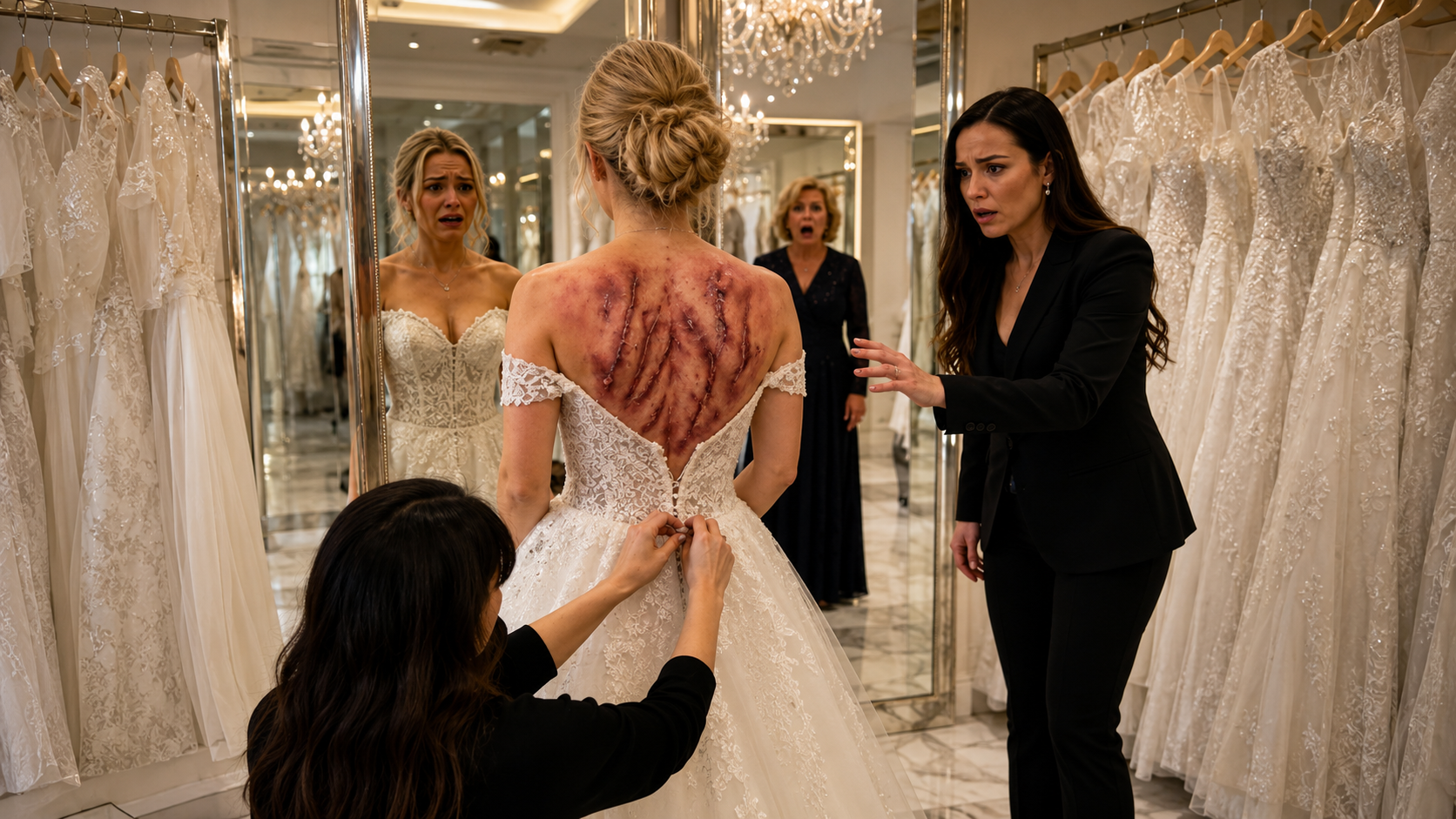
At the bridal boutique, my little sister stepped out to show me her wedding dress.
She looked beautiful.
You May Also Like




Then the seamstress unzipped the back.
And I stopped breathing.
Her entire spine was covered in dark, fresh marks.
My sister grabbed my hands and sobbed:
“If I cancel the wedding, his father will bankrupt Mom and Dad’s company.”
My blood turned cold.
The groom had hurt her.
His father had trapped our family with debt.
And they both believed we were too scared to fight back.
So I kissed my sister’s forehead and whispered:
“Then we won’t cancel the wedding.”
That night, while they slept, I made three phone calls, opened six hidden files, and sent one sealed package to federal investigators.
The next morning, the groom walked down the aisle smiling.
But when he reached the altar, the FBI was waiting for him.
The Story
The moment I saw my sister’s back, the world stopped.
Not slowed down.
Stopped.
The laughter inside the bridal boutique vanished.
The soft piano music faded into nothing.
The seamstress’s measuring tape slipped from her hand.
Even my own heartbeat felt far away, like it belonged to another woman in another room.
Mara stood on the fitting platform beneath glittering lights, wrapped in a stunning ivory wedding gown.
The dress was beautiful.
Delicate lace sleeves.
A narrow waist.
A long train embroidered with tiny pearls.
It was the kind of gown brides dream about.
The kind of gown mothers cry over.
The kind of gown that should have made my little sister glow.
But Mara was not glowing.
She was shaking.
“Turn around, sweetheart,” the seamstress said gently.
Mara hesitated.
Her eyes met mine in the mirror.
For one second, I saw it.
Not bridal nerves.
Not excitement.
Fear.
Real fear.
“Mara?” I asked softly.
She gave a tiny shake of her head.
Almost invisible.
A warning.
But the seamstress had already stepped behind her.
“Let’s check the back before we mark the hem.”
The zipper slid down.
And something appeared beneath the lace that made my blood run cold.
Dark marks stretched across my sister’s back.
Fresh.
Cruel.
Unmistakable.
The room went silent.
The seamstress gasped and covered her mouth.
Mara’s face crumpled in the mirror.
She grabbed the front of the dress and tried to pull it closed.
“Please,” she whispered.
My voice came out calmer than I felt.
“Who did this?”
Mara shook her head.
“Please don’t.”
I stepped onto the platform.
“Who did this to you?”
Tears filled her eyes.
“Elian.”
The groom.
The perfect fiancé.
The golden son of Victor Armand, one of the most feared businessmen in the city.
Elian Armand, who spoke softly at family dinners.
Elian, who brought flowers to my mother and called my father “sir.”
Elian, who talked about honor, legacy, and respect every chance he got.
Elian, who was supposed to marry my baby sister in less than twenty-four hours.
For a moment, I could not speak.
Then Mara let out a broken laugh that did not sound like laughter at all.
“He said I embarrassed him.”
The seamstress slowly stepped back.
Her face was pale.
“I’ll give you a moment,” she whispered.
She left the fitting room and closed the door behind her.
The second we were alone, Mara grabbed my hands.
“You can’t stop the wedding,” she begged.
I stared at her.
“Mara.”
“You can’t.”
“He hurt you.”
“I know.”
“He put marks on your body.”
“I know.”
“Then why are you protecting him?”
“I’m not protecting him,” she cried. “I’m protecting Mom and Dad.”
My stomach tightened.
“What does that mean?”
She looked toward the closed door as if Elian himself might be standing behind it.
“His father owns most of their debt now.”
I froze.
“What?”
“Victor bought the loans. All of them. The warehouse loan. The supplier debt. The emergency credit line Dad took during the pandemic. He has everything.”
My mouth went dry.
“How do you know this?”
“Elian told me last night.”
I reached for her shoulders carefully, avoiding her back.
“What exactly did he say?”
Mara’s lips trembled.
“He said if I walk away, his father will call in every loan by Monday. He said Mom and Dad will lose the company, the house, everything. He said he’ll bury them in court until they beg.”
The fear in her voice was not wedding stress.
It was captivity.
My little sister, the same girl who used to hide behind me during thunderstorms, was standing in a wedding gown with fresh marks across her back, terrified not for herself, but for everyone else.
I felt something inside me go still.
Dangerously still.
“He said nobody would believe me,” Mara whispered. “He said you’re powerless.”
That almost made me laugh.
Men like Elian and Victor had underestimated me my entire life.
They saw quiet clothes.
No public title.
No need to impress strangers.
No loud speeches at parties.
They never understood that some people do not wear power because they do not need to.
I gently wiped a tear from Mara’s cheek.
“Tell me something.”
She looked up.
“Did you save proof?”
Her eyes changed.
Only slightly.
But I saw it.
Under the terror, my sister was still there.
Smart.
Careful.
Brave in secret.
She nodded.
“Everything.”
“Messages?”
“Yes.”
“Emails?”
“Yes.”
“Recordings?”
“All of it.”
“Photos?”
She swallowed.
“Yes.”
“Where?”
“In three places. My phone, a cloud folder, and a flash drive hidden inside my makeup case.”
For the first time that day, I smiled.
“Good girl.”
She started crying harder.
“But we can’t cancel the wedding.”
I leaned forward and kissed her forehead.
“No,” I said softly. “We won’t cancel it.”
She stared at me.
“What?”
“We will not cancel the wedding.”
“But—”
“We will let them walk in smiling.”
Mara looked terrified.
“What are you going to do?”
I turned toward the mirror and looked at her reflection.
“Exactly what they think we can’t.”
My name is Natalia Voss.
Most people in my family still call me Nati.
To strangers, I am quiet.
To relatives, I am “the responsible one.”
To my parents, I am the daughter who never makes noise unless something is on fire.
But to certain people in Washington, New York, and three federal courtrooms, I am the woman they call when dirty money starts wearing a clean suit.
For twelve years, I worked as a forensic financial investigator.
I followed shell companies.
I traced hidden accounts.
I testified in fraud cases where billionaires cried on the stand because no one had ever read their contracts back to them slowly.
Five years ago, I left government work and opened a private compliance firm.
But some doors never fully close.
Some federal agents still answered my calls.
Some prosecutors still trusted my judgment.
And Victor Armand had already been on their radar long before he decided to trap my sister.
He just did not know that.
I helped Mara out of the dress.
She winced every time the fabric brushed her back.
I kept my face calm for her.
Inside, I was building a map.
Elian.
Victor.
Debt.
Threats.
Physical abuse.
Coercion.
Loan control.
Our parents’ company.
A wedding the next morning.
If Victor thought the wedding would make Mara legally and emotionally harder to rescue, then he had planned this carefully.
That meant there was more.
Men like Victor never use one cage.
They build layers.
Mara sat in the boutique chair wearing her jeans and a soft sweater while I knelt in front of her.
“Listen to me,” I said. “You are coming home with me tonight.”
She shook her head immediately.
“No. Elian will know.”
“Let him.”
“He’ll call Victor.”
“Good.”
“Nati, you don’t understand.”
“I understand enough.”
“No, you don’t!” she cried. “Victor owns the debt. He knows Dad is behind on the warehouse payment. He knows Mom signed the supplier guarantee. He told Elian they can take everything before the month ends.”
I took her hands.
“Mara, look at me.”
She tried to breathe.
“Do you trust me?”
Her tears fell.
“More than anyone.”
“Then listen carefully. We are going to let Victor believe he still has control until the last possible second.”
“What does that mean?”
“It means you act like the wedding is still happening.”
Her face went pale.
“I have to marry him?”
“No.”
“Then how—”
“You walk down the aisle,” I said. “But you do not say vows.”
She stared at me.
“What happens before that?”
I stood.
“The truth arrives.”
I drove Mara to my apartment, not our parents’ house.
Mom and Dad were too frightened already.
They had been acting strange for weeks.
Dad barely spoke at dinner.
Mom jumped whenever her phone rang.
I thought it was business stress.
Now I knew better.
When we got to my place, I locked the door, handed Mara warm tea, and told her to send me everything.
Messages.
Emails.
Voice recordings.
Photos.
Loan documents.
Threats.
She opened the hidden cloud folder with shaking hands.
I watched the files appear.
One after another.
Elian’s messages:
Be grateful my father is saving your family.
A wife who embarrasses her husband deserves correction.
If you leave, your parents lose everything.
Natalia can’t help you. She thinks she’s important because people let her read papers.
I smiled at that one.
Not because it was funny.
Because arrogance leaves fingerprints.
Then came the recordings.
Mara’s voice, small and frightened:
“Elian, please, I’m scared.”
Elian’s reply:
“You should be. Fear teaches faster than love.”
My hand tightened around the phone.
Another recording.
Victor’s voice this time.
Older.
Smooth.
Dangerous.
“Mara, no one wants drama tomorrow. Your parents are good people, but good people can still drown in court. Smile at the wedding. Say the vows. Be a sensible girl.”
Mara whispered, “And if I don’t?”
Victor laughed softly.
“Then by Monday, your father will understand what happens when daughters disrespect alliances.”
I sent the file to three people at once.
A former federal prosecutor.
An FBI financial crimes agent.
And my attorney, Simone Vale.
Then I opened my own encrypted folder.
Armand Holdings.
Victor Armand had not appeared out of nowhere.
His companies had been circling distressed family businesses for years.
He bought debt.
Forced partnerships.
Converted loans into ownership.
Moved money through consulting agreements.
Used his son’s relationships as social glue.
When charm failed, pressure began.
When pressure failed, accidents happened.
The FBI had been investigating Victor for racketeering, bank fraud, wire fraud, and extortion.
What they lacked was a living victim willing to connect his business threats to personal coercion.
Now they had Mara.
My phone rang at 10:18 p.m.
Agent Daniel Reese.
“Natalia,” he said. “Tell me the file you just sent is real.”
“It is.”
“Who is the victim?”
“My sister.”
Silence.
Then his voice changed.
“I’m sorry.”
“Don’t be sorry. Be fast.”
“We’ve been waiting for leverage.”
“You have it.”
“Can she testify?”
I looked at Mara.
She was sitting on my couch, wrapped in a blanket, staring at nothing.
“She can,” I said. “But not tonight.”
“What happens tonight?”
“I send you Victor’s missing bridge.”
“What bridge?”
“The family debt he used to trap her. My parents’ company.”
Agent Reese went quiet.
“You have access?”
“It’s my father’s company. I built half his filing system when I was sixteen.”
“Natalia.”
“What?”
“You know I have to tell you not to hack anything.”
“I know.”
“Are you going to listen?”
“I’m going to access documents my father already authorized me to review years ago.”
“That sounded carefully worded.”
“It was.”
He sighed.
“I’ll get a prosecutor awake.”
“Good,” I said. “Because the groom walks down the aisle at noon.”
At 11:04 p.m., I called my father.
He answered on the second ring.
“Nati?”
His voice sounded like a man already expecting bad news.
“Dad,” I said. “I need you to tell me the truth about Victor Armand.”
Silence.
Then my mother’s voice in the background.
“What happened?”
Dad cleared his throat.
“Why are you asking?”
“Because I saw Mara’s back.”
My mother gasped.
Dad said nothing.
That silence told me he knew more than he had admitted.
I closed my eyes.
“Dad.”
His voice broke.
“We didn’t know he was hurting her.”
“But you knew about the debt.”
“Yes.”
“And you knew Victor was using it.”
“I suspected.”
“That is not an answer.”
“I knew,” he whispered.
My mother began crying in the background.
I tried to keep my voice steady.
“Why didn’t you tell me?”
“Because I was ashamed.”
I almost laughed, but there was no humor in me.
“Your shame almost married Mara to a man who beats her.”
He made a sound like I had struck him.
“I thought I could fix it.”
“How?”
“I was negotiating.”
“With Victor?”
“Yes.”
“You don’t negotiate with a man holding your daughter hostage.”
My mother took the phone.
“Nati, please. He told us if we went to anyone, he would destroy the company before the wedding. Your father’s workers would lose their jobs. The bank would sue. We thought if Mara married Elian, maybe things would calm down.”
I stood so quickly my chair scraped the floor.
“Mom.”
“I know,” she sobbed. “I know. I hate myself.”
“Good,” I said.
Then I softened because she was my mother and because guilt would not help Mara tonight.
“Listen to me. I need every loan document. Every email. Every payment demand. Every contract Victor sent. Every message from Elian. Everything.”
Dad came back on the line.
“What are you going to do?”
“What you should have done the first time he threatened your daughter.”
“Nati…”
“I’m going to make him afraid.”
By midnight, my dining table looked like a war room.
Mara slept in my bedroom after I gave her one of my softest shirts and pain medicine approved by her doctor.
My parents arrived at 12:22 a.m. with two bankers boxes, red eyes, and the broken faces of people finally understanding the price of silence.
My father looked toward my bedroom door.
“Can I see her?”
“No,” I said.
He flinched.
“She’s asleep.”
“I just want—”
“She doesn’t need your guilt tonight.”
My mother covered her mouth.
Dad nodded slowly.
“You’re right.”
That was the first useful thing he had said.
We spread the documents across the table.
Loans.
Extensions.
Vendor contracts.
Threat letters disguised as legal notices.
Debt purchases.
Side agreements.
My father pointed to one stack.
“These are the original warehouse loans.”
“And these?”
“Victor bought them through a fund called Blackstone Harbor.”
I looked up.
“Blackstone Harbor is Armand-controlled?”
Dad nodded.
“Through three layers.”
“Show me.”
He did.
That was mistake number one.
Victor had hidden his ownership, but not well enough.
My mother opened another folder.
“These came last week.”
Inside were draft contracts.
I scanned the pages.
Then stopped.
“What is this?”
Dad looked down.
“That’s the restructuring agreement.”
“No. This clause.”
He leaned closer.
“It gives Armand Holdings conversion rights if we miss payment.”
“Not just conversion rights,” I said. “Control rights.”
My father closed his eyes.
“I know.”
I turned the page.
Then the next.
Then the next.
And there it was.
The real trap.
If Mara married Elian, Victor planned to fold my parents’ company into an Armand-controlled holding structure under the appearance of family consolidation.
If she refused, he would trigger defaults.
Either way, Victor wanted the company.
Mara was never the prize.
She was the pressure point.
My mother whispered, “Oh God.”
I sent scans to Agent Reese.
At 1:13 a.m., he called again.
“We have enough for an emergency warrant application.”
“Good.”
“There’s more,” I said.
He exhaled.
“Of course there is.”
I opened the final folder.
Victor had demanded my father move certain vendor payments before the wedding.
The invoices were fake.
The vendor names were familiar.
I had seen them in another Armand case three years earlier.
“Natalia,” Agent Reese said carefully, “how sure are you?”
“Very.”
“These vendors are connected to laundering?”
“Yes.”
“If your father moved those payments—”
“He becomes useful to Victor,” I said. “And vulnerable to prosecutors.”
My father looked at me.
“What does that mean?”
I put the call on speaker.
Agent Reese’s voice filled the room.
“Mr. Voss, did you knowingly participate in fraudulent payments?”
Dad’s face went pale.
“No. Victor said they were required for the refinancing.”
“Did you move the money?”
“No. I delayed it.”
I stared at him.
“You delayed it?”
Dad nodded.
“I told him the controller was sick.”
My mother whispered, “You never told me.”
“I was trying to buy time.”
Agent Reese said, “Mr. Voss, listen carefully. Do not move a dollar. Do not answer Victor. Do not warn him. Do you understand?”
Dad looked at me.
Then at the bedroom door where Mara slept.
“I understand.”
For the first time that night, I saw a little of my father return.
Not enough.
But some.
At 2:30 a.m., Simone Vale arrived.
She wore a black coat over pajamas, carried a leather briefcase, and looked like she had been waiting years for a reason to destroy Victor Armand.
She took one look at my dining table and said, “I hate weddings.”
Mara appeared in the hallway, pale and barefoot.
“Mara,” Mom whispered, standing.
Mara stopped.
Her eyes moved from Mom to Dad.
For a moment, no one breathed.
Dad took one step.
“Mara, I—”
She lifted a hand.
“No.”
He stopped.
Her voice was quiet.
“You knew he was threatening the company.”
Dad’s eyes filled.
“Yes.”
“Did you know he hurt me?”
“No.”
“Elian told me if I spoke, you would lose everything.”
My mother sobbed.
Mara looked at her.
“And I believed him because you both looked so scared.”
Dad lowered his head.
“I failed you.”
Mara’s lips trembled.
“Yes.”
No one tried to soften it.
No one should have.
Simone placed a chair beside Mara.
“Sit, sweetheart. Your sister tells me you saved evidence.”
Mara nodded.
“Good. Then let’s save you.”
Mara sat.
I knelt beside her.
“You don’t have to go tomorrow.”
She looked at me.
“You said we wouldn’t cancel.”
“We won’t. But you can stay home.”
She shook her head.
“No.”
“Mara.”
“I want to walk in.”
My mother cried harder.
Mara’s voice shook, but her eyes were clearer now.
“He told me I would walk down that aisle because I was too afraid not to.”
She looked at me.
“I want him to see me walk in because I’m not afraid anymore.”
I studied her face.
She was terrified.
But courage is not the absence of fear.
It is fear finally choosing sides.
“Okay,” I said.
Dad looked up.
“No. I can’t let her—”
Mara turned toward him.
“You don’t get to decide what protects me anymore.”
Dad closed his mouth.
Good.
Simone opened her briefcase.
“Then here is how tomorrow works.”
By sunrise, the plan was in motion.
The wedding would proceed.
The guests would arrive.
The flowers would be placed.
The string quartet would play.
Elian would stand at the altar in his tailored tuxedo, smiling like a man who believed fear had already done the work for him.
Victor would sit in the front row, hands folded, watching the merger of his son and his leverage.
But federal agents would be outside.
Plainclothes investigators would be inside.
Simone would be seated three rows behind my parents.
Agent Reese would wait near the side entrance.
And Mara would not be alone.
At 8:00 a.m., Elian called Mara.
She answered on speaker.
His voice came smooth and sweet.
“My love. Are you ready?”
Mara looked at me.
I nodded.
She said, “Yes.”
“Good. You sounded emotional last night.”
“I was.”
“You understand why I was upset.”
Mara’s hand trembled.
I placed mine over it.
She said, “You hurt me.”
There was a pause.
Then Elian sighed.
“Mara, don’t start the day like this.”
“You hurt me,” she repeated.
His voice cooled.
“I corrected you.”
My father closed his eyes.
My mother silently cried.
Elian continued.
“You were becoming hysterical. You embarrassed me in front of the planner.”
Mara’s voice shook.
“You left marks.”
“If you hadn’t moved, it wouldn’t have been so bad.”
I felt Simone go still beside me.
Elian kept talking because men like him cannot resist hearing themselves win.
“After today, we will not have these conversations. A wife does not threaten her husband’s family. A wife does not run to her sister. A wife understands consequences.”
Mara asked quietly, “And if I don’t say yes?”
His laugh was soft.
“Then your father loses the warehouse. Your mother loses the house. Your sister loses whatever little reputation she thinks she has. And you, my love, will still come back. Because girls like you always do when the cold begins.”
Mara closed her eyes.
A tear slipped down her face.
Then she said, “I’ll see you at the altar.”
“Good girl,” he said.
She ended the call.
For one second, no one spoke.
Then Simone looked at me.
“That was a gift.”
I nodded.
Mara whispered, “I feel sick.”
I kissed her hand.
“You were perfect.”
Dad stood and walked to the bathroom.
We heard him vomit.
No one followed him.
Some lessons should be digested alone.
The church was full by 11:45 a.m.
White roses climbed the columns.
Gold ribbons decorated the pews.
A violinist played near the altar.
Guests whispered about how beautiful everything looked.
Victor Armand sat in the front row wearing a dark suit and the satisfied expression of a man watching a trap close.
Elian stood at the altar.
Handsome.
Calm.
Smiling.
No one who looked at him would imagine what he had done to Mara’s back.
That was the horror of men like Elian.
Their cruelty did not show unless you belonged to them.
I stood in the bride’s room with Mara.
She wore the same ivory gown.
The seamstress had adjusted the back so the fabric would not scrape her skin.
When she saw the marks, she cried quietly and said, “I have daughters.”
Then she stitched a small blue ribbon inside the dress.
“For protection,” she whispered.
Mara touched it now.
“Do I look scared?”
I smiled gently.
“Yes.”
Her face fell.
“Good,” I said. “Only fools are not scared when facing monsters.”
She laughed once through tears.
“I don’t feel brave.”
“You are standing.”
“That’s enough?”
“Today, it’s everything.”
Mom entered holding the bouquet.
Her eyes were swollen from crying.
“Mara,” she whispered.
Mara took the flowers.
Mom touched her cheek.
“I am so sorry.”
Mara looked down.
“I know.”
“I should have protected you.”
“Yes.”
Mom flinched.
But Mara reached for her hand.
“You can start now.”
Mom nodded, sobbing.
“I will.”
Dad appeared in the doorway.
He had aged ten years overnight.
His tuxedo hung on him like punishment.
“Mara,” he said.
She looked at him.
“I don’t want you to give me away.”
His face crumpled.
“I understand.”
“I want Nati.”
Dad nodded immediately.
“Of course.”
That simple acceptance did not erase his failure.
But it stopped adding to it.
He stepped aside.
I took Mara’s arm.
The music changed.
The doors opened.
Every head turned.
Mara walked.
Slowly.
Beautifully.
Terrified.
Alive.
Elian’s smile widened when he saw her.
He thought she had surrendered.
Victor leaned back slightly, satisfied.
Mara’s grip tightened on my arm.
“You’re with me?” she whispered.
“Every step.”
When we reached the altar, Elian extended his hand.
I did not let Mara take it.
He frowned.
“Natalia.”
“Elian.”
His smile tightened.
“This is usually where you let go.”
I looked at him.
“Not yet.”
A murmur moved through the church.
Victor’s eyes narrowed.
The minister cleared his throat.
“Dearly beloved, we are gathered here today—”
The side doors opened.
Agent Reese stepped inside.
Two more agents followed.
The murmurs grew louder.
Elian’s face changed.
Victor stood.
“What is this?”
Agent Reese walked down the aisle, badge visible.
“Elian Armand?”
Elian backed up.
“What is going on?”
Victor snapped, “Do not answer anything.”
Agent Reese looked at him.
“Victor Armand, you are also being detained pursuant to a federal warrant.”
The church erupted.
Guests stood.
Someone gasped.
Someone dropped a phone.
Elian looked at Mara.
“What did you do?”
Mara stepped forward.
Her voice trembled, but it carried.
“I saved everything.”
His face went pale.
Victor pointed at me.
“This is your doing.”
I smiled coldly.
“No. It’s your paperwork.”
The agents moved fast.
Not dramatically.
Not like movies.
Calm.
Controlled.
Efficient.
Elian tried to speak to Mara.
“Mara, listen to me.”
She stepped back.
“No.”
“You don’t understand what you’ve done.”
“For the first time,” she said, “I do.”
Victor’s voice boomed through the church.
“This is outrageous. I know senators. I know judges. I know—”
Agent Reese cut him off.
“Then you may call them after processing.”
Victor turned red.
“You cannot arrest me at my son’s wedding.”
Agent Reese looked around at the flowers.
“We prefer convenient scheduling.”
I almost smiled.
Elian’s mother, Isabella, stood from the front pew.
She had been silent until then.
Elegant.
Cold.
Always watching.
“Elian,” she said quietly.
He turned.
“Mother, tell them this is ridiculous.”
She looked at Mara.
Then at him.
Then she said something none of us expected.
“Did you hit her?”
Elian froze.
The whole church seemed to hold its breath.
Victor snapped, “Isabella, sit down.”
She did not.
“Elian,” she said again. “Did you hit that girl?”
He swallowed.
“She was being difficult.”
Isabella closed her eyes.
When she opened them, they were full of tears.
“Like your father said I was difficult?”
Victor’s face changed.
“Elena—”
“My name is Isabella,” she said sharply. “You have taken enough from me. Do not take my name too.”
The church fell silent.
That was the twist none of us had planned.
Isabella Armand slowly removed the diamond bracelet from her wrist.
Her hand shook.
She looked at Agent Reese.
“I have records too.”
Victor stared at her.
“What did you say?”
Isabella reached into her purse and pulled out a small black flash drive.
“I have records,” she repeated. “Bank transfers. Personal accounts. The offshore trust. Payments to inspectors. And recordings.”
Victor’s face went gray.
Elian looked horrified.
“Mother.”
She turned to him.
“I prayed you would become different from him.”
His eyes filled with panic.
“I am different.”
“No,” she whispered. “You became his echo.”
Mara’s grip on my hand tightened.
Isabella walked toward her.
I stepped forward automatically.
She stopped.
“I will not touch her,” she said softly.
Then she looked at Mara.
“I saw the way he spoke to you at the engagement dinner. I told myself it was stress. I told myself young couples argue. I told myself every lie women tell when they are afraid to name what they recognize.”
Her voice broke.
“I am sorry.”
Mara stared at her.
Isabella held out the flash drive to Agent Reese.
“If she is brave enough to stand here, then I can stop being silent.”
Victor lunged toward her.
Agents blocked him immediately.
“Isabella!” he shouted.
She did not look at him.
Not once.
The arrests did not end the story.
They began it.
Victor Armand’s empire did not collapse in one dramatic explosion.
It collapsed the way rotten buildings do.
Wall by wall.
Account by account.
Lie by lie.
Federal investigators raided Armand Holdings that afternoon.
They seized computers, phones, hard drives, loan files, and internal communications.
By evening, three banks had frozen related accounts.
By Monday, two executives resigned.
By Wednesday, Victor’s private debt fund was under investigation.
By Friday, news outlets were using words like extortion, racketeering, coercive lending, and forced acquisition.
My parents’ company was placed under temporary court protection.
The loans could not be called in.
The warehouse was safe.
The employees were safe.
And Mara was safe in my apartment, sleeping for twelve hours straight.
When she woke, she walked into the kitchen wrapped in a blanket.
“Is it over?” she asked.
I handed her tea.
“No.”
Her face fell.
I touched her hand.
“But the part where you fight alone is over.”
She sat at the table.
Mom and Dad were across from her.
Dad looked like he had not slept in a year.
“Mara,” he said.
She looked at him carefully.
“I am resigning from the company board,” he said.
Mara blinked.
“What?”
“I failed to protect my family because I was afraid of losing the business. That means I am not the right person to lead it right now.”
Mom reached for his hand.
He continued.
“Natalia and Simone arranged for an independent restructuring adviser. The company will be protected. Employees will be paid.”
Mara said nothing.
Dad’s voice broke.
“I thought saving the company would save us. Instead, I almost handed you to a monster.”
Mara looked down.
“You didn’t hand me to him.”
Dad’s eyes filled with hope.
Then she continued.
“But you let him hold the door open.”
The hope turned into pain.
He nodded.
“Yes.”
Mara’s eyes filled too.
“I need time.”
“I know.”
“No,” she said. “I need you to understand. Time is not punishment. It is protection.”
Dad bowed his head.
“I understand.”
And maybe, for the first time, he did.
Elian tried to blame Victor.
Of course he did.
At his first hearing, his attorney described him as “a young man trapped in his father’s expectations.”
Mara watched from a protected room, not the courtroom.
She did not want to see him.
I sat beside her while the video feed played.
Elian looked smaller in a gray suit without wedding flowers around him.
His lawyer spoke gently.
“My client is not a danger. This is a family dispute that became inflated by business tensions.”
Mara’s hand shook.
I muted the feed.
She looked at me.
“Can they really call it that?”
“They can call it whatever they want,” I said. “Evidence has better vocabulary.”
The prosecutor played Elian’s call from that morning.
His voice filled the courtroom.
A wife understands consequences.
Then:
If you hadn’t moved, it wouldn’t have been so bad.
Then:
Girls like you always come back when the cold begins.
The judge’s expression hardened.
Bail conditions were strict.
No contact.
No access to Mara.
No access to my parents.
No international travel.
Elian lowered his head.
Mara watched silently.
When the hearing ended, she whispered, “I thought hearing him exposed would make me feel free.”
“What do you feel?”
“Tired.”
I nodded.
“That is normal.”
“I hate that I still feel afraid.”
“Fear doesn’t disappear just because the door is locked,” I said. “But now the lock is on your side.”
She leaned against my shoulder.
That was enough for the day.
Isabella Armand became the unexpected witness that changed everything.
She had lived with Victor for thirty-four years.
Long enough to know where the bodies were buried financially, emotionally, and legally.
She gave statements.
She surrendered files.
She identified offshore accounts.
She explained how Victor used debt to control families, companies, and even his own household.
But the most painful testimony came during a closed deposition.
Mara agreed to attend only if I sat beside her.
Isabella entered the room wearing a plain black dress.
No diamonds.
No makeup.
She looked older than she had at the wedding.
Free people often look tired at first.
Simone began.
“Mrs. Armand, when did you first become aware of Elian’s violence toward Mara?”
Isabella closed her eyes.
“I saw bruises on her wrist three months before the wedding.”
Mara’s breath caught.
Isabella opened her eyes, tears already falling.
“I asked Elian about them. He said she had grabbed him first. I knew that was probably not true.”
“Why didn’t you speak?”
Isabella looked at Mara.
“Because speaking would have meant admitting I had raised a son who learned cruelty in my house.”
Mara’s face crumpled.
Isabella continued.
“I spent years surviving Victor by staying quiet. I told myself silence was wisdom. Then I watched my son mistake silence for permission.”
No one spoke.
Isabella turned directly to Mara.
“I cannot undo what happened to you. I cannot ask you to forgive me. But I can tell the truth until it costs me everything it should have cost me years ago.”
Mara wiped her eyes.
“Why did you give the flash drive at the wedding?”
Isabella smiled sadly.
“Because when you walked down that aisle, I saw myself at twenty-two.”
Her voice broke.
“And no one came for me.”
Mara looked away, crying.
Isabella whispered, “I am sorry I waited until you had to come for yourself.”
Months passed.
The case grew.
Victor’s network was larger than even the FBI expected.
Debt traps.
Shell companies.
Fake consulting contracts.
Bribed loan officers.
Threatened small business owners.
Families forced into partnerships.
Companies taken over after engineered defaults.
Mara was not the first victim.
But because she saved proof, she became the one who opened the door.
At first, the media called it a “wedding day scandal.”
Then they called it “The Armand Debt Empire.”
Then, when more victims came forward, they called it what it was:
A machine built to turn fear into ownership.
Mara hated the attention.
She stayed out of cameras.
She went to therapy.
She cut her hair to her shoulders.
She stopped wearing white.
Then one day, she opened her closet and pulled out the wedding gown.
I found her sitting on the floor with it across her lap.
“Mara?”
She looked up.
“I don’t want it in my closet anymore.”
“We can donate it.”
She shook her head.
“I don’t want another bride wearing it.”
“We can burn it.”
She almost smiled.
“That sounds dramatic.”
“You’re allowed to be dramatic.”
She touched the lace.
“The seamstress stitched a blue ribbon inside for protection.”
“I remember.”
Mara’s eyes filled.
“I was walking down the aisle to a man who hurt me, and a stranger was kind enough to stitch protection into my dress.”
I sat beside her.
“What do you want to do with it?”
She was quiet for a long time.
Then she said, “I want to turn it into something useful.”
A month later, the dress was transformed.
Not into another gown.
Into small ivory ribbons sewn with blue thread.
Each ribbon was placed inside emergency legal folders for women leaving abusive relationships.
Mara called the project The Blue Thread Fund.
Its first mission was simple:
Emergency legal help for women trapped by financial threats.
Women whose abusers controlled debt.
Women whose families were being blackmailed.
Women who were told leaving would destroy everyone they loved.
At the launch, Mara stood at a small podium.
No bridal gown.
No fear-hidden smile.
Just a blue blouse, steady hands, and a voice that trembled only at first.
“People asked why I didn’t simply cancel the wedding,” she said. “The answer is simple. I believed canceling would destroy my family. That is what financial abuse does. It makes a cage look like responsibility.”
The room went silent.
She continued.
“So this fund is for every woman who thinks she has to choose between her safety and someone else’s survival. You do not. There are lawyers. There are advocates. There are records. There are people who will believe you. And if you cannot find them yet, hold on. We are building more doors.”
I cried in the back row.
So did Mom.
So did Dad.
So did Isabella.
She sat alone, no longer wearing the Armand name publicly, her testimony still unfolding in federal court.
When Mara stepped down, Isabella approached her carefully.
“I brought something,” she said.
Mara looked cautious.
Isabella opened her hand.
Inside was a diamond bracelet.
The same one she had removed at the wedding.
“I sold most of Victor’s jewelry already,” Isabella said. “But this one was mine before him. I want to donate it to the fund.”
Mara stared at it.
“I don’t know if I can take that.”
“It was given to me the night I was told good wives endure,” Isabella said. “I would like it to pay for women who do not.”
Mara slowly accepted it.
“Thank you.”
Isabella’s eyes filled.
“No. Thank you for making me brave too late, but not never.”
One year after the wedding that never happened, Mara returned to the boutique.
I went with her.
So did Mom.
The seamstress recognized us immediately.
Her name was Lidia.
When she saw Mara, her eyes filled.
“You came back.”
Mara smiled softly.
“I did.”
Lidia wiped her hands on her apron.
“I thought about you every day.”
Mara reached into her bag and pulled out a small box.
Inside was one of the blue-thread ribbons.
“I wanted you to have the first one.”
Lidia covered her mouth.
“Oh, sweetheart.”
“You were the first person besides Nati to see the truth,” Mara said. “And you didn’t look away.”
Lidia cried openly.
“I was afraid.”
“So was I.”
They hugged for a long time.
Then Lidia said, “Do you want to try on something?”
Mara laughed in surprise.
“No wedding gowns.”
“Not a wedding gown,” Lidia said. “Something else.”
She disappeared into the back and returned with a simple blue dress.
Soft fabric.
Clean lines.
No train.
No veil.
No weight.
Mara looked at it.
“I don’t have anywhere to wear it.”
Lidia smiled.
“Then wear it because you are alive.”
Mara tried it on.
When she stepped out, no one spoke.
Not because something was wrong.
Because everything was different.
There were no fresh marks hidden beneath lace.
No forced smile.
No groom waiting.
No father’s debt hanging over her head.
Just Mara.
My little sister.
Standing in blue.
Alive.
She looked at herself in the mirror and cried.
Mom whispered, “You’re beautiful.”
Mara looked at her reflection.
Then said, “I know.”
That was the victory.
Not the arrests.
Not the headlines.
Not Victor’s empire collapsing.
That sentence.
I know.
Victor Armand eventually took a plea deal after three executives and two bank officers agreed to testify.
Elian fought longer.
Men like him always believe accountability is something that happens to other people.
But evidence does not care about confidence.
His messages.
His call.
The photos.
Mara’s medical records.
The seamstress’s statement.
Isabella’s testimony.
The pattern of threats.
It all stood.
At sentencing, Elian asked to speak.
Mara did not attend in person.
She watched from a private room with me beside her.
Elian stood in court wearing a dark suit.
He looked handsome still.
That bothered Mara.
“He still looks like himself,” she whispered.
I knew what she meant.
People expect monsters to transform when exposed.
They don’t.
They just lose control of the room.
Elian turned toward the judge.
“I made mistakes,” he said. “I was under pressure from my father. I was raised in a difficult home. I loved Mara, but I didn’t know how to handle conflict.”
Mara’s eyes went flat.
The prosecutor read part of his own message aloud:
If you hadn’t moved, it wouldn’t have been so bad.
Then the judge spoke.
“Mr. Armand, you did not fail to handle conflict. You used violence and threats to control another person.”
Mara closed her eyes.
The sentence came.
Not as long as some wanted.
Long enough to matter.
When it was over, Mara whispered, “I thought I would feel happy.”
“What do you feel?”
“Free.”
I smiled.
“That’s better.”
The long ending came slowly.
Mara moved into a small apartment near the river.
She filled it with plants.
Too many plants.
Plants on shelves.
Plants on windowsills.
Plants in the bathroom.
I teased her that she was building a jungle.
She said, “Good. Things should grow here.”
Our parents rebuilt their company under supervision.
Dad did not return to leadership.
He became an adviser.
Mom joined the board for the first time in thirty years and immediately made everyone afraid of her spreadsheets.
I liked that version of her.
The employees stayed.
The warehouse stayed open.
The company survived.
Not untouched.
But honest.
Dad and Mara repaired their relationship one hard conversation at a time.
Some days, she forgave him.
Some days, she did not.
He learned not to ask which day it was.
He simply showed up.
With soup.
With receipts.
With quiet apologies that did not demand comfort in return.
One Sunday, I found them sitting on Mara’s balcony, repotting basil.
Dad said, “I used to think protecting the family meant keeping the company alive.”
Mara looked at him.
“And now?”
He pressed soil around the roots.
“Now I think protecting the family means never trading a person for a business.”
Mara’s eyes softened.
“Good.”
That was not forgiveness wrapped with a ribbon.
But it was a door.
Sometimes healing begins as a door left open.
Isabella testified for nearly two years in different cases.
She lost friends.
Status.
Houses.
The Armand name.
But she gained something I had not expected to see in her.
Peace.
She joined the Blue Thread Fund as an anonymous donor at first.
Then not anonymous.
The day her name appeared on the donor list, reporters called it shocking.
Mara called it complicated.
Both were true.
Life is often both.
Five years later, Mara stood in front of a different aisle.
Not in a church.
Not at a wedding.
At a courthouse.
She was not the bride.
She was the attorney.
Yes.
My little sister went to law school.
Not because trauma magically turns everyone into warriors.
Because she discovered that documents had nearly trapped her, and documents had helped free her.
She wanted to understand the language of cages and keys.
Her first case through the Blue Thread Fund involved a woman named Ana, whose husband had threatened to bankrupt her parents’ bakery if she left.
When Mara heard the story, she called me afterward.
“I felt like I was looking at myself.”
“What did you do?”
“I told her we were going to read every loan document.”
I smiled.
“That sounds familiar.”
Mara laughed.
“I learned from the worst.”
“And the best?”
She was quiet.
“From you.”
I swallowed.
“Don’t make me cry at work.”
“You work from home.”
“Still counts.”
The case ended with Ana safe, the bakery protected, and the husband’s financial threats exposed as fraud.
Mara called me after court.
“We won.”
I closed my eyes.
I thought about the bridal boutique.
The zipper.
The marks.
The shaking hands.
The sentence:
If I cancel the wedding, his father will bankrupt our parents’ company.
Then I heard my sister now, strong and breathless.
“We won.”
“Yes,” I whispered. “You did.”
People still ask Mara why she walked down the aisle that day.
They ask why she did not run.
Why she did not hide.
Why she let Elian stand at the altar one last time.
She always answers the same way.
“Because he thought fear would bring me there. I wanted truth to meet him instead.”
People ask me if I regret letting the wedding begin.
No.
I regret that my sister ever had to be brave in that way.
I regret that my parents let fear dress itself as sacrifice.
I regret that Isabella waited years to speak.
I regret every woman who learns too late that love and control can wear the same suit.
But I do not regret the aisle.
Because on that aisle, Elian learned Mara was not alone.
Victor learned debt is not stronger than evidence.
My parents learned a company is not worth a daughter.
Isabella learned silence can end before death.
And Mara learned that the body people try to mark with fear can still carry a soul they cannot own.
At the bridal boutique, I saw my sister’s back and thought the world had stopped.
But I was wrong.
The world had not stopped.
It was waiting.
Waiting for Mara to save the proof.
Waiting for Lidia to step out and make the call.
Waiting for Isabella to open her purse.
Waiting for my parents to choose truth over pride.
Waiting for me to pull the thread.
The blue thread.
The one hidden inside the wedding dress.
The one stitched into emergency folders.
The one that now hangs in offices, shelters, law clinics, and courtrooms.
A reminder.
A promise.
A warning.
You can threaten a woman with debt.
You can trap her with family guilt.
You can tell her no one will believe her.
You can build an empire out of fear.
But if she saves the proof, if someone believes her, if one person refuses to cancel the truth just because the flowers are already paid for—
then the aisle you built for control can become the road that leads straight to your downfall.
Elian thought my sister would walk down the aisle because fear had trapped her. Victor thought our parents’ debt would keep us silent. But Mara saved the proof, Isabella finally spoke, and by the time the groom reached the altar, the wedding had become a federal trap. They planned a marriage. We delivered justice.