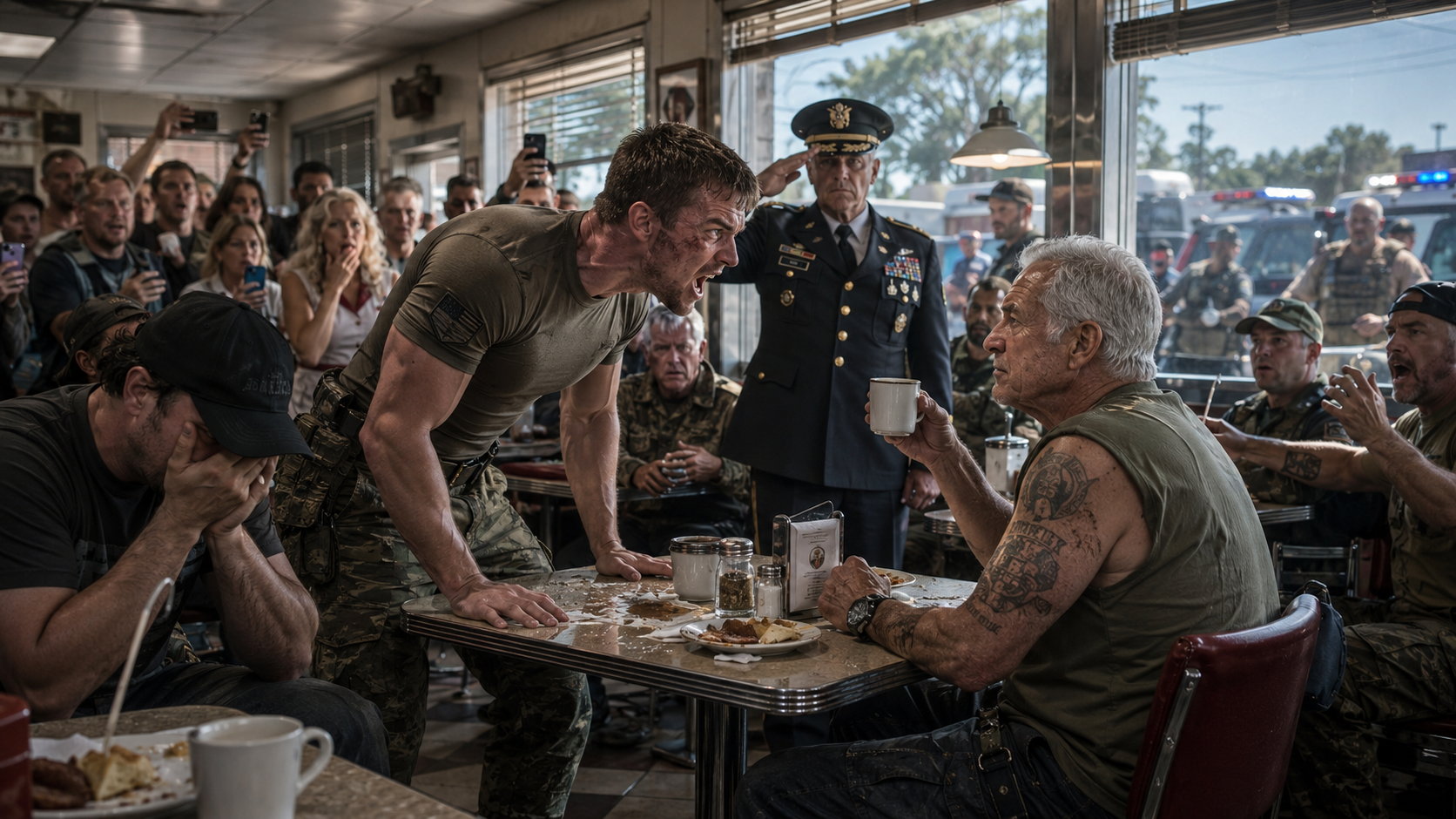
They mocked the old man’s tattoo over breakfast.
They called him a fake.
Then the four-star general rolled up his sleeve and showed the same mark.
Glenn Patterson sat alone in the corner booth of the Scrambled Egg diner, stirring two cubes of sugar into his coffee like the whole world could wait.
You May Also Like
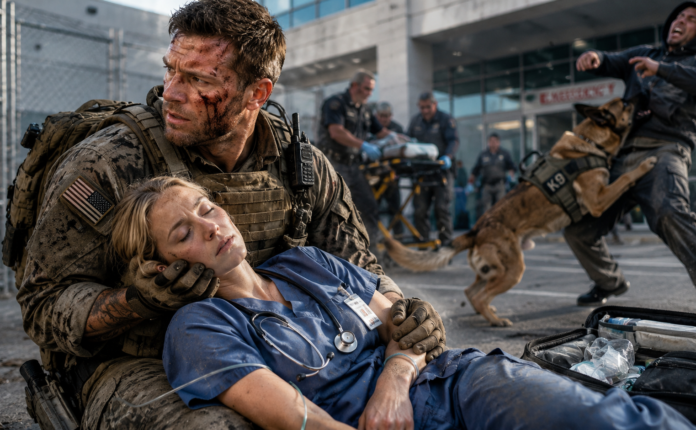
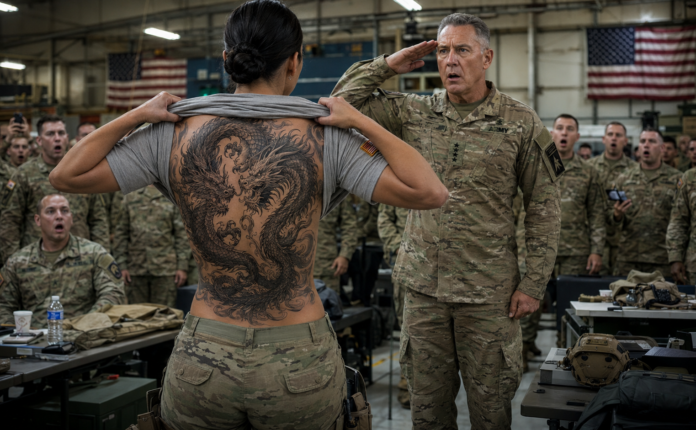
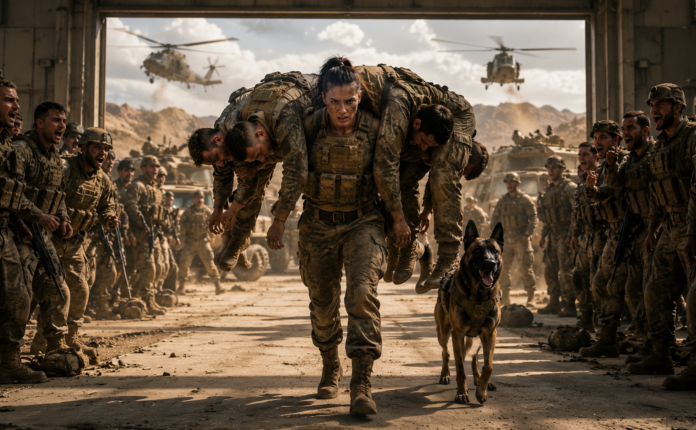
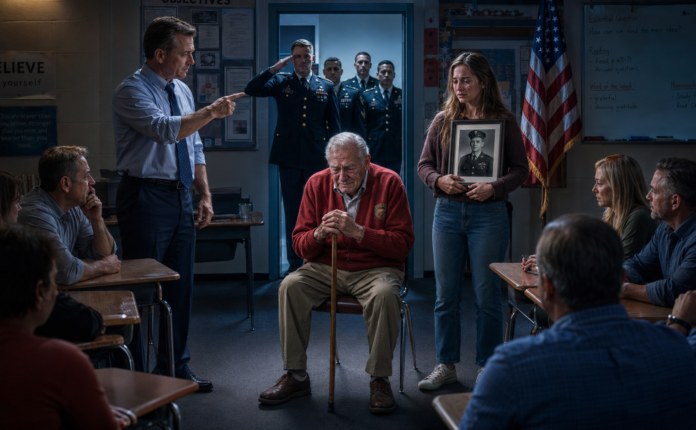
He was eighty-one years old.
Wrinkled hands.
Sun-spotted skin.
A quiet face.
And on his left forearm, faded almost beyond recognition, was a tattoo of a serpent swallowing its own tail with a small star inside the circle.
To Glenn, it was not decoration.
It was a promise.
To Cutler, the young special operator standing over his table, it was a joke.
“You get that ink out of a cereal box, old-timer?” Cutler asked, loud enough for half the diner to hear.
His partner, Reyes, shifted uncomfortably.
“Leave it alone,” Reyes muttered.
But Cutler didn’t.
Men like him rarely stop when an audience is watching.
He leaned over the booth, big hands planted on the table, scarred knuckles inches from Glenn’s coffee.
“What’s it supposed to be?” he sneered. “Some biker thing? Were you in a club? The geriatric guzzlers?”
A few people froze.
The waitress stopped pouring coffee.
The cook stopped moving behind the pass.
Glenn only lifted his cup and took a slow sip.
“It means something,” he said quietly, “to the people it’s supposed to.”
Cutler laughed.
That calm answer bothered him more than anger would have.
He wanted fear.
He wanted embarrassment.
He wanted the old man to shrink.
Instead, Glenn looked at him with pale blue eyes that seemed to carry weather from another century.
Cutler pointed at the tattoo again.
“I’ve never seen that in any unit book. And trust me, I know them all. So either you’re lying, or you spent your war peeling potatoes and got that thing in some back-alley shop to impress girls.”
The diner went silent.
Glenn’s eyes drifted to the window.
For one second, he was not in a diner anymore.
He was in a jungle that officially did not exist.
Rain beating down through leaves.
Mud under his chest.
A wounded young lieutenant on his back.
A bamboo needle carving that serpent into skin while five survivors swore never to forget the men who didn’t make it out.
Project Omega.
The mission that never happened.
The unit that never existed.
The ghosts who wrote the rules before the world knew their names.
Then Cutler made the mistake that changed everything.
He reached out and tapped Glenn’s tattoo with one finger.
The waitress saw Glenn’s arm pull back.
She saw the old man’s eyes change.
And she remembered a number taped inside the office safe, left by the diner’s owner with one instruction:
If you ever see that mark, call.
Minutes later, three black government SUVs screamed into the parking lot.
The door opened.
General Marcus Thorne stepped inside, four stars on his collar, fury in his face, and command in every step.
Cutler went pale.
The general didn’t look at him.
He walked straight to Glenn’s booth, snapped to attention, and saluted the old man in front of everyone.
“Glenn,” he said, voice thick with emotion. “It’s been too long.”
Then he rolled up his own sleeve.
Same serpent.
Same circle.
Same star.
The diner gasped.
General Thorne turned to Cutler.
“This man carried me through enemy territory for two days with a bullet in his body,” he said coldly. “Before there was your unit, there was his. Before your tactics had names, men like him wrote them in blood.”
Cutler couldn’t speak.
The man he had mocked was not a fraud.
He was the beginning.
Glenn stood slowly, looked at the shattered young operator, and said only one thing.
“The tattoo doesn’t make the man, son. The man makes the tattoo mean something.”
And that morning, every person in the diner learned that the quietest old man in the room may be the reason louder men get to come home…
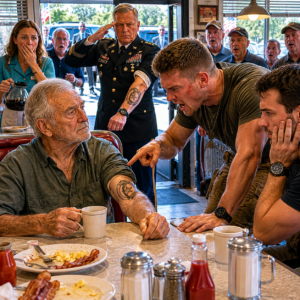
“You get that ink out of a cereal box, old-timer?”
The young man said it loud enough for the whole diner to hear.
Glenn Patterson did not look up from his coffee.
The spoon in his hand moved slowly, gently, in small circles through the dark liquid. Two cubes of sugar dissolved beneath the surface, disappearing in that quiet way sweet things often did. He watched the coffee turn slightly cloudy near the center, then settle back into black.
It was Tuesday morning at the Scrambled Egg, a low-roofed diner three miles from Fort Liberty, where the coffee was too strong, the bacon was too salty, and nobody bothered Glenn unless they needed the ketchup.
That was why he came.
At eighty-one years old, he had grown protective of places that asked nothing from him.
His small house asked him to fix the porch light.
The VA asked him to rate his pain on a scale of one to ten, as if pain had ever respected numbers.
The cemetery asked him to remember dates.
His own body asked him to stand slowly, sleep lightly, and accept that his knees had become weather prophets.
But the Scrambled Egg asked only whether he wanted toast.
He liked that.
The two men standing over his booth disturbed the balance of the morning.
They were big, both of them. Young in the way men in dangerous professions remained young until something inside them broke. Their civilian clothes were expensive but practical: fitted T-shirts, tactical watches, boots too clean for farm work and too worn for fashion. Even without uniforms, every person in the diner knew what they were.
Operators.
The kind of men attached to Fort Liberty who came in hungry after training, carried themselves like coiled wire, and looked at every room as if exits and threats had already introduced themselves.
The one who had spoken leaned closer.
His name was Cutler. Glenn had heard the quieter one say it near the door.
Cutler had a hard jaw, scarred knuckles, close-cropped hair, and eyes that missed details but not because they were weak. Because pride had taught them what to ignore.
“Hey,” Cutler said, planting both palms on Glenn’s table. “I’m talking to you.”
Glenn lifted the spoon, tapped it once on the side of the mug, and set it on the saucer.
Only then did he raise his eyes.
They were pale blue, clouded slightly with age, but clear beneath that film. Still. Watchful. Tired in a way that did not invite pity.
“What about it?” he asked.
His voice sounded like gravel at the bottom of a dry creek bed.
Cutler’s mouth curled.
“The tattoo.”
His chin jerked toward Glenn’s left forearm, where his sleeve had ridden up while he stirred his coffee.
There, on skin thinned and spotted by time, lay a faded tattoo: a black serpent swallowing its own tail, forming a rough circle. Inside the circle sat a single five-pointed star.
The ink had blurred over the decades. The serpent had lost its sharp edges. The star no longer sat perfectly clean. It looked more like an old mistake than a symbol.
To most people, it meant nothing.
Glenn preferred that.
Cutler leaned close enough that Glenn could smell mint gum and black coffee on his breath.
“What’s it supposed to be? Some biker thing? You in a club?”
The second man shifted.
His name was Reyes. He had the thoughtful discomfort of someone whose instincts were better than his loyalty to the moment.
“Cutler,” Reyes said quietly, “leave it alone.”
Cutler ignored him.
“What’s the club called?” he continued. “The Geriatric Guzzlers?”
A few young soldiers in the back booth laughed.
Not fully.
Not comfortably.
Just enough to make Cutler feel he still owned the room.
The Scrambled Egg had gone quiet around them.
Sarah, the waitress, stood near the counter with a coffee pot in her hand. She was fifty-eight, tired around the eyes, and kind in the stubborn way women become when life has tried repeatedly to sand the softness off them and failed. She knew Glenn’s order by heart. Coffee, two sugars, wheat toast, no eggs unless she bullied him into protein.
Her grip tightened around the pot.
“Boys,” she said, voice sharp but controlled, “let the man drink his coffee.”
Cutler glanced toward her.
“We’re just talking.”
“No,” she said. “You’re bothering a customer.”
Cutler smiled.
Not kindly.
“Ma’am, with respect, we’re curious about stolen valor.”
The phrase rolled through the diner like something dirty dropped on the floor.
Glenn looked back down at his mug.
The coffee had stopped steaming.
The word did not anger him.
Not immediately.
Anger took effort, and he rationed effort carefully these days. He had learned long ago that fools often wanted anger because anger gave them permission to escalate.
He had survived worse by giving men nothing.
“Stolen valor,” Cutler repeated, enjoying the sound of his own certainty. “People wear things they didn’t earn. Tattoos, patches, hats. Pretend they were somewhere they weren’t. You’d be surprised how often we see it.”
“I wouldn’t,” Glenn said.
Cutler blinked.
The quiet answer irritated him.
The fact that Glenn was not frightened irritated him more.
“You serve?” Cutler asked.
“Some.”
“Some,” Cutler repeated, turning to Reyes with a grin. “Hear that? Some.”
Reyes looked at Glenn’s arm again.
The tattoo bothered him now. Not because he recognized it. Because he didn’t. He had spent years around special operations history, unit patches, team marks, unofficial insignias, the kind of symbols men carried in ink because regulations did not leave room for grief. He had never seen this one.
And yet the old man wore it without display, without explanation, without any hunger to be believed.
That made Reyes uneasy.
Cutler pressed on.
“What were you? Cook? Clerk? Quartermaster? Maybe pushing pencils in Saigon while real men got busy?”
Glenn took a slow sip of coffee.
Sarah saw his hand.
Still steady.
That steadiness unsettled her more than shaking would have.
Glenn set the mug down.
“Something like that.”
Cutler’s face flushed.
He had wanted denial.
A story.
A stammered defense.
Instead he got a tired old man giving him nothing to swing at.
“You think this is funny?” Cutler asked.
“No.”
“You think I don’t know what I’m looking at?”
Glenn looked at the tattoo.
Then back at him.
“I think you know many things,” he said. “Just not this.”
Reyes stared at him.
For a second, the diner seemed to tilt around those words.
Cutler laughed, but it came out too hard.
“Listen to him. Mystical Grandpa here.”
He straightened and looked around, making sure the room was still watching.
“Let me tell you something, old man. We don’t like phonies. Especially not near post. You want to wear some secret-squirrel tattoo and act mysterious, fine. But if you’re pretending you were part of something you weren’t, that’s disrespect.”
Glenn’s mouth moved slightly.
Not a smile.
Something older.
“Disrespect,” he murmured.
Cutler mistook it for mockery.
He reached down.
Reyes moved too late.
“Don’t,” Reyes said.
Cutler tapped one thick finger against Glenn’s tattoo.
The touch was light.
Almost nothing.
But it opened a door inside Glenn that had been locked for fifty-two years and never truly shut.
The diner disappeared.
The smell of bacon grease became wet earth.
The hum of fluorescent lights became rotor blades somewhere above the canopy, too distant to help.
He was twenty-nine again, crouched in a jungle so dense the moon arrived in pieces.
Laos.
A country he was not supposed to be in.
A mission no agency would claim if he died.
Rain slid down his neck and into the collar of his soaked fatigues. Mosquitoes whined near his ear. The air smelled of mud, blood, leaves, and cordite. Beside him, Marcus Thorne, then a young lieutenant, lay half-conscious with a fever and a strip of shrapnel buried in his shoulder.
Five men had entered.
Two were still moving.
Glenn remembered the makeshift needle.
Bamboo splinter.
Gunpowder ink.
A serpent swallowing its own tail.
The war that never ended.
The star inside.
The five points of a lonely constellation.
Carver.
Bell.
Ortiz.
Thorne.
Patterson.
A mark made in a hidden camp after surviving something no report could safely describe.
Not decoration.
Not pride.
A promise.
We remember the ones the records won’t.
The memory dissolved.
Glenn was back in the booth.
Cutler’s finger was still on his arm.
Glenn slowly pulled his arm away.
“Don’t touch it,” he said.
The words were quiet.
But they changed the room.
Cutler’s eyes hardened.
Behind the counter, Sarah had seen enough.
Glenn Patterson was not family, not officially. But he had been coming to her diner for twelve years. He asked about her grandkids. He left ten-dollar tips on seven-dollar bills. When her husband died, Glenn had sat at the counter for three hours after the funeral crowd left, not speaking much, just staying until the emptiness did not feel so aggressive.
She did not know his story.
She knew his character.
And she knew bullies.
Sarah set the coffee pot down and walked toward the office behind the kitchen.
Cutler saw her moving.
“Where you going?” he called.
“To make a call.”
“Call whoever you want.”
“That’s the plan,” she said.
Inside the cramped office, between boxes of napkins and old tax files, Sarah pulled out her old phone. Her cousin Stacy worked as an administrative assistant inside the Joint Special Operations Command building. Sarah did not like using family favors, but this did not feel like a favor.
It felt like calling the fire department because smoke had started rising under the door.
Stacy answered in her office voice.
“General Thorne’s office, Senior Airman Miller speaking.”
“Stacy, it’s Sarah.”
“Aunt Sarah? I’m at work.”
“I know. Listen. There are two of your guys at the diner harassing Glenn.”
“Glenn who?”
“Glenn Patterson. My regular. Old man. Quiet. They’re making fun of his tattoo.”
A pause.
“Tattoo?”
“Snake eating its tail. Circle. Star in the middle.”
The line went silent.
Sarah frowned.
“Stacy?”
“Say that again.”
Sarah repeated it.
“And his name is Glenn Patterson?”
“Yes.”
Another silence.
This one frightened her.
“Stacy, what is going on?”
“Don’t let them leave,” Stacy said.
“I’m not exactly in command here.”
“Then keep them there any way you can. I have to interrupt the general.”
The call ended.
Sarah stared at the phone.
“Oh, Glenn,” she whispered. “What were you?”
Across post, inside a secure conference room where satellite imagery glowed across screens and men with stars and eagles on their collars discussed matters most citizens would never know enough to fear, Senior Airman Stacy Miller committed the most professionally dangerous act of her young career.
She interrupted General Marcus Thorne.
The four-star commander was in the middle of a classified briefing. The room was sealed. Phones were outside. No one entered unless the world caught fire.
Stacy knocked once and pushed in before anyone answered.
Every head turned.
A colonel near the door hissed, “Airman—”
She walked straight to General Thorne.
His eyes were like flint.
“This had better be the end of the world,” he said.
She leaned close and spoke quietly enough that only he could hear.
“Sir, I received a call from the Scrambled Egg diner. A man named Glenn Patterson is there. Two active-duty operators are harassing him. They are mocking a tattoo. Serpent circle. Five-point star.”
For one second, General Thorne did not move.
Then the color left his face.
The room felt it immediately.
A four-star general going pale was louder than any siren.
Thorne stood so quickly his chair slid back and struck the wall.
“Meeting’s over.”
The colonel blinked.
“Sir?”
“Now.”
He turned to Stacy.
“Vehicles. Detail. No sirens unless we need them. Who are the operators?”
“I don’t know, sir.”
His jaw tightened.
“I will.”
Back at the diner, Cutler had grown bored with humiliation and wanted dominance.
“All right,” he said, voice hard now. “Let’s take a walk outside.”
He grabbed Glenn’s upper arm.
Reyes caught his shoulder.
“Cutler, stop.”
Cutler shoved him off.
“I’m handling it.”
“No,” Reyes said, firmer now. “You’re losing control.”
Cutler turned on him.
“You going soft?”
“No. I’m seeing the room.”
Cutler looked around.
The room had turned against him.
Not loudly.
But clearly.
The cook stood in the kitchen doorway holding a spatula like a weapon he had not yet decided to use. The young soldiers in the back booth were no longer laughing. Sarah had returned from the office and stood by the register, arms folded, face pale but fierce.
Glenn looked at Cutler’s hand on his arm.
Then at his face.
“You should listen to your friend.”
Cutler’s shame turned to rage.
“You don’t tell me what—”
The parking lot outside erupted with the growl of powerful engines.
Three black Suburbans swept into formation in front of the diner, blocking the entrance, the curb, and the side lane. Doors opened before the vehicles fully settled. Men in service dress stepped out, moving with clean, practiced urgency.
Cutler’s face changed.
He knew those vehicles.
Reyes did too.
“Oh no,” Reyes whispered.
The bell over the diner door jingled.
General Marcus Thorne entered.
Not in combat gear.
Not surrounded by shouting MPs.
He wore dress uniform, four stars bright at his collar, his chest heavy with ribbons, his face set in a rage so controlled it felt colder than shouting.
He did not look at Sarah.
Did not look at the customers.
Did not look at Cutler first.
His eyes went directly to Glenn.
Then to Cutler’s hand on Glenn’s arm.
Cutler released him instantly.
The general walked to the booth, stopped beside the table, and came to attention.
In a diner that smelled of coffee, bacon, and syrup, the highest-ranking special operations officer in the United States military saluted an old man in a red shirt.
The room froze.
Glenn looked up.
For a moment, his expression softened.
“Marcus,” he said.
Thorne lowered his hand slowly.
“Glenn.”
“You got old.”
The general’s mouth twitched.
“So did you.”
“I had a head start.”
The brief humanity vanished when Thorne turned toward Cutler and Reyes.
“Names.”
Cutler snapped upright.
“Chief Petty Officer Cutler, sir.”
Reyes followed.
“Senior Chief Reyes, sir.”
Thorne’s gaze stayed on Cutler.
“You questioned this man.”
Cutler swallowed.
“Yes, sir.”
“You mocked his service.”
No answer.
“You touched his tattoo.”
Cutler looked sick.
Thorne rolled up his right sleeve.
Slowly.
Deliberately.
Past the cuff.
Past the watch.
There, on the general’s forearm, crisp but unmistakably identical, was the same tattoo.
The serpent swallowing its tail.
The star inside.
A gasp moved through the diner.
Cutler stared at it as if the ink itself had opened beneath him.
Thorne’s voice was quiet.
“This mark belonged to five men.”
Glenn looked out the window.
Thorne continued.
“Before your units had their names, before your doctrine had manuals, before men like you inherited a tradition polished clean enough to brief, there were men sent into places no one could admit existed. They had no support worth trusting. No recognition. No rescue plan if politics changed. Project Omega.”
Reyes closed his eyes.
He knew that name.
Not from records.
From whispers.
Old ghosts in team rooms.
Thorne looked at Glenn.
“Glenn Patterson was one of the founding members. In 1968, deep inside Laos, our team was compromised. Five men. Three dead over the next three weeks. I was a young lieutenant with shrapnel in my shoulder and fever in my blood. Glenn carried me the last two days through swamp, patrol lines, and monsoon rain to extraction.”
He stepped closer to Cutler.
“Of the five men who wore this mark, two are alive. You are looking at both.”
The diner held its breath.
Cutler’s mouth opened.
Nothing came.
Thorne’s voice sharpened.
“You wear the uniform of the quiet professional. Today you were neither quiet nor professional.”
Cutler flinched.
“You mistook confidence for character. You mistook youth for superiority. You mistook an old man’s restraint for weakness.”
Thorne’s eyes hardened.
“And worst of all, you forgot that every tactic you practice, every doctrine you recite, every piece of gear you carry, every reputation you enjoy was paid for by men whose names you will never know.”
Cutler stared at the floor.
“Both of you report to my office at 0500 tomorrow. Be prepared to turn in your credentials pending review.”
Reyes looked up, stunned.
“Sir—”
Thorne cut him off.
“You stood there.”
Reyes lowered his eyes.
“Yes, sir.”
Glenn pushed himself out of the booth.
His knees cracked.
The sound seemed too ordinary for the moment.
Thorne turned immediately, instinctively reaching to help.
Glenn waved him off.
“I can still stand.”
“Yes,” Thorne said softly. “You can.”
Glenn looked at Cutler and Reyes.
The young men stood broken in place, stripped not of strength but of certainty.
His voice was not angry when he spoke.
That made it worse.
“The tattoo doesn’t make the man,” he said. “The man makes the tattoo mean something.”
Cutler looked up.
Glenn’s pale eyes held him.
“All this—uniforms, units, reputations, call signs—it comes and goes. Character is the only thing you truly own. Try not to lose it.”
For a moment, nobody moved.
Then Glenn looked at Thorne.
“Buy me coffee, Marcus.”
The general blinked.
Then laughed once, very softly.
“It would be my honor.”
They sat across from each other in the booth while the diner slowly remembered how to breathe.
Sarah poured coffee with hands that still shook.
“On the house,” she said.
Glenn gave her a look.
“No.”
“Glenn—”
“I pay for my coffee.”
Thorne said, “Then I’ll pay.”
“That’s worse.”
Sarah almost cried and laughed at the same time.
“You’re impossible.”
“So I’ve been told.”
Cutler and Reyes left under escort, not cuffed, but diminished. The bell over the door rang behind them.
Nobody watched them with triumph.
Only discomfort.
Because everyone in the diner had learned something ugly about how easily a room can let humiliation happen until power arrives to rename it.
Thorne wrapped both hands around the coffee mug.
For a while, he and Glenn said nothing.
Then the general said, “I looked for you after Panama.”
“I know.”
“You didn’t answer.”
“I know.”
Thorne’s jaw tightened.
“We thought you were dead twice.”
“I was, for a while.”
“You could have come in.”
“For what? A plaque? A handshake? A room full of men asking me to explain dead friends?”
Thorne looked down.
“No.”
Glenn studied him.
“Maybe yes.”
The general accepted the hit.
“The program is forgetting its ancestors,” Thorne said.
“Programs always do. Men like clean beginnings.”
“I don’t.”
“You’re still wearing the tattoo. That’s something.”
Thorne touched his sleeve, now rolled back down.
“I wear it because you put it there.”
The memory came between them.
A makeshift aid station under a patched tarp. Rain dripping through the seams. Thorne feverish, jaw clenched, trying not to groan while Glenn cleaned the wound. Three bodies wrapped outside. Two survivors inside.
Glenn, hands steady despite his own exhaustion, dipping bamboo into gunpowder ink.
“It’s not decoration,” he told the young lieutenant. “It’s a promise.”
“To what?” Thorne asked through pain.
“To remember the ones who don’t walk out. And never quit on the ones who still might.”
Now, fifty years later, Thorne looked across the booth.
“We’re quitting on memory,” he said.
Glenn took a sip of coffee.
“Then stop.”
The fallout began before the lunch rush.
By noon, command had identified Cutler and Reyes as members of an elite direct-action element under JSOC authority. By evening, their team chief had been relieved pending internal review of culture and discipline failures. By the next morning, both men were standing in General Thorne’s office at 0500.
Cutler had not slept.
Reyes had, maybe, for twenty minutes.
They stood at attention while Thorne read from two personnel files.
Combat record.
Commendations.
Successful missions.
Leadership reports.
Then he closed the folders.
“You are both capable warriors,” he said.
Neither man moved.
“That makes your failure worse, not better.”
Cutler’s throat worked.
“Yes, sir.”
Thorne looked at Reyes.
“You knew something was wrong.”
Reyes stared straight ahead.
“Yes, sir.”
“And?”
“I didn’t stop him.”
“No.”
“I tried once.”
“Trying is what people call failure when they want partial credit.”
Reyes’s face tightened.
“Yes, sir.”
Thorne looked at Cutler.
“What did you see in that diner?”
Cutler swallowed.
“An old man, sir.”
“What else?”
Cutler’s voice dropped.
“A target.”
Thorne’s eyes sharpened.
The honesty mattered.
Ugly truth was still truth.
“Why?”
Cutler’s jaw flexed.
“Because he didn’t react.”
“And you needed him to?”
“Yes, sir.”
“Why?”
Cutler did not answer quickly.
Thorne waited.
Finally Cutler said, “Because I felt disrespected.”
Thorne leaned back.
“No. You felt unseen.”
Cutler’s eyes flickered.
“That is not the same thing.”
The general stood.
“You will both be removed from operational rotation. Not discharged. Not yet. You will serve as administrative staff for a new instruction block called Legacy. You will coordinate veterans, classrooms, travel, records, and support. You will listen to men whose shoes you are not yet worthy to carry. You will write reflections after each session. You will do this until I believe you have learned the difference between excellence and arrogance.”
Cutler looked stunned.
“Sir, how long?”
“Three years.”
Reyes closed his eyes.
Cutler’s face went pale.
“Three years, sir?”
Thorne stepped closer.
“You put hands on Glenn Patterson and asked him to prove himself. You should be grateful your lesson comes with a salary.”
Cutler lowered his head.
“Yes, sir.”
“Dismissed.”
Legacy began badly.
That was how most real things began.
The first class met in a windowless room with too much air conditioning and not enough humility. Cutler and Reyes arranged chairs, set up microphones, printed schedules, and checked coffee urns. Veterans arrived slowly: a Green Beret from Vietnam with a cane and an oxygen tube, a Ranger from Grenada who laughed too loudly, a Delta operator from Panama with eyes that did not settle anywhere, a female intelligence officer from Iraq who terrified everyone by speaking softly.
Cutler hated the work at first.
Not the tasks.
The position.
Serving coffee to old men.
Carrying bags.
Adjusting microphones.
Standing near the door while candidates sat.
He had gone from mission lead to event staff.
The humiliation burned.
Then the stories began.
Not heroic stories.
Not at first.
One veteran talked about losing three men because a map was wrong.
Another talked about carrying extra socks because trench foot took men out faster than bullets.
Another described writing letters to the families of men whose deaths had to be officially lied about.
The Iraq intelligence officer said, “The hardest part of classified grief is that people expect you to come home normal from things they are not allowed to know happened.”
Cutler stopped checking his watch after that.
Reyes listened from the first day.
Cutler took longer.
But listening, repeated enough, became a kind of pressure.
The old men were not soft.
They were not weak.
They were not relics.
They were survivors of systems Cutler had inherited without understanding the cost.
He began reading after hours.
Project Omega remained mostly classified, but fragments existed in oral histories and redacted files. Names missing. Locations blacked out. Outcomes summarized with cruel efficiency.
Asset recovered.
Enemy site neutralized.
Friendly casualties redacted.
Unauthorized incursion denied.
He found one document with four names visible.
Carver.
Bell.
Ortiz.
Patterson.
The fifth blacked out.
He stared at Patterson for a long time.
The next time he saw Glenn was six months later in a hardware store.
Cutler had gone to buy screws for a shelf in his small apartment. He turned into an aisle and found the old man standing before rows of bolts, holding one up to the light with the concentration of a jeweler examining diamonds.
Cutler froze.
Glenn looked over.
“Cutler.”
“Mr. Patterson.”
“Bolts don’t bite.”
Cutler stepped closer.
His mouth went dry.
“I’ve wanted to apologize.”
“I guessed.”
Cutler let out a breath.
“What I did was wrong. I was arrogant. I was cruel. I didn’t know who you were, but that shouldn’t have mattered.”
Glenn returned the bolt to the wrong bin.
Cutler noticed but wisely said nothing.
“I’m sorry for touching your arm,” Cutler said. “And for making a spectacle of you.”
Glenn looked at him then.
Properly.
Cutler held still.
“Apology accepted,” Glenn said.
Cutler blinked.
It felt too quick.
Too easy.
Glenn reached into the bolt bin again.
“Forgiveness is not the same as forgetting. Don’t confuse them.”
“I won’t.”
“You learning anything?”
“Yes, sir.”
“Stop calling me sir.”
“Yes—sorry.”
Glenn found the bolt he wanted.
“Good. Keep learning.”
That was all.
No grand reconciliation.
No tearful embrace.
No speech.
Just a chance to become better.
Cutler stood in the aisle after Glenn walked away, surprised by the strange heaviness of mercy.
A year passed.
Then two.
Legacy grew.
Thorne expanded it. Operators from different units rotated through. Veterans were flown in, hosted carefully, listened to properly. The program changed curriculum every cycle because Thorne hated performative tradition. He wanted discomfort. Questions. Silence. Reflection.
Reyes became good at it first.
He developed a talent for making old veterans comfortable before they spoke. He remembered coffee preferences. Medical needs. Travel anxieties. Which men hated microphones. Which women preferred not to be introduced by rank. He began telling candidates, “If all you hear is the action, you missed the story.”
Cutler remained rougher.
But sincere.
He stopped laughing at wrong moments.
Stopped needing to dominate rooms.
When a young candidate rolled his eyes during a Vietnam medic’s story, Cutler removed him from the room so quietly it frightened everyone more than shouting would have.
Outside, he said, “You can come back when your ears grow up.”
The candidate came back.
Different.
Glenn spoke only once.
Thorne asked him for two years.
Glenn refused for one year and eleven months.
Then, on a rainy Thursday, he arrived at Legacy wearing the same red shirt from the diner and the same canvas jacket. The room went silent when he entered. Half the candidates knew the story. The other half sensed they were supposed to.
Glenn stood at the front and looked at the chairs.
“Too many people,” he said.
Thorne, seated in the back, replied, “It’s a class.”
“I noticed.”
A few candidates smiled nervously.
Glenn looked at them until the smiles disappeared.
He did not talk about kills.
Did not talk about the dramatic things rumors wanted.
He talked about a man named Bell who sang Motown softly before missions.
A man named Carver who carried letters from his daughters in a plastic pouch.
Ortiz, who could fix any radio and once cried because a rescued prisoner gave him a paper flower.
He talked about Thorne young and feverish, insisting he could walk while actively failing to stand.
The room laughed.
Even Thorne smiled.
Then Glenn talked about the tattoo.
“This isn’t a badge,” he said, pushing up his sleeve. “Badges are awarded by systems. This was made by men who did not trust systems to remember them.”
He touched the faded serpent.
“The snake eating its tail means the work never really ends. The star is five points. Five men. Three gone before any of you were born. One sitting in the back wearing too many stars. One standing here against his better judgment.”
Nobody moved.
“You want to be elite?” Glenn asked.
Several candidates sat straighter.
“Good. Be elite at listening. Be elite at restraint. Be elite at not confusing fear with respect. Be elite at carrying what power gives you without using it on people who can’t push back.”
Cutler, standing near the door, felt every word.
Glenn’s eyes moved to him briefly.
Not accusing.
Not absolving.
Including.
That hurt most.
After class, Thorne asked, “Coffee?”
Glenn said, “Yours is terrible.”
“Then diner?”
Glenn considered.
“You’re buying.”
The Scrambled Egg never recovered from the day General Thorne came in.
Not in a bad way.
People still ate pancakes. Sarah still refilled coffee. The cook still cursed at the griddle. But a photograph appeared behind the counter, small and not labeled publicly: Glenn sitting in his booth, Sarah beside him, Thorne standing awkwardly behind them because generals look strange in diners.
Underneath, Sarah wrote in marker:
Character is the only thing you truly own.
Glenn pretended not to see it.
Everyone knew he saw it.
When his health began to fade, it happened slowly.
He missed a Tuesday.
Then a Thursday.
Sarah called him and got no answer.
She called Thorne.
Thorne sent someone.
Glenn was found in his garage, sitting on a stool beside his half-repaired lawn mower, dizzy from low blood pressure and furious about being discovered.
“I was resting,” he insisted from the ambulance.
“You were unconscious,” the medic said.
“Same thing, if a man’s lucky.”
At the hospital, Thorne visited.
So did Sarah.
Reyes.
Cutler.
Glenn hated the parade of concern.
But he did not send them away.
That was how they knew he was worse than he said.
One evening, Cutler sat beside his bed while rain moved down the hospital window.
Glenn looked smaller beneath the blanket.
His tattooed arm rested above the sheet, skin thin, serpent blurred almost into shadow.
Cutler said, “You scared?”
Glenn opened one eye.
“Bold question.”
“Yes, sir.”
“I told you about sir.”
“Sorry.”
Glenn looked at the ceiling.
“No.”
Cutler waited.
“Not scared. Curious, maybe.”
“About what?”
“If they’ll be there.”
Cutler’s throat tightened.
“The other three?”
Glenn’s mouth moved faintly.
“They better be. Bell owes me money.”
Cutler laughed, then wiped his face quickly.
Glenn saw but said nothing.
After a while, he said, “You kept learning.”
“I’m trying.”
“That’s all there is.”
Cutler looked at him.
“I wish I had met you differently.”
Glenn turned his head.
“You did meet me differently.”
Cutler frowned.
“In the hardware store. In the classroom. Here. Men meet each other more than once if they’re lucky.”
That sentence stayed with Cutler for the rest of his life.
Glenn died at home three months later.
Not in the hospital.
He refused that.
Thorne arranged medical care at the house, not because Glenn asked, but because Sarah threatened to “raise hell in channels you don’t even know exist,” and Thorne believed her.
Glenn died in his chair near the window at dawn.
Coffee on the side table.
Lawn mower manual open in his lap.
The tattoo visible beneath his rolled sleeve.
His funeral was supposed to be small.
That was what he wanted.
What he received was respectful.
Those are not always the same.
They buried him under a gray sky with rain threatening but not falling. Thorne stood in dress uniform. Reyes stood beside Cutler. Sarah came in a black dress and wore sensible shoes because, as she told the general, “Grief is hard enough without bad heels.”
There were no cameras.
Thorne made sure of that.
At the service, Thorne spoke first.
He did not reveal classified details.
He spoke of promises.
Of men who served without applause.
Of the danger of forgetting that foundations are often buried underground.
Then Cutler stepped forward.
He had not expected to speak.
But Glenn’s niece, his only surviving family, found him before the service and handed him a folded note.
“Uncle Glenn said you’d try to avoid talking,” she said. “He told me not to let you.”
The note read:
Cutler,
Don’t make it fancy.
Tell the truth.
—G.
So Cutler stood before the small crowd and did exactly that.
“The first time I met Glenn Patterson,” he said, “I put my hand on him in disrespect.”
The air went still.
“I saw an old man in a diner and thought his silence meant weakness. I saw a tattoo and thought I had the right to judge it. I saw age and mistook it for irrelevance.”
His voice shook.
“I was wrong before I knew he was a legend. That is the lesson. Not that I insulted an important man. That I failed to treat a man with dignity before importance was revealed.”
Thorne lowered his eyes.
Sarah cried silently.
Cutler continued.
“Glenn accepted my apology, but he did not make it easy for me. He gave me something better than comfort. He gave me work. Keep learning, he said.”
Cutler looked at the casket.
“I am still learning.”
After the service, Thorne handed Cutler a small envelope.
“He left this for you.”
Cutler opened it with shaking hands.
Inside was a note and a small object wrapped in cloth.
The note said:
The tattoo stays with me.
The meaning doesn’t have to.
Make it worth something.
Inside the cloth was a small metal star.
Not military issue.
Hand-cut.
Rough.
Five-pointed.
Cutler closed his fist around it and broke down.
Not loudly.
Not performatively.
Just bent over with the weight of being trusted by someone he had once harmed.
Thorne put a hand on his shoulder.
For once, Cutler did not pull away from comfort.
Years later, the Legacy program became a permanent part of special operations training.
Candidates still learned weapons, tactics, language, surveillance, insertion, extraction, violence, endurance. But before they graduated, they sat in a plain room with old men and women who taught them the cost beneath the glory.
On the wall hung no giant portrait.
Glenn would have haunted them for that.
Instead, inside a small frame near the door was a simple black drawing:
A serpent swallowing its tail.
A star inside.
Below it, a sentence from Glenn Patterson:
The man makes the tattoo mean something.
Cutler eventually became an instructor.
Then a chief.
He was not soft.
No one accused him of that.
He pushed candidates hard. He demanded precision. He hated excuses. But he never confused humiliation with teaching, and he never allowed talent to become cruelty.
When candidates got arrogant, he took them to the Scrambled Egg.
Sarah, older now and still impossible to intimidate, would pour coffee.
Cutler would point to Glenn’s old booth.
“This is where I learned I wasn’t as strong as I thought.”
They always looked confused at first.
Good.
Confusion opened doors arrogance kept locked.
On the anniversary of Glenn’s death, Cutler sat alone in that booth with two coffees.
One for him.
One across the table.
Sarah walked by.
“You talking to him today?”
Cutler looked at the empty seat.
“Listening.”
She nodded.
“Better habit.”
He smiled faintly.
Outside, morning light moved across the parking lot.
Fort Liberty traffic hummed in the distance.
A young man in uniform entered the diner, saw Cutler, and started to snap to attention.
Cutler waved him down.
“Eat your breakfast.”
“Yes, Chief.”
The young man sat.
Cutler touched the small metal star he now carried on his key ring.
He thought of Glenn’s arm.
The faded tattoo.
The hand he had touched in arrogance.
The same hand that later extended forgiveness without letting him escape the work.
He thought of Bell, Carver, Ortiz, Thorne, Patterson.
A constellation in a blacked-out sky.
And he understood, finally, that the old man had not been guarding a secret.
He had been carrying a memory too heavy for most people to touch.
Cutler lifted his coffee.
“To character,” he said quietly.
Across from him, the untouched cup cooled.
The diner moved on around him.
Plates clattered.
Coffee poured.
People laughed.
Life, indifferent and holy, continued.
And in the corner booth of a small breakfast place near Fort Liberty, the silence Glenn Patterson left behind remained exactly what it had always been.
Not empty.
Full.