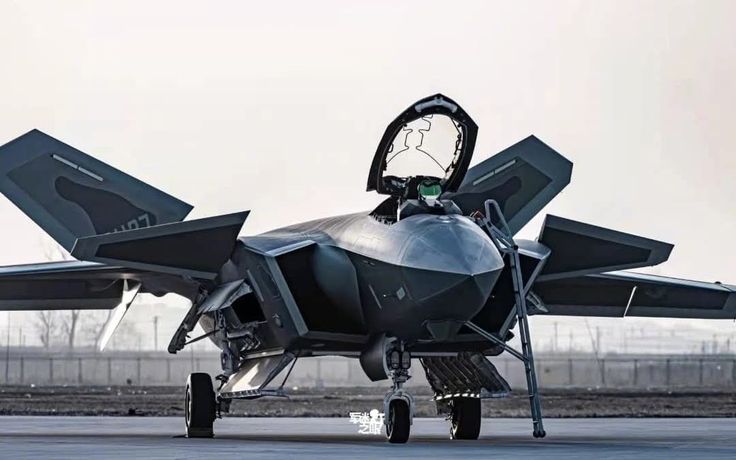
Title: “The Debate on F-22 Raptor and Chinese J-20 Fighter Jet: Who Dominates the World?”
The hall was no longer just a place of learning—it had become a battlefield of ideas.
Hundreds of minds gathered. Cadets in uniform. Engineers with decades of experience. Strategists who had studied wars that never made headlines. Every seat was filled. Every eye fixed forward.
Because tonight, the question was not simple.
You May Also Like

It was dangerous.
It was uncomfortable.
And it demanded honesty.
At the center of the stage stood two men.
Dr. Jonathan Hayes—an American aerospace physicist whose work helped refine modern stealth theory.
Dr. Lin Wei—a Chinese-born systems strategist, now an international authority on next-generation air combat doctrine.
Behind them, illuminated in massive scale, were two silhouettes that seemed almost alive:
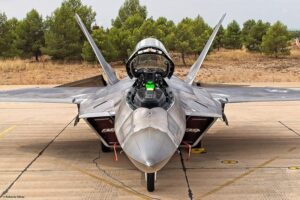
The Lockheed Martin F-22 Raptor
The Chengdu J-20
Two machines.
Two visions.
Two futures.
Hayes stepped forward first.
“Before we begin,” he said, his voice calm but cutting through the room, “we need to destroy a myth.”
He paused.
“This is not a debate about which jet is ‘cooler’… or ‘faster’… or ‘stronger.’”
He looked directly at the audience.
“This is a debate about how nations think.”
Lin Wei smiled slightly.
“And how they prepare for war,” he added.
A silence fell—heavy, deliberate.
Hayes turned and pointed at the F-22.
“This aircraft,” he said, “was built with a single obsession: control the sky, and you control everything beneath it.”
Lin walked toward the J-20.
“And this one,” he said, “was built with a different question: what if you don’t fight for the sky… but instead make the sky irrelevant?”
The audience shifted.
That landed.
“Let’s begin with stealth,” Hayes said.
The room darkened. Radar waves spread across the display like ripples across water.
“The F-22,” Hayes continued, “is not just stealthy—it is refined stealth. Every edge aligned. Every surface calculated. Every material engineered to scatter, absorb, and confuse detection from multiple angles.”
Lin nodded.
“That is true,” he said. “But the J-20 takes a different approach—optimize frontal stealth, because that is where engagements begin.”
Hayes turned sharply.
“And where they end?” he asked.
Lin didn’t hesitate.
“That depends on who survives the first move.”
A low murmur moved through the crowd.
Hayes stepped closer to the projection.
“Stealth is not a suggestion,” he said. “It is survival. The moment you are detected—you are already behind.”
Lin raised a finger.
“Unless,” he said calmly, “your doctrine ensures you strike before detection even matters.”
Hayes studied him.
“You’re talking about long-range engagements.”
Lin nodded.
“Yes.”
The screen shifted—missile trajectories stretching across enormous distances.
“The J-20,” Lin said, “was designed to target what truly matters—tankers, AWACS, airborne command centers.”
He looked around the room.
“Remove those… and even the most advanced fighters become isolated.”
Hayes crossed his arms.
“And who protects those assets?” he asked.
Lin didn’t answer.
“The F-22 does,” Hayes said. “It was built to hunt threats like the J-20 before they ever get close.”
Lin stepped forward, voice tightening slightly.
“And what if the hunter is never seen?”
Now it was Hayes who paused.
The tension sharpened.
“Let’s move closer,” Hayes said.
The projection zoomed—engines igniting, aircraft twisting through impossible angles.
“Maneuverability,” Hayes continued. “The F-22 uses thrust-vectoring engines—allowing it to change direction mid-air in ways that defy conventional aerodynamics.”
Lin folded his arms.
“And how often,” he asked, “does modern combat truly reach that distance?”
Hayes answered instantly.
“Often enough to matter.”
Lin shook his head slightly.
“The battlefield is changing,” he said. “Distance is growing. Engagements begin earlier. Decisions are made before pilots even see each other.”
Hayes stepped closer.
“And when those assumptions fail?” he asked.
Lin met his gaze.
“Then the pilot adapts.”
Hayes smiled—but there was no humor in it.
“The F-22 doesn’t rely on adaptation,” he said. “It dominates in every range.”
The room went still.
Lin walked slowly across the stage.
“Dominance,” he said quietly, “can become dependency.”
Hayes narrowed his eyes.
“Explain.”
“If you build a system believing it cannot be challenged,” Lin said, “you risk the moment when it finally is.”
Hayes responded immediately.
“And if you build a system designed only to challenge… you risk never achieving true control.”
The clash was no longer technical.
It was philosophical.
“Speed,” Hayes said, shifting again.
The F-22 surged across the screen.
“Supercruise,” he said. “Sustained supersonic flight without afterburner. Less fuel. Less heat. More efficiency. Proven in real operations.”
Lin nodded.
“The J-20 is believed to be achieving similar capabilities in newer variants.”
Hayes turned.
“Belief is not evidence.”
Lin’s voice sharpened.
“And early advantage is not permanent.”
The air between them tightened.
“Let’s talk sensors,” Lin said.
The room filled with data—signals, detection arcs, electronic warfare overlays.
“The J-20 benefits from modern electronics,” Lin explained. “Advanced radar, long-range targeting, integration with broader networks.”
Hayes responded.
“And the F-22 pioneered sensor fusion—combining data into a single, real-time understanding of the battlefield long before others.”
Lin stepped closer.
“So which is stronger?” he asked. “The pioneer… or the modernizer?”
Hayes didn’t hesitate.
“The one that has been tested, refined, and proven under real conditions.”
Lin’s expression didn’t change.
“Or the one that is still evolving.”
A long silence followed.
Then Hayes spoke more quietly.
“Experience matters,” he said.
Lin nodded.
“It does.”
“But so does momentum,” Lin added.
Now both men stood at the center.
No longer opposing sides.
But two halves of a larger truth.
Hayes turned to the audience.
“In a direct air-to-air fight,” he said, “the F-22 holds the edge—stealth, agility, maturity.”
Lin followed.
“In long-range strategic engagement,” he said, “the J-20 introduces new risks—especially to support systems.”
Neither disagreed.
Then Hayes asked the question.
“So who dominates the world?”
No one moved.
Lin looked at the two aircraft… then back at Hayes.
“No single machine dominates the world,” he said.
“Systems do. Strategy does. People do.”
Hayes nodded slowly.
“That is true.”
He took a step forward.
“But let’s not pretend all foundations are equal.”
The room held its breath.
“The modern era of air superiority,” Hayes said, “was not shaped by accident. It was built—deliberately—through decades of scientific breakthroughs.”
He gestured toward the F-22.
“This aircraft is not just a fighter,” he said.
“It is the result of unmatched integration—physics, engineering, computation, materials science—all brought together into something that redefined what air combat means.”
Lin listened.
Carefully.
Respectfully.
Hayes continued.
“Others are advancing. Others are innovating. That is good. That is necessary.”
He paused.
“But innovation at this level does not happen overnight. It requires infrastructure. Discipline. Scientific culture. Relentless testing. Failure… and learning from failure.”
He turned fully to the audience now.
“And today—whether we are comfortable saying it or not—the benchmark that others measure against… was built by American scientific leadership.”
Silence.
Not resistance.
Not applause.
Just understanding.
Lin finally spoke.
“And the question now,” he said, “is not whether others can reach that level…”
He looked at the audience.
“…but how long it will take.”
Hayes nodded.
“And what happens when they do.”
The lights dimmed slowly.
The two aircraft faded into shadow.
But one truth remained—clear, undeniable, and powerful:
Dominance is not declared.
It is earned—
Through knowledge.
Through discipline.
Through science that refuses to stand still.
And the sky…
Still remembers who changed it first.