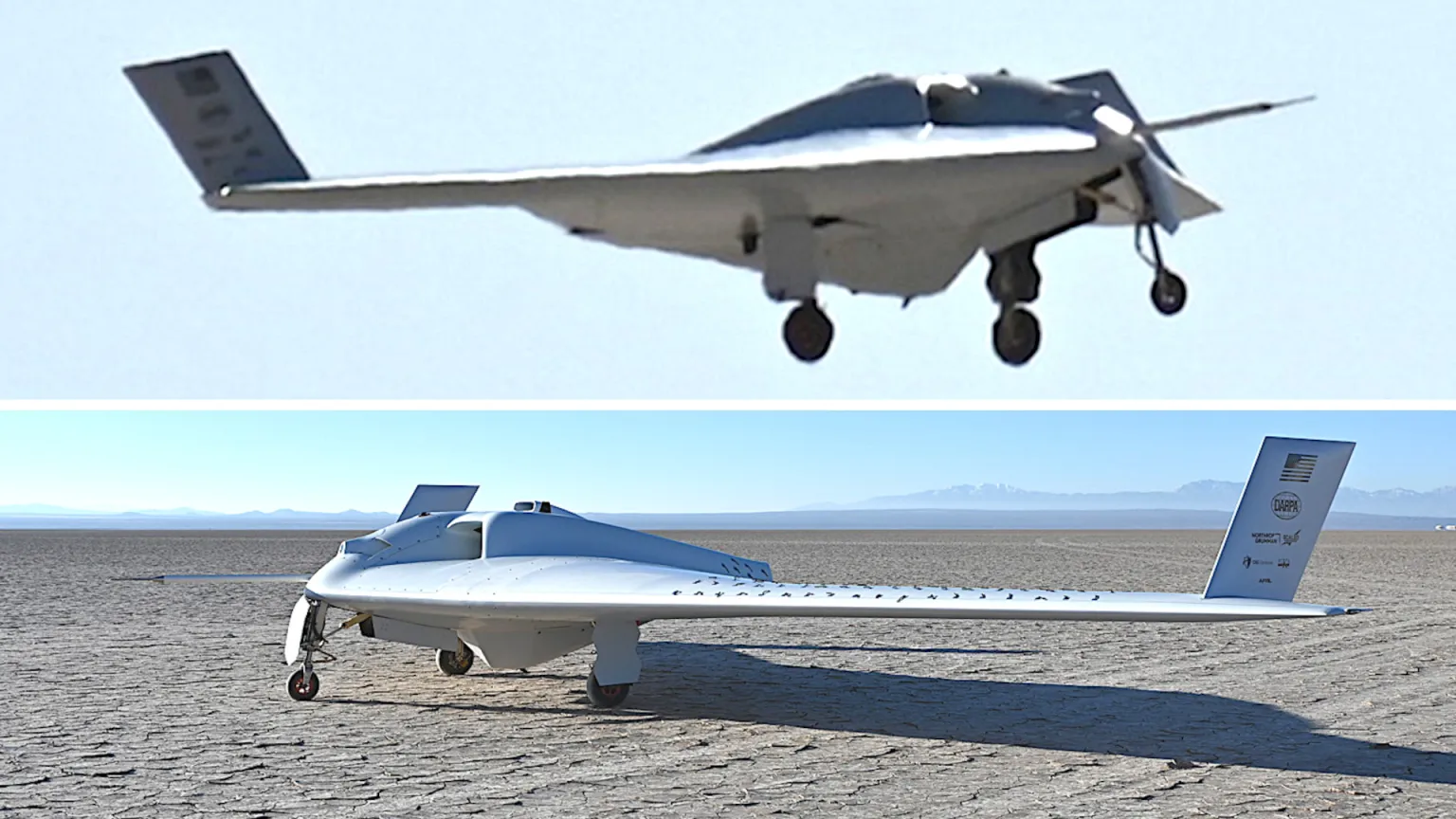
In the silent skies above the California desert, a new kind of aircraft has begun to rewrite the future of aerial warfare.
The experimental XRQ-73 — a futuristic hybrid-electric flying wing drone developed under DARPA’s Series Hybrid Electric Propulsion AiRcraft Demonstration (SHEPARD) program — has officially taken flight. More than just another unmanned aircraft, the XRQ-73 represents a bold leap into a future where drones can fly farther, quieter, and with a level of efficiency that could transform military aviation itself.
Built by Northrop Grumman with major involvement from Scaled Composites — the legendary “bleeding edge” aircraft design house and wholly-owned Northrop subsidiary — the drone took to the skies in April during flight testing conducted from Edwards Air Force Base. The milestone was announced jointly with the Air Force Research Laboratory.
But this flight was about far more than simply getting airborne.
You May Also Like


The XRQ-73 was designed around one critical vision: creating an aircraft that is extraordinarily quiet, highly fuel-efficient, and capable of unlocking entirely new operational possibilities. At the heart of the project is hybrid-electric propulsion technology — a system that blends traditional fuel-powered propulsion with electric power in ways that could dramatically reduce infrared and acoustic signatures while improving endurance and flexibility.
“This milestone is not just about a single flight,” said Air Force Lt. Col. Clark McGehee, the SHEPARD program manager at Defense Advanced Research Projects Agency. “The architecture proven by the XRQ-73 paves the way for new types of mission systems and delivered effects. We look forward to advancing this technology through the flight test program and delivering new capabilities for our warfighters.”
DARPA emphasized that hybrid-electric propulsion could drive the creation of revolutionary aircraft designs by combining fuel efficiency, lower emissions, and enhanced operational flexibility. Northrop Grumman echoed that vision, describing the XRQ-73 as a major step toward next-generation propulsion systems for lightweight autonomous aircraft.
Yet perhaps the most fascinating part of the XRQ-73 story is how much the aircraft has evolved.
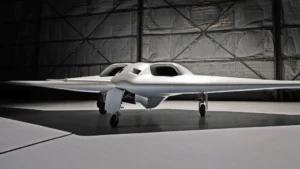
When the drone first emerged publicly in 2024, it already looked unlike most modern unmanned systems — a sleek flying-wing aircraft with a stealthy profile and mysterious mission potential. But the newly released images from its first flight reveal significant design changes that suggest engineers have been refining the aircraft aggressively behind closed doors.
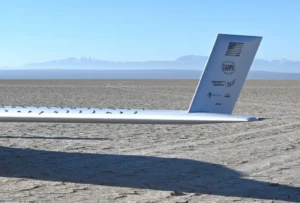
The most visually striking change is the addition of two vertical stabilizers mounted near the outer sections of the wings. Though not positioned at the wing tips themselves, the stabilizers immediately stand out against the drone’s otherwise smooth flying-wing design. Interestingly, its predecessor — the XRQ-72A — also used vertical wingtip stabilizers, hinting at an evolving aerodynamic philosophy carried over from earlier experimentation.
The XRQ-73 itself evolved directly from the XRQ-72A, another advanced Scaled Composites design originally created for the Intelligence Advanced Research Projects Activity.
Additional modifications can now be seen across the aircraft’s upper fuselage. Alongside the two large dorsal air intakes already known from previous sightings, engineers have added a smaller auxiliary intake positioned between them. While exact details of the hybrid propulsion layout remain classified or undisclosed, these modifications strongly suggest ongoing optimization of airflow management and cooling systems.
Observers have also noted at least two new black blade antennas mounted atop the fuselage, hinting at expanded communications, telemetry, or testing systems.
At the nose of the aircraft, another important addition has appeared: a forward-facing camera system enclosed inside a fairing at the front center section of the fuselage. This system likely provides visual data for aircraft control and enhanced situational awareness during flight testing. The fairing itself sits between two rectangular “nostril” intakes, which analysts believe may help cool the hybrid powerplant and onboard electronics or provide cleaner airflow during demanding flight phases such as takeoff and landing.
Despite these changes, the aircraft’s overall shape remains unmistakably stealth-oriented.
A large faceted structure beneath the fuselage — believed to house sensors or test instrumentation — remains present. Combined with the aircraft’s low-observable flying-wing design and reduced thermal and acoustic signatures from hybrid-electric propulsion, the XRQ-73 could potentially become an exceptionally difficult aircraft to detect.
Official details about the drone’s exact performance remain limited, but DARPA has confirmed the XRQ-73 is categorized as a Group 3 Uncrewed Aerial System (UAS), weighing approximately 1,250 pounds. Under U.S. military definitions, Group 3 drones operate between 3,500 and 18,000 feet in altitude and can reach speeds between 100 and 250 knots.
That makes the XRQ-73 substantially larger than the earlier XRQ-72A, whose requirements called for a drone weighing only 300 to 400 pounds. The XRQ-72A reportedly featured a 30-foot wingspan, an 11.2-foot overall length, and a height of four feet including its vertical stabilizers.
What missions the XRQ-73 may ultimately perform remains uncertain — but clues already exist.
Its “RQ” designation traditionally points toward intelligence, surveillance, and reconnaissance missions. However, the aircraft’s design characteristics suggest it could potentially evolve into a multi-role platform. A drone capable of flying quietly with reduced heat and radar signatures could prove invaluable for covert surveillance, electronic warfare, strike operations, or operations deep inside heavily defended airspace.
And the XRQ-73 may not be alone.
Last May, the AFRL awarded General Atomics a contract worth just over $99 million for another highly similar project known as GHOST — a hybrid-electric propulsion ducted-fan next-generation ISR/strike unmanned aerial system.
At the time, General Atomics spokesperson C. Mark Brinkley offered a cryptic remark when asked about the project:
“We’ve been promising something impressive related to hybrid-electric propulsion, and now I can’t talk about it anymore. That’s how it goes with these things. Contrary to what you see on the news, the revolution won’t be televised.”
That statement now feels even more significant.
Behind the scenes, a quiet revolution in military aviation may already be unfolding — one powered not only by stealth and autonomy, but by entirely new forms of propulsion.
DARPA originally hoped the XRQ-73 would fly before the end of 2024, but the schedule slipped due to what officials later described as “complex, unforeseen technical challenges” encountered during ground testing and system integration.
Lt. Col. Clark McGehee later explained:
“X-plane programs are designed to push the extreme limits of aerospace engineering, integrating entirely unproven concepts and revolutionary designs.”
Even so, the aircraft has now crossed one of the most difficult milestones in aerospace development: it has flown.
And that changes everything.
Because once an experimental aircraft leaves the runway and enters the sky, it stops being merely an idea.
It becomes proof that the future has already begun.