Loyalty Under Fire: The Mechanic Who Saved the USS Gerald R. Ford
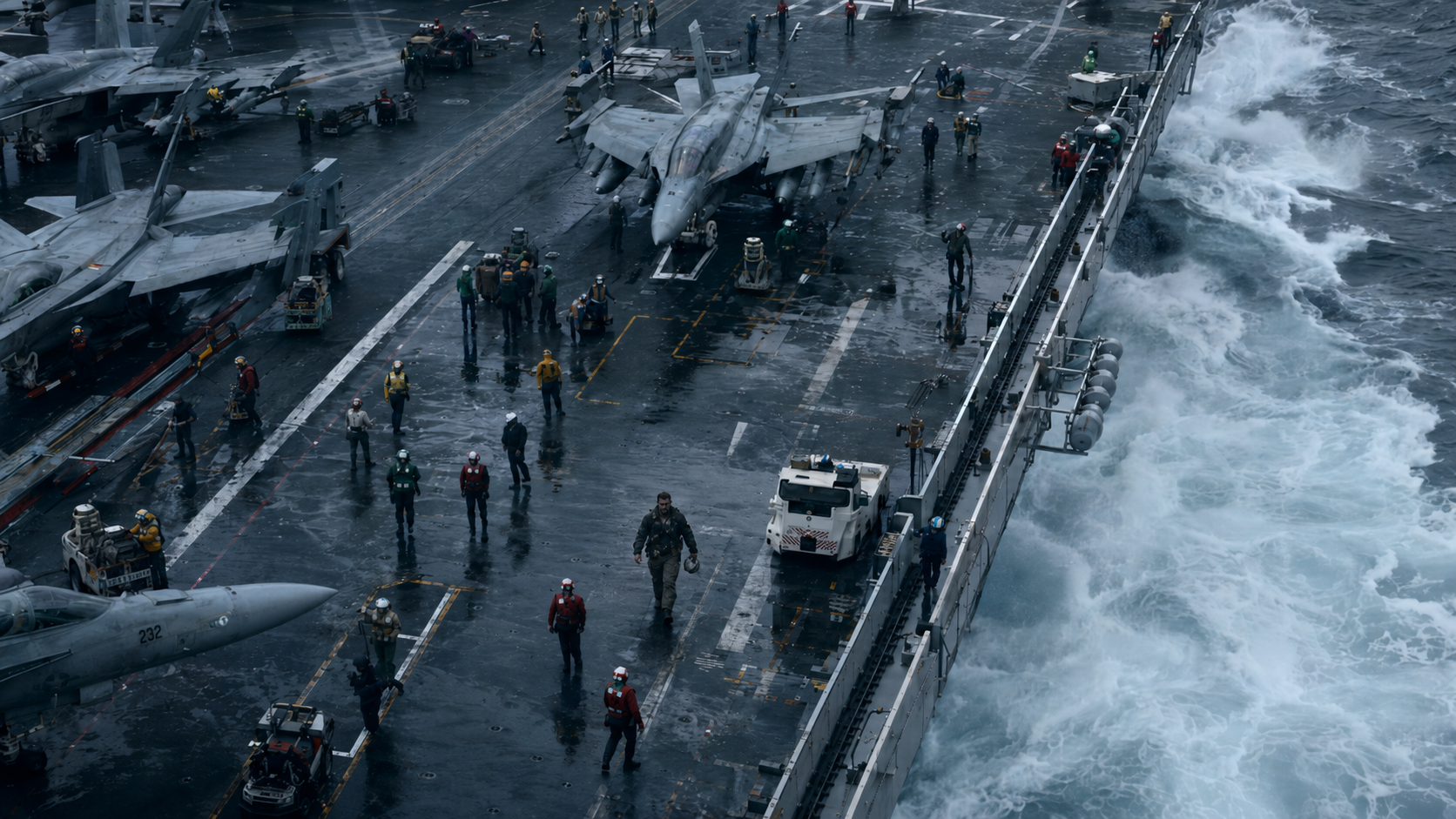
The ocean rose like a black wall beneath the USS Gerald R. Ford.
Rain hammered the flight deck in silver sheets. Wind screamed across the carrier’s island. Every light on the deck seemed to tremble inside the storm, flashing red, amber, and white against the angry Atlantic night.
The Ford was not supposed to be afraid of weather.
She was the pride of American naval power — a floating fortress of steel, technology, discipline, and force projection. Her electromagnetic launch system could throw aircraft into the sky with impossible precision. Her deck crews moved like living machinery. Her reactors powered a city. Her presence could shift the balance of nations.
You May Also Like
But tonight, the sea did not care about reputation.
A wave crashed over the bow hard enough to send white water rushing across the forward deck. Sailors braced against tie-down chains, their boots sliding on the slick non-skid surface. An F/A-18 sat trembling on the catapult line, its nose pointed toward darkness, its wings loaded, its engines whining like an animal held back by a leash.
Inside the launch control station, alarms began to pulse.
A red warning blinked across the display.
EMALS POWER FLUCTUATION — CATAPULT 2 INSTABILITY
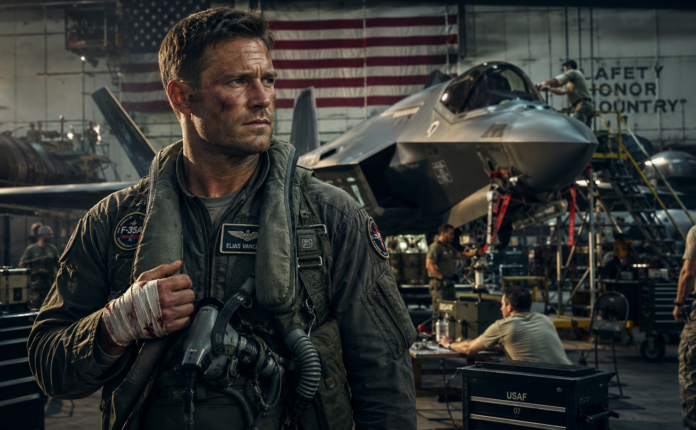
Captain Elias Vance saw it before anyone else understood what it meant.
He was kneeling beside a maintenance access panel near the starboard catapult track, one gloved hand pressed against the wet deck, the other gripping a diagnostic tablet. Rain streamed down his helmet visor. His left leg ached where shrapnel from an old training accident had left him with a permanent limp. Most men would have taken a desk assignment after that injury.
Elias refused.
Machines spoke to him in patterns. Vibrations. Heat signatures. Timing errors. Tiny hesitations before failure. And right now, the Ford’s launch system was telling him something was wrong.
Very wrong.
He pressed his headset tighter.
“Flight Control, this is Vance on Cat Two. Suspend launch. Repeat, suspend launch. I’ve got unstable power cycling in the launch motor segment.”
Static cracked in his ear.
Then a calm, hard voice replied.
“Negative, Captain. Launch window remains active.”
Elias looked up toward the island.
Colonel Marcus Hale stood behind the glass of the flight deck control room, broad-shouldered, composed, and untouchable. Hale had the kind of face men trusted in crisis — sharp jaw, silver hair, a decorated chest, eyes that never seemed to doubt. He was respected by admirals, feared by junior officers, and admired by the press whenever the Navy needed a symbol of command.
But Elias had learned long ago that reputation was not the same as honor.
“Colonel Hale,” Elias said, forcing his voice through the storm, “if that bird launches with Cat Two fluctuating, we risk a cold shot. Pilot won’t clear the bow.”
There was a pause.
Then Hale answered, loud enough for others on the circuit to hear.
“Captain Vance, you have made this warning three times in the past month. Every time, the system checked green. I will not delay flight operations because one mechanic sees ghosts in the machine.”
Elias felt the words cut deeper than the rain.
Around him, deck crew members glanced his way. Some with concern. Some with doubt.
Lieutenant Nora Hayes pushed through the storm toward him, her yellow flight deck jersey soaked dark against her shoulders. She was brilliant, steady, and fiercely loyal — the kind of officer who did not waste words and did not abandon people when pressure came down from above.
“The U.S. Air Force’s B-1B bombers are loading hundreds of JDAM bombs for the Middle East.”
She crouched beside Elias.
“What are you seeing?”
He turned the tablet toward her.
“Voltage spike in segment seven. Then a delayed correction from the control module. It’s small, but it’s repeating.”
Nora’s eyes narrowed.
“That could throw launch force out of tolerance.”
“It will,” Elias said. “Not every time. But soon.”
A voice boomed over deck comms.
“Prepare aircraft for launch.”
The F/A-18’s engines roared harder.
Elias rose, pain stabbing through his leg.
“No,” he whispered.
Then he shouted.
“Abort launch!”
For one frozen second, the entire deck seemed to hold its breath.
Then Colonel Hale’s voice exploded over the circuit.
“Security, remove Captain Vance from the launch zone.”
Two armed sailors approached through the rain.
Nora stood up fast.
“Sir, Captain Vance is the senior mechanic assigned to this system.”
“And he is interfering with operations,” Hale snapped. “Remove him.”
Elias looked past the sailors at the aircraft on the catapult. Inside that cockpit sat Lieutenant Daniel Cross, twenty-six years old, newly married, father to a baby girl he had only seen twice since deployment.
Elias had repaired Cross’s jet three nights ago. He remembered the photo taped inside the pilot’s locker. A smiling woman. A baby in a yellow blanket.
Honor was not a speech. It was not a medal. It was what a man did when obeying orders became easier than telling the truth.
Elias stepped forward.
The sailors grabbed his arms.
“Get him off my deck,” Hale ordered.
Nora’s voice shook with anger.
“Colonel, you’re making a mistake.”
Hale turned toward her.
“Lieutenant Hayes, one more word and you will join him.”
Elias did not fight the sailors. He only stared at the jet.
“Cross,” he said into his headset, hoping the pilot could hear him. “If you feel low acceleration, eject immediately. Do you hear me? Do not hesitate.”
No answer came.
The shooter dropped to one knee and pointed down the deck.
Steam rose.
The catapult fired.
For half a second, the F/A-18 surged forward like thunder given shape.
Then the nose dipped.
Every soul on the deck saw it.
The jet was too slow.
“Cold shot!” someone screamed.
The fighter reached the bow, dropped below the deck line, vanished into spray, and for one unbearable heartbeat disappeared into the black sea.
Then a fireball flashed low beyond the bow as the pilot ejected.
The deck erupted into chaos.
“Man overboard!”
“Pilot in the water!”
“Rescue team deploy!”
“Secure Cat Two!”
Elias tore free from one sailor and ran despite the pain in his leg. Nora sprinted beside him. Rescue lights swept over the waves. A helicopter crew scrambled. The entire carrier shifted from launch operations into emergency recovery.
Colonel Hale said nothing.
He simply stood behind the glass, his face pale now, watching the storm swallow the consequences of his decision.
Lieutenant Cross survived.
Barely.
The rescue helicopter found him fighting the waves beneath a flashing beacon, one arm broken, ribs fractured, flight suit torn, his body half-conscious in freezing water. When they brought him aboard, Elias stood at the edge of the hangar bay as medics rushed the young pilot past on a stretcher.
Cross’s eyes opened for a second.
He saw Elias.
His lips moved.
No sound came out.
But Elias understood anyway.
You warned them.
The next morning, the storm had weakened, but a different kind of storm began below deck.
Captain Elias Vance was ordered into an inquiry room.
The space was cold, windowless, and too clean. A long table sat beneath white lights. On one side were senior officers, legal personnel, and Colonel Marcus Hale. On the other side sat Elias alone, still wearing the same uniform he had been dragged in, his face marked by exhaustion.
Hale stood first.
“Captain Vance has a pattern of disruptive behavior regarding the electromagnetic launch system,” he said. “He has repeatedly questioned certified operational readiness. Last night, during critical flight operations, he created confusion on the deck and compromised command discipline.”
Elias stared at him.
“Compromised command discipline?” Elias said quietly. “A pilot nearly died.”
Hale’s jaw tightened.
“A pilot survived because emergency procedures worked. But the launch failure occurred after unauthorized interference by maintenance personnel.”
Nora, standing near the rear of the room, looked up sharply.
Elias leaned forward.
“Are you saying I caused the cold shot?”
“I’m saying,” Hale replied, “your actions introduced instability into an already complex operation.”
A murmur moved through the room.
Elias felt the trap closing.
He had seen it before in broken machines and broken men: misdirection, pressure, blame. Someone powerful had made a decision. Someone lower had to carry the weight.
Rear Admiral Pierce, the presiding officer, folded his hands.
“Captain Vance, did you open an active catapult access panel before launch?”
“Yes, sir.”
“Did you connect a diagnostic device to the launch control subsystem?”
“Yes, sir. Standard procedure for fault verification.”
“Were you ordered to stand down?”
“Yes, sir.”
“And did you refuse?”
Elias swallowed.
“I refused to ignore a fault that could kill a pilot.”
Hale gave a faint, disappointed sigh, as though Elias had proved his point.
The admiral’s expression hardened.
“Until this inquiry concludes, Captain Vance is relieved of flight deck maintenance authority.”
The words hit the room like a verdict.
Elias did not move.
For eighteen years, he had lived by the rhythm of engines, catapult cycles, launch signals, and deck crews. He had missed birthdays, funerals, Christmas mornings, and every ordinary comfort civilians took for granted. He had bled for the Navy. He had given his leg, his marriage, his sleep, and most of his youth.
Now he was being removed as if he were the danger.
As Elias stepped into the corridor after the hearing, sailors looked away. Some out of shame. Some out of fear. A few whispered.
That’s him.
The mechanic who froze during launch.
Hale said he caused it.
The humiliation burned worse than any wound.
Nora found him near the maintenance bay, standing alone beside a wall of tool lockers.
“You know this isn’t over,” she said.
Elias gave a tired smile.
“It usually is when the decorated officer writes the story first.”
Nora stepped closer.
“Then we find the truth before he finishes writing it.”
He looked at her.
“You heard the inquiry. They’ve already decided I’m the convenient answer.”
“No,” Nora said. “They’ve decided you’re the easiest answer. That’s different.”
For the first time since the accident, Elias breathed deeply.
Nora lowered her voice.
“I checked the logs.”
His eyes sharpened.
“What logs?”
“Cat Two’s maintenance history. Your warnings weren’t ghosts. There were data gaps.”
Elias went still.
“Gaps?”
“Three-second holes in the diagnostic record after every power fluctuation. Too clean to be a system error.”
Elias felt the old mechanic inside him wake up.
“Deleted?”
“Masked,” Nora said. “Someone didn’t erase the problem. They taught the system not to report it.”
A chill moved through him.
Carrier deck launch technology was built around precision. The electromagnetic system had layers of safeguards, diagnostics, and control logic. It could adjust launch energy to aircraft weight, wind conditions, and operational parameters. But if someone manipulated the reporting data, the system might appear ready while hiding a failing component.
That was not negligence.
That was sabotage — or something close to it.
“Who had access?” Elias asked.
Nora hesitated.
“Hale.”
The name hung between them.
Outside, the carrier cut through gray seas. Inside, something darker moved through the chain of command.
Elias shook his head slowly.
“Hale is many things, but why would he risk a pilot?”
Nora’s face tightened.
“Maybe he wasn’t trying to risk one. Maybe he was trying to hide something before inspection.”
That night, Elias did something that could end his career permanently.
He returned to the restricted maintenance compartment below Catapult Two.
Nora went with him.
They moved through narrow passageways lit by red emergency bulbs, past pipes, cables, and steel bulkheads sweating condensation. The ship groaned around them, alive with machinery and motion. Above their heads, aircraft were being repositioned on the deck. Every vibration traveled through the bones of the carrier.
Nora carried a portable access module.
Elias carried tools.
“You realize,” she whispered, “if they catch us here, Hale won’t just relieve you. He’ll bury both of us.”
Elias opened a panel.
“Then let’s be worth burying.”
For two hours, they worked in silence.
Elias traced the power irregularity from the launch motor segment to an auxiliary control interface. Nora pulled encrypted event logs, comparing timestamps with launch cycles, maintenance orders, and command overrides.
“How Many Hours Can The B-2 Spirit Bomber Fly Without Refueling?”
Then she found it.
“Elias.”
He looked over.
On her screen was a hidden command pathway routed through an officer-level authorization key.
The signature was partial, but enough.
M. HALE
Elias felt anger rise, but Nora held up a hand.
“There’s more.”
She opened a second file.
It was a procurement record. Replacement components for Catapult Two had been flagged weeks earlier after microfractures were discovered in a power regulation unit. The system should have been taken offline until the part was replaced.
But the replacement never happened.
Instead, the warning was downgraded.
The inspection report was altered.
And the Ford continued launching aircraft.
Elias stared at the record.
“Why?”
Nora scrolled.
Her face changed.
“What is it?” Elias asked.
She read silently, then turned the screen.
A classified readiness demonstration was scheduled within forty-eight hours. Senior defense officials and allied observers were coming aboard to witness high-tempo flight operations. The Ford’s launch system performance was central to the demonstration.
If Catapult Two had been shut down, the carrier’s readiness rating would have taken a hit.
And Colonel Marcus Hale’s promotion file was under review.
Elias closed his eyes.
A man had risked pilots to protect his reputation.
Suddenly, a sound echoed down the passageway.
Boots.
Nora killed the screen.
Too late.
The hatch opened.
Colonel Hale stepped inside with two security officers.
For a moment, nobody spoke.
Hale looked at the open panel, the unauthorized module, the data cable in Nora’s hand.
Then his expression hardened into something Elias had never seen before — not command, not discipline, but fear disguised as rage.
“Captain Vance,” Hale said, “you just made this very easy.”
Security seized them.
This time, Elias did fight.
Not with fists, but with words.
“You knew Cat Two was unsafe.”
Hale stepped close.
“You are a wounded mechanic with a discipline problem.”
“You altered the logs.”
“You have no proof.”
Nora lifted her chin.
“We copied enough.”
Hale smiled coldly.
“No. You copied what I allowed you to find.”
Elias’s blood went cold.
Hale leaned in, his voice barely above a whisper.
“You think you’re the first honest man to challenge a system that needs results? This ship is bigger than your conscience. The mission is bigger than one pilot. Bigger than you.”
Elias looked at him with disgust.
“No mission is bigger than the truth.”
Hale’s eyes flickered.
“Take them.”
They were confined separately.
Elias was placed in a small holding compartment two decks below the hangar bay. No tools. No comms. No tablet. Just a steel bench, a bolted door, and the distant roar of the carrier continuing operations without him.
Hours passed.
He thought of Lieutenant Cross in medical, breathing through pain because one officer cared more about appearances than life.
He thought of Nora, brave enough to stand beside him when everyone else stepped back.
He thought of his father, a machinist from Ohio who had once told him, “Son, the measure of a man isn’t how loud he defends his name. It’s what he protects when no one believes him.”
Elias had protected machines his whole life.
But now he understood.
He had never really been protecting steel.
He had been protecting the people who trusted it.
A sudden jolt shook the compartment.
Then another.
The lights flickered.
Elias stood.
A general alarm sounded through the ship.
“All hands, brace for heavy seas. Flight operations emergency condition. Catapult Two malfunction. Repeat, Catapult Two malfunction.”
Elias moved to the door.
“No,” he whispered.
Above him, disaster had returned.
On the flight deck, chaos unfolded in rain and darkness.
The readiness demonstration had been moved forward due to changing weather and operational demands. Colonel Hale, desperate to prove control before rumors spread, had authorized another launch from Catapult Two after forcing the system into green status.
This time, it was not an F/A-18.
It was an E-2D Hawkeye aircraft positioned for launch — heavier, broader, vital for airborne command and control.
The catapult shuttle locked.
The aircraft engines spooled.
Then the EMALS system surged.
Not low.
High.
Too high.
Warning lights exploded across the launch console.
The deck crew froze.
If the catapult fired at excessive force, it could rip the nose gear apart, tear the aircraft off-line, send debris across the deck, kill sailors, and ignite fuel in the worst possible place on earth — the crowded flight deck of a nuclear-powered aircraft carrier in rough seas.
In Flight Deck Control, Hale stared at the warning display.
His officers shouted over each other.
“Abort!”
“System not responding!”
“Manual cutoff failed!”
“Power still building!”
Hale’s face drained of color.
For the first time in his decorated career, Colonel Marcus Hale had no speech, no command voice, no blame ready.
He had built a lie around a machine.
Now the machine was telling the truth.
Lieutenant Nora Hayes, being escorted across the hangar bay, heard the alarm and reacted instantly. She drove her elbow into the nearest security officer, twisted free, and sprinted toward the emergency maintenance access ladder.
“Nora!” a sailor shouted.
She did not stop.
She reached the communications station and grabbed a handset.
“Release Captain Vance now! He’s the only one who knows the fault path!”
The officer on duty hesitated.
Nora slammed her palm against the console.
“If that aircraft launches, people die!”
Seconds later, Elias’s holding compartment door opened.
A young petty officer stood there, pale and breathless.
“Captain Vance, they need you on deck.”
Elias did not ask who changed the order.
He ran.
Pain tore through his injured leg with every step, but he climbed ladders, crossed passageways, and pushed through sailors rushing in the opposite direction. By the time he reached the flight deck access, rain and wind blasted into him like a physical wall.
The deck was a nightmare of flashing lights and shouting voices.
The Hawkeye strained against the shuttle.
Deck crew were evacuating the immediate danger zone.
The catapult was charging beyond safe limits.
Nora appeared beside Elias, soaked and breathing hard.
“Segment seven overload,” she shouted. “Control module won’t accept abort.”
Elias looked across the deck.
“How long?”
“Maybe two minutes before automatic discharge or structural failure.”
“Manual isolation?”
“Locked out from command.”
Elias looked up at the island.
Behind the glass, he could see Hale standing frozen.
Elias grabbed a toolkit from a nearby locker.
Nora understood immediately.
“No,” she said. “The isolation junction is under the forward access trench.”
“I know.”
“You’d have to cross the launch path.”
“I know.”
“If it fires—”
“It won’t.”
She grabbed his arm.
“Elias.”
For one second, in the middle of the storm, there was no carrier, no rank, no accusation, no Hale.
Only two people who knew the cost of courage.
Nora’s voice broke.
“You don’t have to prove anything to them.”
Elias looked at the sailors on the deck, the aircraft trembling against the catapult, the terrified young crewmen trusting officers they could not see.
“Yes,” he said softly. “I do.”
Then he ran.
The deck tilted beneath him as the Ford punched through another wave. Rain blinded him. Wind shoved him sideways. The Hawkeye’s engines screamed behind him. He crossed beneath warning lights, dropped to his knees at the access trench, and tore open the panel.
Inside, cables and junction hardware vibrated with dangerous energy.
Nora was in his headset now, feeding him readings.
“Power climbing. Elias, hurry.”
He reached into the panel.
A spark snapped across his glove.
He grunted but kept working.
“Main cutoff is fused,” he said.
“Can you bypass?”
“Not cleanly.”
“What does that mean?”
“It means the system won’t forgive me.”
He pulled a manual isolation wrench from the kit and fitted it onto the emergency mechanical disconnect.
The wrench did not move.
His injured leg slipped on the wet deck.
He tried again.
Nothing.
Above him, the Hawkeye shuddered.
The catapult tone changed — a rising electrical scream.
Nora shouted, “Thirty seconds!”
Elias looked at the wrench.
Then at his left leg.
The damaged one.
The one everyone thought made him weaker.
He braced his boot against the edge of the trench, wrapped both hands around the wrench, and drove his full body weight into it.
Pain exploded through him.
He screamed.
The wrench turned one inch.
Then two.
A warning alarm changed pitch.
“Twenty seconds!” Nora cried.
Elias pulled again.
His knee buckled.
He fell hard, shoulder slamming into the deck.
For a moment, he almost blacked out.
Then a shadow covered him.
A deck crewman had returned.
Then another.
Then three more.
No order had been given. No speech made. They had simply watched a falsely accused man crawl into danger to save them, and something stronger than fear had answered.
Together, they grabbed the wrench.
“On three!” Elias shouted.
“One!”
The ship rolled.
“Two!”
The catapult screamed.
“Three!”
They pulled.
The isolation lever slammed into place.
A burst of sparks shot into the rain.
The lights on Catapult Two went dead.
The Hawkeye’s engines roared harmlessly against silence.
The deck froze.
Then the alarm stopped.
For two seconds, there was only rain.
Then cheers erupted across the flight deck.
Sailors shouted Elias’s name. Crewmen pounded each other on the shoulders. Nora ran to him, sliding to her knees as he collapsed beside the open panel.
“A Sergeant Humiliated Her in the Mess Hall —Then Her Navy SEAL Dragon Tattoo Froze the Military Base…”
“Elias!”
He tried to smile.
“Tell me the aircraft is still on deck.”
She laughed through tears.
“It’s still on deck.”
“Good,” he said. “I hate paperwork.”
Nora pressed her hand against his shoulder.
“You idiot.”
He closed his eyes.
“Loyal idiot.”
By dawn, the storm had passed.
The sky opened in pale gold above the USS Gerald R. Ford. The sea still rolled, but the violence had gone out of it. Sailors moved across the flight deck with quiet purpose, inspecting tie-downs, checking aircraft, and repairing the scars of the night.
Colonel Marcus Hale was summoned to the admiral’s conference room at 0600.
This time, Elias Vance was not alone.
Lieutenant Nora Hayes stood beside him.
So did three deck crewmen.
So did the launch control officer.
So did the recovered system logs, Nora’s copied files, and the emergency data recorded during the final malfunction.
Admiral Pierce entered with a face like stone.
He did not sit.
“Colonel Hale,” he said, “you altered readiness reports, suppressed maintenance warnings, bypassed safety protocols, and falsely accused a subordinate officer to conceal your actions.”
Hale’s mouth tightened.
“Admiral, operational pressure required—”
“Silence.”
The room went still.
The admiral stepped closer.
“Operational pressure does not excuse cowardice. It reveals it.”
Hale looked toward Elias with hatred burning beneath his polished composure.
Elias did not look away.
The admiral continued.
“Captain Vance warned command repeatedly. He was ignored, humiliated, confined, and blamed for a failure he tried to prevent. Then, when the system failed again, he risked his life to save this ship and its crew.”
Hale said nothing.
“Colonel Marcus Hale, you are relieved of duty pending court-martial proceedings.”
The words landed with finality.
Security stepped forward.
For the first time, Hale looked small.
Not because his rank had been removed.
But because the truth had.
As they escorted him out, Hale paused beside Elias.
“You think they’ll remember you?” he whispered.
Elias looked at the flight deck through the conference room window, where sailors were already returning to work.
“No,” he said. “I think they’ll remember what almost happened when honor became optional.”
Hale had no answer.
Later that day, the crew gathered in the hangar bay.
Lieutenant Cross, arm in a sling and ribs bandaged, stood with medical support near the front. When Elias entered, walking slowly with a brace on his leg, the entire bay rose in applause.
He stopped, overwhelmed.
Mechanics. Pilots. Deck crew. Officers. Sailors who had doubted him. Sailors who had believed him. All of them standing together.
Nora stood near the front, smiling through tired eyes.
Admiral Pierce approached with a citation in hand.
“Captain Elias Vance,” he said, voice carrying through the hangar, “you demonstrated courage under pressure, technical excellence under impossible conditions, and loyalty not to reputation, not to comfort, but to the lives entrusted to this ship.”
The admiral paused.
“In the United States Navy, honor is not proven when the sea is calm. It is proven when the deck is shaking, the order is wrong, and the truth costs everything.”
Elias lowered his eyes.
For once, he had no words.
Lieutenant Cross stepped forward carefully.
“My daughter gets to grow up with a father,” Cross said, voice breaking. “Because you refused to stay silent.”
The hangar bay fell quiet.
Elias swallowed hard.
“I just did my job.”
Nora shook her head.
“No,” she said softly. “You did what everyone hopes they would do when the moment comes.”
The applause returned, louder this time, echoing against steel, aircraft, and the great beating heart of the carrier.
That evening, Elias walked alone onto the flight deck.
The storm had left salt streaks across the aircraft and puddles in the tie-down points. The horizon burned orange beneath a fading sun. Somewhere below, Catapult Two was offline, finally receiving the repairs it should have received weeks earlier.
Nora joined him at the rail.
“For the record,” she said, “you’re terrible at staying out of trouble.”
Elias smiled.
“For the record, you’re terrible at abandoning people.”
She leaned beside him, looking out at the sea.
“Do you ever regret staying in after your injury?”
Elias flexed his wounded leg slightly.
“Some days.”
“And today?”
He watched a group of young sailors securing equipment nearby. One of them saw him and raised a hand in quiet respect.
Elias returned the gesture.
“No,” he said. “Not today.”
The USS Gerald R. Ford moved forward into the evening, massive and steady, her flight deck scarred but unbroken. She was still a machine of power, still a symbol of American strength, still a warning to enemies and a promise to allies.
But for Elias Vance, the carrier was something more.
It was proof that steel alone did not make a nation strong.
Technology did not make it honorable.
Rank did not make it righteous.
A ship like the Ford survived because somewhere in the storm, when fear shouted, when pride lied, when pressure demanded silence, one person still chose the truth.
And sometimes, that was enough to save everyone.
Because true honor is not proven by medals under bright lights.
True honor is proven on a dark deck, in rough seas, with the world shaking beneath your feet — when loyalty is tested by fire, and justice finally rises with the dawn.




One Comment on “One Mission, One Secret, One Hero: The Story of Captain Elias Vance – The Night the USS Gerald R. Ford (CVN-78) Exposed a Dangerous Betrayal”