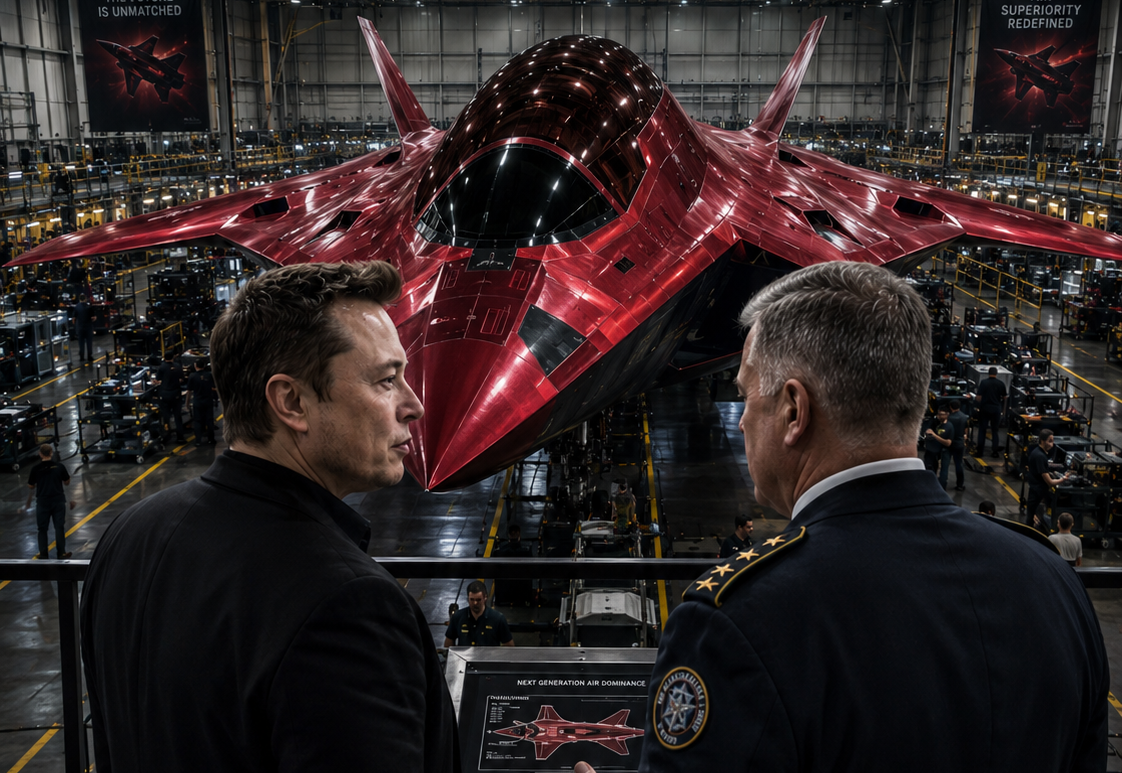
In February 2020, the room fell silent when Elon Musk delivered a statement that challenged decades of military aviation doctrine:
“The fighter jet era has passed.”
For the thousands of Air Force officers, defense executives, and aerospace experts gathered at the Air Warfare Symposium, the words were nothing short of seismic.
For over 70 years, fighter jets have represented the pinnacle of air power. Aircraft such as the F-16 Fighting Falcon, F-15 Eagle, and F-35 Lightning II have dominated the skies and defined military superiority.
You May Also Like


But Musk’s message was clear: the future of air combat may belong not to human pilots, but to intelligent machines.
A Six-Word Prediction That Shook the Pentagon


Musk followed his headline-making declaration with a more detailed vision:
“Locally autonomous drone warfare is where the future will be.”
He argued that a drone fighter—guided by a human but enhanced by onboard artificial intelligence—would outperform traditional manned aircraft.
According to Musk, even the advanced F-35 would struggle against an autonomous drone capable of making split-second decisions, pulling maneuvers no human body could survive, and operating without fear, fatigue, or hesitation.
Why Drones Could Outperform Human Pilots

Human pilots remain extraordinary, but they are limited by biology.
A pilot can lose consciousness under extreme G-forces. Fatigue degrades performance. Training takes years and costs millions of dollars.
Autonomous drones face none of these limitations.
Key Advantages of Autonomous Combat Drones
- No physical limits: Can perform maneuvers far beyond human tolerance.
- Lower cost: No cockpit, life-support systems, or pilot training required.
- Attritable: Designed to be affordable enough to lose in combat if necessary.
- Mass deployment: Dozens or hundreds can operate together.
- Continuous upgrades: Software can be improved much faster than redesigning aircraft.
The result is a potentially revolutionary shift in air warfare.
The F-35: Powerful, but Increasingly Vulnerable

The Lockheed Martin-built F-35 is one of the most advanced fighter aircraft ever created.
It combines stealth, sensors, and networking to serve as a battlefield command center in the sky.
Yet it also illustrates the challenge of modern military procurement.
- Unit cost exceeds $80 million per aircraft.
- Sustainment costs are immense.
- Production cycles take decades.
- Losing even one aircraft is a major strategic and financial blow.
Musk’s criticism was not that the F-35 lacks capability, but that future warfare may reward adaptability, scale, and software over exquisite hardware.
What U.S. Air Force Leaders Really Think


Senior Air Force leaders did not dismiss Musk’s warning.
Gen. Mike Holmes acknowledged that future aircraft replacement decisions may include autonomous systems rather than simply buying more manned fighters.
His key question was straightforward:
When older F-16s retire, will they be replaced entirely by F-35s, or by something radically different?
That question continues to shape the Air Force’s modernization efforts.
Skyborg: Building the AI Wingman


The U.S. Air Force Research Laboratory launched the Skyborg program to create autonomous “loyal wingmen.”
These drones are designed to:
- Fly alongside human pilots.
- Carry sensors and weapons.
- Jam enemy defenses.
- Extend communications.
- Accept high-risk missions.
Rather than replacing fighter pilots immediately, Skyborg is intended to multiply their effectiveness.
The Real Future: Humans and Machines Fighting Together


Experts increasingly agree that the near-term future is neither all-human nor all-machine.
It is a tightly connected ecosystem where:
- Pilots make strategic decisions.
- Autonomous drones scout ahead.
- Swarms overwhelm defenses.
- Artificial intelligence processes data in real time.
Arthur Holland Michel describes this future as a networked force in which unmanned systems act as trusted partners rather than mere tools.
Why Fighter Jets Still Matter

Despite rapid advances in artificial intelligence, fully autonomous air combat remains a formidable challenge.
Combat involves uncertainty, deception, incomplete information, and moral decisions about the use of lethal force.
Humans still provide:
- Judgment under ambiguity.
- Ethical accountability.
- Adaptability in unforeseen situations.
- Strategic understanding beyond algorithmic rules.
For these reasons, fighter pilots will remain central to military aviation for years to come.
A Historic Turning Point in Air Power


Musk’s statement was provocative, but it captured a fundamental truth.
Every era of warfare has been transformed by new technology:
- Battleships yielded to aircraft carriers.
- Manned reconnaissance gave way to satellites.
- Precision-guided weapons changed the battlefield.
Now autonomous systems are poised to reshape air combat.
The question is no longer whether drones will play a decisive role.
The question is how quickly militaries can adapt.
Final Thoughts: The Pilot Is Evolving, Not Disappearing


The fighter jet era is not ending overnight.
But its defining feature is changing.
Tomorrow’s ace may not sit alone in a cockpit. Instead, they may command a team of intelligent drones, directing a constellation of machines that think, maneuver, and strike with unprecedented speed.
The future of air warfare belongs to those who can combine human judgment with machine precision.
And in that future, the most powerful weapon may not be the aircraft itself—but the intelligence behind it.