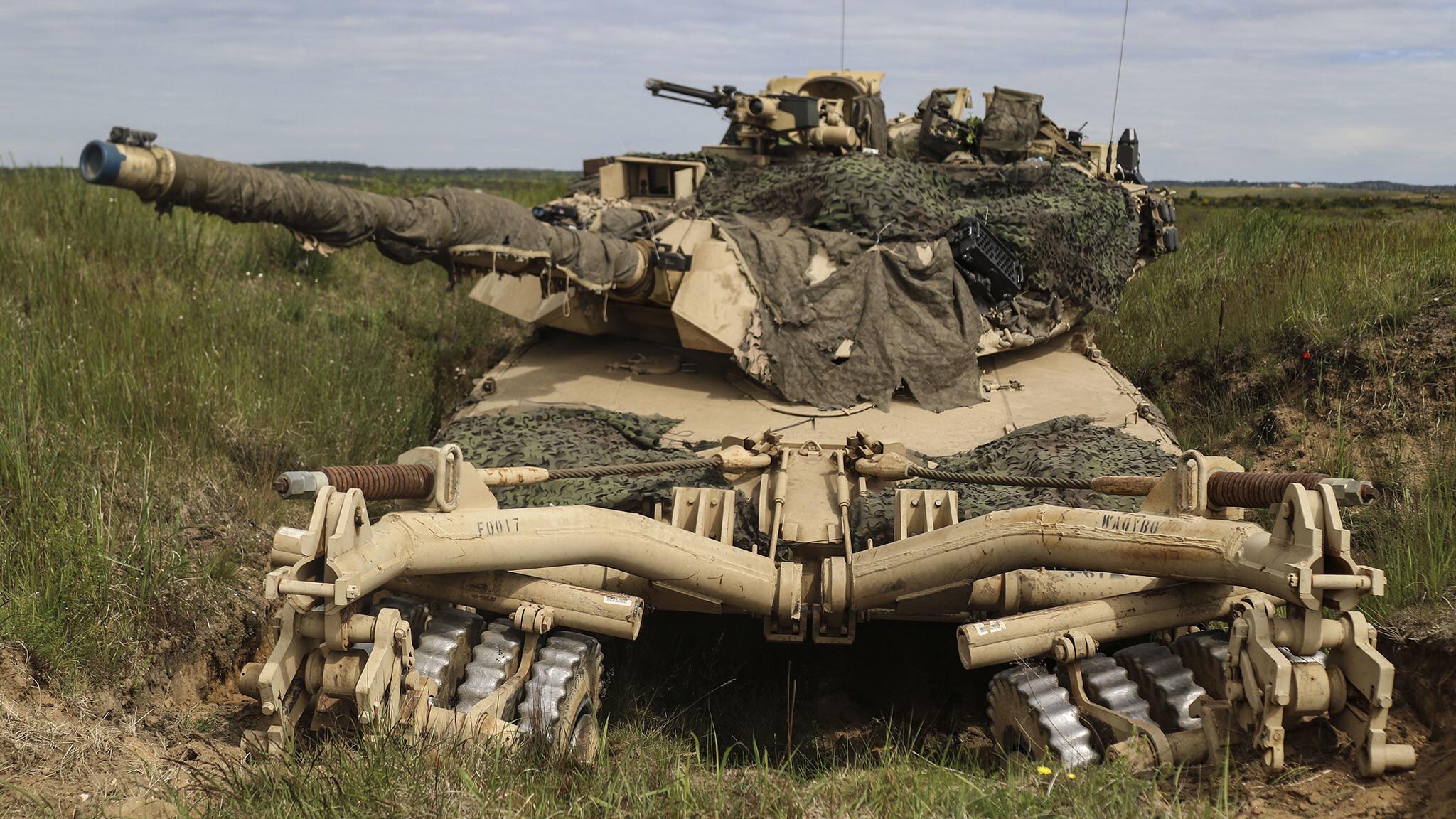
M1 Abrams: The Iron Giant That Changed Modern Warfare Forever
The roar of an M1 Abrams tank is more than just the sound of an engine — it is the sound of overwhelming power, battlefield dominance, and decades of military innovation. Built during the tense years of the Cold War, the Abrams was designed with one mission: defeat the most dangerous armored threats on Earth. More than 40 years later, it remains one of the deadliest and most respected main battle tanks ever created.
From the burning deserts of Iraq to the battlefields of Eastern Europe, the Abrams has earned a reputation for survivability, devastating firepower, and relentless combat performance. It is not simply a tank — it is a symbol of American military engineering and one of the most feared armored vehicles ever to enter combat.
The Birth of a Battlefield Legend


You May Also Like

The M1 Abrams was born from Cold War urgency. During the 1970s, American military planners feared Soviet armored forces could overwhelm NATO defenses in Europe. The aging M60 Patton tank was no longer enough. The United States needed something faster, stronger, and far more survivable.
That answer became the M1 Abrams.
Developed by General Dynamics after the collapse of the troubled MBT-70 project, the Abrams entered service in 1980 and immediately transformed armored warfare. It introduced revolutionary technologies rarely seen together in one vehicle: composite armor, computerized targeting systems, and a powerful turbine engine normally associated with aircraft.
The tank was named after General Creighton Abrams, a legendary U.S. Army commander known for aggressive battlefield tactics during the Vietnam War.
Built for Survival
One reason the Abrams became legendary is simple: crews trusted it to keep them alive.
Its advanced Chobham-style composite armor, later reinforced with depleted uranium layers, gave the tank extraordinary protection against enemy shells and anti-tank weapons. Ammunition storage compartments were specially designed with blowout panels so explosions would vent outward rather than kill the crew inside.
In modern warfare, where one hit can destroy an armored vehicle instantly, crew survivability became one of the Abrams’ greatest strengths.
Soldiers often described the Abrams as a “moving fortress.”
The Firepower That Dominated Battlefields


At the heart of the Abrams sits its devastating 120mm smoothbore cannon — one of the most powerful tank guns in the world.
Combined with laser rangefinders, thermal imaging, and advanced fire-control computers, the Abrams can detect, track, and destroy targets with terrifying precision, even while moving at high speed or fighting at night.
During the 1991 Gulf War, Abrams crews routinely destroyed Iraqi tanks before enemy forces even realized they were being targeted. The combination of superior optics and long-range firepower created a massive advantage.
Its secondary weapons include:
- A .50 caliber heavy machine gun
- Multiple 7.62mm machine guns
- Advanced smoke grenade systems
This allows the Abrams to engage infantry, vehicles, aircraft threats, and fortified positions simultaneously.
Speed of a Beast
Despite weighing over 70 tons in modern configurations, the Abrams moves with shocking speed.
Powered by the Honeywell AGT1500 gas turbine engine producing 1,500 horsepower, the tank can exceed 42 mph (67 km/h). Its acceleration is so powerful that many soldiers compare it to driving a sports car — except this one carries a massive cannon and thick armor plating.
Unlike traditional diesel-powered tanks, the turbine engine gives the Abrams remarkable agility and mobility. However, that power comes at a price: enormous fuel consumption.
Keeping Abrams tanks supplied with fuel during war requires a huge logistical effort.
The Gulf War: When the Abrams Proved Itself


The Abrams earned global fame during Gulf War.
Facing Iraqi forces equipped with Soviet-made tanks, the Abrams demonstrated overwhelming superiority. American tank crews achieved kill ratios that shocked military analysts around the world.
Many Iraqi tanks were destroyed at ranges where they could not even effectively return fire.
The war proved several things:
- The Abrams’ armor was extraordinarily resilient
- Its targeting systems were years ahead of competitors
- American armored doctrine had evolved into one of the most effective fighting systems on Earth
The tank quickly became a symbol of modern military dominance.
Evolving for a New Era
The Abrams never stopped evolving.
Key Variants
- M1 — Original version with a 105mm cannon
- M1A1 — Introduced the larger 120mm gun and stronger armor
- M1A2 — Added advanced digital systems, battlefield networking, and improved optics
- M1A2 SEP — Enhanced electronics, thermal imaging, and active protection systems
Modern versions can integrate with drones, battlefield command networks, and advanced defensive systems like the Israeli-developed Trophy Active Protection System, capable of intercepting incoming anti-tank missiles before impact.
The Abrams in Modern Warfare


The Abrams continues serving across multiple modern conflicts and military deployments.
It has fought in:
- Iraq
- Afghanistan
- Counterinsurgency operations
- NATO exercises in Europe
- The ongoing conflict involving Ukraine and Russian forces
Countries operating the Abrams include:
- United States
- Poland
- Australia
- Saudi Arabia
- Taiwan
- Egypt
- Kuwait
- Ukraine
Its global adoption reflects enormous confidence in the platform’s combat effectiveness.
Strengths — And Real Challenges
The Abrams remains one of the world’s best tanks, but modern warfare is changing rapidly.
Major Strengths
- Exceptional crew protection
- Highly accurate firepower
- Outstanding battlefield mobility
- Advanced electronics and targeting systems
- Proven combat record
Modern Challenges
- Heavy weight complicates transport
- High fuel usage strains logistics
- Vulnerability to drones and loitering munitions
- Increasing battlefield transparency from satellites and surveillance systems
Today’s threats are no longer only enemy tanks. Small drones, precision-guided missiles, and electronic warfare are reshaping armored combat.
That is why the Abrams continues receiving upgrades instead of retirement.
More Than a Tank
The Abrams represents more than military hardware. It reflects decades of technological ambition, battlefield lessons, and the constant race between armor and firepower.
For soldiers inside it, the Abrams is protection.
For allies, it is reassurance.
For adversaries, it is a warning.
Even after four decades, the M1 Abrams remains one of the most formidable armored vehicles ever built — a machine designed not just to survive war, but to dominate it.
And as warfare evolves into the drone age and beyond, the legend of the Abrams is still being written.