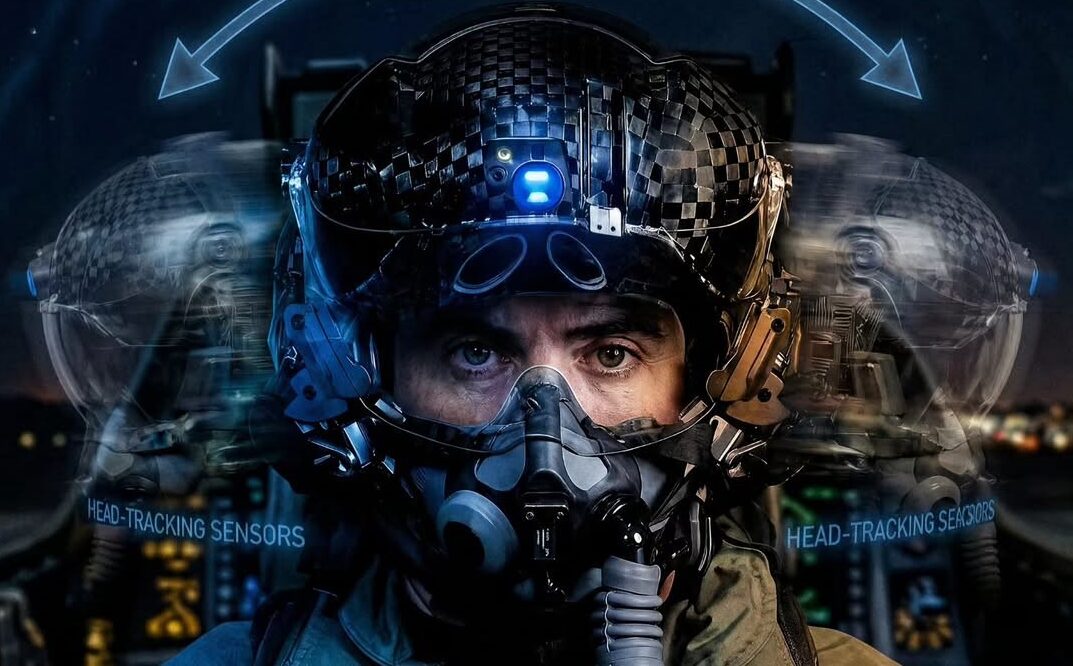
At first glance, it seems almost absurd.
How can a pilot’s helmet cost as much as a luxury supercar?
Why would the United States spend roughly $400,000 on a single flight helmet—more than the price of many Ferraris, Lamborghinis, and Rolls-Royces?
The answer is simple.
You May Also Like

This is not just a helmet.
It is one of the most sophisticated pieces of wearable military technology ever created.
For the pilot of the Lockheed Martin F-35 Lightning II, the helmet is not an accessory. It is the aircraft’s primary interface, the pilot’s eyes, and in many ways, a second brain.
It transforms the way a human being sees, thinks, and fights at supersonic speed.
In modern aerial combat, where milliseconds determine survival, this helmet can mean the difference between returning home and never being seen again.
A Flying Computer Needs a Helmet to Match

The F-35 is widely regarded as the most advanced fighter aircraft ever fielded.
Built by Lockheed Martin, the jet combines stealth, sensor fusion, and networked warfare into a single combat platform.
But unlike older fighters, the F-35 has no traditional head-up display mounted in the cockpit.
That is because the entire cockpit display is projected directly onto the pilot’s visor.
Wherever the pilot looks, critical information follows.
Altitude, speed, targeting cues, missile warnings, and infrared imagery all appear in real time, seemingly floating in space.
The helmet is, quite literally, the cockpit.
A $400,000 Helmet Worth Every Dollar

The F-35 Helmet Mounted Display System (HMDS) is produced by a partnership involving Collins Aerospace and Elbit Systems.
Although costs vary depending on production lots and support arrangements, the price per helmet has often been cited at around $400,000.
That figure reflects far more than materials.
It includes:
- Custom fitting and calibration.
- High-resolution displays.
- Precision optics.
- Advanced head-tracking sensors.
- Night vision integration.
- Software and testing.
- Maintenance support.
This is a mission-critical system, not a piece of protective gear.
Custom-Built for One Pilot Only

No two F-35 helmets are identical.
Each helmet is built for a specific pilot.
During a specialized fitting process that can take two days, technicians create a detailed 3D map of the pilot’s head and eyes.
Measurements are taken with extraordinary precision to ensure that projected imagery aligns perfectly with the pilot’s line of sight.
Even tiny deviations can create visual errors.
This is why changes as small as significant weight fluctuation or facial structure differences may require refitting.
The helmet must feel like a natural extension of the pilot.
Two Millimeters That Can Save a Life

One of the most critical steps is optical alignment.
Technicians use a pupilometer to position the displays so that both eyes merge the projected imagery into one perfectly centered picture.
The acceptable tolerance is measured in millimeters.
At combat speeds, inaccurate alignment could lead to misread information or targeting errors.
In a world where a fighter may close several miles in seconds, precision is not optional.
It is survival.
Seeing Through the Aircraft

Perhaps the helmet’s most astonishing feature is its ability to let pilots “see through” the airplane.
The F-35’s AN/AAQ-37 Distributed Aperture System uses six infrared cameras positioned around the airframe.
As the pilot turns his or her head, the helmet displays a live image from the appropriate sensors.
Look down, and the pilot can see the terrain beneath the aircraft.
Look behind, and the pilot sees what is happening in the rear hemisphere.
This creates unprecedented 360-degree situational awareness.
Built-In Night Vision Without Goggles

Traditional night-vision goggles are bulky and can limit visibility.
The F-35 helmet eliminates the need for them entirely.
Infrared imagery is projected directly onto the visor, giving pilots clear nighttime vision while retaining access to all mission data.
This integration reduces equipment burden and improves combat effectiveness.
The result is a seamless day-and-night interface.
Targeting by Looking
In earlier generations, pilots often maneuvered their aircraft to point sensors and weapons.
The F-35 helmet changes that equation.
With helmet-mounted cueing, a pilot can designate targets simply by turning and looking at them.
The aircraft’s sensors and weapons can then respond accordingly.
This dramatically reduces engagement time and increases tactical flexibility.
The pilot’s gaze becomes a weapon.
The First Modern Fighter Without a Fixed HUD
Most combat aircraft rely on a cockpit-mounted head-up display.
The F-35 broke with this tradition.
By moving all critical information to the helmet, engineers eliminated the fixed HUD altogether.
This offers several advantages:
- Less cockpit clutter.
- Reduced weight.
- More flexible display positioning.
- Continuous information regardless of head angle.
The pilot no longer needs to look straight ahead to access essential data.
Engineering Materials Built for Combat

Despite its advanced electronics, the helmet must remain relatively light and durable.
Manufacturers use high-strength materials such as carbon fiber and Kevlar to balance protection with wearability.
The helmet must withstand high-G maneuvers, vibration, and harsh operational environments while maintaining optical stability.
It is designed to protect both the pilot and the technology inside.
The Software Challenge
A large portion of the helmet’s cost lies in software.
The system must integrate flawlessly with the F-35’s avionics, sensors, and mission computers.
It processes and displays data with extremely low latency to prevent motion mismatch and visual disorientation.
Achieving this level of synchronization requires years of development, testing, and updates.
The helmet is as much a software platform as it is hardware.
Low Production, High Precision
Consumer electronics become cheaper because millions are produced.
The F-35 helmet is manufactured in comparatively small numbers.
Each unit is custom-built, calibrated, and tested.
This low-volume, high-complexity production model drives up cost.
When every component must meet military standards, prices rise accordingly.
Constant Inspection and Maintenance
These helmets undergo regular inspections to ensure peak performance.
Operators perform scheduled checks, and fit assessments are conducted periodically.
Pilots often keep the same helmet for many years, with adjustments and repairs as needed.
Given its central role in flight operations, maintenance is treated with the same seriousness as aircraft upkeep.
Why a Ferrari Is the Wrong Comparison
A Ferrari is designed for speed, beauty, and exclusivity.
The F-35 helmet is designed to help a pilot survive in one of the most dangerous environments imaginable.
One is a luxury.
The other is a life-support and combat system.
When viewed in that context, the comparison becomes less surprising.
The helmet is expensive because the mission is unforgiving.
A Symbol of Human-Machine Integration
The F-35 helmet represents the future of warfare.
It blends human judgment with machine-generated information, allowing pilots to make better decisions faster than ever before.
Rather than replacing the pilot, the technology amplifies human capability.
The pilot remains at the center—but now sees the battlespace with unprecedented clarity.
The True Value of the Helmet
The question is not why the helmet costs $400,000.
The real question is what that investment delivers.
It provides:
- 360-degree awareness.
- Integrated night vision.
- Precision targeting.
- Continuous flight data.
- Reduced reaction time.
- Improved survivability.
If those capabilities allow a pilot to avoid one missile or complete one critical mission, the helmet has justified its cost.
Final Thoughts: The Most Advanced Helmet Ever Built
The F-35 helmet is more than a technological marvel.
It is a reminder that the most important component of any advanced weapon system is still the human being operating it.
By giving pilots the ability to see farther, react faster, and understand more, the helmet transforms information into survival.
Its price tag may exceed that of a Ferrari, but its purpose is far more profound.
A Ferrari is built to impress.
The F-35 helmet is built to keep a pilot alive and help secure victory.
And in the unforgiving skies of modern combat, that capability is priceless.