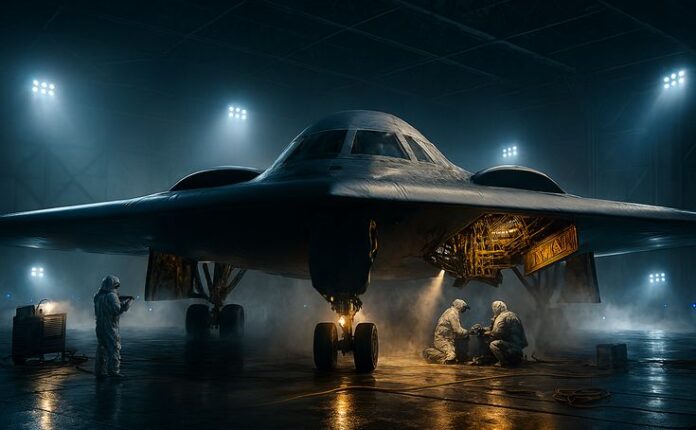
For more than three decades, the Northrop B-2 Spirit has represented one of the most formidable symbols of American air power.
Its flying-wing design, radar-absorbing materials, and ability to penetrate heavily defended airspace have made it a strategic icon. The B-2 was built to do what few other aircraft can: fly deep into hostile territory, evade sophisticated air defenses, and strike high-value targets with extraordinary precision.
To many observers, it seemed almost untouchable.
But warfare never stands still.
You May Also Like


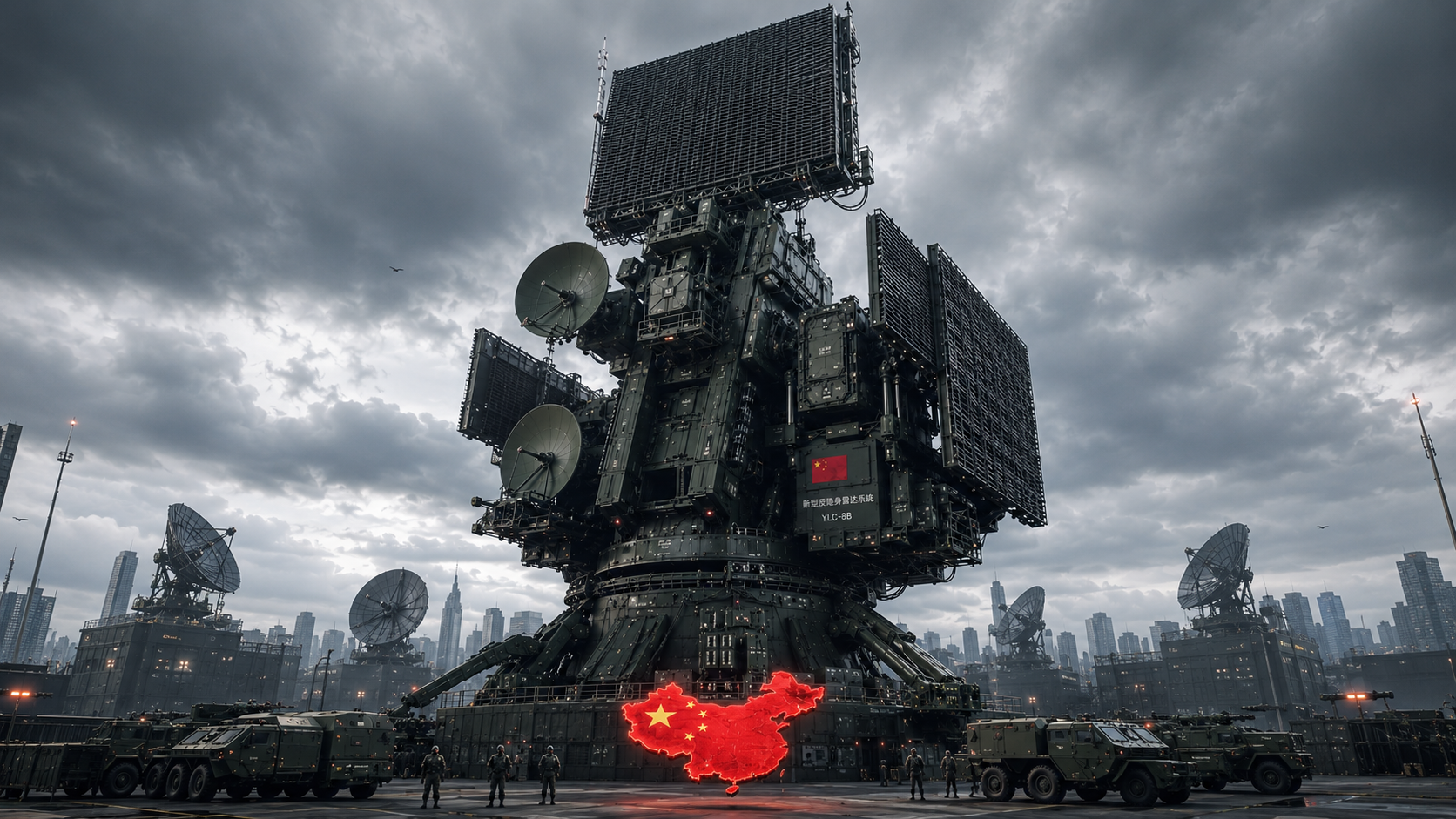
Now, a Chinese defense firm claims that an artificial intelligence system can detect signals associated with the B-2 Spirit, suggesting that the future of air combat may be shaped not only by aircraft design, but by the power of algorithms.
If validated, this would mark a significant development in the long-running contest between stealth and detection.
Yet the real story is more nuanced—and far more fascinating.
Stealth Was Never About Being Truly Invisible

One of the most common misconceptions about stealth technology is that stealth aircraft are invisible.
They are not.
Stealth reduces the probability of detection and delays the defender’s ability to build a reliable targeting solution.
That delay can be decisive.
A stealth aircraft seeks to:
- Minimize radar reflections.
- Reduce infrared emissions.
- Limit electromagnetic signatures.
- Confuse enemy sensors.
- Compress the enemy’s reaction time.
In combat, even a few extra minutes of uncertainty can be the difference between mission success and failure.
The B-2 embodies this principle at the highest level.
The Legend of the B-2 Spirit
The B-2 remains one of the most advanced aircraft ever built.
With an estimated unit cost exceeding $2 billion, it was designed during the Cold War to penetrate the Soviet Union’s dense air-defense network.
Its capabilities include:
- Intercontinental range with aerial refueling.
- Extremely low radar observability.
- Precision strike with conventional and nuclear weapons.
- Ability to attack heavily defended targets.
- Global reach from bases in the continental United States.
The aircraft’s combat history—from Kosovo to Afghanistan, Iraq, and beyond—has reinforced its reputation as a strategic game changer.
China’s Claim: Artificial Intelligence as a Stealth Detector

According to Chinese reporting, a defense company has developed an AI-based system that can identify stealth aircraft signatures by combining multiple sensor inputs.
Rather than relying on a single radar, the system reportedly fuses:
- Low-frequency radar returns.
- Infrared observations.
- Electromagnetic emissions.
- Historical flight patterns.
- Environmental and atmospheric data.
AI models are then trained to detect subtle patterns that might indicate the presence of a stealth platform.
This approach reflects a broader trend toward multi-sensor data fusion.
Why Artificial Intelligence Changes the Game

Traditional radar operators often face overwhelming volumes of information.
Artificial intelligence excels at analyzing enormous datasets and identifying weak correlations that humans may overlook.
Potential advantages include:
- Faster processing.
- Improved anomaly detection.
- Reduced false alarms.
- Better sensor integration.
- Adaptive learning over time.
In theory, AI can turn fragmented clues into actionable intelligence.
That is why militaries worldwide are investing heavily in machine learning for surveillance and targeting.
Detection Is Only the First Step

Even if AI can indicate that a stealth aircraft is present, that does not mean the aircraft can be engaged successfully.
A complete kill chain requires:
- Initial detection.
- Accurate tracking.
- Positive identification.
- Fire-control quality data.
- Weapon launch.
- Midcourse updates.
- Terminal guidance and intercept.
Stealth is designed to disrupt every stage.
An uncertain AI alert is not equivalent to a missile-quality track.
The Multi-Sensor Battlefield

Modern warfare increasingly relies on combining data from many sources.
This concept, often called sensor fusion, is central to both offensive and defensive operations.
A defender might integrate:
- Ground-based radars.
- Passive radio-frequency sensors.
- Infrared search and track systems.
- Satellites.
- Airborne early warning aircraft.
- Cyber and signals intelligence.
Artificial intelligence helps correlate all of this information.
The result is a richer operational picture—but also a more complex and fragile system.
Strategic Signaling and Information Warfare
Claims about breakthrough technologies are often part of strategic messaging.
By suggesting that U.S. stealth aircraft are no longer secure, China may seek to:
- Deter adversaries.
- Strengthen domestic confidence.
- Market defense technologies.
- Influence military planning.
- Shape public perception.
Without independent verification, such announcements should be viewed cautiously.
Military history is full of systems that performed differently in combat than in promotional materials.
The U.S. Response: Stealth Continues to Evolve
The United States has never assumed stealth would remain unchallenged.
Successive generations of aircraft—including the Lockheed Martin F-35 Lightning II and the forthcoming Northrop Grumman B-21 Raider—feature advances in:
- Materials science.
- Thermal management.
- Electronic warfare.
- Mission systems.
- Networked operations.
Stealth today is part of a broader ecosystem that includes cyber warfare, electronic attack, and real-time intelligence.
Why the B-2 Still Matters
Despite new detection claims, the B-2 remains extraordinarily capable.
Its survivability depends on more than shape and coatings.
It benefits from:
- Mission planning.
- Route optimization.
- Electronic support.
- Stand-off weapons.
- Classified defensive systems.
The aircraft’s strategic value lies in the combination of all these elements.
The Eternal Contest: Sword Versus Shield
Military history is an ongoing cycle of innovation and counter-innovation.
Armor led to stronger weapons.
Submarines led to sonar.
Stealth led to multi-band sensors and AI.
Each advance narrows an opponent’s advantage, but rarely eliminates it entirely.
Artificial intelligence is the latest chapter in this technological duel.
What Experts Say
Defense analysts generally agree on three points:
- Stealth is becoming more difficult, but remains highly valuable.
- AI can enhance detection, but does not guarantee engagement success.
- Real-world effectiveness is difficult to judge without combat evidence.
In other words, the strategic advantage of stealth may be reduced over time, but it is far from obsolete.
The Future of Air Warfare
Tomorrow’s battles may hinge on which side can process information faster and act on it more effectively.
The critical question may no longer be “Can you see the aircraft?”
Instead, it may be:
“Can you turn weak and ambiguous clues into a timely, actionable decision?”
Artificial intelligence offers new possibilities, but so do countermeasures.
Stealth aircraft will continue to evolve in response.
A Lesson in Technological Humility
Announcements of revolutionary breakthroughs should always be met with careful analysis.
Technological races are rarely decided by one invention.
True military effectiveness depends on:
- Integration.
- Training.
- Doctrine.
- Operational experience.
- Adaptation under pressure.
The side that learns fastest often gains the advantage.
Final Thoughts: Invisibility Is Relative
China’s claim that AI can detect the B-2 Spirit may prove to be an important milestone—or it may be an ambitious assertion that falls short in real combat.
Either way, it highlights a profound reality.
No military advantage lasts forever.
Stealth changed the balance of air power for a generation.
Artificial intelligence is now challenging the assumptions that made stealth so dominant.
But stealth was never about becoming invisible.
It was about making detection harder, decision-making slower, and defense less effective.
As long as that remains true, aircraft like the B-2 Spirit will continue to shape strategy and deter adversaries around the world.
The future of warfare belongs not to those who claim to see everything, but to those who can adapt faster than their opponents.
And in that relentless contest between innovation and counter-innovation, the race is far from over.