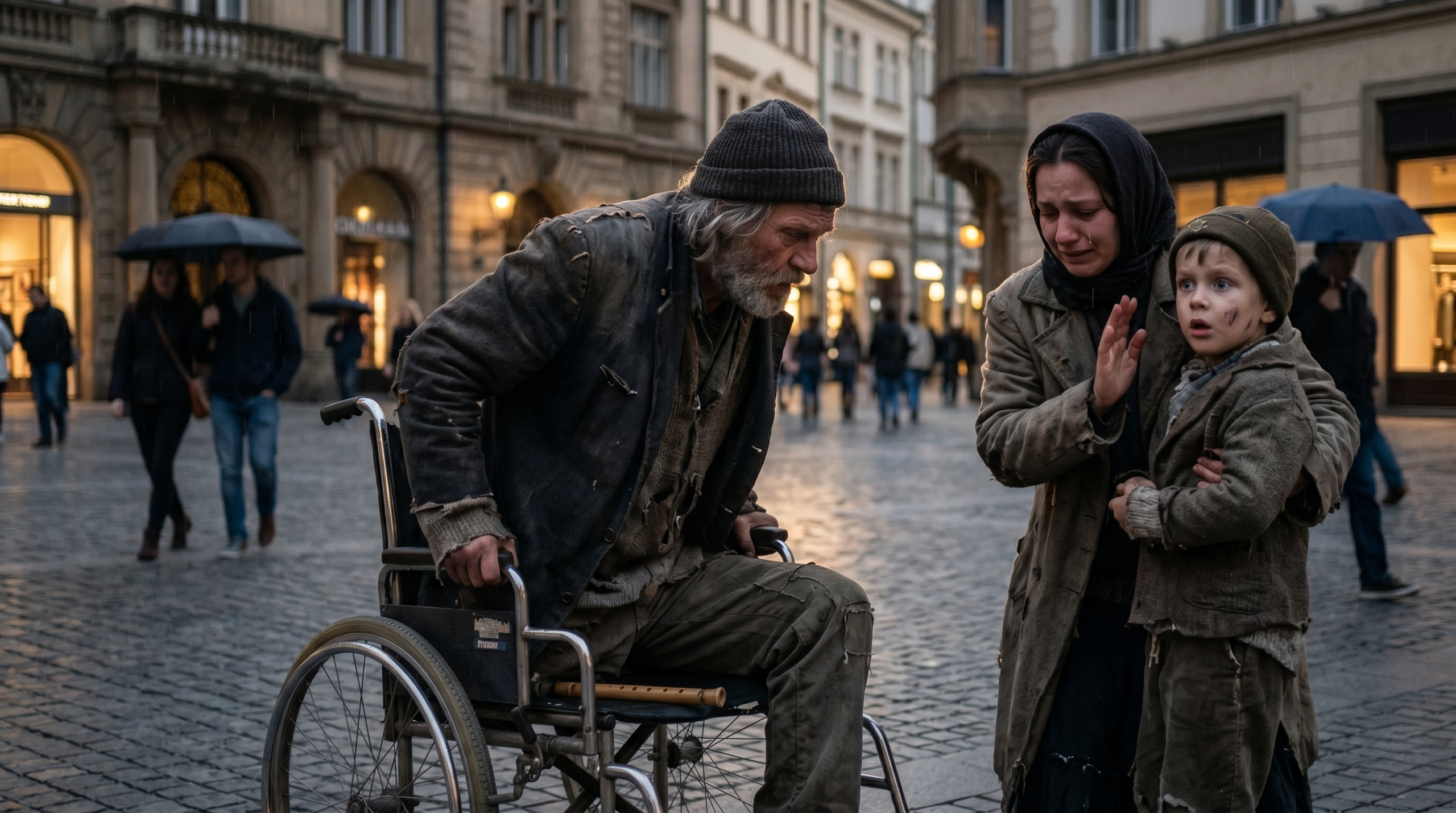
I was sitting in my usual spot at the city square, playing my flute, when I first met the boy. My fingers moved effortlessly over the instrument, guided by years of practice, while my thoughts drifted far away—as they often did during my daily performances.
After fifteen years of living on the streets, you learn to escape reality however you can. For me, music was the only thing that dulled the constant ache in my lower back and hips. When I played, I could almost forget the pain. I would close my eyes and let the melody carry me somewhere else—somewhere better.
There was a time when my life looked very different.
My name was **Ethan Brooks**. I used to work in a factory. The job was tough, but I enjoyed it. There was something comforting about the rhythm of the work—the repetition, the sense of purpose. It felt almost like dancing in its own way.
You May Also Like
Then the pain began.
At first, I brushed it off as aging. But when it started interfering with my work, I went to see a doctor.
**Dr. Reyes** looked at my scans and said quietly,
“Ethan… this is a chronic condition. It will worsen over time. There’s no cure. Only pain management.”
I remember staring at him and whispering,
“So… I just lose my life slowly?”
He didn’t answer.
The next day, I went to my supervisor, **Mr. Dalton**, and begged for a different position.
“Sir, I can still work,” I said. “Put me in quality control… shipment checking… anything lighter.”
He shook his head without even looking at me.
“Ethan, you’re reliable. But company policy won’t allow it. Those roles require certification.”
“I don’t need titles,” I replied. “I just need to work.”
“I’m sorry,” he said coldly. “We can’t make exceptions.”
I held on as long as I could. But eventually, my body gave out before my pride did.
On my last day, my coworkers handed me a gift I would never forget: a wheelchair.
“Don’t disappear on us, Ethan,” one of them said quietly. “You kept this place moving more than you know.”
That chair became my lifeline.
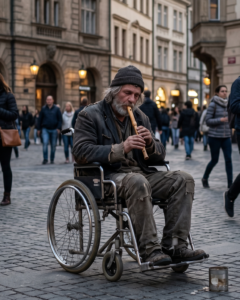
A small voice suddenly pulled me out of my thoughts.
“Mom… listen! It’s beautiful!”
I opened my eyes.
A small crowd had gathered nearby. Among them was a tired-looking woman holding a boy—about eight years old—in her arms.
The boy stared at me in awe as I played my flute. His eyes were wide, shining.
His mother, **Sarah**, looked exhausted, but there was warmth in her expression as she watched him.
“Can we stay a little longer?” the boy asked. “Please? I’ve never heard music like this before.”
“Just a few minutes, Noah,” Sarah replied softly. “We have to get to your appointment.”
“But it feels like magic…” Noah whispered.
I lowered my flute and smiled.
“Do you want to try?” I asked gently. “I can teach you a simple note.”
Noah’s smile faded.
“I can’t walk,” he said quietly. “It hurts too much.”
Sarah held him tighter.
“We can’t afford crutches or a wheelchair,” she said, voice trembling. “So I carry him everywhere. The doctors say he needs therapy… but we can’t manage it.”
For a moment, silence hung between us.
And in that silence, I saw myself.
But I also saw something else.
Hope.
Noah leaned forward slightly, eyes still fixed on the flute.
“It sounds like it’s telling a story…” he whispered.
I felt something break inside me—in a way that wasn’t painful.
“How long have you been carrying him?” I asked Sarah.
“Three years,” she answered.
Three years.
I looked at my wheelchair.
I remembered the day I received it.
And suddenly, I knew what I had to do.
Before I could change my mind, I pushed myself up. Pain shot through my body, but I forced a smile.
“Take my wheelchair,” I said.
Sarah’s eyes widened. “No—no, we can’t accept that.”
I pushed it closer.
“Please,” I insisted. “It… it just takes space for me anyway.”
The lie burned in my throat.
Noah blinked at me.
“Really?” he asked softly.
I nodded.
Sarah covered her mouth, tears forming instantly.
“I don’t know what to say…”
“Say nothing,” I replied. “Just take care of him.”
Slowly, she placed Noah into the wheelchair.
Noah looked up at me.
“Will I ever see you again?”
I forced a smile through the pain.
“If you listen closely… maybe you will.”
They left slowly, turning back more than once.
And I stayed there, sitting on the bench afterward, pretending I wasn’t shaking from pain.
—
Five years passed.
Time was not kind to me.
Without the wheelchair, I relied on crutches, and my condition worsened. Every step felt like fire crawling through my bones.
But I kept playing.
Not because it healed me anymore—but because it reminded me I was still alive.
Sometimes, I thought about Noah.
I wondered if he was okay.
If Sarah was still carrying him.
If my decision had helped… or hurt.
—
One afternoon, everything changed.
I was playing an old melody when a shadow fell across my cup.
I looked up.
A young man stood there—well-dressed, confident, holding a long package.
He smiled gently.
“Hello, sir,” he said. “Do you remember me?”
I stared.
“Noah…?”
He nodded.
My hands froze.
“You’re… walking.”
He laughed softly.
“Life changes in ways we don’t expect.”
He sat down beside me.
“After we met, something happened. We received an inheritance from a distant relative. Suddenly, we could afford treatment.”
My voice shook.
“And your legs…?”
“It wasn’t permanent,” he said. “Doctors were wrong about the full extent. Therapy helped more than anyone thought possible.”
I felt my throat tighten.
“And your mother?”
“She started a catering business,” he said proudly. “She always loved cooking. She just never had the chance before.”
He handed me the package.
“This is for you.”
Inside was a beautiful flute case.
“I can’t accept this,” I said immediately.
Noah shook his head.
“Yes, you can. You gave us something far more important than money.”
“Hope?” I whispered.
He nodded.
Before leaving, he hugged me tightly.
“Thank you for not ignoring us when the world did.”
—
That night, I opened the case.
Inside was not a flute.
It was stacks of money—more than I had ever seen.
On top was a note:
**“Payment for the pain you endured because of your kindness. Thank you for believing in us.”**
I sat there for hours.
Thinking about every painful step I had taken.
Every moment I regretted.
Every moment I didn’t.
And then I thought about Noah’s smile.
About Sarah’s tears.
About the life they built.
And I finally understood.
That wheelchair was never the greatest thing I gave them.
It was belief.
I whispered into the empty room:
“One act of kindness… can echo for a lifetime.”