In the history of the United States Navy, some ships are lost in battle.
Others disappear beneath enemy fire.
But few tragedies are as shocking, painful, and haunting as the destruction of the USS Bonhomme Richard — a massive American amphibious assault warship consumed not by missiles or enemy attack, but by flames from within.
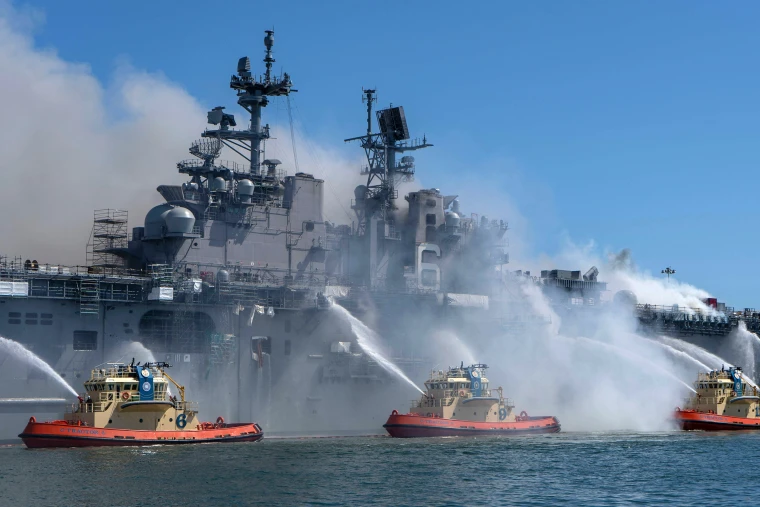
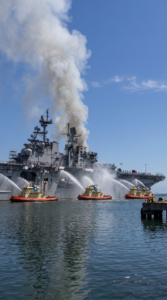
For more than four terrifying days in July 2020, thick black smoke towered above San Diego as firefighters, sailors, helicopters, and emergency crews fought desperately to save one of the Navy’s most powerful warships.
You May Also Like



The fire became one of the worst naval disasters outside of combat in modern American history.
At the center of the catastrophe stood a horrifying possibility:
That the destruction of a billion-dollar warship may have begun with a single sailor.
Now, years later, the U.S. Navy has officially charged a sailor with aggravated arson and willfully endangering a vessel, accusing him of starting the inferno that ultimately destroyed the USS Bonhomme Richard.
The case stunned military officials, defense experts, and Americans across the country.
Because this was not just a fire.
It was the loss of a floating fortress.
A symbol of American naval power.
And a warning about how fragile even the mightiest military machines can become.
The Day America’s Warship Became an Inferno
On July 12, 2020, the USS Bonhomme Richard sat docked at Naval Base San Diego undergoing a massive modernization and maintenance overhaul expected to cost nearly US$250 million.
The ship was nearing the end of a two-year upgrade.
Everything appeared routine.
Then suddenly, disaster erupted.
A fire ignited deep inside the vessel’s lower storage area — a compartment packed with cardboard boxes, cleaning rags, maintenance materials, and other highly combustible supplies.
At first, it may have seemed manageable.
But within minutes, the situation spiraled out of control.
Powerful winds sweeping across San Diego Bay fed the flames with oxygen. The fire rapidly climbed through elevator shafts and ventilation systems, turning the inside of the ship into a deadly furnace.
Then came the explosions.
Massive blasts echoed across San Diego County, with at least one reportedly heard more than 13 miles away.
The inferno intensified.
Thick columns of toxic smoke darkened the skies over Southern California as emergency alarms sounded across the naval base.
What began as a fire had transformed into a national military emergency.
A Floating Battlefield In America’s Harbor
The USS Bonhomme Richard was no ordinary vessel.
At 840 feet long, the amphibious assault ship was among the largest and most versatile warships in the U.S. Navy fleet.
These ships are often described as “mini aircraft carriers” because they can launch helicopters, transport Marines, deploy landing craft, and support advanced military operations around the world.
The vessel represented American expeditionary power — designed to carry troops, aircraft, armored vehicles, and combat systems into some of the world’s most dangerous conflict zones.
But on that July morning, the warship became a battlefield itself.
Inside the ship, temperatures rose to catastrophic levels.
Metal warped.
Compartments collapsed.
Flames spread uncontrollably through multiple decks.
Visibility vanished in choking smoke.
Firefighters entering the vessel faced conditions resembling an industrial apocalypse.
And still, they kept going.
Four Days Of Hell
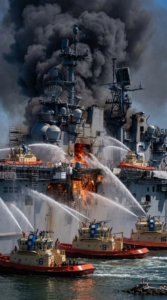
The battle to save the USS Bonhomme Richard would last more than four days.
It became one of the largest firefighting operations in modern naval history.
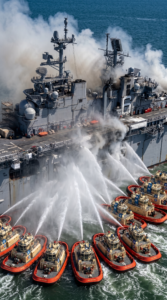
Federal firefighters, Navy crews, local emergency responders, helicopters, and firefighting vessels all joined the desperate effort.
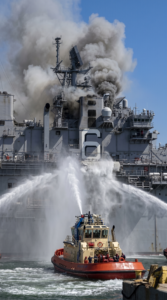
From the water, fireboats blasted enormous streams of seawater into the ship’s burning interior.
From the sky, helicopters dropped water repeatedly onto the inferno.
Inside the vessel, firefighters crawled through smoke-filled passageways with almost zero visibility, battling extreme heat while risking explosions, collapsing structures, and toxic inhalation.
Many described the environment as nightmarish.
More than 60 sailors and civilians suffered injuries ranging from burns and heat exhaustion to smoke inhalation.
The smoke itself became a public health concern.
Dark clouds of toxic fumes drifted across San Diego, forcing authorities to warn residents to stay indoors and avoid outdoor exercise.
For four endless days, America watched one of its own warships burn in its home harbor.
And slowly, painfully, hope began to disappear.
A Warship Beyond Saving
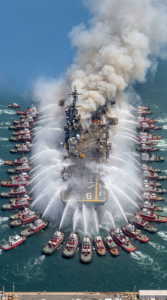
Eventually, Navy officials faced a devastating conclusion:
The USS Bonhomme Richard could not be saved.
The damage was catastrophic.
The ship’s structural integrity had been severely compromised. Electrical systems were destroyed. Internal compartments were gutted. Mechanical infrastructure melted under the heat.
Repair estimates climbed toward unimaginable levels.
Some projections suggested restoration could cost as much as US$4 billion.
The Navy made the painful decision to scrap the vessel entirely.
A warship built to survive combat zones across the globe had been defeated by a fire while docked in peacetime America.
The loss sent shockwaves throughout the military.
Not only because of the financial destruction, but because of what the disaster revealed:
Even the world’s most advanced military can be vulnerable to internal failures.
The Sailor Accused Of Destroying A Giant
The tragedy took an even darker turn when investigators concluded the fire may not have been accidental.
After an extensive investigation, the Navy charged a sailor who had served aboard the ship with aggravated arson and willfully hazarding a vessel.
The accusation was extraordinary.
If proven true, it would mean a single individual allegedly caused the destruction of one of America’s premier warships.
Yet many questions remain unanswered.
The Navy has not publicly released the sailor’s name.
Officials also have not fully revealed what evidence led investigators to the charges or what motive may have existed.
That mystery has fueled enormous speculation.
How could one person allegedly trigger such devastation?
How did safety systems fail to stop the fire?
Could the catastrophe have been prevented?
And perhaps most disturbing of all:
What does this incident reveal about vulnerabilities inside the U.S. military itself?
A Disaster That Exposed Deeper Problems
The destruction of the USS Bonhomme Richard was not simply a tragic accident.
It exposed systemic weaknesses that military experts continue analyzing today.
Investigations revealed serious concerns regarding preparedness, training, communication, maintenance procedures, and emergency response coordination.
Reports suggested the ship’s fire suppression systems were not fully operational during maintenance.
Some crew members reportedly lacked sufficient firefighting readiness.
Command decisions during the early stages of the fire have also faced scrutiny.
The disaster became a painful reminder that modern warships are incredibly complex machines — essentially floating cities packed with fuel, ammunition, electronics, machinery, aircraft systems, and hazardous materials.
When disaster strikes inside such environments, the consequences can become catastrophic with terrifying speed.
And unlike combat at sea, this tragedy occurred in port, under supposedly controlled conditions.
That reality shook confidence throughout the Navy.
The Human Cost Behind The Headlines
Lost amid the billion-dollar damage estimates and military analysis are the human stories.
Hundreds of sailors served aboard the USS Bonhomme Richard.
For many, the ship was more than steel and machinery.
It was their home.
Their mission.
Their pride.
Some sailors spent years deployed aboard the vessel across dangerous oceans and military operations.
Others had poured countless hours into restoring and upgrading the ship during its long maintenance period.
Watching it burn was emotionally devastating.
Many firefighters and sailors risked their lives trying to save it.
Some continued fighting the blaze even as explosions erupted and temperatures became nearly unbearable.
The courage displayed during those four days deserves to be remembered alongside the tragedy itself.
Because while the ship was ultimately lost, countless lives were saved through extraordinary bravery.
Why The USS Bonhomme Richard Disaster Still Matters Today
Years later, the destruction of the USS Bonhomme Richard continues to resonate far beyond San Diego.
It became a symbol of how modern military power can be undone not only by enemies abroad, but by vulnerabilities within.
At a time when global tensions are rising and the United States faces growing strategic competition with China, Russia, Iran, and other adversaries, the incident raised urgent questions about military readiness, discipline, infrastructure, and resilience.
The disaster also revealed the staggering costs of modern naval warfare.
Today’s warships are not merely vessels.
They are floating military ecosystems worth billions of dollars, requiring enormous manpower, maintenance, technology, and security.
Losing one without a single enemy shot fired was almost unthinkable.
And yet it happened.
The Deeper Lesson Of The Fire
The destruction of the USS Bonhomme Richard carries a lesson larger than one ship or one sailor.
Power alone does not guarantee security.
Even the strongest institutions can become vulnerable when discipline weakens, systems fail, or small dangers are underestimated.
History often remembers wars through dramatic battles against foreign enemies.
But some of the greatest disasters emerge quietly from inside.
A spark in a storage room.
A missed warning.
A failed system.
A single moment that changes everything.
The USS Bonhomme Richard was built to project American strength across the world’s oceans.
Instead, its final battle became a tragedy fought against fire, chaos, and human failure in its own harbor.
And for the U.S. Navy, the scars of that inferno may last far longer than the smoke that once darkened the skies above San Diego.