The city of Marveston had always been a place that hid its secrets well.
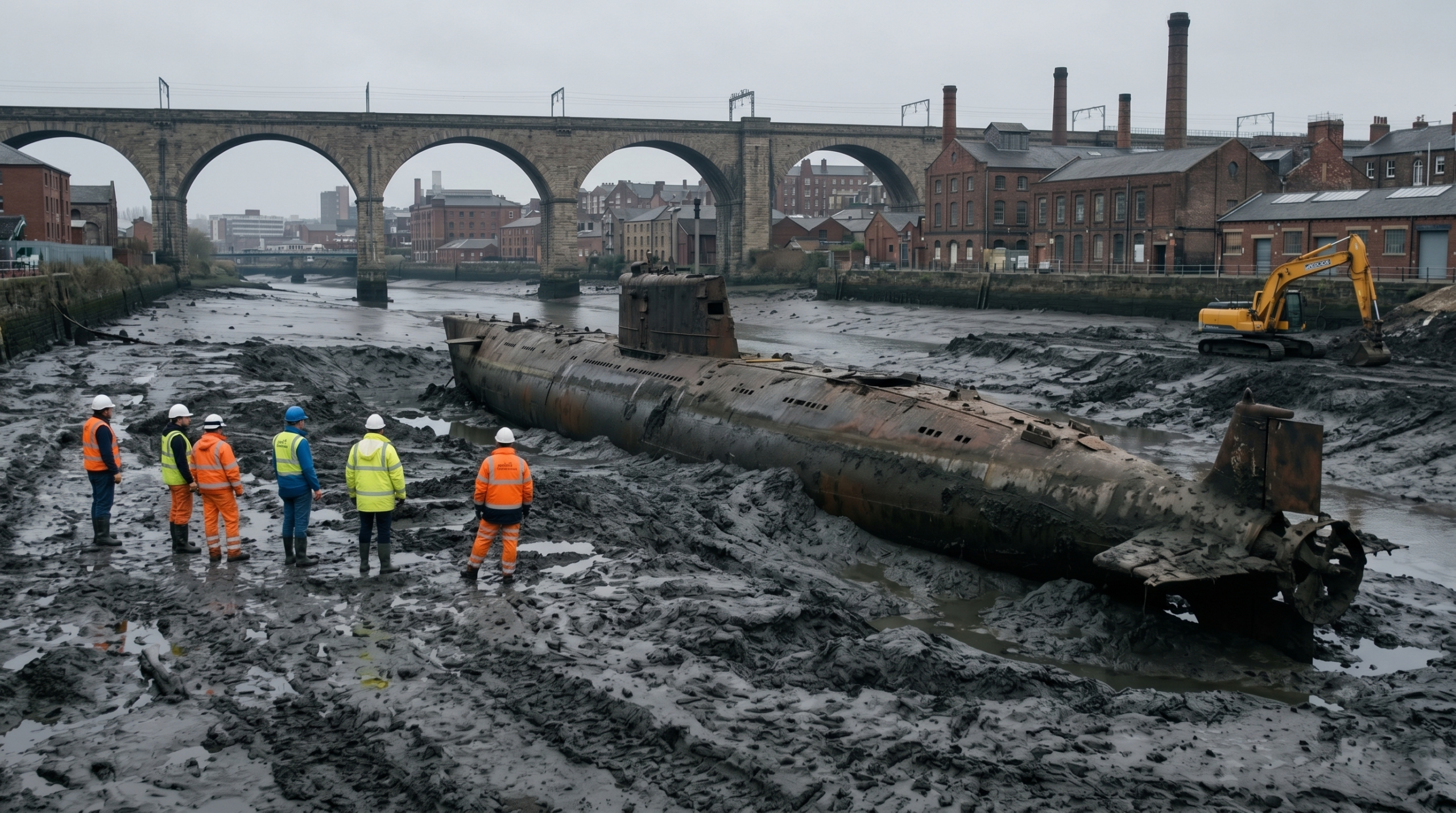
Factories rose above the skyline like rusted monuments to another century. Old warehouses leaned beside cracked roads. The Aldermoor Canal cut through the industrial district like a scar — dark, silent, and strangely lifeless even on windy days. Most people ignored it completely. Office workers crossed its bridges without looking down. Children were warned to stay away from its oily banks. Taxi drivers joked that if something disappeared in Marveston, the canal probably swallowed it.
Nobody imagined the canal had swallowed a submarine.
The drainage operation had been planned for more than a year. Every decade, city authorities emptied sections of the Aldermoor Canal to clear debris, inspect retaining walls, and repair old infrastructure buried beneath the waterline. Normally the work was uneventful — filthy, exhausting, but predictable. Workers expected to find shopping carts, abandoned bicycles, broken furniture, maybe even stolen safes or wrecked vehicles dumped by criminals years earlier.
You May Also Like


Nothing more.
Certainly not a military vessel hidden beneath the center of the city.
Before dawn on March 4th, maintenance supervisor Declan Hurst arrived at Pumping Station 14 wearing the same heavy waterproof jacket he had used for nearly fifteen winters. At fifty-two years old, Declan carried the exhausted posture of a man who had spent decades solving problems nobody else wanted. He knew canals the way sailors know oceans. He understood how water concealed things. Mud shifted. Objects sank deeper over time. Entire histories disappeared beneath black water.
Still, nothing in his career prepared him for what was waiting below Aldermoor.
The pumps started shortly after sunrise.
Massive industrial turbines groaned awake as millions of liters of canal water began flowing out toward temporary flood reservoirs outside the city. Slowly, the waterline dropped. Thick algae clung to the exposed walls. The smell intensified — stagnant water mixed with oil, rust, and decades of industrial decay.
By noon, workers could already see the canal floor emerging in patches through the murky water.
At first, nobody noticed anything unusual.
Then the mud moved.
Not dramatically. Just enough.
A dark shape slowly pushed upward from beneath the sludge as though the earth itself had exhaled after holding its breath for decades.
One worker thought it was an old tanker truck. Another guessed it might be construction machinery buried during some forgotten expansion project in the 1970s. But as more water drained away, the outline became impossible to misunderstand.
The shape was cylindrical.
Metallic.
Long.
And disturbingly smooth.
Priya Nair, one of the younger engineers on the crew, stared down from the concrete bank in silence before calling for Declan.
“Declan,” she said quietly. “You need to see this.”
Declan walked over expecting another rusted vehicle.
Instead, he froze.
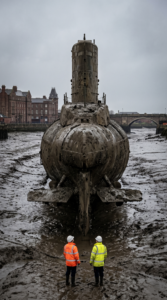
Half-submerged in black mud below them was the unmistakable hull of a submarine.
For several seconds, nobody spoke.
The vessel looked ancient and impossibly out of place. Its steel surface was coated in decades of hardened grime and mineral buildup. Sections of the hull were scarred with corrosion, but its shape remained shockingly intact. The rounded conning tower protruded from the sludge like the spine of some prehistoric creature surfacing after centuries underground.
And strangest of all — it was enormous.
Far too large to belong inside a city canal.
Workers gathered silently along the bank as the realization spread from person to person. Someone laughed nervously, assuming it had to be a movie prop or abandoned military replica. But Declan knew immediately that it wasn’t.
The steel was real.
The weld lines were real.
And the proportions were terrifyingly authentic.
Within thirty minutes, city officials halted the drainage operation entirely.
Police arrived first, followed by emergency response teams. Then came military officers. By sunset, the entire canal district had been sealed off behind temporary barriers while helicopters circled overhead.
Nobody in Marveston understood what they were looking at.
How could a submarine possibly exist beneath the middle of a modern industrial city?
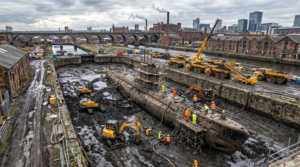
The canal itself was far too narrow for a vessel of that size. There were no records of military transport operations through Aldermoor. No missing naval submarines matched the dimensions. Local historians insisted nothing remotely similar had ever been documented.
Yet there it was.
Buried beneath the city like a secret someone had desperately wanted forgotten.
By nightfall, rumors had spread across the internet.
Some claimed it was a Cold War relic hidden during a nuclear crisis. Others believed it belonged to a foreign military. Conspiracy theories exploded instantly. Social media users compared satellite images, searched naval databases, and speculated wildly about espionage operations beneath Marveston.
But the truth proved stranger than any rumor.
The following morning, after additional water was drained, investigators descended onto the canal floor for the first close inspection.
Declan insisted on joining them.
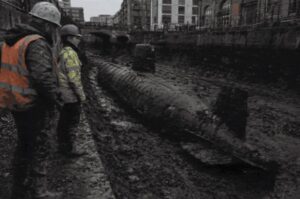
The mud reached nearly to their knees as they approached the vessel. Up close, the submarine looked even more unsettling. Its exterior bore no visible national markings. No identification numbers. No flags. The hull design seemed old but oddly unfamiliar — as though it belonged to a forgotten branch of naval engineering history.
Then Priya noticed something disturbing.
The hatch was slightly open.
Not damaged.
Not forced.
Open.
Every member of the inspection team stopped moving.
A silence settled over the canal that none of them would ever forget.
Because suddenly the submarine no longer felt abandoned.
It felt waiting.
Military personnel ordered everyone back immediately, fearing explosives, toxic gas, or even structural instability inside the vessel. Bomb disposal experts were flown in. Radiation scans were conducted. Atmospheric sensors tested the air surrounding the hatch.
Nothing unusual appeared.
No radiation.
No chemical threat.
No explosive residue.
Finally, after hours of preparation, a small entry team was authorized to go inside.
Declan entered with them.
Years later, he would still struggle to describe the feeling of climbing through that hatch.
The interior smelled dry.
Not flooded.
Not rotten.
Dry.
That alone made no sense.
The submarine had supposedly rested underwater for decades, yet many internal compartments remained eerily preserved. Narrow corridors stretched into darkness illuminated only by helmet lights. Old pipes lined the walls. Dust floated through stale air untouched for generations.
It felt less like entering a wreck and more like entering time itself.
Then they found the first object.
A coffee mug.
Still sitting upright beside a control station.
Declan stared at it in disbelief.
Nothing about the scene looked chaotic. There were no signs of panic, no evidence of flooding, no skeletal remains collapsed against walls. Instead, the submarine appeared abandoned in the middle of ordinary activity — as though the crew had simply stood up and walked away.
The deeper they moved inside, the stranger the mystery became.
Maps remained pinned to bulkheads. Tools rested neatly in storage compartments. Mechanical systems appeared partially maintained. One battery-powered emergency light still flickered weakly after all those years, casting intermittent red light through a sleeping compartment.
And then they reached the command center.
Priya found the logbook first.
Most pages had been ruined by time, but several entries remained partially legible. Dates were missing. Signatures had faded. Yet one sentence remained horrifyingly clear:
“We cannot surface. They are above us.”
Nobody understood what it meant.
Military intelligence immediately confiscated the logbook along with every removable document aboard the submarine. The city was placed under temporary information restrictions. Officials publicly claimed only that “an unidentified historic vessel” had been discovered during canal maintenance.
But information always leaks.
Within days, former naval officers began examining leaked photographs online. Several experts privately admitted the submarine’s design resembled experimental postwar prototypes developed during the late 1940s and early Cold War period.
That revelation only deepened the mystery.
If the vessel truly dated back that far, how had it entered the canal? Why had it vanished completely from historical records? And most disturbing of all — where had the crew gone?
Theories multiplied endlessly.
Some believed the submarine had been intentionally hidden beneath the city during covert intelligence operations. Others suspected a classified Cold War accident buried to avoid international scandal. A few even claimed the vessel had never officially existed at all.
Declan ignored most of the speculation.
But he could not stop thinking about the silence inside that submarine.
He returned several times during the investigation. Each visit unsettled him more deeply. The vessel felt frozen between worlds — neither fully dead nor alive. Every object inside hinted at sudden disappearance rather than destruction.
Then investigators made another discovery.
Deep inside a sealed compartment near the rear engineering section, they found a small locked locker untouched by corrosion. When forced open, it contained photographs.
Families.
Children.
Crew members smiling beside the submarine while docked at an unknown harbor.
And on the back of one photograph, written in faded ink, was a sentence that transformed the entire mystery:
“If this is ever found, tell them we tried to come home.”
Declan reportedly sat in silence for several minutes after reading it.
Because in that moment, the submarine stopped being merely a machine.
It became a tomb.
Not necessarily for bodies — none were ever found aboard — but for forgotten lives swallowed by secrecy, war, and history itself.
The discovery captured global attention for months. Historians debated its origins. Governments denied involvement. Naval archives were quietly reexamined. Yet many questions remained unanswered.
Perhaps they always will.
But for the people of Marveston, everything changed after the canal was drained.
The Aldermoor Canal no longer felt like just another polluted waterway cutting through an industrial city. Residents began stopping on bridges to stare into the dark water below. Older citizens whispered stories about strange military activity during the Cold War. Some swore they remembered hearing deep metallic sounds beneath the canal late at night decades earlier.
And Declan Hurst never looked at the water the same way again.
Because he learned something terrifying that March morning:
Cities bury secrets the same way oceans do.
Quietly.
Patiently.
For generations.
Until one day, without warning, the past rises back to the surface.