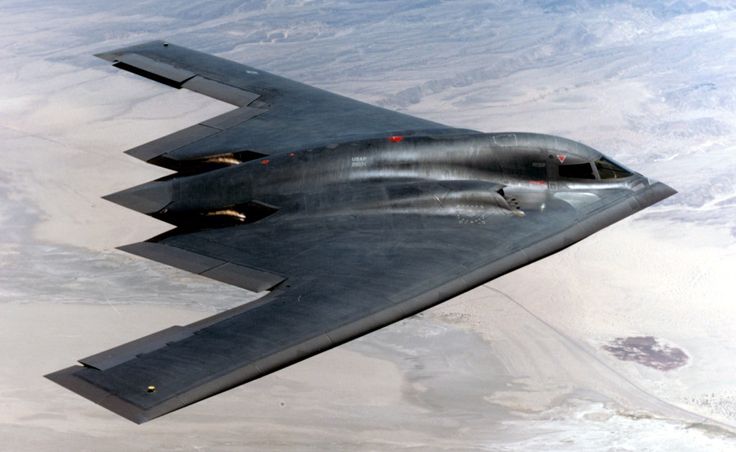
At first glance, the Northrop Grumman B-2 Spirit does not even look like it should fly.
There is no tail.
No vertical stabilizer.
No visible design features that resemble a traditional aircraft.
Instead, it appears almost alien — a dark triangular shadow sliding silently through the sky like something from the future.
And yet, despite being one of the most technologically advanced stealth bombers ever created, pilots who fly the B-2 often describe it in surprisingly simple terms:
You May Also Like


calm,
smooth,
predictable,
and remarkably easy to control.
That reality feels almost impossible.
How can one of the world’s most complex and strategically important aircraft feel gentle to fly?
The answer reveals one of the greatest engineering achievements in aviation history.
Because the B-2 Spirit is not a triumph of raw aerodynamics.
It is a triumph of computers, stealth science, and human ingenuity working together to make the impossible appear effortless.
The B-2 Was Never Designed To Fly Like A Fighter Jet
The Northrop Grumman B-2 Spirit was designed for one mission above all others:
to penetrate the world’s most heavily defended airspace without being detected.
Everything about the aircraft serves that purpose.
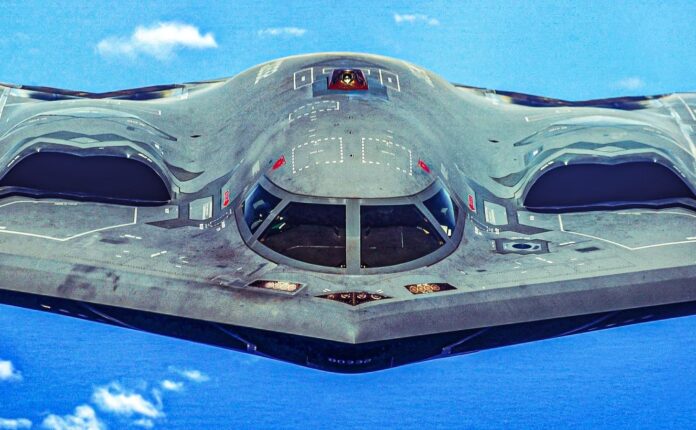
Its smooth flying-wing design minimizes radar reflections.
Its engines are buried deep inside the airframe to reduce infrared heat.
Its surfaces are carefully aligned to scatter enemy radar signals away from receivers.
The result is one of the stealthiest aircraft ever built.
But there was a major problem.
Aircraft naturally rely on tails and vertical fins for stability. These surfaces help pilots maintain directional control, balance, and recovery during maneuvers.
The B-2 removed them almost entirely.
From an aerodynamic perspective, that made the bomber inherently unstable.
In simple terms:
the aircraft constantly wants to drift, shift, and destabilize itself.
Without advanced technology correcting it every second, the B-2 would be extremely difficult — and potentially impossible — to fly safely.
And that is where the real magic begins.
The Computers Fly The Aircraft So The Pilot Doesn’t Have To Fight It
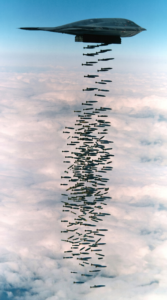
The reason the B-2 feels smooth is because the pilot is never flying alone.
Behind every movement of the control stick, the aircraft’s computerized fly-by-wire system is making hundreds of invisible corrections every second.
The system constantly analyzes:
- speed,
- airflow,
- altitude,
- aircraft balance,
- control surface position,
- and aerodynamic pressure.
Then it instantly adjusts the aircraft before instability becomes dangerous.
To the crew, these corrections feel invisible.
The aircraft simply responds gently and precisely, almost like a massive glider floating through the atmosphere.
But underneath that calm behavior is an incredibly complex digital balancing act happening continuously.
The B-2 does not remain stable naturally.
It remains stable because its computers never stop working.
Flying The B-2 Is More Like Guiding Than Controlling
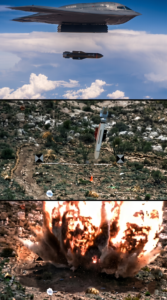
Unlike fighter jets designed for violent maneuvering and high-G combat, the B-2 was designed for long-range stealth penetration.
Its mission is not to dogfight.
Its mission is to quietly cross continents, evade radar networks, and deliver devastating precision strikes before enemies even realize it is there.
As a result, the bomber’s controls are intentionally smooth and deliberate.
Pilots often compare the aircraft’s behavior to a giant sailplane or high-performance glider. Small control inputs produce measured, stable responses rather than aggressive movements.
This makes sense strategically.
The B-2 survives through invisibility, not speed.
Aggressive maneuvers could expose the aircraft to radar by changing its shape, revealing engine heat, or disrupting its carefully controlled stealth geometry.
So the aircraft is designed to discourage violent movement altogether.
In the B-2, stealth always comes first.
The Aircraft Is Constantly Protecting Its Own Stealth
One of the most fascinating aspects of the B-2 is that the aircraft is not simply flying.
It is also constantly protecting its radar invisibility.
The bomber’s stealth performance works best when it maintains:
- controlled bank angles,
- steady speeds,
- smooth altitude transitions,
- and carefully managed flight profiles.
Sharp turns or abrupt maneuvers could increase radar reflections or expose sensitive parts of the aircraft to enemy sensors.
That means the B-2’s flight control systems are not only helping the aircraft stay stable.
They are also helping the aircraft stay hidden.
Every maneuver is filtered through stealth considerations.
The aircraft essentially asks:
“Can I do this movement without compromising invisibility?”
That level of integration between aerodynamics and stealth engineering is extraordinary.
The B-2 is not merely an airplane.
It is a flying balance between physics and invisibility.
A Giant Flying Wing With Intercontinental Reach
Despite its graceful handling, the B-2 is still an enormous strategic weapon.
The bomber has:
- a wingspan of 172 feet,
- a maximum takeoff weight exceeding 336,000 pounds,
- intercontinental range,
- aerial refueling capability,
- and the ability to carry nuclear and conventional weapons.
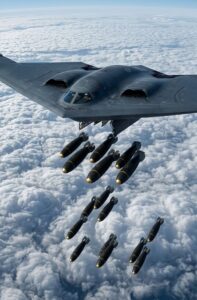
Inside its internal weapons bays, the aircraft can carry roughly 40,000 pounds of precision-guided bombs and strategic payloads.
Yet because of its aerodynamic efficiency, the aircraft cruises with remarkable smoothness at high altitude for extremely long missions.
Its flying-wing design creates excellent lift and fuel efficiency, allowing it to travel vast distances while maintaining stealth.
This is why the B-2 became one of the most important strategic bombers in American military history.
It can strike almost anywhere on Earth while remaining extraordinarily difficult to detect.
The Real Genius Of The B-2 Is Not The Shape — It’s The System
Many people assume the B-2’s greatest achievement is its appearance.
But the real masterpiece is the invisible system underneath it.
The aircraft combines:
- advanced computer control,
- stealth materials,
- aerodynamic compromise,
- sensor integration,
- and pilot-machine coordination
into one seamless platform.
The pilot experiences calm simplicity.
Behind that simplicity is overwhelming technological complexity.
That is the hallmark of truly great engineering:
making impossible tasks feel natural.
The B-2 does not overwhelm its crew with chaos.
It hides the chaos behind intelligent systems.
The Spirit Bomber Changed Aviation Forever
When the Northrop Grumman B-2 Spirit entered service in 1997, it represented more than a new bomber.
It represented a completely different philosophy of warfare.
Previous generations of bombers survived through:
- speed,
- armor,
- altitude,
- or escort fighters.
The B-2 survives through absence.
It is designed not to fight enemy defenses directly — but to pass through them like a ghost.
That idea transformed modern military aviation.
Today, stealth has become central to the future of airpower, influencing aircraft like the Lockheed Martin F-35 Lightning II, Lockheed Martin F-22 Raptor, and Northrop Grumman B-21 Raider.
But the B-2 remains unique because it proved that a flying wing once considered aerodynamically impractical could become one of the most capable strategic bombers ever built.
The Aircraft That Made The Impossible Feel Easy
The most astonishing thing about the B-2 may not be its stealth.
It may not be its range.
Or its cost.
Or even its strategic power.
It may be this:
One of the most unstable aircraft ever designed became one of the smoothest aircraft to fly.
That transformation captures the essence of modern aerospace engineering.
The B-2 Spirit is not powerful because it looks intimidating.
It is powerful because it hides extraordinary complexity beneath extraordinary simplicity.
To radar, it is nearly invisible.
To pilots, it feels almost effortless.
And that combination is exactly what made the Spirit bomber legendary.