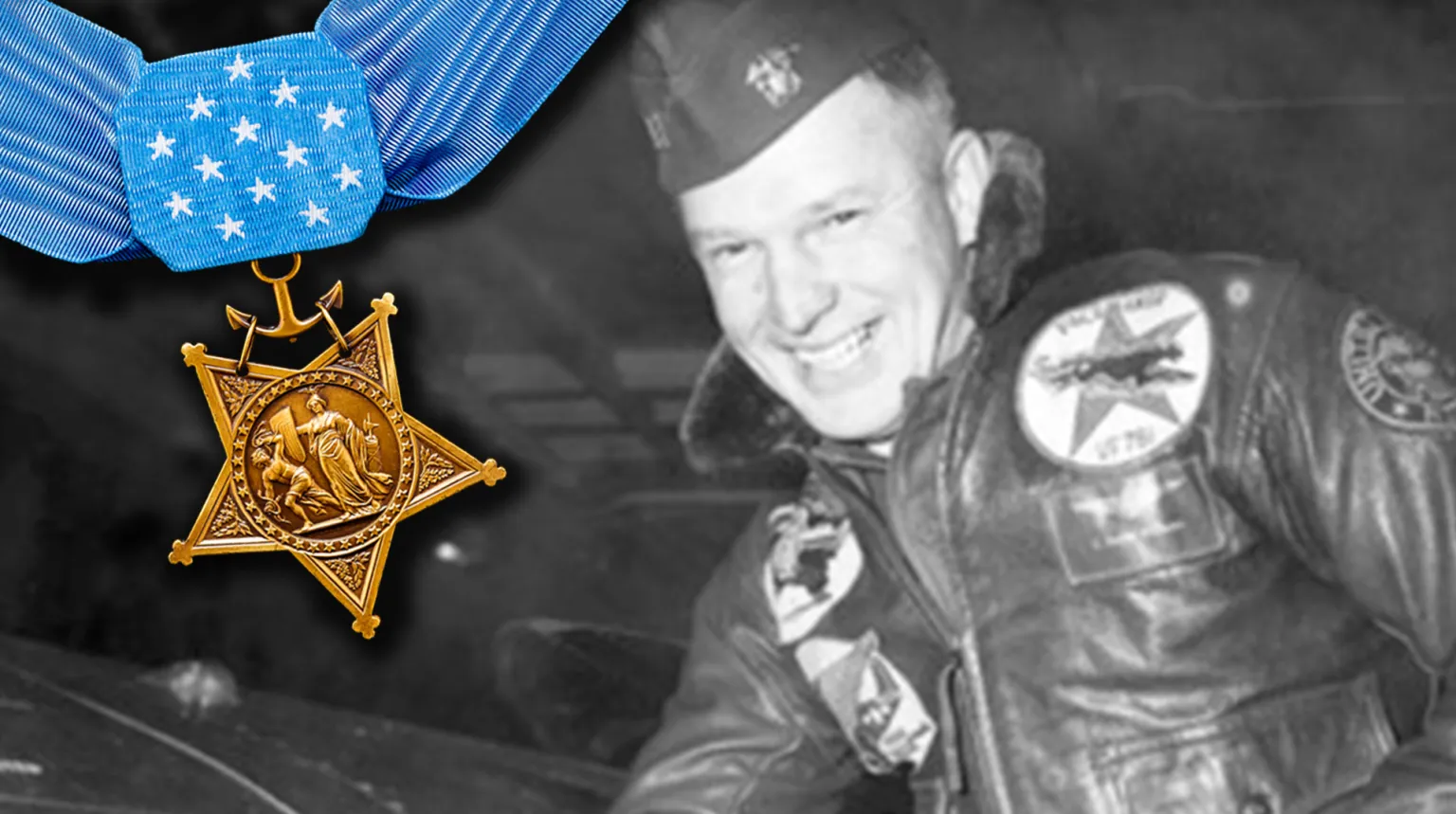
For more than seventy years, one of the greatest aerial battles in American military history remained buried in silence.
No movie was made about it.
No headlines celebrated it.
No crowds welcomed home the pilot who survived it.
The United States government classified the truth.
And the man at the center of the battle obeyed orders and said almost nothing for decades.
You May Also Like

But history has a way of refusing to stay hidden forever.
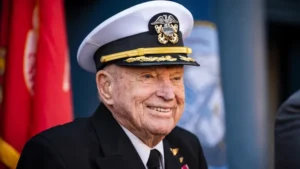
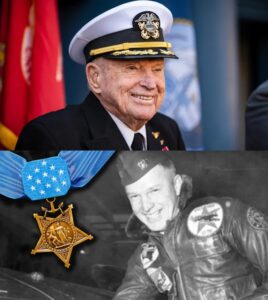
Now, nearly 75 years after one of the most extraordinary dogfights ever fought by an American pilot, retired Navy Capt. Royce Williams will finally receive the Medal of Honor — the nation’s highest military award for valor.
The decision closes one of the most remarkable chapters in naval aviation history.
Because on a freezing day over the Sea of Japan in 1952, Williams did something that sounded almost impossible even by the standards of war heroes:
He fought six Soviet MiG fighters alone.
And won.
A Battle Hidden By The Cold War
The Korean War is often called “The Forgotten War.”
Overshadowed by World War II before it and Vietnam after it, many of its greatest stories disappeared into history with little public recognition.
But few stories were buried as deeply as Royce Williams’ dogfight.
On Nov. 18, 1952, Williams was a young Navy lieutenant flying a Grumman F9F Panther from the aircraft carrier USS Oriskany.
At the time, tensions in the Korean War had become far more dangerous than many Americans realized publicly.
Officially, the United States was fighting North Korean and Chinese communist forces.
Unofficially, the Soviet Union was also deeply involved.
Soviet pilots secretly flew combat missions in Korean airspace while Moscow publicly denied direct participation. The Cold War balance depended heavily on maintaining that fiction. Neither Washington nor Moscow wanted open acknowledgment that American and Soviet pilots were directly fighting each other in the skies.
Then Royce Williams encountered seven Soviet MiGs.
And everything changed.
The Day The Sky Exploded
Williams and three other Navy fighters were flying patrol over the Sea of Japan when enemy aircraft suddenly appeared.
The fighters were Mikoyan-Gurevich MiG-15 jets — among the deadliest combat aircraft of the era.
Fast.
Aggressive.
Heavily armed.
The MiG-15 had already proven itself a terrifying opponent during the Korean War. In many respects, it outperformed several American aircraft then operating in the region. Soviet pilots flying MiGs were highly trained, experienced, and operating under direct military command.
As tensions escalated, two American planes were ordered back to the carrier.
That left Williams and his wingman alone.
Then four MiGs attacked.
Within moments, the skies turned into chaos.
Jets screamed through freezing air at hundreds of miles per hour. Cannon fire ripped across the clouds. Pilots fought violently for position in a battle where survival depended on split-second decisions.
Williams immediately opened fire and damaged one Soviet fighter. His wingman pursued the crippled MiG away from the main engagement.
Suddenly, Royce Williams found himself alone against six enemy jets.
One Man Against Six Soviet Fighters
By every logical measure, Williams should have died.
The MiG-15s were faster than his Panther.
They climbed faster.
They maneuvered more aggressively.
They carried deadly 37mm cannons capable of shredding aircraft instantly.
And there were six of them.
But combat is not decided only by statistics.
It is decided by courage, skill, instinct, and the ability to remain calm while surrounded by death.
Williams later explained that his Panther possessed one critical advantage:
Its gunsight system.
Using precise flying and tight defensive turns, Williams forced the Soviet pilots into firing positions where he could counterattack. Again and again, he maneuvered his aircraft through impossible angles, firing brief but devastating bursts whenever a MiG crossed his sights.
The dogfight stretched on.
Five minutes.
Ten minutes.
Twenty minutes.
The battle became the longest dogfight in Navy history.
As the Soviet fighters circled around him repeatedly, Williams continued shooting.
One MiG exploded into destruction.
Another spiraled downward.
Another crashed after being damaged.
A fourth was hit so badly it later went down as well.
The American pilot who was supposed to be outnumbered and overwhelmed was systematically destroying Soviet fighters one by one.
The Panther Refused To Die
But the battle nearly killed him.
During the engagement, a Soviet 37mm cannon shell slammed into Williams’ aircraft. The round tore through his wing while shrapnel ripped across the fuselage.
More than 250 holes scarred the Panther.
Fuel leaked.
Systems failed.
The aircraft shook violently.
Williams had also fired every single round of ammunition aboard his fighter — all 760 rounds of 20mm ammunition completely exhausted during the battle.
And yet he still had to survive the journey home.
The damaged Panther struggled to remain airborne as Williams guided it back toward the USS Oriskany through rough weather and dangerous seas.
Then came another near disaster.
As Williams approached the fleet, two American destroyers mistakenly opened fire on his crippled jet, apparently unable to identify the heavily damaged aircraft correctly in the confusion.
Fortunately, they missed.
Even after surviving six Soviet fighters, Royce Williams still had to land a dying aircraft on the pitching deck of an aircraft carrier.
Carrier landings are among the hardest maneuvers in aviation even under normal conditions.
Williams’ situation was anything but normal.
His Panther had to approach much faster than usual simply to avoid falling out of the sky.
Yet somehow, against overwhelming odds, he brought the aircraft safely onto the carrier deck.
The nightmare was finally over.
But the silence was only beginning.
America Buried The Truth
Today, such a battle would dominate global headlines.
But in 1952, the Cold War made truth dangerous.
American intelligence quickly confirmed something explosive:
The enemy fighters had not been North Korean or Chinese aircraft.
They were Soviet MiGs controlled by Soviet ground stations near Vladivostok.
That revelation threatened to escalate Cold War tensions dramatically.
If publicly acknowledged, the battle could have exposed direct military conflict between the United States and the Soviet Union — two nuclear powers rapidly moving toward confrontation.
So the government classified the details.
Williams was ordered not to discuss the engagement.
And he obeyed.
For decades, one of the greatest aerial victories in Navy history remained hidden from the American public. Williams received the Silver Star for bravery, but the full truth behind the mission stayed locked away in classified files.
He carried the story silently for years.
Only much later, after the government informed him that the mission had been declassified, did Williams finally tell someone the truth.
His wife.
Imagine that moment.
A man carrying one of the most extraordinary combat stories in American history for decades — finally allowed to speak.
Why Royce Williams Matters Today
The decision to award the Medal of Honor to Royce Williams is about far more than correcting a historical oversight.
It reflects something deeper about courage itself.
Modern warfare often focuses on technology, missiles, artificial intelligence, and advanced weapons systems. But Royce Williams’ story reminds us that history can still turn on the actions of a single human being under impossible pressure.
One pilot.
One aircraft.
One decision to keep fighting.
At multiple moments during that battle, Williams could have disengaged or attempted escape. Instead, he stayed in the fight against overwhelming odds because survival depended on it.
And remarkably, he never described himself as extraordinary.
When asked how he managed to shoot down four Soviet MiGs, Williams gave a simple answer:
“I have a God that did it for me.”
That humility may be one reason his story resonates so powerfully today.
He did not seek fame.
He did not demand recognition.
He did not build himself into a legend.
He simply served.
The Meaning Of The Medal Of Honor
The Medal of Honor represents the highest standard of military courage in the United States.
It is awarded only for acts of valor above and beyond the call of duty — actions involving extraordinary risk and selflessness.
Many recipients never survive the actions that earn it.
For Royce Williams, receiving the medal at 100 years old transforms the award into something even more profound.
It becomes a victory over time itself.
History nearly forgot him.
Classification nearly buried his achievement forever.
The Cold War nearly erased his battle from public memory.
But truth endured.
And now the nation is finally recognizing what happened in those freezing skies over the Sea of Japan.
A Hero From Another Era
Royce Williams belongs to a generation rapidly disappearing from history.
These were men who fought not for internet fame or public attention, but because duty demanded it. Many returned from war and quietly resumed ordinary lives without speaking about what they had endured.
Today’s world often moves too quickly to fully understand sacrifices like theirs.
But stories such as Williams’ remind us why remembering matters.
Because courage is not abstract.
Sometimes it looks like a damaged fighter jet limping across freezing skies.
Sometimes it looks like a pilot refusing to surrender against impossible odds.
Sometimes it looks like decades of silence carried with dignity.
And sometimes, after nearly seventy-five years, it finally receives the honor it always deserved.
The Legacy Of Royce Williams
Long after modern aircraft replace today’s fighters…
Long after drones and artificial intelligence reshape warfare…
The story of Royce Williams will still endure.
Because technology changes.
Weapons evolve.
Wars transform.
But human courage remains timeless.
Somewhere in the history of naval aviation, there will always be a young Navy pilot alone over the Sea of Japan, surrounded by six Soviet MiGs, refusing to back down.
And now, at last, the world knows his name.