Marine Corps F-35Cs Head Toward the Middle East: A Historic Land-Based Combat Move for America’s Carrier Stealth Fighter
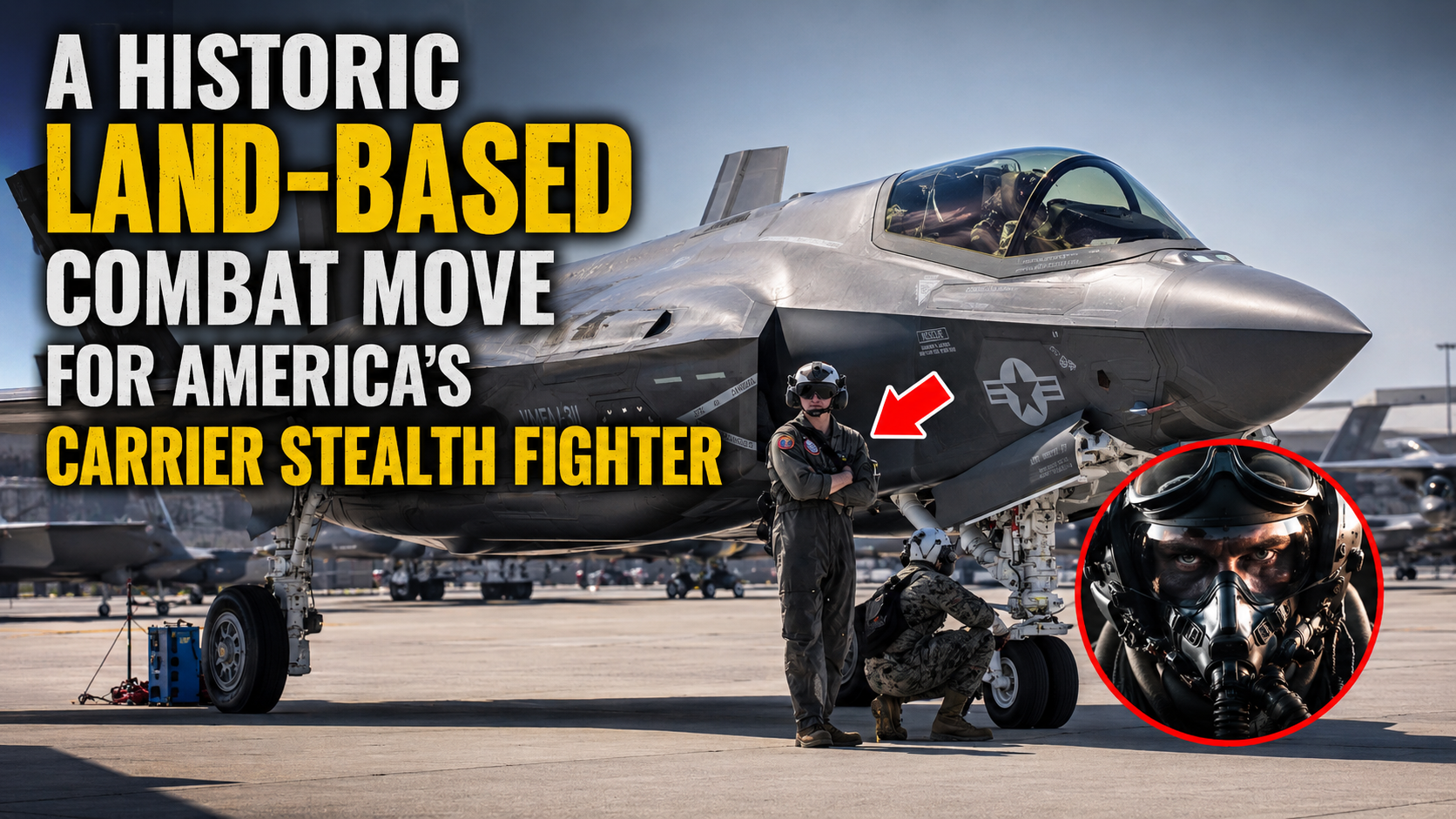
The U.S. Marine Corps is making a move that could mark a major moment in the history of the F-35C.
For years, the F-35C has been known mainly as America’s carrier-based stealth fighter — the version of the Joint Strike Fighter built with larger wings, stronger landing gear, and the ability to operate from the decks of U.S. Navy aircraft carriers.
But now, Marine Corps F-35Cs are moving toward the Middle East in what is being described as their first land-based combat deployment.
That detail matters.
You May Also Like
This is not simply another fighter jet movement. It is a sign that the U.S. military is pulling more advanced airpower into a region already under intense pressure. It also shows how the Marine Corps is using its newest fifth-generation aircraft in ways that go beyond traditional carrier operations.
According to reporting from TWZ, F-35Cs from Marine Fighter Attack Squadron 311, known as VMFA-311 or the “Tomcats,” began moving from Marine Corps Air Station Miramar in California and arrived at RAF Lakenheath in England while heading toward the U.S. Central Command area of responsibility. The aircraft are connected to Operation Epic Fury, the large U.S. military campaign against Iran.
The final destination of the aircraft was not publicly confirmed in the original reporting. But their movement alone sends a clear message: Washington is adding more high-end stealth capability to a theater where airpower, naval power, missile defense, and regional pressure are all becoming more important by the day.
The most interesting part of this deployment is the aircraft itself.
The F-35C is different from the F-35A and F-35B. The F-35A is the conventional takeoff and landing version used by the U.S. Air Force. The F-35B is the short takeoff and vertical landing version used by the Marine Corps from amphibious assault ships and expeditionary bases. The F-35C, however, was built for aircraft carriers.
It has larger wings, stronger landing gear, a more robust tailhook, and greater internal fuel capacity compared with other variants. Those features help it launch from catapults, recover using arresting wires, and fly longer-range missions from carrier decks.
That is why a land-based combat deployment of Marine Corps F-35Cs is so significant.
These aircraft are not only being used from the sea. They are now being positioned like land-based stealth strike fighters, giving commanders more flexibility in a fast-moving regional crisis.
VMFA-311 is also an important squadron to watch. The “Tomcats” have a long Marine aviation history, but their modern F-35C chapter is still relatively new. The squadron was reactivated as part of the Marine Corps’ transition toward a more advanced fifth-generation force and declared initial operational capability with the F-35C in 2024.
Now, less than two years later, its aircraft are being moved toward one of the most dangerous regions in the world.
That makes this deployment more than a routine rotation. It is a test of how quickly a newly modernized Marine squadron can plug into a major combat campaign.
Operation Epic Fury has already pulled a wide range of U.S. forces into the region, including aircraft, warships, missile defense systems, and Marine expeditionary forces. The arrival or movement of more F-35s adds another layer to that buildup.
The F-35 is not just a fighter jet. It is a sensor platform, a strike aircraft, an intelligence collector, and a battlefield networking system. Its stealth design allows it to operate in contested airspace where older aircraft would face higher risk. Its sensors allow pilots to detect, track, and share information with other aircraft and commanders. Its weapons allow it to strike ground targets or defend against airborne threats.
In a region like the Middle East, where air defenses, ballistic missiles, drones, naval threats, and political pressure all overlap, that combination is extremely valuable.
For the United States, the movement of F-35Cs could serve several purposes.
First, it strengthens the air campaign. If the aircraft are used in combat, they could help strike high-value targets, support other aircraft, suppress threats, or provide advanced surveillance and targeting data.
Second, it adds flexibility. Land-based F-35Cs could operate from airfields while carrier-based F-35Cs continue flying from ships. That means commanders are not limited to one launch point. They can distribute aircraft across land and sea, making U.S. airpower harder to predict and harder to target.
Third, it supports Marine forces in the region. The uploaded report also notes that Marine expeditionary forces and amphibious assault ships were moving toward the CENTCOM area. If Marines were called upon for operations near the Persian Gulf or along key maritime routes, F-35Cs could provide close air support, reconnaissance, and strike power.
That matters because the Marine Corps is designed to fight as a combined air-ground team. Its aircraft do not exist only to win air battles. They also exist to support Marines on the ground, protect expeditionary forces, and give commanders options in difficult terrain.
In the current Middle East environment, those options could be critical.
One of the biggest flashpoints mentioned in the report is the Strait of Hormuz. This narrow waterway is one of the most important energy routes in the world. Any threat to shipping there can shake global markets, raise oil prices, and trigger military responses from multiple countries.
If the strait is threatened by mines, missiles, drones, fast boats, or coastal defense systems, aircraft like the F-35C could help detect threats, support naval forces, and strike dangerous targets if ordered.
The F-35C’s range also gives it an advantage. Because it carries more internal fuel than other F-35 variants, it can fly longer missions, especially when supported by aerial refueling. That is important in the Middle East, where distances between bases, carriers, targets, and patrol zones can be large.
Its stealth also matters. Iran has invested in air defenses, ballistic missiles, drones, and other systems intended to make any attack costly. No aircraft is invisible or invincible, but stealth can reduce detection risk and allow pilots to operate with greater survivability in dangerous environments.
That is why fifth-generation aircraft are so important in modern conflict.
Older aircraft may still carry heavy weapons and perform valuable missions, but aircraft like the F-35 bring something different: the ability to see first, share information quickly, and operate in contested airspace with reduced vulnerability.
In a major campaign, that can shape the entire battlefield.
The movement through RAF Lakenheath also shows the importance of U.S. and allied infrastructure. RAF Lakenheath in the United Kingdom is a key U.S. Air Force base in Europe and often serves as an important hub for fighter movements. Aircraft traveling from the United States toward Europe, the Middle East, or other regions can use bases like Lakenheath as staging points.
That kind of global network is one of America’s biggest military advantages.
The United States can move aircraft from California to Europe and then toward the Middle East because it has bases, tankers, maintenance crews, logistics systems, and allies positioned across the world. A fighter jet is powerful, but it cannot move globally without fuel, spare parts, pilots, weapons, intelligence, and ground support.
This deployment is therefore not only about the F-35C. It is also about the military machine behind it.
Every aircraft movement tells a bigger story: tankers in the air, crews on the ground, diplomatic agreements, maintenance planning, weapons storage, intelligence updates, and command decisions happening behind the scenes.
For the Marine Corps, this moment also reflects a broader transformation.
The Marines have been reshaping themselves for future conflict, especially in the Indo-Pacific, where dispersed operations, island chains, long-range missiles, and naval integration are becoming central. The F-35 is a key part of that future. The F-35B gives the Marines short takeoff and vertical landing flexibility from ships and austere sites. The F-35C gives them longer range and carrier integration.
By using F-35Cs from land bases, the Marines may be showing that their aviation force can adapt quickly to different theaters and different missions.
This is important because modern warfare rarely follows a clean script. Aircraft designed for carriers may need to operate from land. Aircraft designed for land bases may need to support maritime operations. Drones may act as scouts, decoys, or strike platforms. Missile defense systems may need to protect not just bases, but ports, ships, oil routes, and cities.
Flexibility is now one of the most valuable weapons a military can have.
The F-35C brings that flexibility into the Middle East crisis.
Still, it is important not to exaggerate. The movement of F-35Cs does not automatically mean a specific operation will happen. It does not confirm where they will be based. It does not reveal their exact mission. Military aircraft often move as part of deterrence, reinforcement, planning, or contingency preparation.
But the timing and direction of the movement make the message clear: the U.S. is increasing its high-end combat options in the region.
For Iran, that is a warning.
For U.S. allies, it is a reassurance.
For military watchers, it is a historic development in the operational use of the Marine Corps F-35C.
The carrier variant of the Joint Strike Fighter is stepping into a land-based combat role at a time when the region is already filled with tension. That makes this deployment not only a technical milestone, but also a strategic signal.
The F-35C was built for carrier warfare. But in today’s battlefield, the line between sea power, land power, and air power is becoming more blurred.
A stealth fighter launched from a carrier can support ground forces. A land-based aircraft can protect naval operations. A Marine squadron can reinforce a major air campaign. A fighter jet can act as both a weapon and a sensor for the entire force.
That is the new face of modern war.
The Marine Corps F-35Cs moving toward the Middle East represent more than aircraft in transit. They represent America’s ability to shift advanced combat power across continents, adapt carrier aircraft for land-based operations, and bring fifth-generation stealth capability into one of the world’s most volatile regions.
In past wars, the sight of more fighters arriving often meant more firepower.
Today, it means something bigger.
It means more sensors, more data, more stealth, more deterrence, and more options for commanders.
The F-35C may have been designed for the deck of an aircraft carrier, but this moment shows its role can reach far beyond the sea.
And as the Middle East remains tense, one thing is clear: the arrival of Marine Corps F-35Cs is not just another deployment.
It is a signal that America is preparing for whatever comes next.