
Angeles, weeks after Sasha Obama was also photographed with a cigarette. The public sighting has renewed attention on the Obama sisters, their post-White House lives, and Barack Obama’s past struggle with smoking.
Malia Obama has once again found herself in the public spotlight — not for a political statement, a red-carpet appearance, or a major career announcement, but for a quiet moment outside a Los Angeles convenience store.
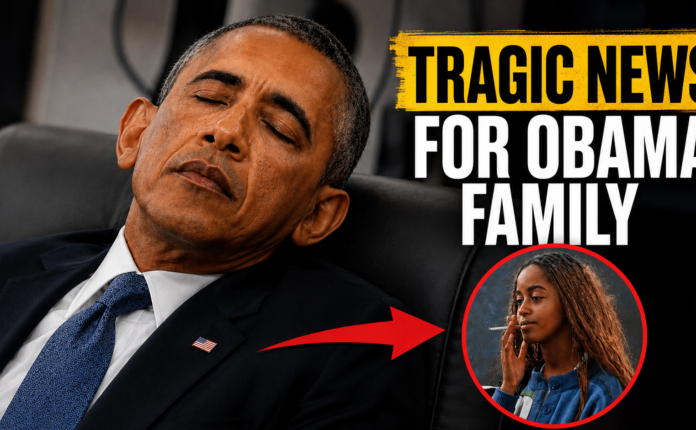
The eldest daughter of former President Barack Obama and former First Lady Michelle Obama was photographed smoking a cigarette while standing near a black car and speaking with a friend. Dressed casually in a blue cardigan, brown trousers, and black shoes, Malia appeared relaxed, makeup-free, and low-key.
For most people, a smoke break outside a store would be forgettable.
You May Also Like


For Malia Obama, it became a headline.
The photos quickly attracted attention because Malia is not just any young adult living in Los Angeles. She is one of the most recognizable former first daughters in modern American history. She grew up in front of the world, moved through childhood under Secret Service protection, attended Harvard, and has since begun building a creative life outside politics.
But public curiosity around her has never fully faded.
The sighting also came weeks after her younger sister, Sasha Obama, was photographed smoking a cigarette while leaving a Labor Day party in Los Angeles. That timing made the story travel even faster, with many people connecting the two sightings and comparing them with their father’s well-known history as a former smoker.
Still, the larger story is not simply that two adult women were photographed smoking.
The bigger story is why the public still watches the Obama daughters so closely — and why even ordinary private moments can become national entertainment when they involve a famous family.

A Quiet LA Moment Becomes a Public Story
According to reports, Malia was seen outside a convenience store in Los Angeles, cigarette in hand, while talking with a friend beside a vehicle.
The moment appeared casual. There was no public event, no official appearance, no political setting, and no sign that Malia was seeking attention. She looked like many young adults in Los Angeles: relaxed, stylish, and going about her day.
Her outfit also attracted notice. She wore a soft blue cardigan, loose brown trousers, dark shoes, and her long hair down. The look was simple, natural, and very different from the polished public image often associated with political families.
Some online reactions focused on the cigarette. Others focused on her style. Some criticized the smoking. Others defended her privacy and pointed out that she is an adult living her own life.
That split reaction shows the complicated space Malia Obama occupies.
She is not an elected official.
She is not a government figure.
She does not regularly seek celebrity attention.
But because she grew up in the White House, the public still treats her life as news.
Sasha Obama Was Also Spotted Smoking
The story gained more attention because Sasha Obama had also recently been photographed smoking a cigarette in Los Angeles.
Sasha, the younger Obama daughter, was seen leaving a Labor Day party while wearing a colorful bikini-style top and a blue maxi skirt. She was photographed socializing with friends and holding a cigarette.
Like Malia, Sasha is now an adult and living outside the political world. She graduated from the University of Southern California and has also been seen spending time in Los Angeles.
The two sightings created a familiar tabloid pattern: one photo becomes a lifestyle story, and two photos become a “family trend.”
But it is important to be careful.
Seeing someone smoke once or even more than once in public does not prove a full-time habit. It does not prove addiction. It does not reveal someone’s private health choices. It simply shows what was photographed in that moment.
That distinction matters.
The Obama daughters may be famous, but they are still private citizens. Public interest does not mean every personal choice should be turned into a moral judgment.


Why the Obama Sisters Still Attract So Much Attention
Malia and Sasha Obama entered the White House as children.
When Barack Obama became president in 2009, Malia was 10 and Sasha was 7. Millions of people watched them grow up from a distance. They appeared at campaign events, holiday ceremonies, state occasions, and family moments, but their parents worked hard to protect them from becoming celebrities.
Michelle Obama often spoke about wanting her daughters to have as normal a childhood as possible, even though their father held the most powerful office in the world.
That was never easy.
The girls lived under constant security. Their school life, friendships, travel, clothing, and public appearances were watched by media and strangers. Even normal teenage behavior could become a headline if photographed.
Now, years later, Malia and Sasha are adults, but public interest remains.
Part of that is nostalgia. Many Americans remember them as young girls in the White House. Seeing them as grown women living independent lives feels surprising to people who still picture them as children.
Part of it is celebrity culture. The Obama family remains one of the most famous families in the world, even years after leaving the White House.
And part of it is the internet. A single photo can travel across entertainment sites, social media pages, TikTok clips, and Facebook posts within hours.
That is why a cigarette outside a convenience store becomes news.
Malia Obama’s Life After the White House
Malia has spent recent years building her own identity away from politics.
After graduating from Harvard, she moved into the entertainment world and has been linked to writing and filmmaking projects. She has worked in creative spaces and has tried to build a career using the name Malia Ann, a move many interpreted as an effort to separate her professional identity from the Obama surname.
That choice says a lot.
Being the child of a former president opens doors, but it also creates pressure. Every move is compared with the family name. Every project is judged through politics. Every public appearance becomes part of a larger story.
For Malia, building a creative career means stepping into public life in a different way. She is not running for office. She is not working as a political spokesperson. She is not trying to become a public activist in the same way her parents are.
She appears to be choosing a quieter creative path.
But because of who she is, even quiet choices become public.
Sasha Obama’s Life in Los Angeles
Sasha has also grown into adulthood outside the constant political spotlight.
She studied at the University of Southern California after transferring from the University of Michigan, and she has been seen spending time in Los Angeles with friends and family. Like Malia, she appears to be living a young adult life in a city where celebrity sightings are common.
Los Angeles is a place where many famous families try to blend into normal life while still being photographed constantly.
That is the strange reality for Malia and Sasha. They are not traditional Hollywood celebrities, but they live in an environment where photographers watch restaurants, gyms, parties, stores, and public streets.
A casual moment can become an entertainment headline before the day is over.
For young adults trying to live normally, that can be exhausting.
Barack Obama’s Own Smoking History
The public interest in Malia and Sasha’s cigarette sightings grew partly because their father has publicly spoken about his own smoking struggle.
Barack Obama has admitted that he used to smoke and that quitting was difficult. During his presidency, he acknowledged that he struggled with the habit and sometimes slipped, while also saying he did not smoke in front of his children or family.
His smoking became a frequent media topic during his early years in the White House.
Later, in his memoir, Obama described how his daughter Malia played a role in helping him finally stop. He wrote that Malia’s reaction after smelling cigarette smoke on his breath affected him deeply and pushed him toward quitting with the help of nicotine gum.
That family history makes the recent sightings more noticeable to the public.
There is an irony in the story: the daughter who reportedly helped motivate her father to quit has now been photographed smoking herself as an adult.
But that irony should not be turned into cruelty.
Many families have complicated relationships with smoking. A parent may quit while a child later experiments. A child may dislike a parent’s habit and still make different choices years later. Addiction, stress, social habits, and personal behavior do not follow simple family scripts.
The Obama family is famous, but in this way, they are also very human.

Smoking Is Still a Serious Health Issue
Even though the story has a celebrity angle, smoking itself remains a serious health topic.
Cigarette smoking is widely known to harm the body. Health authorities link smoking to cancer, heart disease, stroke, lung disease, diabetes, and many other conditions. Even occasional smoking can carry risks, especially because nicotine is addictive.
This is why people react strongly when public figures are photographed smoking.
Some worry that celebrity images can make cigarettes look stylish again. Others point out that adults are free to make their own choices, even unhealthy ones.
Both ideas can be true.
Adults have personal freedom.
Smoking is still harmful.
Public images can influence culture.
Famous people still deserve privacy.
The best response is not to shame someone, but to be honest about the risks.
A cigarette may look casual in a photo, but it is not harmless.
The Internet’s Mixed Reaction
Online reaction to Malia’s smoke break was divided.
Some people criticized her, saying smoking is unhealthy and disappointing. Others defended her, arguing that she is an adult and should not be judged for a private moment. Some focused on her outfit and called her stylish. Others criticized the media for continuing to follow the Obama daughters years after they left the White House.
That mix of reactions is predictable.
The Obama family remains politically symbolic. For supporters, Malia and Sasha are often treated with affection and protectiveness. For critics, any public image can become a reason to attack the family.
But many people simply see two young women living ordinary lives.
That may be the healthiest way to view it.
Malia and Sasha are not children anymore. They are not responsible for their father’s presidency. They are not public officials. Their personal choices should not be treated as national scandals.
At the same time, because they are famous, their choices will be discussed whether they want that attention or not.
That is the difficult reality of growing up in a political dynasty.
The Privacy Problem for Former First Children
Former presidents and first ladies choose public life.
Their children do not.
This is one reason stories about presidential children are always complicated. They may benefit from fame, access, and opportunity, but they also carry a burden they did not choose. Their childhoods become public memory. Their mistakes become headlines. Their normal development becomes entertainment.
Malia and Sasha grew up under a level of attention most people will never understand.
They could not simply go to school, attend parties, date, travel, or experiment like other teenagers without the risk of being photographed or judged. Even now, as adults, they remain tied to the image people formed of them when they were children.
That creates an unfair expectation.
The public remembers them as polished first daughters standing beside their parents. But real adulthood is messier than a White House photo.
People grow.
People change.
People make choices.
People try things.
People live imperfect lives.
Famous families are not exempt from that.
Why This Story Keeps Spreading
The story spreads because it combines several things people pay attention to:
The Obama name.
A casual celebrity photo.
A health-related habit.
A family connection to Barack Obama’s past smoking.
A contrast between polished public image and normal adult behavior.
A debate about privacy and judgment.
That combination makes the story easy to share.
It is not a major political event. It is not a policy issue. It is not a scandal involving government power. But entertainment media thrives on moments that feel personal and familiar.
Smoking is also visually loaded.
A cigarette can suggest stress, rebellion, style, carelessness, nostalgia, or danger depending on who is looking. That is why the same photo can produce very different reactions.
Some see a bad habit.
Some see a stylish young woman in LA.
Some see a private citizen being unfairly watched.
Some see a famous family repeating an old pattern.
That ambiguity keeps the conversation alive.
A More Human Way to Read the Moment
There is a better way to understand this story.
Instead of treating Malia’s smoke break as shocking, it may be more accurate to see it as an ordinary adult moment made unusual by fame.
She was not giving a speech.
She was not promoting smoking.
She was not representing the government.
She was not asking for attention.
She was standing outside a store with a friend.
That does not make smoking healthy. It simply puts the moment in perspective.
The public can acknowledge that smoking is harmful without turning a young woman’s private choice into a moral drama.
The same applies to Sasha.
They are adults. They are allowed to make decisions, even imperfect ones. They are also allowed to grow, change, and move beyond the images people formed of them when they were children in the White House.
The Obama Family Image
The Obama family has long been associated with discipline, education, elegance, and public responsibility.
Barack Obama projected calm intelligence.
Michelle Obama emphasized health, family, and self-respect.
Malia and Sasha were often seen as grounded, protected, and carefully raised.
Because of that, small moments that seem to break the polished image attract attention.
But no family is perfect.
The public version of a family is never the full version. Behind the speeches, photographs, and official appearances are ordinary human struggles: stress, habits, mistakes, private conversations, and personal growth.
Barack Obama’s own smoking history is an example. He was president of the United States, but he still struggled with a habit millions of people struggle with. That did not make him less human. It made him relatable.
The same standard should apply to his daughters.
Conclusion: A Small Cigarette, a Big Conversation
Malia Obama’s Los Angeles smoke break became news because of who she is, not because the moment itself was extraordinary.
She is the daughter of a former president.
She grew up in the White House.
Her sister Sasha was recently photographed smoking too.
Their father has publicly discussed his own struggle to quit cigarettes.
And the Obama family remains one of the most watched families in America.
That combination turned a simple public sighting into a larger conversation about smoking, privacy, fame, health, and growing up under national attention.
The facts are simple: Malia was photographed smoking outside a convenience store in Los Angeles. Sasha had also been photographed with a cigarette weeks earlier. Barack Obama has spoken openly about his past smoking and how his family influenced his decision to quit.
But the meaning of the story depends on how people choose to read it.
It can be treated as gossip.
It can be treated as a health reminder.
It can be treated as a privacy debate.
It can be treated as another example of how difficult it is to grow up famous.
The most balanced view is this: smoking is harmful, but Malia and Sasha Obama are adults living their own lives. Their choices may attract attention, but they should not be turned into public condemnation.
They were once America’s first daughters.
Now they are simply young women trying to live outside the shadow of the White House.
And sometimes, even an ordinary moment on a Los Angeles sidewalk can remind the world how hard that shadow is to escape.