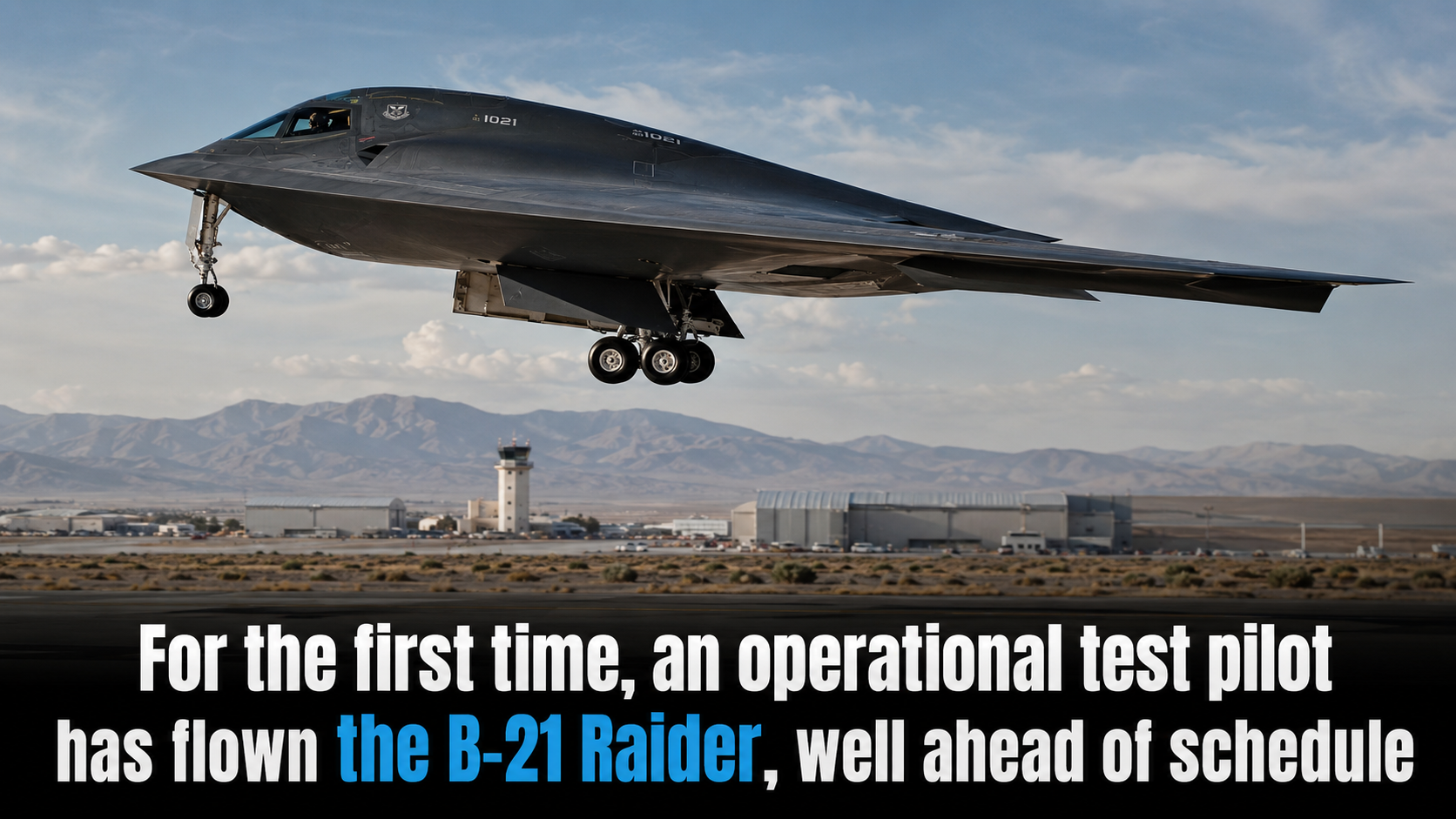
The U.S. Air Force’s most secretive new bomber just reached a major milestone. For the first time, an operational test pilot has flown inside the B-21 Raider, marking a powerful step toward bringing America’s next-generation stealth bomber closer to real combat service.
The flight took place at Edwards Air Force Base in California, where the B-21 Raider is undergoing testing. According to the 412th Test Wing, the sortie included both a developmental test pilot and an operational test pilot in the cockpit.
At first, that may sound like a small detail. But in the world of military aviation, it is a big deal.
Why This Flight Matters
Every new military aircraft goes through testing before it can enter service. Normally, that testing happens in stages.
You May Also Like

First comes developmental testing. This phase checks whether the aircraft flies safely, performs correctly, and meets the basic requirements set by the Air Force.
After that comes operational testing. This phase answers a different question: can real frontline crews use the aircraft effectively in real missions?
Traditionally, these two phases can be separated by years. That long gap has caused many defense programs to lose time, spend more money, and face delays when problems are discovered too late.
But the B-21 Raider program is trying to do things differently.
By putting an operational test pilot in the cockpit while the bomber is still in development, the Air Force can receive real-world feedback much earlier. That means pilots who understand combat missions can help shape the aircraft before the design is fully locked in and before production increases.
In simple words, the Air Force is not waiting until the end to ask: “Will this work in real combat?”
They are asking that question now.
A Faster Way to Build the Future Bomber
The operational pilot came from the Air Force Operational Test and Evaluation Center’s Detachment 5 at Edwards Air Force Base.
This is important because operational test pilots look at aircraft differently from developmental test pilots. A developmental pilot focuses heavily on whether the aircraft meets technical and safety standards. An operational pilot focuses more on mission effectiveness, combat usefulness, and how the aircraft will perform in the hands of real crews.
Bringing both perspectives together early could help the B-21 avoid costly redesigns later.
It also shows that the Air Force wants the Raider to move from testing to service as smoothly as possible.
The B-21 Program Is Moving Quickly
This latest test flight fits a larger pattern: the B-21 Raider program appears to be moving at an unusually fast pace.
In May, Northrop Grumman revealed that the B-21 test force completed a developmental test campaign originally scheduled for 180 days in only 73 days.
That result was seen as a strong sign that the aircraft arrived for testing with mature software, stable systems, and fewer early problems than many major defense programs have faced in the past.
For a bomber as advanced as the B-21, that is a major achievement.
Modern stealth aircraft are extremely complex. They rely on advanced sensors, flight controls, communications, software, electronic systems, and low-observable technology. If those systems are not mature, testing can slow down quickly.
So far, officials have suggested the Raider is staying on track.
First B-21 Expected at Ellsworth in 2027
The Air Force says the program remains on schedule to deliver the first B-21 Raider to Ellsworth Air Force Base in South Dakota in 2027.
Ellsworth is expected to become the first main operating base for the new bomber. That means the base will play a central role in introducing the Raider into active service.
Once operational, the B-21 will become one of the most important aircraft in the U.S. military. It is designed to fly long-range missions, penetrate advanced enemy air defenses, and carry both conventional and nuclear weapons.
The Raider is not just another bomber. It is being built for the future of strategic warfare.
Replacing the B-1 and B-2
The B-21 Raider was first unveiled in late 2022. It is being developed by Northrop Grumman as the next generation of American stealth bomber.
Over time, the aircraft is expected to replace older bombers such as the B-1 Lancer and B-2 Spirit.
The B-1 is a powerful supersonic bomber, but it has been flying for decades and has faced heavy wear from years of operations. The B-2 Spirit remains one of the most advanced stealth bombers ever built, but the fleet is small and expensive to maintain.
The B-21 is designed to solve those problems by giving the Air Force a modern, more sustainable stealth bomber fleet.
The Air Force plans to buy at least 100 B-21 Raiders, making it a central part of America’s future bomber force.
Why the Raider Is So Important
The B-21 Raider is being built at a time when global threats are changing fast.
Countries like China and Russia have invested heavily in advanced air defense systems, long-range missiles, sensors, and electronic warfare. In a future conflict, older aircraft may struggle to survive in heavily defended airspace.
That is where the B-21 comes in.
Its stealth design is meant to help it penetrate dangerous areas while avoiding detection. Its long range allows it to strike targets far from U.S. bases. Its modern systems are expected to give it the ability to adapt as threats evolve.
The Raider is also expected to be highly connected, meaning it can share information with other aircraft, satellites, drones, and command centers.
In future warfare, that kind of connection may be just as important as speed or firepower.
A Small Flight With Big Meaning
This test sortie may not look dramatic from the outside. There was no combat mission, no public airshow, and no major weapons demonstration.
But inside the Air Force, this flight matters.
Putting an operational test pilot in the B-21 shows that the aircraft is moving closer to the stage where real combat crews can begin shaping how it will be used.
It also shows confidence in the program’s progress.
The Raider is still in testing, and much work remains before it becomes fully operational. But each milestone brings it closer to joining the fleet.
Final Thoughts
The B-21 Raider is not just a new aircraft. It is a symbol of where U.S. airpower is heading.
By combining developmental and operational testing earlier than usual, the Air Force is trying to avoid old mistakes, reduce delays, and prepare the bomber for real-world missions faster.
The first operational test pilot flight marks a major step in that journey.
If the program continues on track, the B-21 Raider could begin arriving at Ellsworth Air Force Base in 2027, opening a new chapter for America’s bomber force.
The age of the Raider is coming closer.
And this flight proves the future of U.S. stealth aviation is already taking shape.