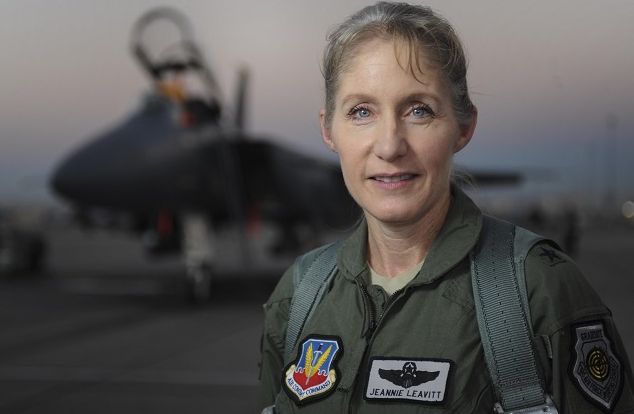
“Breaking the Sound Barrier of Bias: A Relentless Debate Inside the Cockpit of the F-35 Lightning II”
The room felt like a war zone of ideas long before any aircraft ever touched the sky.
A massive screen dominated the wall. On it, the sleek, almost predatory silhouette of the F-35 Lightning II hovered in digital space—rotating slowly, revealing its curves, its sharp edges, its quiet promise of overwhelming power.
You May Also Like




Inside that cockpit sat a pilot.
A woman.
Dr. Nathan Cole didn’t sit. He paced. Hands clasped behind his back, jaw tight, mind sharper than his tone—yet not softer.
“You want me to believe,” he began, voice controlled but edged with tension, “that nothing about this matters? That physiology, history, and battlefield reality suddenly disappear because we want them to?”
Across from him, Dr. Elena Vasquez leaned forward slightly, fingers interlocked, eyes locked on him with calm precision.
“I want you to believe,” she said, “that reality is more complex than your assumptions.”
Nathan stopped pacing.
“Complexity doesn’t win dogfights at Mach 1.6.”
Elena didn’t flinch.
“No,” she replied quietly, “but understanding does.”
Nathan turned to the screen and zoomed into the cockpit interface—an overwhelming array of data layers, targeting systems, sensor fusion overlays.
“Let’s start with facts,” he said. “This isn’t a traditional fighter jet. It’s not just flying anymore—it’s managing an entire battlespace. One pilot, multiple systems, continuous decision-making under extreme pressure.”
Elena nodded.
“Correct.”
Nathan turned.
“And you think this level of cognitive load doesn’t demand the absolute peak of human capability?”
Elena tilted her head slightly.
“I think it demands the right kind of capability. Not the kind you assume.”
Nathan exhaled slowly, almost a laugh, but without humor.
“Alright,” he said. “Let’s not dance around it.”
He tapped the screen again.
“High-G maneuvering. Up to 9G. Blood drains from the brain. Vision collapses into tunnel vision. The body fights to stay conscious. On average—on average—men have greater muscle mass and cardiovascular resilience. That’s not opinion. That’s data.”
Elena nodded again, almost as if agreeing—but her eyes said otherwise.
“On average,” she repeated. “And yet we don’t recruit averages into fighter cockpits, do we?”
Nathan paused.
“We recruit the best.”
“Exactly.”
She stood now, walking toward the screen, her voice gaining quiet intensity.
“And among the best, you’ll find individuals—men and women—who meet and exceed those physiological thresholds. G-tolerance isn’t a gender trait. It’s a trained, conditioned response.”
Nathan crossed his arms.
“With limits.”
“With training,” she corrected.
He shook his head slightly.
“You’re narrowing the gap with training. I’m asking whether the gap exists in the first place.”
Elena turned fully toward him now.
“Yes,” she said. “Differences exist. That’s science.”
Nathan raised an eyebrow, almost surprised.
“But here’s what you keep missing,” she continued. “Difference does not equal limitation.”
Nathan walked closer.
“In combat, it might.”
Elena didn’t step back.
“In combat, assumptions kill faster than differences.”
There was a pause—heavy, deliberate.
Nathan broke it.
“Fine. Let’s move beyond physiology.”
He swiped to another display—mission simulations, decision trees, threat response timelines.
“This aircraft compresses decision-making into seconds—sometimes milliseconds. Identify, assess, engage, evade. No hesitation. No doubt.”
Elena nodded slowly.
“Yes.”
Nathan leaned in.
“Do you believe—honestly—that psychological response under lethal pressure is equal across all individuals?”
Elena smiled faintly.
“No.”
Nathan blinked.
“No?”
“No,” she repeated. “It’s not equal across individuals. But again—you’re trying to turn individual variation into a gender rule.”
Nathan looked at her carefully now.
“And you’re trying to erase patterns.”
“I’m trying to interpret them correctly.”
He paused.
Then, quieter:
“Historically, combat roles have been male-dominated. That’s not accidental.”
Elena’s expression sharpened—not defensive, but precise.
“No,” she said. “It’s not accidental. It’s structural.”
Nathan tilted his head.
“Explain.”
“For most of history,” she said, “women were excluded—not tested. You can’t claim inferiority in a system that never allowed equal participation.”
Nathan frowned slightly.
“So you’re saying the data is incomplete.”
“I’m saying the data was biased from the start.”
Nathan looked back at the pilot on the screen.
She was preparing for takeoff now—helmet sealed, oxygen steady, posture composed.
“Let’s assume you’re right,” he said. “Let’s assume capability exists equally at the top level.”
He turned back.
“What about risk?”
Elena didn’t answer immediately.

He continued.
“Equipment historically designed around male physiology. Cockpit ergonomics. Ejection forces. Long-term spinal strain under G-load.”
Elena nodded slowly.
“Valid concerns.”
Nathan pressed.
“And if those risks disproportionately affect female pilots?”
“Then we redesign the system.”
Nathan laughed—short, sharp.
“Redesign a multibillion-dollar fighter platform?”
Elena’s voice didn’t rise—but it carried more weight now.
“Yes.”
Silence.
“Because if the system excludes capable individuals,” she continued, “then the system is flawed—not the individuals.”
Nathan stared at her.
“You’re talking about rewriting decades of engineering.”
“I’m talking about refining it.”
Nathan shook his head.
“At what cost?”
Elena stepped closer.
“At the cost of progress—or the cost of stagnation. You choose.”
He looked back at the screen.
The engine ignited.
A low, controlled roar.
“She’s about to take off,” he said quietly.
“Yes,” Elena replied.
They both watched.
The jet began to move—smooth, deliberate, accelerating with controlled power.
Nathan spoke again, softer now.
“Do you ever worry… that in trying to prove something, we push people into roles that demand more than they can give?”
Elena didn’t look away from the screen.
“I worry more about denying people the chance to prove what they can give.”
The aircraft lifted.
Clean. Stable. Effortless.
Nathan’s eyes followed it upward.
“No hesitation,” he murmured.
“No doubt,” Elena added.
They stood in silence as the jet climbed into the sky, shrinking into the horizon.
Finally, Nathan spoke again.
“So what decides it?” he asked. “Who gets to sit in that cockpit?”
Elena turned to him.

“Not ideology.”
“Not history?”
“Not history.”
“Then what?”
She held his gaze.
“Capability. Measured. Tested. Proven.”
Nathan nodded slowly.
“And if the best pilot is a woman?”
Elena’s answer came without pause.
“Then the sky belongs to her.”
Nathan exhaled—a long, thoughtful breath.
“You know,” he said, “I started this conversation thinking this was about fairness.”
Elena raised an eyebrow.
“And now?”
He looked back at the empty sky on the screen.
“Now I think it’s about accuracy.”
Elena smiled slightly.
“That’s all science has ever been about.”
Nathan nodded.
“Then maybe the real question isn’t whether women should fly fighter jets…”
Elena finished it:
“…but whether we’re willing to see clearly who can.”
The room fell quiet again—but this time, it wasn’t tension.
It was clarity.
Somewhere far above, beyond sight, beyond doubt, a pilot—human, trained, capable—cut through the sky at supersonic speed.
And the aircraft didn’t ask who she was.
It responded only to what she could do.
Because in the end, the laws of physics don’t recognize bias.
Only performance.