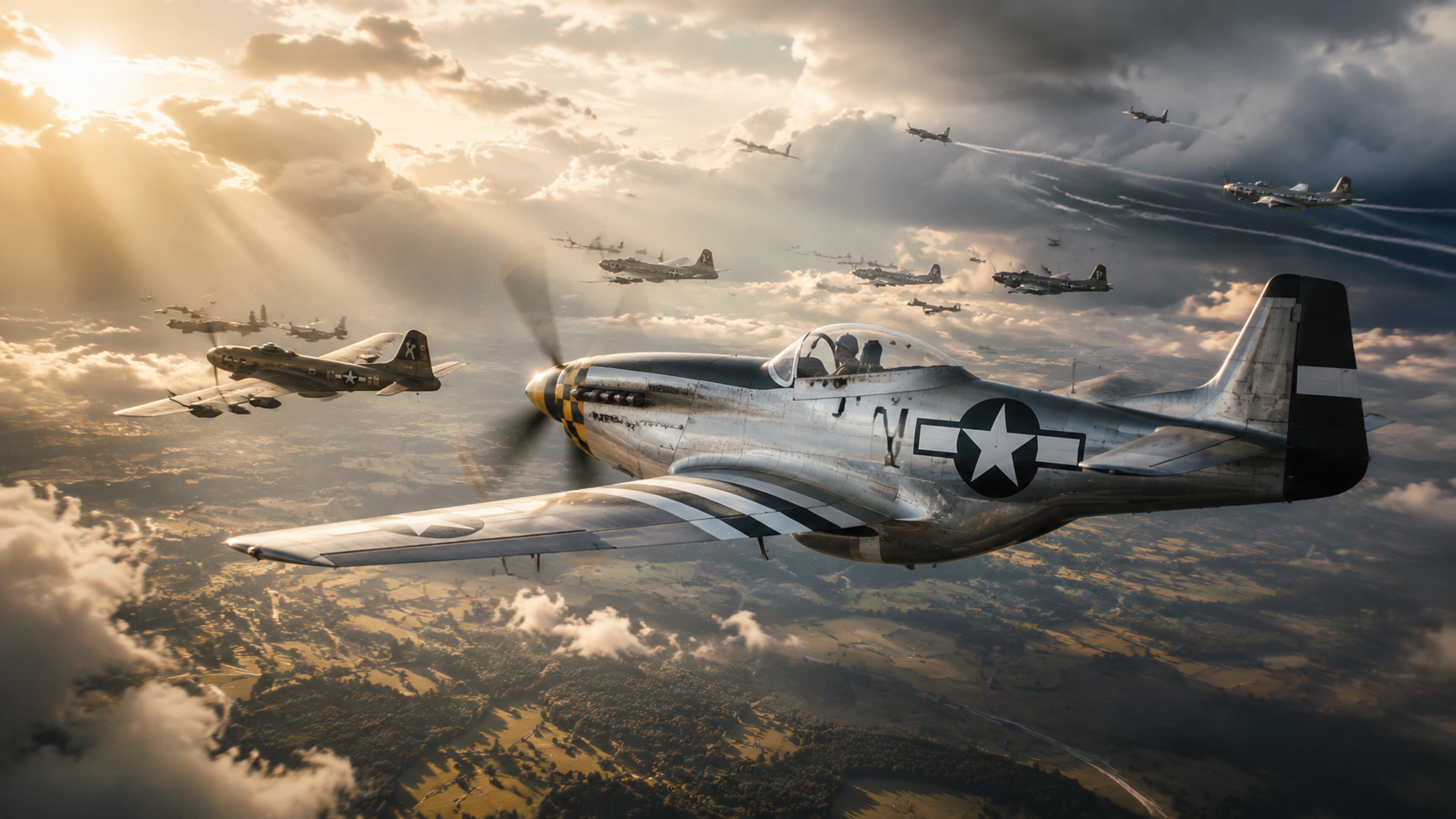
The Fighter That Changed the Fate of a Continent
In the dark days of World War II, Allied bomber crews faced a terrifying reality every time they crossed into enemy territory.
Thousands of feet above Europe, formations of American bombers flew through skies filled with anti-aircraft fire and swarms of enemy fighters. Many crews knew that once they flew beyond the range of friendly escort fighters, they were largely on their own.
German fighter pilots waited for those moments.
They knew the bombers were vulnerable.
You May Also Like
And they struck relentlessly.
Entire bomber formations could be torn apart within minutes.
Losses became so severe that military planners feared the Allied strategic bombing campaign might fail altogether.
Then a new aircraft arrived.
Sleek, fast, elegant, and deadly, it would become one of the most famous fighter planes ever built.
Its name was the North American P-51 Mustang.
What began as an ambitious aircraft project soon evolved into the fighter that many historians consider the greatest escort aircraft of World War II. More than just a weapon, the Mustang became a symbol of innovation, courage, and determination—a machine that helped reshape the air war over Europe and contributed to the eventual Allied victory.
Born From Urgency
The story of the P-51 Mustang began not in a secret laboratory or military think tank, but in a moment of desperate wartime necessity.
In 1940, as Nazi Germany swept across Europe, Britain urgently needed modern fighter aircraft. The British government approached North American Aviation, expecting the company to build more Curtiss P-40 fighters under license.
Instead, North American Aviation made a bold proposal.
The company claimed it could design an entirely new fighter aircraft—and do it faster than producing existing designs.
Many considered the idea unrealistic.
Designing a new combat aircraft normally required years.
North American engineers had only months.
Yet the company delivered.
A prototype was developed at remarkable speed and completed in just 117 days after design work began.
When the aircraft first flew in October 1940, it immediately showed promise.
It was fast.
It was efficient.
And it possessed an aerodynamic design that was years ahead of many competitors.
Few people realized they were witnessing the birth of a future legend.
THE CLASSROOM THAT TOUCHED THE STARS: How One Museum Beamed Space History Into the Lives of Students
The Secret Behind Its Performance
One of the Mustang’s greatest strengths came from an innovative wing design known as a laminar-flow wing.
Unlike conventional wings of the era, the Mustang’s wing reduced drag and allowed smoother airflow.
The result was greater speed, improved fuel efficiency, and exceptional performance at long distances.
The aircraft’s streamlined appearance was not just beautiful—it was functional.
Every curve served a purpose.
Every line contributed to performance.
Pilots often described the Mustang as feeling incredibly responsive and balanced in the air.
But despite its potential, early versions of the Mustang had limitations.
At high altitudes, where much of the air war was fought, performance was less impressive than military leaders wanted.
The aircraft needed something more powerful.
Something that would unlock its true potential.
That breakthrough came in the form of an engine.
The Engine That Created a Legend
One of the most fascinating facts about the P-51 Mustang is that the aircraft many people remember today was transformed by a British innovation.
Engineers decided to equip the aircraft with the legendary Rolls-Royce Merlin engine.
The change was revolutionary.
Almost overnight, the Mustang became one of the most capable fighters in the world.
The Merlin engine dramatically improved high-altitude performance, climb rate, speed, and combat effectiveness.
Now the aircraft could escort bombers deep into Germany while still having the power to challenge enemy fighters.
Many aviation historians consider the marriage between the Mustang airframe and the Merlin engine one of the most successful engineering partnerships in military history.
The result was an aircraft capable of speeds exceeding 430 miles per hour and operational ranges that few fighters of the era could match.
The Mustang had become exactly what the Allies desperately needed.
The Bomber Escort Crisis
To understand why the P-51 became so important, it is necessary to understand the crisis facing Allied bombers.
The United States Army Air Forces believed strategic bombing could weaken Germany’s industrial base and reduce its ability to wage war.
Massive formations of B-17 Flying Fortresses and B-24 Liberators crossed Europe almost daily.
But bombing missions came at a terrible cost.
German fighters attacked relentlessly.
Without escorts capable of accompanying bombers all the way to their targets, casualties mounted.
Some missions suffered devastating losses.
The situation became so serious that military leaders questioned whether deep-penetration bombing raids could continue.
The Allies needed a fighter that could fly farther than any previous escort aircraft.
The Mustang was the answer.
THE GHOST WITH A LASER: How the AC-130 Gunship Keeps Rewriting the Future of War
The Fighter That Protected Europe’s Skies
With external fuel tanks attached beneath its wings, the P-51 could escort bombers all the way from England into Germany and back.
This capability changed everything.
For the first time, Allied bombers enjoyed continuous fighter protection during the most dangerous portions of their missions.
German pilots suddenly faced a new challenge.
Instead of attacking defenseless bombers, they now encountered highly capable escort fighters ready for battle.
The Mustang did more than defend.
It hunted.
American fighter groups began aggressively engaging German aircraft before they could reach bomber formations.
Many Luftwaffe pilots found themselves fighting for survival against skilled Mustang pilots.
Gradually, German air power weakened.
The balance of the air war shifted.
The Allies gained increasing control of the skies.
Historians often point to this period as a major turning point in the European air campaign.
Amazing Facts About the P-51 Mustang
The Mustang’s story is filled with remarkable facts that continue to fascinate aviation enthusiasts today.
It Was Built In Record Time
The original prototype was designed and built in approximately 117 days—an extraordinary achievement during an era when aircraft development often took years.
It Could Fly Extraordinary Distances
With drop tanks, the Mustang could travel more than 1,600 miles, giving it unmatched escort capabilities during World War II.
It Served Around The World
Although most famous for its role in Europe, the Mustang also served in the Pacific Theater and other regions around the globe.
It Remained In Service After World War II
The aircraft continued serving in various air forces for years after the war and even saw action during the Korean War.
Many Still Fly Today
More than eighty years after its first flight, restored P-51 Mustangs still perform at airshows around the world, thrilling spectators with the same roar that once echoed across wartime skies.
The Pilots Who Flew the Mustang
The aircraft’s reputation was built not only by engineering excellence but also by the extraordinary men who flew it.
Mustang pilots endured freezing temperatures, mechanical challenges, enemy attacks, and missions that often lasted for hours.
Some escorted bombers through intense combat.
Others engaged in dangerous dogfights high above Europe.
Many never returned home.
Their courage transformed the Mustang into more than a machine.
It became a symbol of sacrifice and determination.
For countless bomber crews, the sight of Mustangs appearing on the horizon often brought enormous relief.
It meant they were no longer alone.
It meant help had arrived.
A Lasting Legacy
When World War II ended, the P-51 Mustang had earned a place among the greatest aircraft in aviation history.
Its combination of range, speed, firepower, and reliability made it one of the most effective fighters ever built.
More importantly, it helped secure Allied air superiority at a critical moment in the war.
Many military historians believe that the Mustang’s ability to escort bombers deep into Germany significantly accelerated the collapse of Nazi Germany’s war machine.
Few aircraft can claim such a profound impact on history.
THE A-10 WARTHOG REFUSES TO DIE: The Jet the Air Force Keeps Trying to Bury
Conclusion: More Than Just an Airplane
The North American P-51 Mustang was far more than an aircraft.
It was a technological breakthrough.
A guardian of bomber crews.
A nightmare for enemy fighters.
And a symbol of Allied determination during one of humanity’s darkest conflicts.
From its remarkable first flight in 1940 to its legendary combat record over Europe, the Mustang proved that innovation can change the course of history.
More than eight decades later, the sleek silhouette of the P-51 still captures imaginations around the world.
Its engine may no longer roar across wartime skies, but its legacy continues to soar.
The Mustang did not simply fly through history.
It helped make history.




One Comment on “The Legendary P-51 Mustang: How One Aircraft Helped Turn the Tide of World War II”