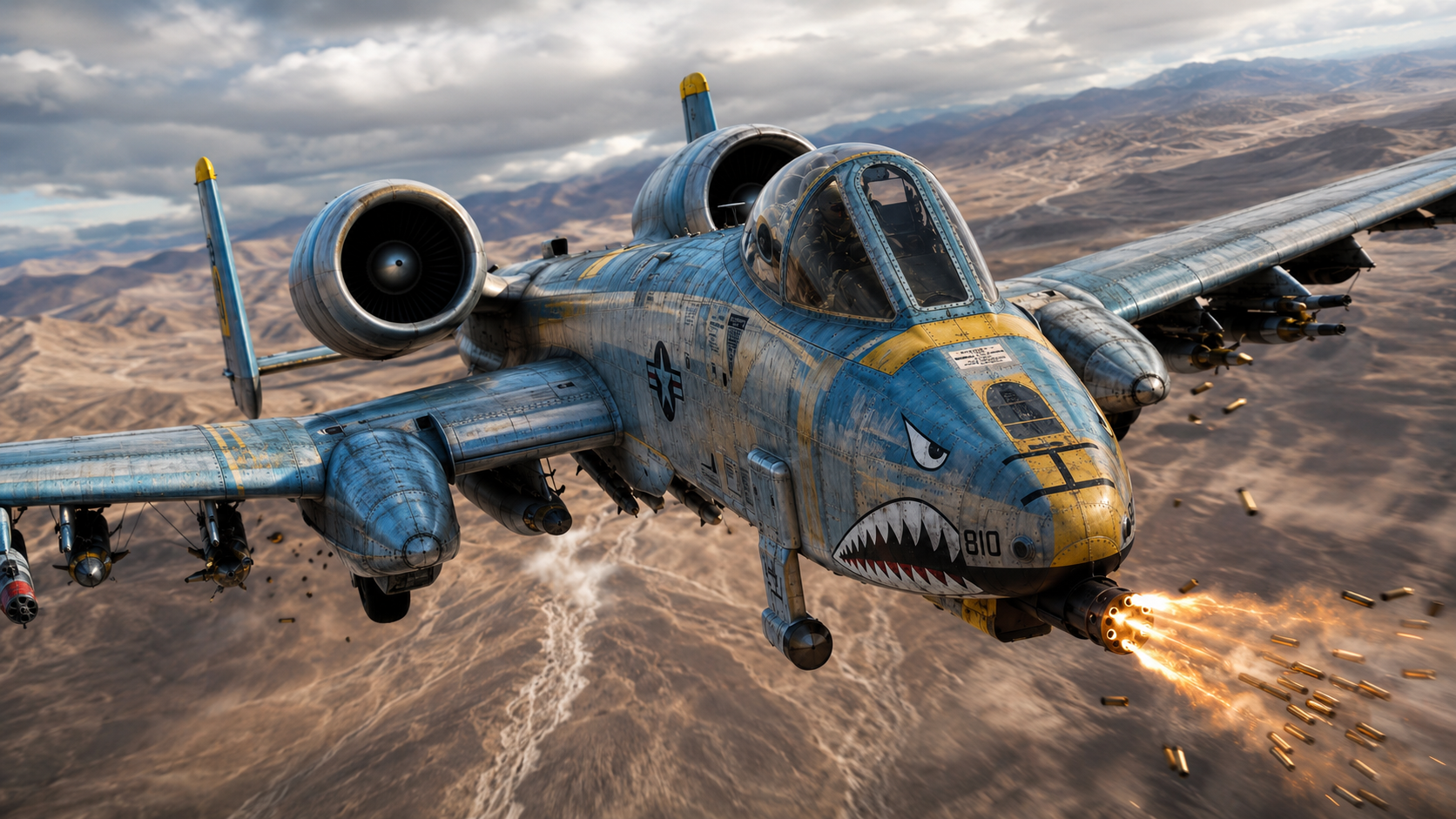
Year after year, the same message comes from the top: the A-10 Thunderbolt II is old, outdated,They have tried to retire it.
They have tried to replace it.
They have tried to starve it of parts, funding, upgrades, and political oxygen. too slow, too vulnerable, too expensive to keep, and no longer fit for the wars of the future.
But every time the grave is dug, the Warthog climbs out.
You May Also Like
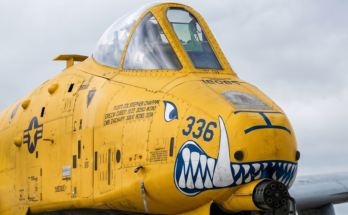
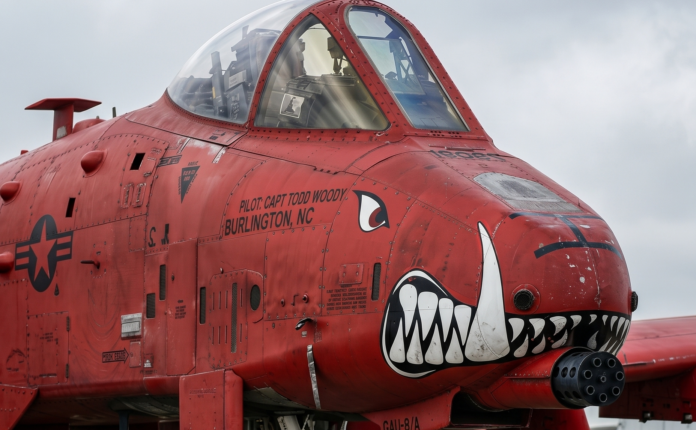

Scarred.
Loud.
Ugly.
Unforgiving.
Still armed.
Still flying.
Still loved by the troops on the ground.
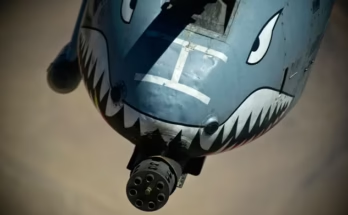
The A-10 Warthog was never built to look beautiful. It was built to survive punishment, fly low through danger, and protect soldiers when everything below has turned into fire, dust, smoke, and fear. Its body is wrapped around a legendary 30mm GAU-8/A cannon so powerful the aircraft almost feels like a weapon with wings attached.
To some Air Force leaders, the A-10 is a relic.
To many ground troops, it is a guardian angel with a gun.
And to Congress, it has become one of the most controversial aircraft in the American military — a machine caught between budget politics, future-war theories, bureaucratic pressure, and the hard reality that no other aircraft has fully replaced what it does best.
The Air Force has wanted the Warthog gone for years.
But the A-10 refuses to die.
This is the story of a jet that became more than metal.
It became a battlefield promise.
A promise to the soldier pinned down in the dirt.
A promise to the rescue team searching for the wounded.
A promise to the men and women on the ground who hear that unmistakable sound and know one thing:
Help has arrived.
Part 1: The Aircraft Nobody Could Ignore
The A-10 Thunderbolt II, better known as the Warthog, was created for one purpose above all others: to protect troops on the ground.
It was not designed to win beauty contests.
It was not designed to dominate air shows with sleek lines and futuristic curves.
It was not designed to impress politicians from a distance.
It was designed for the brutal work of close air support.
That means flying near the battlefield, identifying threats close to friendly forces, staying overhead long enough to matter, absorbing damage if necessary, and delivering firepower with precision when soldiers are in danger.
The A-10 became famous because it did this job with a kind of stubborn honesty that troops could trust.
Its straight wings gave it stability at low speeds. Its armor protected the pilot. Its engines were mounted high and apart to help survive damage. Its landing gear was built for rough conditions. Its cockpit was protected by titanium armor often described as a “bathtub.” And at the heart of the aircraft sat the weapon that made it legendary: the 30mm cannon.
The sound of the A-10’s cannon became one of the most recognizable sounds in modern military aviation.
“BRRRRT.”
To civilians, it became a meme.
To troops under fire, it meant survival.
The A-10’s role is especially powerful because close air support is not an abstract mission. It is personal. It happens when friendly soldiers are close to the enemy. It happens when a mistake could kill the wrong people. It happens when pilots must understand the ground fight, communicate clearly, identify friend from enemy, and make decisions under intense pressure.
This is why the Warthog earned such deep loyalty from the people it supported.
Ground troops did not love the A-10 because it was new.
They loved it because it showed up.
They loved it because it could loiter.
They loved it because its pilots trained deeply for close air support.
They loved it because when the situation on the ground became desperate, the Warthog could stay, circle, watch, communicate, and strike.
In war, that matters.
A fast jet may arrive quickly, drop weapons, and leave. But the A-10’s reputation came from something different: presence.
It could remain near the fight.
It could watch the battlefield unfold.
It could support troops through a long and dangerous moment, not only a quick strike.
That presence created trust.
And trust is not easy to replace.
The Air Force has argued for years that newer, more advanced aircraft can take over the A-10’s mission. Platforms like the F-35 and F-15EX are more modern, more technologically advanced, and more suited for many high-end threats. But the question has never been whether those aircraft are impressive.
The question is whether they can truly replace the A-10’s unique combination of close air support culture, cost, survivability in certain environments, loiter time, low-speed handling, and battlefield intimacy.
Congress has repeatedly pushed back because the answer has never been simple.
The Warthog may be old.
But old does not always mean useless.
Sometimes old means proven.
Sometimes old means trusted.
Sometimes old means the machine has survived every argument against it because the people who needed it most still believe in it.
That is the heart of the A-10 story.
It is not just about an aircraft.
It is about a fight over what matters most in war: the future imagined by planners, or the life of the soldier on the ground right now.
Part 2: The Long War Against the Warthog
The battle over the A-10 did not begin with one budget request or one speech. It has been a long, slow campaign.
Year after year, Air Force leaders have argued that retiring the A-10 would save money and allow resources to move toward newer aircraft. On paper, that sounds logical. Militaries must modernize. Old fleets cost money. Future threats demand advanced technology.
But the A-10 debate became controversial because critics argue that the Air Force has not simply tried to retire the aircraft openly. They argue the service has weakened it slowly from the inside.
According to the source article, the A-10 fleet has dropped from nearly 350 aircraft in 2013 to around 103, with the possibility of falling even lower. That is not a simple retirement. That is a dramatic shrinking of a once-significant force.
And with each cut, the same concern grows louder:
If the A-10 disappears before a true replacement exists, who protects the troops on the ground?
The controversy became even more intense because of accusations of institutional pressure and bureaucratic maneuvering. The source article describes a pattern of neglect, selective data presentation, resource starvation, and decisions that critics say worked against congressional intent.
One of the most dramatic moments came in 2015, when a two-star general reportedly told officers that speaking positively about the A-10 to Congress was comparable to treason. The backlash was serious enough that he was fired. That moment became symbolic. It suggested that the fight over the Warthog was no longer just about aircraft performance. It had become a battle over narrative, loyalty, and institutional pride.
Congress responded by demanding more accountability, including an A-10 versus F-35 comparison. But according to the source article, the results were effectively buried for years because the A-10 performed better than expected.
That detail matters because it goes to the core of the debate.
If the A-10 truly cannot compete, why fear the comparison?
If the replacement is clearly superior in the A-10’s mission, why not prove it publicly?
For supporters of the Warthog, these questions are not just political. They are operational. They involve the lives of soldiers, Marines, special operators, and rescue teams who may one day need close air support under the worst possible conditions.
The article also describes how parts shortages, ammunition issues, and maintenance problems helped reduce readiness. In one case, a clerical error reportedly reduced 30mm ammunition availability by 90 percent in 2018. Other issues involved parts like brake pads, gun parts, and wing fasteners.
To an outsider, these may sound like small bureaucratic mistakes.
But aircraft readiness lives or dies by details.
A jet without parts cannot fly.
A cannon without ammunition cannot train properly.
A squadron without maintenance support becomes weaker.
And when a platform becomes weaker, its opponents can point to that weakness as proof that it should be retired.
That is why A-10 supporters see a dangerous cycle.
First, reduce support.
Then readiness falls.
Then say the aircraft is no longer viable.
Then retire it.
The source article also says certain upgrades were delayed or blocked because the aircraft was considered to be approaching “sunset” status. These included capabilities related to refueling procedures, laser-guided rockets, combat fuel tanks, small diameter bombs, decoys, and probe refueling.
That is another major part of the controversy.
If an aircraft is denied modernization because leaders want to retire it, then later criticized for not being modern enough, the outcome becomes almost predetermined.
The Warthog is not just fighting enemy ground fire.
It is fighting a bureaucracy that may already have decided its future.
And still, it refuses to die.
Part 3: Why the Warthog Still Matters
The strongest argument for the A-10 is not nostalgia.
It is not emotion alone.
It is mission reality.
The A-10 exists because close air support is one of the hardest, most sensitive, and most dangerous missions in airpower. It requires more than speed and sensors. It requires pilots trained to understand the ground fight. It requires communication with troops under stress. It requires patience, judgment, and the ability to deliver force close to friendly forces without making a fatal mistake.
The Air Force has argued that other aircraft can perform the mission.
In some situations, they can.
But the question is not whether another aircraft can drop a weapon in support of ground troops. The real question is whether other aircraft can replace the entire A-10 ecosystem: the training, the cost, the culture, the loiter time, the cannon, the rugged design, the mission focus, and the trust built over decades.
That is where critics remain unconvinced.
The source article describes congressional questioning about whether aircraft like the F-35, F-15E, and F-15EX can fully cover close air support and combat search and rescue after A-10 retirement. Air Force leaders reportedly gave broad assurances but limited specifics.
That lack of detail matters.
Because replacing the A-10 is not simply a matter of assigning a mission to another aircraft.
If pilots already have many missions, adding more responsibilities does not automatically create mastery. A modern fighter pilot may be expected to train for air-to-air combat, strike, electronic warfare, suppression of enemy air defenses, intelligence gathering, and other roles. If close air support and combat search and rescue are added on top, something must give.
When every mission is the priority, none of them are.
That is the fear.
The A-10 has long been valuable because it is not trying to be everything. It is focused. It was built around a specific battlefield need. That specialization is exactly what makes it politically vulnerable in an era obsessed with multi-role platforms — but it is also what makes it operationally beloved.
The source article also challenges the claim that combat search and rescue is merely a subset of close air support. It notes that CSAR is a distinct mission, governed by different doctrine. This distinction is important because rescue operations require unique training, coordination, timing, and risk management.
When a pilot is down, when a rescue team is moving, when enemy forces are close, the aircraft overhead must understand the mission deeply. It is not just another CAS task. It is a life-or-death recovery operation.
The A-10 has historically played an important role in that kind of mission.
That is why some lawmakers and veterans worry about losing it too quickly.
Another argument against the Warthog is vulnerability. Critics say the A-10 cannot survive in modern contested environments against advanced air defenses. That argument has weight. No serious person should pretend the A-10 is invincible.
But the counterargument is also important: no aircraft is invincible.
Modern stealth fighters can be expensive, maintenance-heavy, and limited in numbers. High-end aircraft may be needed for high-end threats. Using them for every close support mission may not be cost-effective or operationally wise.
The question is not whether the A-10 can do everything.
It cannot.
The question is whether there are still missions where it can do something important better, cheaper, or more effectively than the alternatives.
Supporters say yes.
They argue that the A-10 still has value in permissive or semi-permissive environments, counter-fast attack craft operations, special operations support, air interdiction, forward air control, and rescue support. They argue that the aircraft is not truly single-role, even if critics describe it that way.
They also argue that eliminating it may cost more than keeping it.
This is where the financial debate becomes complicated. The Air Force often says retiring old aircraft saves money. But if newer aircraft must absorb the mission at higher flight-hour and sustainment costs, savings may not be as simple as advertised.
If an A-10 can perform certain missions at a fraction of the operating cost of newer fighters, then retiring it could shift expenses rather than eliminate them.
That is why Congress keeps asking for proof.
Not slogans.
Not general statements.
Proof.
What replaces the loiter time?
What replaces the gun?
What replaces the low-altitude support profile?
What replaces the A-10 pilot community’s close air support expertise?
What replaces the trust of the soldier on the ground?
What does it cost?
Who pays the price if the answer is wrong?
These are not sentimental questions.
They are battlefield questions.
And until they are answered clearly, the Warthog’s defenders will keep fighting.
Powerful Ending: The Jet That Still Answers the Call
The A-10 Warthog was never supposed to be glamorous.
It was born ugly.
Built around a gun.
Armored like a survivor.
Slow compared to sleek fighters.
Loud enough to shake the bones of anyone beneath it.
But war does not always reward beauty.
War rewards the machine that arrives when the radio call is desperate.
War rewards the pilot who understands the ground fight.
War rewards the aircraft that can take damage, stay nearby, and deliver firepower when soldiers need it most.
That is why the A-10 became legendary.
Not because it was perfect.
Not because it was modern forever.
Not because it could defeat every threat in every sky.
But because, for decades, when troops on the ground needed help, the Warthog was one of the aircraft they wanted overhead.
The Air Force may still retire it.
Budgets may still shrink it.
Bureaucracy may still weaken it.
New fighters may eventually take over more of its missions.
But none of that erases what the A-10 represents.
It represents a promise that airpower must never forget the soldier in the dirt.
It represents the idea that technology should serve the battlefield, not just the budget chart.
It represents the uncomfortable truth that sometimes the old tool still does the job better than the expensive new one.
And most of all, it represents loyalty.
The Warthog has been written off again and again.
Too old.
Too slow.
Too ugly.
Too vulnerable.
Too expensive.
Too outdated.
But somehow, it is still here.
Still flying.
Still fighting for its place.
Still defended by those who know what it means to hear that sound overhead when the situation below has gone bad.
The A-10 does not need to be beautiful.
It does not need to be fashionable.
It does not need to impress the people who only see war through slides, charts, and budget lines.
It only needs to do what it was built to do.
Protect the troops.
Stay in the fight.
Refuse to die.
And as long as soldiers on the ground still trust the sound of that cannon in the sky, the legend of the Warthog will not disappear quietly.
Because some aircraft are retired.
Some aircraft are replaced.
Some aircraft are forgotten.
But the A-10 is different.
The A-10 is the jet they keep trying to bury.
And every time the dust settles, the Warthog is still there —
scarred, stubborn, roaring, and ready to answer the call.




2 Comments on “THE A-10 WARTHOG REFUSES TO DIE: The Jet the Air Force Keeps Trying to Bury”