The students did not board a bus.
They did not travel across Kansas.
They did not walk through museum doors, stand beneath rockets, or crowd around glass cases filled with space artifacts.
And yet, for one unforgettable hour, a classroom in Overland Park felt as if it had opened a door to the universe.
You May Also Like
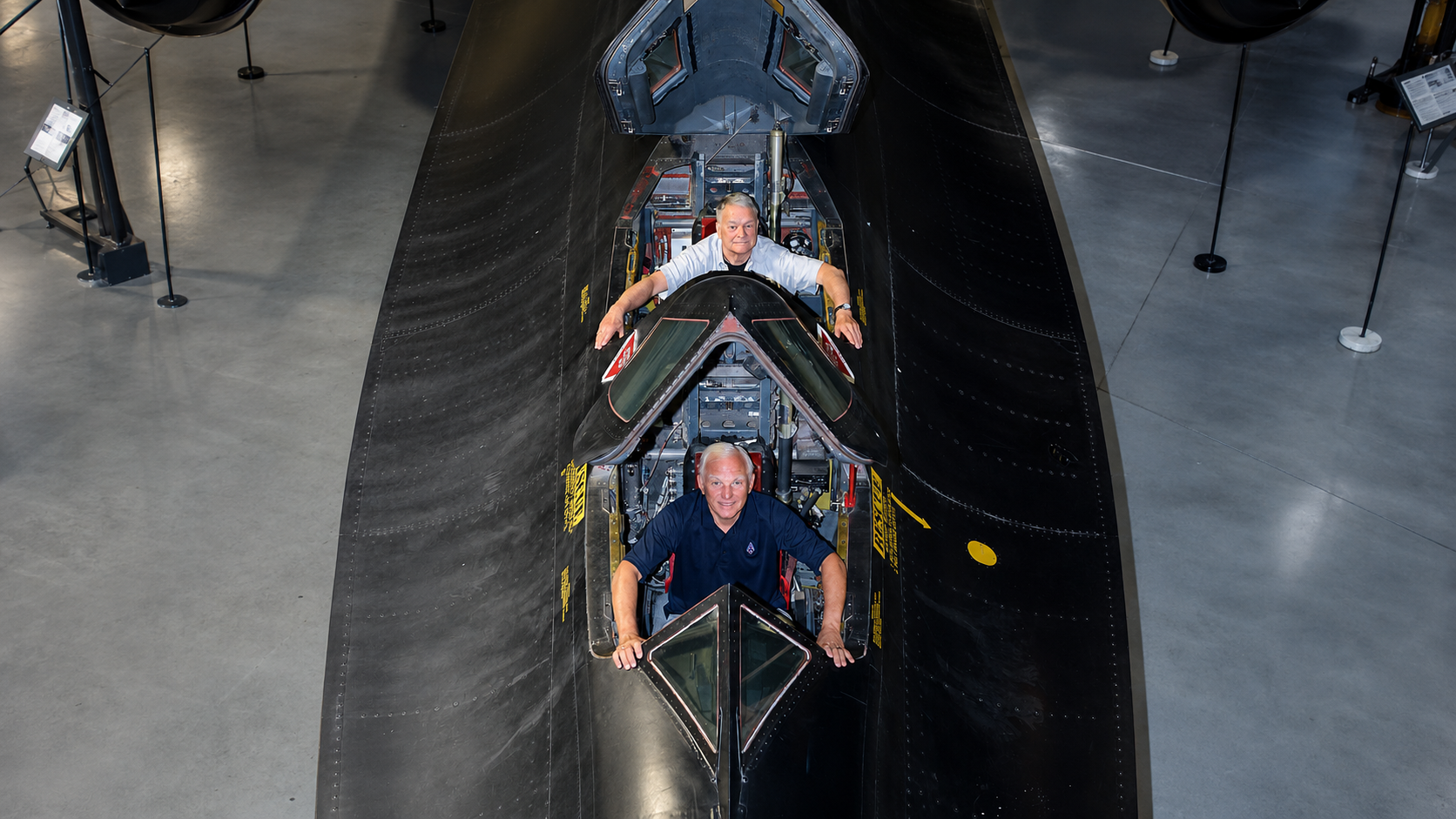
A retired SR-71 Blackbird pilot stood hundreds of miles away inside the Cosmosphere in Hutchinson, Kansas. Behind him was one of the fastest aircraft ever flown. Nearby was the shadow of space history. On the screen in front of the students was not a textbook, not a worksheet, not another ordinary lecture.
It was a living connection to the sky.
The sixth-graders at Harmony Middle School were studying space in social studies. Like many students before them, they were supposed to learn about rockets, astronauts, the Cold War, the Space Race, and the great machines that carried human imagination beyond Earth.
But this time, something different happened.
The museum came to them.
The artifacts came to them.
The experts came to them.
The stories came to them.
And suddenly, space history was no longer something locked behind museum walls. It was alive in the classroom, speaking directly to students who might never forget the moment they realized that science was not just something to memorize.
Science was adventure.
History was personal.
Space was not far away.
It was right there, glowing on the classroom screen.
The $400,000 Fighter Pilot Helmet That Nearly Exposed a Deadly Air Force Secret
Part 1: The Field Trip That Never Left the Classroom
For years, students had traveled to the Cosmosphere in Hutchinson to experience one of the most impressive space and science museums in the country. The Smithsonian-affiliated museum has long been a destination for young people learning about space exploration, aviation, engineering, and the history of human curiosity.
A traditional field trip to the Cosmosphere could be exciting. Students could see real artifacts, walk through exhibits, and feel the scale of the Space Race in a way no textbook could fully capture.
But school field trips are not always easy.
Buses cost money.
Travel takes time.
Teachers must plan schedules, permission slips, meals, supervision, transportation, and safety.
A trip that sounds simple can become a full-day operation.
For Harmony Middle School librarian Ronda Hassig, that challenge was real. Her students used to visit the Cosmosphere every year. But over time, those trips became harder to organize. The distance, the logistics, and the time away from school made the experience more difficult to repeat.
Then came a new idea.
What if the Cosmosphere could travel without moving?
What if the students could meet the experts, see the artifacts, ask questions, and experience the museum without leaving the classroom?
That is what made the moment at Harmony Middle School so special.
The students stayed in Overland Park.
The teachers stayed at school.
But through online video conferencing, the Cosmosphere entered the room.
It was simple in appearance but powerful in meaning. A screen became a doorway. A classroom became a museum. A lesson became an experience.
For the students, it was not just another day of school. They were not only reading about space exploration. They were hearing from someone connected to aviation history. They were seeing museum artifacts through the eyes of people who understood their meaning. They were interacting with experts in real time.
That matters because students remember experiences more than information.
They may forget a date.
They may forget a paragraph.
They may forget a worksheet.
But they remember the day an SR-71 pilot spoke to them from inside a space museum.
They remember the moment a question made the room laugh.
They remember the feeling that something far away suddenly became close.
That is the magic of this new kind of education.
It does not replace wonder.
It delivers wonder.
Ghost of the Skies: How the B-2 Spirit Became the Most Feared and Mysterious Bomber in Modern Military History
Part 2: Why the Cosmosphere Wanted to Change the Way Students Learn
The online curriculum did not happen overnight. According to the Cosmosphere’s education leadership, the program had been under development for years.
The goal was not simply to put a camera inside a museum.
That would have been easy.
The deeper goal was to create learning experiences that students could actually remember.
This matters because museum field trips can sometimes become overwhelming. Students walk through exhibits quickly. They see artifacts, hear facts, move from one station to another, and then return home with only scattered memories.
A student might stand near something extraordinary, like the Apollo 13 capsule, and later barely remember seeing it.
That is heartbreaking because artifacts are not just objects.
They are witnesses.
A spacecraft is not just metal.
It is fear, courage, engineering, risk, failure, survival, and human determination.
A spacesuit is not just fabric.
It is a personal shelter against death.
A rocket engine is not just machinery.
It is the sound of humanity trying to leave the ground.
The Cosmosphere understood that students needed more than a quick walk-through. They needed context. They needed emotion. They needed a reason to care.
That is one of the hardest challenges in education.
Every middle-school student eventually asks the same question, even if they do not say it out loud:
“Why does this matter to me?”
Why do I care about history?
Why do I care about math?
Why do I care about science?
Why do I care about space?
A great teacher does not simply answer with, “Because it will be on the test.”
A great teacher builds a bridge between the lesson and the student’s life.
The Cosmosphere’s online curriculum tried to build that bridge.
Instead of only showing students the Space Race as an old competition between nations, the program could connect it to today’s race to Mars. Instead of treating space junk as a strange technical problem, it could show students that humanity’s future in orbit depends on solving the mess we have already left behind. Instead of making science feel distant, it could show students that engineering, math, history, and imagination all come together in the story of space exploration.
That kind of learning matters because space is not only about astronauts.
Space is about problem-solving.
It is about courage.
It is about failure.
It is about teamwork.
It is about people who dared to ask impossible questions and then spent their lives trying to answer them.
When students understand that, the lesson becomes bigger than the classroom.
It becomes a challenge:
What problems will your generation solve?
What machines will you build?
What questions will you ask?
What future will you help create?
That is why this program is inspiring. It does not only teach students about the past. It invites them into the future.
THE A-10 WARTHOG REFUSES TO DIE: The Jet the Air Force Keeps Trying to Bury
Part 3: The Day the SR-71 Pilot Entered the Classroom
One of the most unforgettable moments came when students at Harmony Middle School heard from Buz Carpenter, a retired pilot who flew the SR-71 Blackbird.
The SR-71 is not just an aircraft.
It is a legend.
It was built for speed, altitude, and reconnaissance. It flew so fast and so high that it seemed less like an airplane and more like a machine from the edge of science fiction. For generations, the Blackbird has represented the extreme limits of aviation engineering.
To students, seeing someone speak from near the SR-71 was already powerful.
But hearing from a person who had actually flown it made the moment come alive.
Carpenter spoke from Hutchinson while students watched from their classroom. Behind him was the aircraft. Behind him was space history. Around him was the museum itself. For the students, it felt almost as if they were standing there with him.
That is the difference between information and inspiration.
A textbook can say the SR-71 was fast.
A video can show images of it.
But a pilot can make students feel what it meant to fly one.
A pilot can describe the discipline, the pressure, the skill, and the wonder of operating a machine designed to push the limits of what humans can do.
The students were reportedly glued to the presentation for the entire hour. That is no small achievement. Middle school attention is not easily won. These are students surrounded by phones, games, videos, social media, and constant distraction. To hold them for 60 minutes, the speaker must do more than talk.
He must transport them.
That is what happened.
The classroom became a cockpit.
The screen became a window into aviation history.
The students were not simply listening to a retired pilot.
They were meeting someone who had touched the edge of the impossible.
And then came the question every adult in the room probably knew was coming eventually.
A student asked how people go to the restroom in space.
It was honest.
It was practical.
It was exactly the kind of question middle school students ask because they are curious about the real human details that adults sometimes avoid.
The answer made administrators nervous, but the students did not flinch.
That moment is funny, but it also reveals something important about teaching.
Students want truth.
They want real answers.
They want to know not only how rockets launch, but how astronauts live. They want to understand the human side of exploration. They want to know what happens when science meets ordinary life.
That question may seem small, but it is actually a gateway.
Because once a student asks how astronauts use the restroom in space, the conversation can open into engineering, human biology, gravity, spacecraft design, sanitation, survival, and the reality that space travel is not only heroic — it is complicated, uncomfortable, and deeply human.
That is what makes live expert interaction so valuable.
A student asks a question.
An expert answers.
The classroom wakes up.
Suddenly, learning is not passive.
It is alive.
Part 4: A Museum Without Walls
The Cosmosphere’s online curriculum represents something larger than one school visit.
It points toward a new future for museums.
For generations, museums were places people had to physically visit. If students lived nearby, they could go. If schools had money, buses, time, and permission, they could go. If not, the museum remained distant.
But digital learning changes that.
A museum without walls can reach classrooms across the country.
Eventually, it can reach students around the world.
That idea is powerful because access is one of the greatest challenges in education. Not every student lives near a major museum. Not every school has the budget to travel. Not every teacher has specialized knowledge in space science or aviation history.
But if the museum can beam into the classroom, the distance begins to disappear.
A student in Kansas can speak to an expert in Hutchinson.
A student in a rural town can see artifacts they might never visit in person.
A teacher who is not an astrophysicist can still bring high-level expertise into the classroom.
A school can connect science, history, engineering, and storytelling in one powerful experience.
That is why Ronda Hassig described it as the wave of the future.
And she was right.
The future of education will not be only physical or only digital. It will be a blend. Students still need real places, real objects, real teachers, and real experiences. But technology can extend those experiences beyond geography.
A museum can become a partner.
An expert can become a guest teacher.
An artifact can become a live lesson.
A classroom can become a launchpad.
This does not make traditional field trips meaningless. Nothing can fully replace standing in front of a real artifact and feeling its presence. But online programs can prepare students before they visit, deepen learning after they leave, or reach students who may never be able to go.
In the best version of this future, digital learning does not reduce wonder.
It multiplies it.
Part 5: Why This Story Matters
At first glance, this story may seem simple.
A school used video conferencing.
A museum delivered a lesson online.
Students learned about space.
But the deeper story is much bigger.
It is about the future of learning.
It is about bringing expertise to students instead of waiting for students to reach expertise.
It is about making history memorable.
It is about helping young people understand why science matters.
It is about proving that a classroom does not have to be limited by its walls.
For a sixth-grader, one powerful lesson can change everything.
Maybe one student watched the SR-71 presentation and became curious about aviation.
Maybe another student began wondering about engineering.
Maybe one student who thought history was boring suddenly realized history is full of danger, courage, mistakes, and discovery.
Maybe one student who never imagined working in science began thinking, “What if I could do something like that?”
That is how inspiration works.
It often begins quietly.
A single question.
A single speaker.
A single image on a screen.
A single moment when a student sits up straighter because something finally feels real.
Teachers know this. Librarians know this. Museum educators know this. The challenge is not simply delivering content. The challenge is lighting a spark.
And sometimes, that spark comes from a retired pilot standing in front of a legendary aircraft, talking to students who are hundreds of miles away.
Sometimes it comes from an expert explaining space junk.
Sometimes it comes from seeing the Apollo 13 story not as a chapter in a book, but as a human drama of survival.
Sometimes it comes from asking an embarrassing question and getting a real answer.
That is education at its best.
Not memorization.
Transformation.
Part 6: The World Beyond the Classroom
The Cosmosphere’s ambitions do not stop with one school district.
The program was designed to grow. With interpreters available in languages such as Spanish and German, the museum’s educational reach could expand far beyond Kansas. The goal is not only to serve nearby schools but to carry the Cosmosphere’s resources to students across the country and eventually around the world.
That global possibility is exciting.
Imagine a classroom in Europe learning about the Space Race from experts standing beside real artifacts.
Imagine students in small towns connecting with museum educators they would never otherwise meet.
Imagine a teacher building an entire unit around Mars exploration, space debris, rocketry, or aviation history, supported by live museum programming.
Imagine students from different countries sharing questions about the same human dream: reaching beyond Earth.
Space has always belonged to the imagination of the whole world.
It is not only an American story.
It is a human story.
The Moon landing, the Space Race, Mars exploration, satellites, space junk, rockets, telescopes, and future missions all belong to the larger story of humanity trying to understand its place in the universe.
The Cosmosphere’s online curriculum gives students a chance to step into that story.
Not someday.
Not only if their school can afford a bus.
Not only if they live nearby.
Now.
From their classroom.
That matters because the next generation of scientists, pilots, engineers, teachers, astronauts, designers, and problem-solvers is sitting in classrooms today. Some of them may not yet know what they are capable of. Some may not think science is for them. Some may not realize that their curiosity could become a career.
A powerful learning moment can change that.
It can turn confusion into curiosity.
Curiosity into confidence.
Confidence into ambition.
Ambition into a future.
Part 7: The New Field Trip
The old field trip was simple.
Students got on a bus.
They traveled to the museum.
They walked through exhibits.
They came home.
The new field trip is different.
The museum can appear on a screen.
The expert can speak live.
The artifact can become part of the lesson.
The students can ask questions.
The teacher can connect the experience directly to classroom standards.
And the learning does not have to end when the bus returns because there may be no bus at all.
This is not a smaller version of a field trip.
It is a different kind of field trip.
One built for a world where education must be flexible, accessible, memorable, and connected.
The best part is not the technology itself. Technology is only the bridge. The real power is what crosses that bridge: knowledge, wonder, experience, and human connection.
A student does not remember the software.
A student remembers the pilot.
A student remembers the artifact.
A student remembers the answer to the question everyone was afraid to ask.
A student remembers the moment the classroom felt bigger than the building.
That is the future this story points toward.
A future where schools are not limited by distance.
A future where museums are not limited by location.
A future where experts are not locked away from students who need them.
A future where the universe can enter a classroom.
Powerful Ending: When the Classroom Opens to the Cosmos
The sixth-graders at Harmony Middle School did not leave Overland Park that day.
But in a way, they traveled farther than a bus could ever take them.
They traveled into history.
They traveled into aviation.
They traveled into space.
They stood, through a screen, beside one of the most legendary aircraft ever built. They listened to a pilot who had lived a story most people only read about. They asked real questions. They laughed. They listened. They learned.
And maybe, without even realizing it, they saw the future of education.
A future where a museum can beam into a classroom.
A future where distance does not decide who gets inspired.
A future where a student in an ordinary room can look up at a screen and feel the universe come closer.
That is why this story matters.
Because education is not only about delivering information.
It is about opening doors.
It is about making students care.
It is about showing them that the world is larger, stranger, more difficult, more beautiful, and more possible than they imagined.
Somewhere in that classroom, there may have been a student who had never thought seriously about space before.
Somewhere in that room, there may have been a future engineer, pilot, scientist, teacher, or astronaut.
And perhaps all it took was one hour, one screen, one museum, one pilot, and one unforgettable moment to make that future feel real.
The students did not go to the Cosmosphere.
The Cosmosphere came to them.
And for one powerful hour, the classroom touched the stars.




One Comment on “THE CLASSROOM THAT TOUCHED THE STARS: How One Museum Beamed Space History Into the Lives of Students”