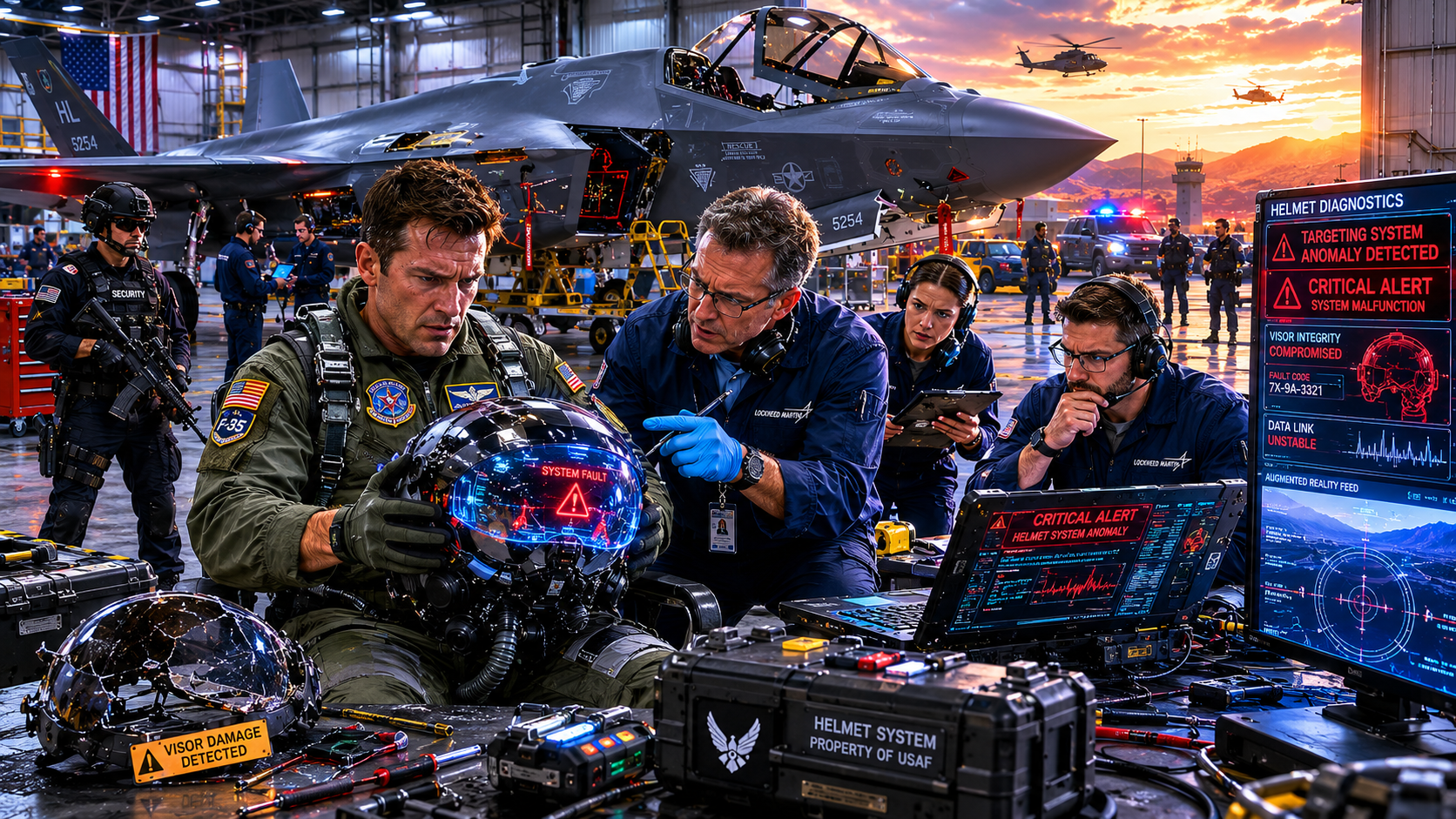
The helmet was not ordinary flight gear. It was a custom-fitted digital system built around the pilot’s skull, eyes, posture, and cockpit position. Every measurement mattered. If the visor sat too low, the image could distort. If the display shifted even slightly, a pilot flying at combat speed could misread altitude, miss a target, or react to something that was not truly there.
For modern U.S. fighter pilots, the helmet is more than protection. It is a command center strapped to the head. It projects flight data, targeting information, night vision imagery, and camera feeds that create the feeling of 360-degree awareness. Pilots can look down and see what sensors beneath the jet are seeing. They can track threats without turning the aircraft. They can fight in darkness, cloud cover, and chaos.
That morning, Reed was preparing for a high-risk training evaluation after three weeks of helmet calibration. Master Sergeant Daniel Harper, the lead life-support technician, had already scanned Reed’s head, adjusted internal padding, tested visor alignment, and checked the eye-tracking system. The process was slow, expensive, and unforgiving.
You May Also Like


Then Reed saw the impossible.
During the final simulator check, a target marker flashed at his left side even though the test screen showed empty airspace.
“Reset the feed,” Reed said.
Harper did.
The marker appeared again.
A software officer blamed a calibration lag. Another technician said fatigue could make the eye-tracker drift. But Harper noticed something no one else did: the helmet shell had a pressure mark near the lower mount, as if someone had opened it after certification.
Reed removed the helmet and rubbed his temple. A red line had formed above his ear.
Before Harper could inspect the mount, a crash came from the equipment cage behind them. Airman Lucas Price staggered out, bleeding from a cut on his cheek, clutching a cracked visor lens.
“Don’t let him fly,” Price said.
Security sealed the hangar within minutes. Officially, the issue was a technical delay. But inside the helmet bay, one question turned urgent: was America’s most advanced pilot vision system failing—or had someone tampered with Reed’s $400,000 helmet before takeoff?
Part 2By 6:10 a.m., the helmet fitting room had become the most guarded space in the hangar.
Captain Tyler Reed stood near the simulator cockpit with his flight suit half-zipped and a cold pack pressed against his temple. Master Sergeant Daniel Harper held the helmet like evidence from a crime scene. Around them, security forces blocked the doors while engineers argued in low voices over data logs, camera angles, and responsibility.
The training flight was supposed to test Reed’s ability to use full 360-degree visual integration during simulated combat conditions. The helmet’s sensors, visor display, and aircraft cameras had to line up with his exact head position. A pilot could not simply grab another helmet from a shelf. Each unit was measured, molded, balanced, and calibrated for one person. Even the spacing between the pilot’s pupils affected how the display appeared in motion.
That was the secret most Americans never see. The helmet’s price is not only the hardware. It is the precision: laser head scans, custom liners, optical alignment, display mapping, pressure checks, night-vision verification, oxygen mask fit, ejection safety testing, and repeated simulator runs until the pilot and machine behave like one system.
But Reed’s helmet was no longer behaving like one system.
Harper connected it to a diagnostic station. The data showed a brief alignment change at 2:36 a.m., long after the official fitting team had signed out. Someone had accessed the helmet bay using a temporary maintenance credential.
The credential belonged to Airman Lucas Price—the same young technician now sitting in medical with blood on his cheek.
Price denied touching the helmet.
“I came back because I forgot my tablet,” he told investigators. “The cage was already open. Someone was inside.”
“Who?” Harper asked.
Price hesitated.
That hesitation nearly destroyed him.
Security found a cracked visor lens in his locker, along with cleaning cloths marked with optical residue. To the command staff, it looked simple: a junior airman damaged expensive gear, tried to hide it, then panicked when Reed noticed the display problem.
But Reed did not believe it.
Price had worked on his gear before. He was nervous, sometimes careless, but not malicious. And the pressure mark on the helmet mount was too precise. This was not a dropped lens or a clumsy repair.
Then came the first twist.
The cracked lens in Price’s locker did not belong to Reed’s helmet. Its serial number matched an older test unit removed from service months earlier. Someone had planted evidence using parts from the disposal inventory.
Harper ordered a deeper audit. That decision triggered an argument with Major Eric Lang, the systems officer overseeing the evaluation. Lang insisted the flight should continue after a software reset.
“Canceling now creates paperwork we don’t need,” Lang said.
Harper stared at him. “A pilot seeing ghost targets is paperwork you want?”
Lang’s face tightened. “Watch your tone, Sergeant.”
Reed stepped between them. “Nobody flies with that helmet until we know what changed.”
At 7:04 a.m., the answer began to surface. A hidden configuration file had been loaded into the helmet’s display processor. It was not enough to take control. It would not crash the jet by itself. But under high-G maneuvers, it could offset visual markers just enough to make a pilot trust the wrong picture at the worst possible second.
The room went silent.
A helmet meant to give perfect awareness had been turned into a subtle weapon of confusion.
Investigators reviewed access footage again. The person entering the helmet bay at 2:36 a.m. wore a maintenance cap low over his face and used Price’s credential. But one camera near the hallway caught a reflection in a glass panel: a silver academy ring on the person’s right hand.
Price did not wear a ring.
Major Lang did.
When confronted, Lang denied everything. He claimed the ring proved nothing. He said Harper was overreacting. He accused Price of lying and Reed of letting fear interfere with mission readiness.
Then Harper found the second configuration file on Lang’s secured laptop.
Lang tried to leave the room.
Security stopped him.
The struggle was brief but violent. Lang shoved Price into a metal tool cabinet, reopening the cut on his cheek. Reed grabbed Lang’s wrist as Lang reached for a data drive on the desk. Harper knocked the drive away, and two security officers forced Lang to the floor. No shots were fired, but the fight left the helmet bay in chaos—blood on a white calibration cloth, a cracked diagnostic screen, and a $400,000 helmet resting inches from the concrete.
The motive was not foreign sabotage or battlefield espionage. It was career panic.
Lang had approved a rushed software patch during an earlier test cycle. If Reed’s evaluation exposed the problem officially, Lang’s record, promotion, and future command prospects could collapse. So he created a hidden fault that would make the issue appear pilot-related or technician-related instead of command negligence. If Reed reported confusion during flight, Lang could blame fatigue, fit, or Price’s supposed mishandling.
He had gambled with a pilot’s life to protect his reputation.
The training flight was canceled. The helmet was removed from service. Every related configuration file was reviewed. Price was cleared after investigators confirmed his credential had been lifted from his workstation. Harper received quiet praise but no public spotlight. Reed returned to flight two weeks later with a newly fitted helmet and a sharper understanding of what trust means inside a cockpit.
The base issued only a limited statement about “equipment irregularities” and “personnel accountability.” That language frustrated many inside the squadron. Some believed the public deserved to know how close a pilot came to flying with a compromised display system. Others argued that revealing too much about helmet vulnerabilities could put future pilots at risk.
The debate never fully ended.
What is clear is this: a fighter pilot’s 360-degree vision depends on more than sensors and screens. It depends on the people who measure, fit, certify, and protect the system before the jet ever leaves the ground.
Captain Reed later described the moment simply.
“The helmet lets you see everything,” he said. “But that morning, it almost made me trust something that wasn’t real.”
One detail remains unresolved. The erased message thread on Lang’s phone showed he had discussed “controlling the test outcome” with someone outside the squadron. The contact was never publicly named.
Would you trust a $400,000 helmet after one hidden file nearly changed a pilot’s fate? Comment below—America should know.




One Comment on “The $400,000 Fighter Pilot Helmet That Nearly Exposed a Deadly Air Force Secret”