A Rich Man Faked His Own Death to See How His Family Would Treat His Poor Widow | What He..
THE BILLIONAIRE FAKED HIS OWN DEATH TO TEST HIS FAMILY—THEN HE SAW WHAT THEY DID TO HIS POOR WIDOW
Three weeks after she buried her husband, Efeoma Okafor stood beside a rusty roadside stove in the rain, frying bean cakes to feed her six-year-old son.
Then three black cars blocked the entire street.
A stranger in a charcoal suit stepped out, walked toward the woman everyone now called a beggar, and opened his palm.
You May Also Like




Inside was the gold wedding ring Efeoma had watched disappear into her husband’s grave.
Her hand froze above the pan.
The oil hissed.
Rain struck the patched umbrella over her head.
For one terrible second, the whole street seemed to stop breathing with her.
Efeoma knew that ring.
The gold had worn thin on one side because Nnamdi always turned it with his thumb when he was thinking. There was a tiny scratch near the top from the afternoon he tried to repair Kelechi’s wooden bicycle himself and refused to let the household mechanic help.
She had laughed at him that day.
“You own a shipping company, Nnamdi.”
“And?”
“You do not know how bicycle brakes work.”
“A brake is a brake.”
“You said that about the kitchen blender.”
“The blender was badly designed.”
“You broke it.”
“It failed under leadership.”
She had laughed until she cried.
Then Nnamdi kissed her forehead, left grease on her cheek, and spent another two hours destroying the bicycle before secretly paying the mechanic to fix everything the next morning.
That scratch.
Efeoma had touched it a thousand times.
She touched it at church.
At dinner.
In bed when Nnamdi slept and she lay awake wondering how a girl who once sold oranges on an Enugu roadside had somehow become the wife of one of the richest men in Nigeria.
The ring had been on Nnamdi’s hand when he collapsed.
She remembered holding that hand.
Remembered screaming his name.
Remembered doctors shaking their heads.
Remembered the coffin.
The burial.
The red earth falling.
Now the ring rested in a stranger’s palm.
Efeoma stepped backward.
“Where did you get that?”
The man said nothing immediately.
His expression was gentle, but there was something painful behind it.
“Mrs. Okafor.”
Her son pressed against her side.
“Mama?”
Efeoma put one hand over Kelechi’s shoulder.
The man closed his fingers around the ring.
“My name is Barrister Tunde Bello.”
Efeoma’s eyes narrowed.
“I was your husband’s attorney.”
“My husband’s attorney was not at the funeral.”
“I was.”
“I would remember you.”
“No.”
Tunde lowered his voice.
“You were not looking at faces that day.”
The truth of that silenced her.
She had seen nothing at the funeral except wood, soil, and the impossible shape of a future without Nnamdi.
Tunde extended the ring again.
“Your husband trusted me.”
“Then tell me why you have his ring.”
“I will.”
“When?”
“In the car.”
Efeoma shook her head.
“No.”
People had spent three weeks making decisions for her.
Leave the mansion.
Give up the bedroom.
Take the envelope.
Remove Kelechi from school.
Work for your food.
Go back to your village.
Disappear.
No more.
Tunde saw the refusal.
He nodded slowly.
“Fair.”
He looked at the rusted stove.
The black pan.
The plastic bowl containing the few remaining bean cakes.
Then at Kelechi’s thin school shirt, which Efeoma had washed so many times the blue was fading.
Tunde’s face tightened.
“There is something you need to see.”
“What?”
“A person.”
“Who?”
Tunde looked toward the black cars.
Then back at her.
“Someone you believe is dead.”
Efeoma stopped breathing.
Kelechi looked up.
“Mama?”
Her knees nearly failed.
She gripped the wooden table.
“No.”
Tunde did not move.
“You are lying.”
“I wish the truth were easier.”
“Do not do this.”
“Mrs. Okafor—”
“My husband is dead.”
The street watched.
Neighbors appeared behind windows.
Two children stopped kicking a football.
A market woman held her umbrella still.
Efeoma’s voice rose.
“I held him.”
Tunde’s eyes filled with regret.
“I know.”
“I watched them take him into the hospital.”
“I know.”
“I saw the coffin.”
“I know.”
“I stood at his grave this morning!”
Her last sentence broke.
Tunde closed his eyes briefly.
Then he said, “Bring your son.”
Efeoma stared at the ring.
A terrible hope opened inside her.
She hated it immediately.
Hope could be crueler than grief.
Grief said something was over.
Hope reopened the door and demanded you risk losing everything twice.
Efeoma looked at Kelechi.
The boy had asked every day when his father was returning from his trip.
Efeoma had corrected him gently.
Daddy is with God.
Kelechi refused to accept it.
Now a stranger held Nnamdi’s ring.
“Tunde.”
“Yes?”
“If this is a joke…”
“It is not.”
“If someone sent you to humiliate me…”
“No.”
“If I get into that car and—”
Tunde stepped closer.
“Your husband told me once that you judge people by their eyes.”
Efeoma became still.
Nnamdi had said that.
Many times.
“You trust eyes before words,” Tunde continued. “So look at me.”
Efeoma did.
The man looked tired.
Ashamed.
Nervous.
But not cruel.
She had learned the difference.
Three weeks surrounded by smiling cruelty had made her an expert.
Efeoma turned off the stove.
She wrapped the pan.
Took Kelechi’s hand.
Then got into the car.
To understand why those black cars came for a widow on a rainy roadside, you have to return to a Sunday morning three weeks earlier.
Before the grave.
Before the servant’s room.
Before the bean cakes.
Before Nnamdi Okafor became a ghost inside his own home.
At forty-seven, Nnamdi possessed enough wealth to become suspicious of almost every compliment he received.
He owned cargo ships.
Commercial buildings.
Warehouses.
Land.
Shares in energy and telecommunications companies.
The Okafor Maritime Group moved goods across West Africa and maintained partnerships stretching into Europe and Asia.
Newspapers called Nnamdi an industrialist.
People at parties called him “Chief” even though he disliked the title.
Relatives called constantly.
Many conversations began with concern and ended with money.
Nnamdi understood the pattern.
He had spent thirty years watching wealth change the posture of people around him.
Some became excessively respectful.
Others became resentful.
A few became creative.
Uncles appeared with business proposals.
Cousins arrived with emergencies.
Old classmates suddenly remembered childhood friendships.
Nnamdi rarely complained.
His father had died early.
His mother, Mama Obi, raised him and his younger brother Chike through years when the family possessed a respected surname but very little cash.
Nnamdi built the empire.
At least that was the public version.
Privately, he knew thousands of people built it with him.
Dockworkers.
Accountants.
Drivers.
Captains.
Mechanics.
Managers.
Baba Sule, the old gateman who began working for the Okafors before Nnamdi bought his first ship.
Nnamdi remembered names.
He wore old sandals around his Lagos estate.
He ate garri and okra soup with his fingers.
Once, a visiting investor found him cleaning mud from a drainage channel after heavy rain.
The investor became horrified.
“Chief, why are you doing this?”
“Because the water is here.”
“You have staff.”
“The water does not care.”
That was Nnamdi.
Money enlarged his life.
It never convinced him that ordinary work was insulting.
His family found this irritating.
Especially Chike.
Chike was six years younger and had spent most of adulthood believing he had somehow been cheated by being born second.
He enjoyed cars.
Jewelry.
Expensive clothing with visible labels.
Chike did not merely want money.
He wanted witnesses.
When Nnamdi purchased a new warehouse, Chike asked why he had not bought a yacht.
When Nnamdi paid university expenses for twenty children of company employees, Chike called it “emotional business.”
“You cannot save everybody,” Chike once said.
Nnamdi replied, “Good. Then I will help twenty.”
Their mother, Mama Obi, rarely corrected Chike.
He was her last son.
Her favorite in the quiet, destructive way families sometimes have favorites while pretending they do not.
Nnamdi knew.
He said nothing.
Then he married Efeoma.
That changed everything.
Efeoma was not from a wealthy family.
Her father repaired bicycles.
Her mother sold vegetables and died when Efeoma was nineteen.
Efeoma worked from childhood.
She helped her father.
Sold oranges.
Cooked.
Saved.
She had never entered a five-star hotel before meeting Nnamdi.
The first time they saw each other, Efeoma was sitting beside a basket of oranges near a dusty road outside Enugu.
Nnamdi’s car stopped because his driver wanted water.
Nnamdi stepped out.
“How much?”
Efeoma looked at him.
“For water?”
“The orange.”
“Which one?”
Nnamdi frowned.
“An orange.”
“They are not all the same.”
He stared at the basket.
“They look similar.”
Efeoma shook her head.
“That one is sweet.”
She pointed.
“That one is sour.”
Another.
“That one looks good but is dry.”
Nnamdi smiled.
“You know their personalities?”
“I sell them.”
“Fine. Give me the sweet one.”
Efeoma chose an orange.
Nnamdi paid.
She handed back too much change.
He counted.
“You made a mistake.”
“No.”
“You gave me extra.”
“You paid too much.”
“Keep it.”
“No.”
“Why?”
“Because the orange is not worth that.”
Nnamdi laughed.
Most people who recognized him attempted to charge more.
This girl refused extra money.
He sat nearby.
They talked.
One orange became three.
Thirty minutes became an hour.
During the conversation, an old man approached asking for food.
Efeoma opened the small package containing her lunch.
She divided it.
Then gave the old man the larger portion.
Nnamdi noticed.
“You gave him more.”
“He is older.”
“You don’t know him.”
“He is hungry.”
“You are also hungry.”
Efeoma shrugged.
“I am younger.”
Nnamdi never forgot that answer.
He returned the following week.
Then again.
Efeoma eventually learned who he was.
She became angry.
“You lied.”
“I did not.”
“You said your name was Nnamdi.”
“It is.”
“You forgot to mention the ships.”
“They rarely come up during orange discussions.”
“I told you my father’s roof leaks.”
“Yes.”
“You let me complain about money to a millionaire.”
“Billionaire.”
Efeoma stared.
Nnamdi smiled.
She threw an orange at him.
He fell in love immediately.
Their wedding was quiet.
Not because Nnamdi wanted secrecy.
Because Efeoma wanted peace.
Chike disapproved openly.
“A village girl?”
Nnamdi looked at him.
“A woman.”
“You could marry anybody.”
“I am.”
“People will laugh.”
“At what?”
Chike could not answer.
Mama Obi was subtler.
She examined Efeoma’s hands during their first family dinner.
“You have rough palms.”
“Yes, Mama.”
“Women in our family use creams.”
Efeoma smiled.
“My father says hands should remember the work they survive.”
Mama Obi sniffed.
Chike’s wife, Ngozi, was the worst.
Ngozi smiled constantly.
Her cruelty arrived dressed as concern.
“My dear, don’t worry,” she told Efeoma before one formal event. “Nobody expects you to understand these dinners immediately.”
“Thank you.”
“I told the cook not to serve anything complicated.”
Efeoma smiled.
“That is kind.”
Ngozi smiled back.
Both women understood.
Nnamdi protected his wife.
Whenever he saw an insult, he stopped it.
“Do not speak to her that way.”
“Efeoma sits beside me.”
“My wife chooses the menu.”
“My wife belongs here.”
“My wife does not need your permission.”
Efeoma loved him for it.
But protection created a problem Nnamdi began noticing years later.
His family behaved differently when he entered rooms.
Chike softened.
Mama Obi smiled.
Ngozi became affectionate.
Nnamdi would arrive and find Efeoma quiet.
“What happened?”
“Nothing.”
He did not believe her.
Once, Baba Sule approached him.
“Sir.”
“Yes?”
“Madam is strong.”
Nnamdi smiled.
“I know.”
Baba Sule hesitated.
“But strong people also feel pain.”
Nnamdi looked at him.
The old man lowered his eyes.
“I said nothing.”
Then walked away.
That conversation stayed with Nnamdi.
So did another.
Nnamdi had a business associate named Obinna Eze.
Obinna died unexpectedly.
Within six months, his brothers pushed his widow from the family company.
Within a year, the widow was involved in three inheritance cases.
One evening, Nnamdi sat with Barrister Tunde Bello.
“If I died tomorrow, what happens?”
Tunde looked at him.
“Please do not.”
“Legally.”
“You have a will.”
“People challenge wills.”
“Yours is difficult to challenge.”
“Difficult is not impossible.”
Tunde closed a folder.
“What are you asking?”
Nnamdi looked through the office window.
“Who protects Efeoma?”
“Your documents.”
“Documents do not stand in rooms.”
Tunde remained silent.
Nnamdi continued.
“My brother smiles at her because I am there.”
“You suspect Chike.”
“I suspect money.”
“That is broader.”
“Money makes people honest.”
Tunde raised an eyebrow.
“I thought poverty did.”
“Poverty shows desperation. Money shows appetite.”
“And what do you intend to do?”
Nnamdi turned.
“I want to know.”
Tunde stared.
“What?”
“Who they become when they believe I am gone.”
The attorney’s face hardened.
“No.”
Nnamdi smiled slightly.
“I have not explained.”
“You don’t need to.”
“Tunde.”
“No.”
“Listen.”
“I am a lawyer.”
“Yes.”
“Not a theatre director.”
Nnamdi laughed.
Tunde did not.
The plan took months.
Tunde resisted repeatedly.
Nnamdi insisted.
A doctor who owed Nnamdi his son’s life agreed after long arguments and under strict conditions.
A staged medical collapse.
Controlled hospital access.
A private room.
A false public announcement.
The legal documents remained intact.
No actual transfer would occur.
Tunde would monitor everything.
Audio devices, placed lawfully in Nnamdi’s private estate offices and common rooms under a security review, would document financial wrongdoing if anyone attempted it.
The coffin would contain weighted bags.
The burial would happen quickly.
Nnamdi would remain hidden.
Then he would return disguised as an older gardener and handyman while Tunde arranged a temporary staffing change.
“Three days,” Tunde said.
“A week.”
“Three days.”
“Ten.”
“Nnamdi.”
“I need time.”
“You are asking your wife to grieve a living husband.”
Nnamdi’s face changed.
“I know.”
“No, you do not.”
Tunde leaned forward.
“You understand the idea. You do not understand the moment she receives the news.”
Nnamdi looked away.
“I need to know.”
“Why?”
“Because one day I will actually die.”
Tunde remained silent.
Nnamdi continued.
“And if I leave her surrounded by wolves, I need to know now.”
Tunde eventually agreed.
Later, he would consider that agreement one of the greatest mistakes of his professional life.
The Sunday arrived.
Nnamdi walked into the garden before breakfast.
Tomato plants grew along a low wall.
He loved them because his father had grown tomatoes.
Efeoma often joked that the billionaire’s most emotional investment was four rows of vegetables worth less than a restaurant dinner.
Inside, she fried akara.
Kelechi, their six-year-old son, stood near the kitchen window.
“Daddy!”
Nnamdi looked up.
Kelechi waved.
“Breakfast!”
Nnamdi touched his chest.
Then fell.
Kelechi screamed.
Efeoma dropped the spoon.
She ran barefoot through the garden.
“Nnamdi!”
He lay between the tomato plants.
His eyes were closed.
The staged collapse was supposed to be controlled.
Nnamdi had practiced breathing.
Stillness.
But he had not prepared for Efeoma’s voice.
“Open your eyes.”
She held his head.
“Nnamdi.”
Her hands shook.
“Please.”
Baba Sule ran.
Staff shouted.
The car moved.
At the hospital, the plan continued.
Efeoma was kept outside.
The doctor entered.
Nnamdi sat up.
He heard his wife’s crying through the wall.
The sound nearly ended everything.
“I cannot,” Nnamdi whispered.
The doctor looked at him.
“Then stop.”
Nnamdi stood.
“I will tell her.”
He reached the door.
Then heard Chike’s voice outside.
“Where are the company papers?”
Nnamdi froze.
The doctor looked at him.
Chike had arrived less than forty minutes after the collapse.
His first clear question involved documents.
Nnamdi’s face closed.
“Continue.”
The doctor hated him for that decision.
Hours later, he stepped into the corridor.
He shook his head.
Efeoma understood before he spoke.
She collapsed.
Nnamdi heard from the room.
He put both hands over his ears.
It did not help.
The funeral took place in Enugu.
Nnamdi watched through a secure live feed.
He saw the coffin.
The crowd.
His mother in expensive black lace.
Chike receiving condolences like a man already inheriting importance.
Ngozi adjusting her sunglasses.
Then Efeoma.
Her wrapper had a tear near the hem.
She held Kelechi’s hand.
The boy kept asking, “When is Daddy coming from the trip?”
Each question tore through Nnamdi.
“Tunde.”
The lawyer stood nearby.
“End it.”
Tunde looked at him.
“Do you mean that?”
Nnamdi stared at the screen.
Efeoma touched the coffin.
Her mouth moved.
No microphone picked up the words.
Nnamdi knew.
She always said the same thing when one of them traveled.
Come back to me.
He turned away.
“End it.”
Tunde reached for his phone.
Then Chike approached Efeoma.
He said something.
Efeoma stepped back.
Chike laughed.
Ngozi whispered to another woman.
The women looked at Efeoma.
Smiled.
Nnamdi watched.
“What did they say?”
“I don’t know.”
“Find out.”
Tunde lowered the phone.
The test continued.
Three days after the burial, Chike called a family meeting.
The Lagos mansion had a large formal sitting room Nnamdi rarely used.
Chike sat in Nnamdi’s chair.
That detail reached Nnamdi first through the camera feed.
He leaned closer.
Tunde sat beside him in a private apartment across the city.
Mama Obi sat to Chike’s right.
Ngozi remained behind him.
Efeoma sat on a low stool near the edge of the room.
Kelechi pressed against her.
Chike cleared his throat.
“We are here because of the estate.”
Nnamdi’s jaw tightened.
“My brother is gone.”
Chike paused dramatically.
“May his soul rest.”
Nnamdi muttered, “Generous.”
Tunde looked at him.
“Do not joke.”
“I will go mad otherwise.”
Chike continued.
“Someone must manage the properties.”
Mama Obi nodded.
“I am the eldest man remaining.”
Nnamdi laughed once.
Tunde said nothing.
Chike turned toward Efeoma.
“My brother’s wife.”
Not sister.
Not Efeoma.
My brother’s wife.
“You have suffered.”
Efeoma waited.
“You are young.”
Another pause.
“You should return to your village.”
Nnamdi stopped moving.
“Rest with your people.”
Efeoma’s face remained calm.
“I will handle these heavy matters.”
Chike smiled.
“They are not for women like you.”
He pushed an envelope across the table.
Thick.
Cash.
“Take this.”
Efeoma looked at it.
“Start a business.”
Chike leaned back.
“Feed the boy.”
Nnamdi gripped the edge of the table.
“And later, you can marry again.”
Efeoma looked up.
“Life continues.”
Silence.
Everyone expected her to take the money.
Even Nnamdi held his breath.
Efeoma touched the envelope.
Then pushed it back.
“Thank you.”
Chike’s smile weakened.
“But I am not leaving.”
Nnamdi closed his eyes.
“This was my husband’s home.”
Efeoma looked at Kelechi.
“This is my husband’s son.”
Her voice remained steady.
“He will grow knowing his father’s house.”
Mama Obi shifted.
“His father’s land.”
Chike’s expression hardened.
“His father’s name.”
Efeoma looked directly at him.
“I did not marry Nnamdi for money.”
Nnamdi began crying.
Tunde watched silently.
“And I will not leave because of money.”
Efeoma stood.
She took Kelechi’s hand.
“Good evening.”
Then walked out.
Nnamdi lowered his face into his hands.
Tunde said quietly, “You have your answer.”
Nnamdi did not respond.
“Nnamdi.”
“She passed.”
“This is not an exam.”
Nnamdi lifted his head.
On the screen, Chike whispered to Ngozi.
The audio was clear.
“She will leave.”
Ngozi smiled.
“How?”
Chike looked toward the door Efeoma had used.
“Everyone leaves when the room becomes uncomfortable enough.”
Nnamdi stared.
“Not yet,” he said.
Tunde closed his eyes.
That was the beginning.
The next week, a new gardener arrived at the estate.
He called himself Madu.
Older.
Thin.
Gray stubble.
A slight limp.
Low cap.
Rough voice.
Nobody noticed him.
Nnamdi Okafor had spent decades being noticed.
Cars opened doors for him.
Waiters straightened.
Managers stood.
People whispered his name.
As Madu, the gardener, he became invisible.
He carried tools.
Swept leaves.
Moved buckets.
People spoke in front of him.
Ignored him.
For the first time, Nnamdi saw his family without the performance.
Within four days, Chike ordered Efeoma moved from the master wing.
Ngozi delivered the news.
“You cannot remain in my late brother’s bedroom.”
Efeoma stared.
“Why?”
“It isn’t proper.”
“I am his wife.”
“Was.”
The word fell softly.
Efeoma flinched.
Ngozi pretended not to notice.
“People will talk.”
“What people?”
“Important people.”
Efeoma almost smiled.
“Ngozi, important people usually have their own bedrooms to worry about.”
Ngozi’s face tightened.
“This is the family decision.”
Efeoma looked toward Mama Obi.
Nnamdi’s mother stood at the end of the corridor.
Efeoma waited.
“Mama?”
Mama Obi looked away.
That hurt more than Ngozi.
Efeoma nodded slowly.
“Where do you want us?”
Ngozi smiled.
“A room near the generator.”
Nnamdi heard from the garden.
He nearly dropped the shears.
The room had once housed a junior house boy.
Small.
Hot.
The generator vibrated through the wall.
Efeoma’s belongings were carried out.
Not all.
Ngozi kept several dresses.
“Family property,” she said.
Efeoma did not argue.
Kelechi entered the small room.
His face fell.
“Mama.”
Efeoma knelt.
“What?”
“This room is small.”
“No.”
She looked around dramatically.
“It is a secret adventure room.”
Kelechi frowned.
“Yes.”
“Important explorers live in small rooms.”
“Daddy lives in heaven.”
Efeoma’s smile broke for half a second.
“Yes.”
“Is heaven big?”
“Very.”
“Then Daddy is not an explorer.”
Efeoma laughed and cried at once.
Outside the window, Nnamdi stood hidden behind a wall.
He covered his mouth.
The next morning, Efeoma woke before everyone.
She cleaned the room.
Hung Nnamdi’s photograph.
Then went to the kitchen.
She prepared breakfast.
For everyone.
Ngozi entered.
“You’re cooking?”
“Yes.”
“We have cooks.”
“They are busy.”
Efeoma placed food on a tray.
She served Mama Obi.
Chike.
Ngozi.
The people who removed her from her bedroom.
Nnamdi watched through the doorway.
Tunde had called it a test.
That word now disgusted him.
Efeoma was not passing tests.
She was surviving injuries he had permitted.
Nnamdi began asking himself a dangerous question.
At what point did seeking truth become participating in cruelty?
He had no answer.
Chike made the next move.
Kelechi attended a respected school.
One Monday, the school bus passed the estate.
It did not stop.
Kelechi waited at the gate.
“Mama, the bus.”
Efeoma frowned.
She called the school.
No answer.
She took Kelechi by taxi.
At reception, a woman looked uncomfortable.
“Mrs. Okafor.”
“Yes?”
“The fees.”
“What fees?”
“The term balance.”
“My husband paid yearly.”
The receptionist lowered her voice.
“Mr. Chike contacted the school.”
Efeoma became still.
“He said the family would no longer be responsible.”
Kelechi stood beside her.
The woman continued.
“We sent two notices.”
“To where?”
“The estate office.”
Efeoma understood.
Chike.
“How much?”
The woman told her.
Efeoma looked down.
She had almost nothing.
Nnamdi had always handled large household expenses.
Her personal account had been temporarily frozen during estate administration after the staged death—a complication Tunde had warned Nnamdi about.
Nnamdi had insisted the process appear real.
Now his son stood outside school because of that realism.
Efeoma thanked the receptionist.
She and Kelechi walked away.
“Mama?”
“Yes?”
“Am I bad?”
Efeoma stopped.
“What?”
“School said no.”
She knelt immediately.
“No.”
“Uncle Chike said—”
“You listen to me.”
She held his face.
“You are good.”
“Then why?”
Efeoma struggled.
“Sometimes grown people make small hearts carry problems that belong to grown people.”
Kelechi stared.
“That is wrong.”
“Yes.”
“Daddy would say?”
Efeoma swallowed.
“Your daddy would be angry.”
Behind a vehicle across the road, an old gardener cried.
That evening, Efeoma counted her remaining money.
She could beg Chike.
She imagined it.
Kneel.
Apologize.
Take the envelope.
Leave.
No.
She tied her wrapper.
Went to the market.
Bought beans.
Palm oil.
Pepper.
Onions.
At four the next morning, she ground the beans.
At five thirty, she carried a stove outside the estate.
Baba Sule saw her.
“Madam.”
Efeoma arranged the pan.
“Good morning, Baba.”
“What are you doing?”
“Business.”
“Here?”
“Yes.”
“You?”
She looked at him.
Baba Sule regretted the question.
Efeoma smiled.
“My father repaired bicycles.”
“I know.”
“These hands have worked before.”
“Madam.”
“There is no shame in honest work.”
She poured batter into hot oil.
The first akara rose golden.
“I will keep my son in school.”
“With this?”
“With this.”
Baba Sule’s eyes filled.
Efeoma handed him the first bean cake.
“Eat.”
“I cannot.”
“Then pay.”
He laughed through tears.
Nnamdi arrived in disguise twenty minutes later.
He stood in line.
Efeoma did not recognize him.
“How much?”
“Three for ten.”
“Give me thirty.”
She stared.
“You cannot eat thirty.”
“Mama, I am hungry.”
“You are not that hungry.”
Nnamdi’s heart twisted.
Same Efeoma.
Same orange seller.
Same refusal to take unnecessary money.
“Twenty.”
“Ten.”
“Madam.”
“Fifteen.”
Nnamdi smiled beneath the gray beard.
“Agreed.”
He paid too much.
Efeoma called after him.
“Old man!”
Nnamdi walked faster.
“Your change!”
He pretended not to hear.
Every morning, he returned.
He bought too much.
She complained.
He escaped before change.
Nnamdi watched his wife stand beside the road before sunrise.
Rich women passed in cars.
Some recognized her.
Whispers spread.
The widow of Nnamdi Okafor sells akara.
The village girl has returned to the gutter.
Chike heard.
He laughed.
“Good.”
Nnamdi stood nearby holding a rake.
Chike continued.
“Let everyone see what she really is.”
Nnamdi looked at his brother.
The rake handle creaked beneath his grip.
“She was born roadside,” Chike told Ngozi. “My brother dressed her in silk. Remove the silk, and there she is.”
Ngozi smiled.
Nnamdi walked away before he revealed himself.
That night, Tunde visited the hidden apartment.
“This ends.”
Nnamdi stared out the window.
“You said that four times.”
“I mean it.”
“You do not.”
“Nnamdi.”
“I watch her every morning.”
“Then stop.”
“She is stronger than me.”
“That should not comfort you.”
Nnamdi turned.
“It doesn’t.”
Tunde stepped closer.
“You are becoming the man watching harm because he wants more evidence.”
Nnamdi’s face hardened.
“My brother is controlling accounts.”
“I am monitoring them.”
“He is moving company records.”
“We can intervene.”
“I need to know his plan.”
“At what price?”
Nnamdi looked away.
Tunde’s voice softened.
“Your wife?”
Silence.
“Your son?”
Nnamdi closed his eyes.
“Two more days.”
Tunde swore.
The two days became longer.
Chike hosted a party.
Executives.
Politicians.
Social friends.
People who once attended events because Nnamdi invited them now came because Chike wanted to wear his brother’s position.
He sat in Nnamdi’s chair.
Drank Nnamdi’s wine.
Introduced himself as “the man handling the Okafor transition.”
Efeoma served trays.
Ngozi insisted.
“You live here.”
Ngozi smiled.
“You contribute.”
Efeoma understood the humiliation.
She accepted anyway.
Kelechi needed the room.
The school fees were almost saved.
During the party, Ngozi suddenly screamed.
“My necklace!”
Music stopped.
Guests turned.
“My gold necklace!”
Chike appeared.
“What happened?”
“It is gone.”
Ngozi touched her throat.
“I left it upstairs.”
Efeoma stood holding a tray.
Ngozi looked at her.
The room followed the gaze.
“No,” Baba Sule whispered.
Ngozi raised one finger.
“Who else?”
Efeoma’s face changed.
“Ngozi.”
“A desperate woman.”
“Be careful.”
“Sleeping in servants’ quarters.”
Guests whispered.
“Selling food beside the road.”
Efeoma placed the tray down.
“You are calling me a thief?”
“I am asking a question.”
“No.”
Efeoma looked directly at her.
“You are accusing me while hiding inside a question.”
The room became quieter.
Chike stepped forward.
“Search her room.”
Kelechi heard.
He ran toward his mother.
“Mama!”
Efeoma held him.
Two house boys went to the small room.
Nnamdi stood in the corner wearing gardener’s clothing.
His entire body shook.
He wanted to cross the room.
Pull off the beard.
End it.
Tunde’s investigation remained incomplete.
Chike had moved money.
Not enough to prove the larger fraud.
Nnamdi stayed.
The house boys returned.
“Nothing.”
Ngozi frowned.
“Search again.”
“Nothing, Madam.”
Baba Sule stepped forward.
“Maybe search flower pot.”
Everyone turned.
Ngozi’s face changed.
“What?”
Baba Sule walked toward the balcony.
He reached into a large clay pot.
Pulled out a gold necklace.
Gasps.
Ngozi became pale.
Baba Sule looked at her.
“I saw your house girl.”
The house girl began crying.
Ngozi snapped, “Quiet.”
Baba Sule continued.
“She put it here.”
Chike raised his voice.
“Enough.”
The guests watched.
The truth was obvious.
Ngozi had attempted to frame Efeoma.
Surely, Nnamdi thought, someone would apologize.
Nobody did.
Ngozi laughed nervously.
“My house girl is careless.”
“You told me,” the girl cried.
Ngozi turned.
“Get out.”
Chike raised a hand.
“Music.”
The band hesitated.
“Music!”
The party resumed.
Mama Obi told a guest, “These things happen in large houses.”
Efeoma remained standing.
Innocent.
Cleared.
Humiliated.
Not one apology.
Nnamdi watched.
That night, Efeoma held Kelechi in the small room.
The boy slept.
She cried silently.
Nnamdi sat outside beneath the window.
He heard her pray.
“God.”
Her voice was barely audible.
“I am tired.”
Nnamdi covered his face.
“I don’t know why this is happening.”
She breathed.
“I don’t ask you to punish them.”
Nnamdi looked up.
“Please.”
Efeoma touched her son’s hair.
“Let Kelechi stay good.”
Her voice broke.
“Let him not become hard because of this.”
Nnamdi cried.
“Let his heart stay soft.”
The room went quiet.
“That is all.”
Nnamdi sat in the dirt.
One of the richest men in the country.
Owner of ships.
Employer of thousands.
Hidden beneath gray makeup.
His wife had every reason to curse his family.
She prayed only that their son remain kind.
Nnamdi stood.
Enough.
He walked toward the entrance.
His hand reached for the fake beard.
A car arrived.
Tunde.
The lawyer stepped out.
Saw Nnamdi.
“Not here.”
“I am ending it.”
“Come.”
“No.”
Tunde grabbed his arm.
“I found something.”
Nnamdi stared.
“What?”
“Chike is stealing.”
Nnamdi stopped.
“Not managing.”
Tunde lowered his voice.
“Stealing.”
They went to the apartment.
Documents covered the table.
Bank transfers.
Copies.
Draft deeds.
Company records.
Chike had contacted a document broker.
The plan was larger than cruelty.
Forged transfer instruments would move properties, company shares, and investment holdings into Chike-controlled entities.
“He is cutting out Mama Obi,” Nnamdi said.
“Yes.”
“Ngozi?”
“Probably.”
“My son?”
Tunde placed another page down.
A succession declaration.
Kelechi’s legal status had been deliberately misstated.
Chike was preparing to argue that Nnamdi never formally recognized the boy under certain family corporate structures.
False.
Completely false.
Nnamdi read.
Again.
His hands began shaking.
“He called my son…”
Tunde nodded.
“Illegitimate in the draft filing.”
Nnamdi sat.
The room became silent.
“He wants them gone.”
“Yes.”
“Off the property.”
“Yes.”
“Before filing.”
“Yes.”
Nnamdi closed his eyes.
“I need proof.”
“We have enough.”
“Proof nobody can challenge.”
Tunde looked at him.
“Nnamdi.”
“My brother will say advisers misled him.”
“We have signatures.”
“He will blame Ngozi.”
Tunde said nothing.
“I need the broker.”
“We are finding him.”
Nnamdi looked toward the documents.
“One more day.”
Tunde stared.
“Your wife prayed for your son tonight while you sat outside pretending to be a gardener.”
The words hit.
“I know.”
“Do you?”
Nnamdi’s eyes filled.
“I know every second.”
Chike changed Efeoma’s status the next morning.
“She is no longer family staff priority.”
Ngozi told the house manager.
“What does that mean?”
“She works.”
“Madam Efeoma?”
“Do not call her Madam.”
The manager looked uncomfortable.
Ngozi smiled.
“She wants the room?”
“Yes.”
“She wants food?”
“Yes.”
“Then she is a housemaid.”
Efeoma heard.
For Kelechi, she accepted.
She scrubbed floors.
Washed dishes.
Cleaned bedrooms.
One afternoon, she entered the master bedroom.
Her bedroom.
The bed had new sheets.
Ngozi had moved some of her clothing into the wardrobe.
Efeoma stood beside Nnamdi’s side.
She opened the closet.
His clothes were gone.
Chike had placed them in storage.
Efeoma touched the empty shelf.
Tears fell.
She wiped them quickly.
The old gardener entered carrying a bucket.
Efeoma turned.
“Sorry.”
Nnamdi lowered his voice.
“For what?”
“I am crying while working.”
“Maybe work can survive tears.”
She almost smiled.
“You always say strange things.”
“I am old.”
“You are not that old.”
Nnamdi became nervous.
Efeoma looked closer.
For one dangerous second, her eyes searched his.
Nnamdi lowered his face.
She stepped away.
“You remind me of someone.”
His heart stopped.
“Who?”
Efeoma looked toward the empty wardrobe.
“My husband.”
Nnamdi could barely breathe.
“Was he handsome?”
Efeoma laughed through tears.
“Very.”
“Then you insult me.”
She smiled.
Nnamdi turned toward the bucket.
Efeoma said, “He would hate this.”
“What?”
“Seeing me clean our room.”
Nnamdi gripped the handle.
“Maybe.”
“He used to tell me I didn’t need to prove anything.”
The irony nearly destroyed him.
Efeoma continued.
“But I think I do.”
“To who?”
“Myself.”
Nnamdi looked at her.
“I need to know I can survive without him.”
The sentence entered him like a blade.
Efeoma looked around.
“I don’t want to.”
Her voice softened.
“But I need to know.”
Nnamdi walked out before she saw him cry.
The next great test came from Chidinma.
Chike and Ngozi’s five-year-old daughter.
Chidinma was quieter than her parents.
She loved Efeoma.
Ngozi disliked this.
“Stay away from the servants’ room.”
“Why?”
“Because.”
“Why?”
“Chidinma.”
Children often expose adults simply by refusing to accept unexplained rules.
One night, Chidinma became ill.
A high fever.
She shook.
Ngozi panicked.
“Chike!”
Chike was out of town meeting the document broker.
The driver had taken Mama Obi to another property.
The estate descended into confusion.
“Call someone!”
Ngozi screamed.
A house worker tried.
The private doctor did not answer immediately.
Chidinma became weak.
Efeoma heard the crying.
She ran.
Ngozi turned.
“Get out.”
Efeoma ignored her.
She touched Chidinma’s forehead.
“She’s burning.”
“I know.”
“Remove the heavy clothes.”
Ngozi stared.
“Now.”
Something in Efeoma’s voice commanded obedience.
They stripped the heavy pajamas.
Efeoma requested cool water.
Cloths.
She held Chidinma.
Sponged her skin gently.
Talked.
“Stay with us.”
The little girl murmured.
“Aunty Efeoma.”
“I am here.”
Ngozi stood helpless.
The doctor finally called.
Medicine was needed immediately.
Baba Sule found a chemist willing to open.
“Money,” he said.
Ngozi searched.
Chike controlled household cash.
Her cards had stopped working because he was shifting accounts.
“I don’t have cash.”
Baba Sule stared.
“How much?”
He told them.
Ngozi cursed.
Efeoma ran.
She entered the servant’s room.
Opened a small metal tin.
Inside was her akara money.
School fees.
Every dawn.
Every drop of oil.
Every bean cake.
Her plan to keep Kelechi in school.
Beside the money rested the coral beads Nnamdi gave her at their wedding.
Efeoma took the money.
Baba Sule counted.
“Not enough.”
Efeoma looked toward Chidinma.
The child trembled.
Efeoma picked up the beads.
“No.”
Baba Sule stepped back.
“Madam.”
“Sell them.”
“No.”
“Baba.”
“These are from Oga.”
“I know.”
“Your wedding.”
“I know.”
“I cannot.”
Efeoma pressed the beads into his hand.
“Chidinma cannot die because I love jewelry.”
“Madam.”
“Go.”
Baba Sule cried.
“Go!”
He ran.
Outside the room, hidden in darkness, Nnamdi watched.
He saw everything.
The money.
The beads.
His wedding gift.
Efeoma returned to Chidinma.
She held the girl all night.
Ngozi sat nearby.
For once, she had no insults.
Near dawn, the fever broke.
Chidinma opened her eyes.
“Water.”
Efeoma laughed.
She cried.
She gave the child water.
Ngozi looked at her.
“Why?”
Efeoma frowned.
“Why what?”
“After…”
Ngozi could not finish.
After the bedroom.
The school.
The necklace.
The servant work.
“She’s a child,” Efeoma said.
Simple.
Ngozi began crying.
Efeoma did not comfort her.
She continued holding Chidinma.
Outside, Nnamdi broke.
Completely.
He walked away from the house.
Removed the low cap.
Tore off the beard.
Tunde waited in a car.
Nnamdi entered.
“Enough.”
The lawyer looked at him.
“Say it again.”
“Enough.”
“Meaning?”
“Tomorrow.”
Tunde exhaled.
Nnamdi looked toward the house.
“I asked a question.”
His voice cracked.
“I wanted to know who they were.”
“And?”
Nnamdi cried openly.
“My wife sold our wedding beads to save Ngozi’s daughter.”
Tunde closed his eyes.
“I know.”
“I put her there.”
“Chike did.”
“I stayed.”
Silence.
Nnamdi whispered, “I stayed.”
Tunde did not excuse him.
That was why Nnamdi trusted him.
“The broker signed a statement,” Tunde finally said.
Nnamdi looked up.
“What?”
“We have him.”
“The papers?”
“Forged.”
“Evidence?”
“Complete.”
Nnamdi stared.
Tunde nodded.
“You have your answer.”
Nnamdi looked at the mansion.
“Yes.”
The next morning, the old gardener did not buy akara.
Efeoma noticed.
She told herself she did not care.
Then checked the road three times.
Baba Sule saw.
“You are looking for Madu.”
“No.”
“He comes every morning.”
“He buys too much.”
“Maybe he is hungry.”
“He is wasteful.”
Baba Sule smiled.
Efeoma narrowed her eyes.
“What?”
“Nothing.”
The plan had changed.
Nnamdi ordered Tunde to bring security.
Prepare the family trust documents.
Call investigators.
Arrange witnesses.
Nnamdi intended to reveal himself that afternoon.
Chike moved first.
He returned from his trip carrying forged papers.
Signed.
Stamped.
Ready.
He believed the estate was finally his.
But one obstacle remained.
Efeoma.
And Kelechi.
Chike wanted them gone before announcing his control.
Rain covered Lagos that morning.
Heavy.
Gray.
Chike ordered house workers to remove Efeoma’s belongings.
A bag.
A photograph.
Two dresses.
Kelechi’s school books.
The few possessions left.
Workers hesitated.
Chike shouted.
“Move!”
Efeoma ran from the kitchen.
“What are you doing?”
Chike pointed toward the gate.
“Leaving.”
“What?”
“You heard.”
“This is my home.”
“No.”
He stepped closer.
“My brother is dead.”
Efeoma became still.
“This house belongs to the Okafors.”
“I am an Okafor.”
“By marriage.”
“And Kelechi?”
Chike looked at the boy.
Nnamdi’s son stood near the doorway.
Fear in his face.
Chike chose cruelty.
“That child?”
Efeoma’s eyes hardened.
“Be careful.”
“He is nothing here.”
Baba Sule approached.
“Chief.”
“Stay away.”
“This is your brother’s wife.”
“Was.”
“Have mercy.”
Chike grabbed Efeoma’s arm.
She pulled away.
“Do not touch me.”
He ordered security.
Nobody moved.
Chike became furious.
He pushed her toward the gate himself.
Kelechi screamed.
“Mama!”
Rain soaked everyone.
Neighbors gathered.
Market women watched.
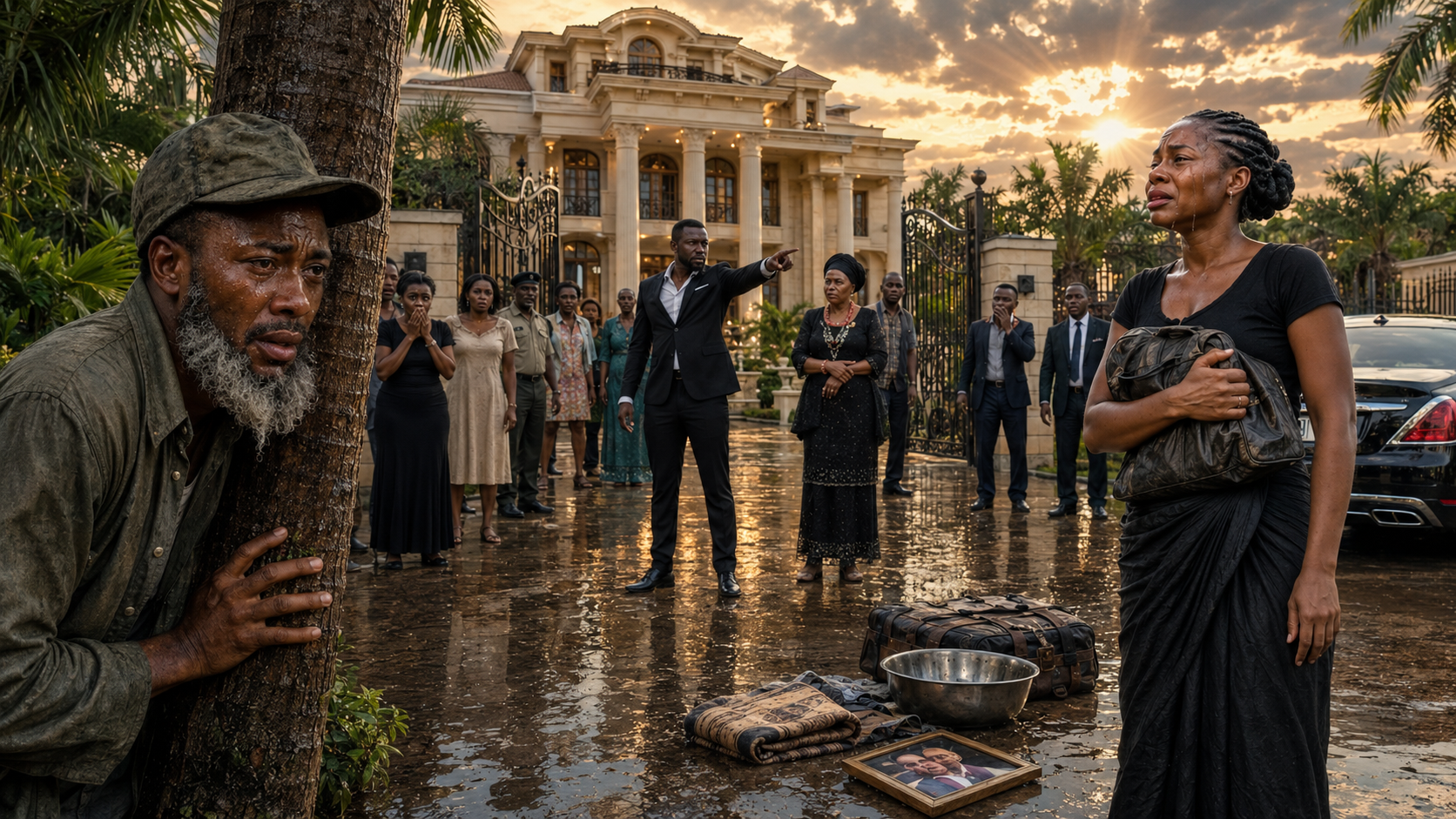
Efeoma’s belongings landed in mud.
Chike stood beneath the mansion gate.
“Get out!”
Efeoma held her son.
“You were never family.”
Baba Sule stepped between them.
“Chief, please.”
Chike shoved him.
The old man fell.
His cap disappeared into mud.
Efeoma immediately bent.
She helped Baba Sule first.
Before her clothes.
Before her bags.
Before herself.
“Are you hurt?”
The old man cried.
“Madam.”
She lifted him.
Behind them, Chike shouted.
“Take your boy!”
Efeoma slowly turned.
“And go back to the village.”
Rain moved down Chike’s face.
“My foolish brother picked you from the roadside.”
Efeoma stared.
“Now the roadside can take you back.”
The neighborhood heard.
Every word.
Chike looked at Kelechi.
Then said something he could never take back.
“Take that bastard and go.”
Efeoma crossed the distance.
She did not strike him.
She stood close.
“My son knows his father.”
Her voice shook.
“He knows who loved him.”
Chike smiled.
“Your father?”
Efeoma looked at him.
“No.”
“Yours.”
Chike’s smile disappeared.
Efeoma gathered her things.
Kelechi carried his school books.
They walked down the road.
No destination.
No home.
Rain continued.
After two streets, Efeoma stopped.
Kelechi cried.
“Mama, where?”
She looked around.
Then saw her stove.
A worker had thrown it with her belongings.
Efeoma set it upright beneath a shop awning.
She opened the pan.
“Here.”
Kelechi stared.
“What?”
“We work.”
“In rain?”
“Rain is not a police officer.”
The boy almost smiled.
Efeoma lit the stove.
Within an hour, the widow of one of the richest men in Nigeria was frying akara beside the road.
Homeless.
Her son beside her.
That was when the black cars arrived.
Now, sitting inside one of those cars, Efeoma held Kelechi’s hand.
Tunde sat across from them.
Nnamdi’s ring rested between his fingers.
“Where are we going?”
Tunde looked out the window.
“Home.”
Efeoma laughed bitterly.
“We were removed.”
“Not legally.”
“Legality did not carry my bags.”
“No.”
“Legality did not stop my son from standing in rain.”
Tunde lowered his eyes.
“No.”
Efeoma studied him.
“You knew my husband well?”
“Yes.”
“Did he trust you?”
“Yes.”
“Then answer.”
Tunde looked up.
“Is Nnamdi alive?”
The car became silent.
Kelechi stopped moving.
Tunde had promised Nnamdi he would not reveal it before the room.
But Efeoma had endured enough manipulation.
“Yes.”
The word was quiet.
Efeoma’s face emptied.
Kelechi whispered, “Daddy?”
Tunde nodded.
Efeoma turned toward the window.
For several minutes, she did not speak.
Tunde waited.
Then she asked, “How?”
The story came.
The staged collapse.
Hospital.
Doctor.
Empty coffin.
Disguise.
Efeoma listened.
Her expression did not change.
When Tunde finished, she asked one question.
“How long did he watch?”
Tunde’s answer nearly failed.
“Three weeks.”
Efeoma closed her eyes.
“He watched.”
“Yes.”
“The room.”
“Yes.”
“School.”
“Yes.”
“The necklace.”
“Yes.”
“My work.”
Tunde swallowed.
“Yes.”
“The beads.”
“Yes.”
Efeoma looked at him.
“He watched me sell my wedding beads?”
Tunde’s eyes filled.
“Yes.”
Efeoma turned away.
Kelechi tugged her sleeve.
“Mama.”
She held him.
“He’s alive?”
“Yes.”
“Daddy is alive?”
Efeoma forced a smile.
“Yes.”
Kelechi began laughing.
Pure joy.
He bounced in the seat.
“Daddy!”
Efeoma held him while anger rose inside her with equal force.
The mansion appeared ahead.
The gates opened.
Inside, Chike celebrated.
Forged transfer papers covered the table.
A bottle of expensive whiskey stood open.
Mama Obi sat nearby.
Ngozi remained quiet after the night with Chidinma, but not brave enough to oppose her husband.
Several guests had been invited.
Chike lifted a glass.
“The Okafor empire enters a new era.”
Applause.
Then the front doors opened.
Efeoma entered.
Wet.
Tired.
Kelechi beside her.
Tunde behind.
Chike stopped.
“What is this?”
Efeoma said nothing.
“Who let her in?”
Tunde removed his coat.
Chike pointed.
“I threw her out.”
“I know.”
“Tunde, you are my brother’s lawyer.”
“I was.”
Chike smiled.
“Then you understand the papers.”
“I understand them extremely well.”
“Good.”
Chike looked at Efeoma.
“Remove her.”
Tunde remained still.
“I did not bring her.”
Chike frowned.
“What?”
Tunde looked toward the side door.
“He did.”
The door opened.
An old gardener entered.
Low cap.
Plain clothing.
Gray stubble.
Chike rolled his eyes.
“Madu?”
The gardener stopped.
He straightened.
The limp disappeared.
Silence moved through the room.
The man removed his cap.
Then wiped his face with a cloth.
Gray makeup came away.
The beard loosened.
Mama Obi stood.
Her glass slipped.
Ngozi’s mouth opened.
Chike stared.
Efeoma could not move.
Nnamdi Okafor stood in his sitting room.
Alive.
The glass in Chike’s hand fell.
It shattered.
Kelechi screamed.
“Daddy!”
The boy ran.
Nnamdi dropped to his knees.
Kelechi hit him with enough force to knock him backward.
“Daddy!”
Nnamdi held him.
Cried.
Kissed his face.
“My boy.”
“You came back!”
“Yes.”
“From the trip!”
Nnamdi laughed and sobbed.
“Yes.”
Efeoma stood near the entrance.
Nnamdi looked up.
Their eyes met.
The room disappeared.
He stood slowly.
“Efeoma.”
She stepped backward.
Nnamdi stopped.
“My love.”
“No.”
Her voice was almost nothing.
He did not approach.
“You died.”
“I know.”
“I held you.”
“I know.”
“They buried you.”
“I know.”
“I told our son you were with God.”
Nnamdi cried.
“I am sorry.”
Efeoma looked around.
The family.
The papers.
The house.
Then at Nnamdi.
“You watched.”
He lowered his head.
“Yes.”
The answer hurt more because he did not lie.
“How long?”
“Three weeks.”
She nodded.
The room waited.
Efeoma whispered, “Three weeks.”
Nnamdi stepped forward.
She raised one hand.
He stopped.
“No.”
“Efeoma.”
“Not yet.”
Her face hardened.
“You do not come back from the dead and immediately call me my love.”
Nnamdi flinched.
Tunde looked down.
Efeoma’s eyes filled.
“I cried at an empty grave.”
“I know.”
“You watched me.”
“Yes.”
“I slept beside a generator.”
“Yes.”
“You watched.”
“Yes.”
“Kelechi lost school.”
“Yes.”
“You watched.”
Nnamdi broke.
“Yes.”
“I sold akara.”
“Yes.”
“You bought it.”
Efeoma suddenly understood.
The old man.
Too much money.
No change.
Her face changed.
“That was you.”
“Yes.”
She laughed once.
Not with humor.
“You let me feed my dead husband.”
Nnamdi cried.
“I am sorry.”
Efeoma looked at him for a long time.
Then she said, “You should be.”
The room became painfully silent.
Nnamdi nodded.
“Yes.”
No excuses.
That was the first correct thing he did.
Then Nnamdi turned toward his family.
Something changed.
The husband remained broken.
The businessman returned.
“Chike.”
His brother stepped backward.
“Nnamdi.”
“I watched you.”
Chike lifted both hands.
“Brother, this is confusion.”
“I watched you offer my wife money to disappear.”
“I was helping.”
“I watched you remove her from our bedroom.”
“Family tradition—”
“I watched you stop my son’s school fees.”
“It was a financial—”
“I watched your wife accuse Efeoma of theft.”
Ngozi lowered her face.
“I watched Baba Sule find the necklace your house girl hid on Ngozi’s instruction.”
Mama Obi began crying.
Nnamdi continued.
“I watched my wife become a housemaid in the home she built with me.”
His voice shook.
“I watched her clean my side of our bedroom while I stood three feet away wearing a false beard.”
Efeoma closed her eyes.
Nnamdi looked at Chike.
“And today.”
His voice became low.
“I watched you drag her into rain.”
Chike’s face became pale.
“I watched you throw my son’s books into mud.”
“Nnamdi—”
“I watched you push a seventy-year-old man to the ground.”
Baba Sule stood near the doorway.
“And I heard you call my son a bastard.”
Chike stopped speaking.
Nnamdi moved closer.
“I asked a question.”
The room waited.
“I wanted to know who my family would become when they believed I was dead.”
He looked at Mama Obi.
“At Ngozi.”
Then Chike.
“You answered.”
His voice cracked.
“Every one of you answered.”
He turned toward Efeoma.
The iron disappeared.
“But I saw her.”
Efeoma looked at him.
“I saw my wife refuse money because she wanted our son to know his father’s home.”
Nnamdi cried openly.
“I saw her cook for people who humiliated her.”
Chike looked away.
“I saw her wake before sunrise.”
Nnamdi’s voice broke.
“Stand beside a hot pan.”
Efeoma’s eyes filled.
“With a straight back.”
He took a breath.
“No shame.”
“I saw her save school fees one bean cake at a time.”
Nnamdi looked toward Ngozi.
“I saw her forgive a public accusation she did not deserve.”
Ngozi began sobbing.
“I saw her pray.”
Efeoma closed her eyes.
Nnamdi whispered, “She did not ask God to punish any of you.”
The room became still.
“She asked that our son not become like you.”
Chike stared at the floor.
Nnamdi reached into his jacket.
“And then I saw this.”
A cloth bundle.
He opened it.
Coral beads.
Efeoma gasped.
Her wedding beads.
Nnamdi held them.
“I saw Efeoma empty her last savings.”
His hands trembled.
“And when it wasn’t enough, I watched her take the last thing she had from our wedding.”
Ngozi cried harder.
“To save Chidinma.”
Nnamdi looked at his sister-in-law.
“Your daughter.”
He stepped toward Efeoma.
Tunde had quietly bought the beads back from the chemist.
Nnamdi held them out.
“I ordered Tunde to find them.”
Efeoma stared.
Nnamdi did not touch her.
“May I?”
She understood.
The beads.
He was asking permission.
Perhaps for the first time since this terrible plan began, Nnamdi was not deciding for her.
Efeoma nodded once.
Nnamdi moved behind her.
He placed the coral beads around her neck.
His fingers shook.
Then he stepped back.
He did not kneel immediately.
He looked at her.
“I faked my death because I did not trust the people around you.”
Efeoma remained still.
“The truth is I also did not trust you enough.”
Her face changed.
Nnamdi continued.
“I needed proof of what I already knew.”
His tears fell.
“And my need for proof became more important than your pain.”
Tunde looked at him.
Nnamdi’s voice lowered.
“That was wrong.”
He went down on his knees.
The billionaire.
The owner of ships.
Buildings.
Land.
Kneeling before the woman his family called a beggar.
“I am sorry.”
Efeoma cried.
“I put you through grief to answer my fear.”
Nnamdi looked up.
“There is no excuse.”
Silence.
“I will spend whatever time you give me repairing what I broke.”
Efeoma did not forgive him.
Not there.
Not immediately.
That mattered.
She looked down.
“Stand.”
Nnamdi obeyed.
“We will talk.”
Hope moved across his face.
Efeoma’s eyes hardened.
“Do not smile.”
He stopped.
“I said talk.”
“Yes.”
“Later.”
“Yes.”
She turned away.
Nnamdi accepted it.
Then he faced Chike.
Tunde approached the table.
“Barrister.”
“Yes?”
“The papers.”
Tunde lifted one.
“Forgeries.”
Gasps.
Chike stepped forward.
“That is false.”
Tunde opened a folder.
“The broker who prepared these documents signed a statement.”
Chike’s face changed.
“No.”
“Signed.”
Tunde continued.
“Witnessed.”
“No.”
“Transaction records connect payment to your account.”
Chike began sweating.
Nnamdi said, “You were not protecting the family.”
“Brother.”
“You were cutting out Mama.”
Mama Obi looked at Chike.
“What?”
Nnamdi nodded toward the papers.
“You transferred everything to yourself.”
Mama Obi stood.
“Chike.”
“It was temporary.”
Ngozi looked at him.
“What about me?”
Chike said nothing.
Ngozi understood.
He had been willing to use everyone.
Then remove everyone.
Nnamdi looked at his brother with grief.
“I thought greed made you cruel.”
Chike swallowed.
“It seems cruelty was only a tool for greed.”
“Nnamdi, please.”
“The investigators have been notified.”
Chike’s knees weakened.
“Please.”
“I am your brother.”
Nnamdi closed his eyes.
“Yes.”
“That is why this hurts.”
“I made a mistake.”
“No.”
Nnamdi looked at him.
“A mistake is signing the wrong line.”
His voice remained calm.
“You built this for weeks.”
“Months,” Tunde corrected.
Nnamdi flinched.
Chike stared.
Nnamdi continued.
“I am not destroying you.”
“Please.”
“You destroyed yourself.”
The words settled.
“The forged papers are void.”
Tunde nodded.
“You will answer questions regarding fraud.”
Chike began crying.
“Everything I tried to gain…”
Nnamdi finished.
“You lost.”
He turned toward Mama Obi.
His mother looked old.
“Nnamdi.”
He remained silent.
“I thought…”
She stopped.
“What?”
Mama Obi cried.
“I thought Efeoma would leave.”
“Yes.”
“I thought Chike would manage.”
“Yes.”
“I did not know.”
Nnamdi’s expression hardened.
“You knew she slept in the servant’s room.”
Mama Obi looked down.
“You knew my son lost school.”
Silence.
“You heard the thief accusation.”
Mama Obi cried.
“Nnamdi.”
“You watched.”
His voice broke.
“Mother.”
That word hurt.
“You watched a widow and a child suffer because helping them would require you to disagree with your favorite son.”
Mama Obi covered her face.
Nnamdi said quietly, “You are my mother.”
She looked up.
“I love you.”
Hope appeared.
“But I do not trust you.”
The hope vanished.
“Not now.”
He looked at Ngozi.
She trembled.
“Nnamdi.”
“You tried to frame Efeoma.”
Ngozi cried.
“I was jealous.”
“Of what?”
Ngozi looked at Efeoma.
“Everything.”
Efeoma almost laughed.
Her clothing was wet.
Her home had been taken.
Her son’s books remained muddy.
“Everything?”
Ngozi sobbed.
“She had you.”
Nnamdi stopped.
“You defended her.”
Ngozi looked at her husband.
“Chike never…”
She did not finish.
Nnamdi understood.
That did not excuse her.
“Your pain explains something.”
Ngozi looked up.
“It does not make it acceptable.”
She nodded.
Nnamdi looked toward Chidinma, standing with a nanny.
“The woman you tried to disgrace saved your daughter’s life.”
Ngozi collapsed into a chair.
“I know.”
“You will remember that.”
“I will.”
“No.”
Nnamdi’s face became cold.
“You will prove you remember.”
The legal consequences unfolded over months.
Chike faced investigation for forgery and financial misconduct.
Nnamdi did not interfere.
That was important.
He also did not use his wealth to seek exaggerated punishment.
The facts were enough.
Chike’s scheme failed.
His access to Okafor companies ended.
The estate returned to lawful control.
Ngozi separated from Chike during the investigation.
Not because she suddenly became noble.
Because betrayal had finally reached her personally.
It took time for her to understand the hypocrisy.
Efeoma understood immediately.
“Pain becomes real to some people only when it learns their address,” she told Nnamdi.
He wrote the sentence down.
Efeoma saw.
“What are you doing?”
“Remembering.”
“I am not a philosopher.”
“You sell oranges with character analysis.”
“I sold oranges years ago.”
“You still judge fruit.”
“Some oranges lie.”
Nnamdi laughed.
Then stopped.
Their marriage was difficult.
Of course it was.
The world around them expected a romantic reunion.
The billionaire returned.
The faithful wife forgave.
Family restored.
Real hearts were not that neat.
Efeoma moved into a separate guest house on the estate.
Nnamdi accepted.
Kelechi spent mornings with his father.
Nights with Efeoma.
The boy did not understand why his parents were not immediately sleeping in the same room.
“Daddy came back.”
“Yes,” Efeoma said.
“So adventure room finished.”
“Yes.”
“Then why Daddy there?”
Kelechi pointed toward the main house.
Efeoma sat beside him.
“Because Daddy made a very big mistake.”
“Bigger than breaking bicycle?”
“Much.”
“Bigger than blender?”
“Much.”
Kelechi considered.
“Wow.”
Efeoma laughed despite herself.
Nnamdi attended therapy.
Privately at first.
Then he told Efeoma.
“I have a problem.”
She looked at him.
“I know.”
Nnamdi smiled sadly.
“I thought control was protection.”
“Yes.”
“I thought if I could predict betrayal, it would hurt less.”
Efeoma said nothing.
“I hurt you trying to protect you from people who might hurt you.”
“Yes.”
Nnamdi looked down.
“I need you to stop agreeing so quickly.”
“No.”
He laughed.
Small progress.
They talked.
For months.
Efeoma described the grave.
Nnamdi listened.
She described the night Kelechi asked if he had been bad.
Nnamdi cried.
She described cleaning their bedroom while the old gardener carried a bucket.
Nnamdi covered his face.
“I stood there.”
“I know.”
“I wanted to tell you.”
“You didn’t.”
“I know.”
Efeoma’s anger arrived in waves.
Some days, she missed him.
Other days, seeing him made her furious.
Nnamdi accepted both.
He stopped asking, “When will you forgive me?”
His therapist explained why the question was another form of pressure.
So Nnamdi waited.
Not as a test.
As consequence.
One evening, Efeoma found him in the garden.
The tomato plants.
The place of the false collapse.
He sat on the ground.
“You still grow these?”
“Yes.”
“Why?”
“My father.”
She nodded.
Nnamdi looked at her.
“I thought you would hate the garden.”
“I did.”
“What changed?”
Efeoma sat beside him.
“Kelechi likes tomatoes.”
They remained quiet.
Then Efeoma asked, “Did you ever think I would take the money?”
Nnamdi answered honestly.
“Yes.”
She looked at him.
“For a second.”
Her face hardened.
“I see.”
“I was afraid.”
“Of me?”
“Of everybody.”
“That is not better.”
“I know.”
She looked toward the plants.
Nnamdi continued.
“When you pushed it back…”
“What?”
“I cried.”
Efeoma laughed bitterly.
“You cried in a comfortable apartment while I thought my husband was dead.”
“Yes.”
The answer remained painful.
Nnamdi did not defend.
Efeoma looked at him.
“You have changed.”
“I am trying.”
“No.”
She shook her head.
“You’ve learned silence.”
Nnamdi smiled faintly.
“Expensive lesson.”
“Very.”
Efeoma stood.
Then stopped.
“I am not ready to move back.”
“I know.”
“But…”
Nnamdi looked up.
“Dinner tomorrow.”
He froze.
“With Kelechi.”
“Yes.”
“Of course.”
“And no dramatic flowers.”
“Agreed.”
“No jewelry.”
“Agreed.”
“No musicians.”
Nnamdi looked offended.
“I have never hired musicians for an apology.”
“You faked a funeral.”
“Fair.”
Efeoma almost smiled.
Dinner became another.
Then another.
Trust returned slowly.
Not because Nnamdi had wealth.
Because he learned to accept answers he disliked.
Meanwhile, Baba Sule received a surprise.
Nnamdi visited the gatehouse.
The old man stood immediately.
“Oga!”
“Sit.”
“No.”
“Baba.”
“I cannot sit when you stand.”
Nnamdi sat first.
Baba Sule laughed.
Then joined him.
Nnamdi placed a folder down.
“What is this?”
“Retirement.”
Baba Sule’s face changed.
“I am not old.”
“You fell in mud.”
“Because your brother pushed me.”
“Exactly.”
“I can work.”
“I know.”
Nnamdi opened the folder.
A house.
Medical support.
Education funds for Baba Sule’s grandchildren.
A pension.
The old man stared.
“No.”
Nnamdi frowned.
“What do you mean no?”
“I do not need this.”
“You served my family thirty years.”
“I was paid.”
“You defended my wife.”
“She was right.”
“You found the necklace.”
“My eyes worked.”
“You ran for medicine.”
“A child was sick.”
Nnamdi smiled.
“You are difficult.”
Baba Sule shrugged.
“Maybe that is why Madam likes me.”
Nnamdi’s smile faded.
“Does she?”
Baba Sule laughed.
“Oga, you are rich and still foolish.”
“Explain.”
“Madam is still angry.”
“I know.”
“Anger is not absence of love.”
Nnamdi became quiet.
Baba Sule looked at the folder.
“I will take retirement.”
Nnamdi smiled.
“But.”
Nnamdi sighed.
“Of course.”
“I keep my chair at the gate.”
“Why?”
“To watch.”
“You are retired.”
“My eyes still work.”
Nnamdi agreed.
Baba Sule spent the next five years sitting near the gate criticizing younger security guards.
The foundation began with Efeoma.
Nnamdi suggested it carefully.
“I have an idea.”
She looked suspicious.
“No.”
“I have not spoken.”
“You use that voice before large ideas.”
“What voice?”
“The billionaire voice.”
Nnamdi lowered his tone.
“Better?”
“Worse.”
He laughed.
Then explained.
During the weeks Efeoma sold akara, women came to her.
Widows.
Single mothers.
Women removed from homes after husbands died.
Women with inheritance disputes.
Some bought food.
Others told stories.
Efeoma remembered all of them.
“What if we help?”
Nnamdi asked.
“With money?”
“With structure.”
Efeoma waited.
“Legal aid.”
Nnamdi counted.
“Small business grants.”
She listened.
“School support.”
More.
“Temporary housing.”
Efeoma’s expression changed.
Nnamdi continued.
“And you run it.”
She laughed.
“No.”
“Why?”
“I sell akara.”
“You ran this house.”
“That is different.”
“You kept our son in school with a pan.”
“Nnamdi.”
“You saved Chidinma.”
“Stop.”
“You survived my family.”
Efeoma’s eyes hardened.
“Do not use what I suffered to promote me.”
Nnamdi stopped.
She was right.
He nodded.
“Then forget the idea.”
Efeoma stared.
“That’s it?”
“Yes.”
“You are not arguing?”
“No.”
She became suspicious.
“You are learning tricks.”
“No.”
“What happens now?”
“Nothing.”
Efeoma thought for two weeks.
Then went to Nnamdi’s study.
“The foundation.”
He looked up.
“Yes?”
“My way.”
Nnamdi smiled.
“Your way.”
“No photographs of me crying.”
“Agreed.”
“No story about faithful widow.”
“Agreed.”
“No speeches about resilience without giving women lawyers.”
Nnamdi sat straighter.
“Agreed.”
“And the grants are not charity.”
“What are they?”
“Starts.”
Nnamdi nodded.
“Starts.”
The Sunrise Women’s Foundation opened a year later.
Efeoma disliked the name.
Mama Obi suggested it.
Efeoma almost rejected it for that reason alone.
Eventually, she kept it.
The foundation symbol became a black pan with three golden akara.
Nnamdi wanted an elegant logo.
Efeoma overruled him.
“People understood the pan.”
A simple sentence appeared beneath it:
THERE IS NO SHAME IN HONEST WORK.
The second line was Baba Sule’s addition.
AND GOD IS NOT ASLEEP.
Efeoma laughed when she saw it.
“The old gardener used to say that.”
Nnamdi froze.
She turned.
“You.”
“Yes.”
“You said that.”
“Yes.”
Efeoma stared.
“I used to think Madu was my only friend.”
Nnamdi’s face fell.
She continued.
“That is still strange.”
“I know.”
“Sometimes I miss him.”
Nnamdi looked offended.
“I was him.”
“No.”
“You were.”
“Madu was quiet.”
Nnamdi laughed.
The foundation changed lives.
A widow named Amaka arrived after relatives removed her from a family shop.
The foundation provided legal aid.
She recovered her share.
A mother named Sade received equipment to begin tailoring.
Another woman started a food stall.
Efeoma refused to hide her own story.
But she told it carefully.
“My husband made a terrible choice,” she said during one small meeting.
Nnamdi sat in the back.
“He is here.”
Several women turned.
Nnamdi lifted one hand awkwardly.
Efeoma continued.
“He knows I say this.”
The women laughed.
“He thought pain could be used to reveal truth.”
Her voice softened.
“What he learned is pain also creates damage that truth does not automatically repair.”
Nnamdi listened.
“But we learned something else.”
Efeoma looked around.
“People often call women strong when what they mean is nobody came to help.”
The room became quiet.
“I do not want this foundation to praise you for surviving alone.”
Efeoma touched the table.
“I want us to arrive before survival becomes your only option.”
Nnamdi cried.
Baba Sule, sitting beside him, whispered, “Rich men cry too much.”
Nnamdi looked at him.
“You cried over your retirement folder.”
“That was dust.”
“Inside my study?”
“Very dusty.”
Nnamdi smiled.
Three years after the fake funeral, Chike was convicted on fraud-related charges connected to the forged transfer scheme.
Nnamdi attended one court day.
Chike asked to speak afterward.
They sat across a table.
“You won.”
Nnamdi looked at him.
“This was never a game.”
“You got everything.”
“I already had everything.”
Chike laughed bitterly.
“Exactly.”
Nnamdi waited.
“You don’t understand.”
“Explain.”
“You were first.”
Nnamdi frowned.
“First son.”
Chike continued.
“Father looked at you differently.”
“He died when we were young.”
“Old enough.”
Chike’s eyes filled.
“You built ships.”
“Yes.”
“I entered a room and people asked where you were.”
Nnamdi became quiet.
“Mama loved me.”
“Yes.”
“But the world loved you.”
“No.”
Chike laughed.
“Listen to yourself.”
“The world loved access.”
Chike shook his head.
“Easy for you.”
Nnamdi looked at his brother.
“Do you think I never felt used?”
“At least you were useful.”
The sentence saddened him.
Chike continued.
“I wanted one thing nobody could compare.”
“So you stole.”
“I tried.”
“You hurt my wife.”
Chike looked down.
“You hurt my son.”
Silence.
“You pushed Baba Sule.”
Chike almost smiled.
“He still hates me?”
“No.”
That surprised him.
“He should.”
“Baba Sule says hatred is unpaid work.”
Chike laughed.
A real laugh.
Then cried.
Nnamdi did not forgive everything in that room.
But he listened.
Years later, Chike began slowly rebuilding contact with Kelechi.
Under Efeoma’s conditions.
No entitlement.
No money requests.
No stories blaming Nnamdi.
Chike accepted.
Mama Obi’s reckoning was quieter.
She moved out of the mansion.
Not because Nnamdi expelled her.
She chose to.
“I am ashamed.”
Efeoma looked at her.
Mama Obi had asked to meet.
They sat beneath a tree at the foundation.
“I watched.”
“Yes.”
Mama Obi cried.
“I was angry when Nnamdi married you.”
“I know.”
“I thought you took him.”
Efeoma frowned.
“From you?”
Mama Obi looked away.
“My first son became powerful.”
She wiped her face.
“Everyone wanted him.”
Efeoma waited.
“I thought I had lost him.”
“So you punished me.”
“Yes.”
The honesty surprised Efeoma.
Mama Obi continued.
“When he died…”
She stopped.
“When I thought he died, I should have held you.”
Efeoma’s eyes filled.
“You did not.”
“I know.”
“You let me sit alone.”
“I know.”
“You watched Chike.”
“I know.”
Efeoma breathed.
Mama Obi looked at her.
“I am sorry.”
The words arrived too late.
But they arrived.
Efeoma nodded.
“I hear you.”
Mama Obi cried harder.
“Do you forgive me?”
Efeoma looked toward the foundation courtyard.
A group of women sat beneath a canopy learning basic bookkeeping.
“I am trying.”
Mama Obi accepted.
That was more than she deserved.
Nnamdi and Efeoma renewed their vows five years after the staged death.
Not because the first marriage stopped being valid.
Because Efeoma wanted a new memory.
“Small,” she said.
“Of course.”
“Family.”
“Yes.”
“No newspapers.”
“Yes.”
“No coffin.”
Nnamdi looked at her.
“That is unnecessarily specific.”
Efeoma stared.
“Understood.”
The ceremony happened in the garden.
Near the tomatoes.
Kelechi, now eleven, stood beside them.
The old scratch remained on Nnamdi’s ring.
Efeoma wore the coral beads.
Before the vows, Nnamdi spoke privately.
“I want to say something.”
Efeoma sighed.
“Billionaire voice?”
“No.”
“Good.”
Nnamdi looked at her.
“I spent years believing I was the wall protecting you.”
Efeoma waited.
“The wall fell.”
He swallowed.
“And you stood.”
Her eyes filled.
“I thought I needed to know whether you would survive without me.”
Nnamdi shook his head.
“That was arrogance.”
“Nnamdi.”
“Let me finish.”
She nodded.
“You did survive.”
His voice broke.
“But I am no longer proud that I proved it.”
Efeoma cried.
“I am proud of you.”
He took her hand.
“But I wish you never needed to prove it.”
Silence.
Efeoma touched his face.
“That is the first time you’ve said it correctly.”
Nnamdi smiled through tears.
“I practiced.”
“I knew.”
During the ceremony, Efeoma promised nothing dramatic.
“I love you.”
Nnamdi smiled.
“I am still angry about certain things.”
Guests laughed.
Nnamdi nodded.
“Fair.”
“You are not allowed to fake any medical condition.”
“Agreed.”
“Or funeral.”
“Agreed.”
“Or disappearance.”
“Agreed.”
“For richer or poorer.”
Nnamdi smiled.
“I prefer richer.”
Efeoma laughed.
Then became serious.
“I choose you.”
That was enough.
Years passed.
Kelechi grew.
He learned the truth gradually.
At thirteen, he asked his father directly.
“You pretended to die?”
Nnamdi put down his newspaper.
“Yes.”
“That is crazy.”
“Yes.”
“Mama says therapy helped you.”
Nnamdi stared.
“Your mother discusses too much.”
Kelechi laughed.
“Why?”
Nnamdi looked at his son.
“I was afraid.”
“You were rich.”
“Yes.”
“What were you afraid of?”
Nnamdi thought.
“Being loved for things that were not me.”
Kelechi became quiet.
“And Mama?”
“I should have trusted her.”
“Did she forgive you?”
“Yes.”
“Why?”
Nnamdi smiled sadly.
“You must ask her.”
Kelechi did.
Efeoma answered differently.
“Because forgiveness was something I wanted for myself.”
“Not Daddy?”
“No.”
She touched her son’s shoulder.
“I did not want anger to become the person making all my decisions.”
“But what Daddy did was bad.”
“Yes.”
“And Uncle Chike.”
“Yes.”
“Grandma.”
“Yes.”
Kelechi frowned.
“Everybody was bad.”
Efeoma laughed.
“No.”
“Baba Sule?”
“Good.”
“Me?”
“Annoying.”
“Mama.”
She smiled.
“People are not one moment.”
Kelechi listened.
“But moments reveal things.”
“What did my moments reveal?”
“That you ask too many questions.”
He rolled his eyes.
Efeoma pulled him close.
The Okafor empire changed.
Nnamdi placed core assets inside structures designed to protect Efeoma and Kelechi.
Not as a reward for passing a test.
Nnamdi hated that language now.
As recognition of partnership.
Efeoma became a trustee.
She attended business meetings.
The first time, Chike’s former associates underestimated her.
One executive spent twenty minutes explaining shipping margins as though speaking to a child.
Efeoma listened.
Then asked three questions.
The room changed.
Nnamdi smiled.
Afterward, the executive approached him.
“Your wife is sharp.”
Nnamdi looked at Efeoma.
“She sold oranges.”
The man frowned.
Nnamdi walked away.
Efeoma later hit his arm.
“Why do you keep telling people that?”
“I like watching their faces.”
“You are childish.”
“Very.”
The roadside where Efeoma once sold akara changed too.
The foundation leased a small building there.
Women received equipment.
Training.
Legal support.
Childcare.
The black pan from Efeoma’s original roadside stove sat inside a glass display.
She hated this.
“It is a pan.”
Nnamdi said, “History.”
“It has oil stains.”
“Authentic history.”
One morning, a young widow stood before it.
Her name was Chioma.
Her husband’s relatives had removed her from a small grocery business.
She had two daughters.
Chioma stared at the pan.
“Is it true?”
Efeoma approached.
“What?”
“You sold food.”
“Yes.”
“After living in that mansion?”
“Yes.”
“Were you ashamed?”
Efeoma thought.
“At first.”
Chioma looked surprised.
“People tell the story like I was brave every second.”
Efeoma smiled.
“I was embarrassed.”
“What changed?”
“My son was hungry.”
Simple.
Chioma cried.
Efeoma touched her hand.
“Courage is not always a feeling.”
“What is it?”
“Sometimes it is what you do while wishing nobody could see you.”
Nnamdi heard from the doorway.
He remembered watching her.
He left quietly.
Some memories still hurt.
He accepted that they always might.
On the tenth anniversary of the fake funeral, Tunde sent Nnamdi a black invitation card.
Nnamdi opened it.
CELEBRATION OF LIFE
He stared.
Efeoma walked in.
“What?”
Nnamdi handed her the card.
Tunde had written below:
Attendance mandatory. Coffins prohibited.
Efeoma laughed for five minutes.
Tunde hosted dinner.
Baba Sule attended.
Mama Obi came.
Ngozi brought Chidinma, now a teenager.
Even Chike attended after completing his sentence and years of rebuilding his life quietly.
The atmosphere was awkward.
Then Kelechi stood.
“I want to say something.”
Everyone looked.
He was sixteen.
Tall.
Nnamdi’s eyes.
Efeoma’s calm.
“My family is weird.”
Laughter.
Nnamdi covered his face.
Kelechi continued.
“Very weird.”
“Son,” Nnamdi warned.
“I learned the story when I was thirteen.”
He looked at his father.
“Dad made a terrible decision.”
Nnamdi nodded.
“Correct.”
“Uncle Chike made worse decisions.”
Chike nodded.
“Also correct.”
“Grandma did not make enough decisions.”
Mama Obi closed her eyes.
“Child.”
Kelechi smiled.
“Sorry.”
He became serious.
“But I think the reason we can sit here is because everyone eventually stopped pretending their worst choice was somebody else’s fault.”
The room became still.
Nnamdi looked at Efeoma.
She looked proud.
Kelechi continued.
“My mother says people are not one moment.”
He looked at Chike.
“But moments reveal things.”
Then at Nnamdi.
“What you do after the revealing also matters.”
Nnamdi’s eyes filled.
Kelechi raised his glass.
“To no more fake funerals.”
Everyone laughed.
Glasses lifted.
Nnamdi said, “I feel attacked.”
Efeoma leaned toward him.
“You should.”
Later that night, Nnamdi and Efeoma returned home.
They walked past the garden.
Tomato plants moved in the evening breeze.
Nnamdi stopped.
“What?”
Efeoma asked.
“Nothing.”
She waited.
He looked toward the place where he had collapsed.
“I used to think that morning changed everything.”
“It did.”
“No.”
Nnamdi took her hand.
“The morning changed what I could see.”
Efeoma watched him.
“You were always who you were.”
Her eyes softened.
“Chike was who he was.”
Nnamdi continued.
“Mama.”
“Ngozi.”
“Baba Sule.”
He smiled.
“I thought I created a test.”
Nnamdi shook his head.
“Really, I removed myself from the room and discovered the room already had answers.”
Efeoma looked at him.
“That sounds like therapy.”
“It was expensive.”
She laughed.
They continued walking.
The original gold ring remained on Nnamdi’s finger.
The scratch near the top had deepened.
Efeoma touched it sometimes.
Years ago, a stranger held that ring beside a rainy roadside.
She thought it was evidence of a ghost.
Now it reminded her of something different.
Truth can be hidden.
For a while.
Under gray makeup.
Inside an empty coffin.
Behind polite smiles.
Inside forged papers.
Truth may stand in a garden holding a rake while everyone speaks freely.
But hidden truth creates its own cost.
Nnamdi learned that.
He wanted to know who his family truly was.
He received the answer.
His brother’s greed.
His mother’s weakness.
Ngozi’s jealousy.
Baba Sule’s loyalty.
Efeoma’s character.
But the test revealed Nnamdi too.
That was the truth nobody expected.
The man who believed himself a protector discovered that fear had made him manipulative.
The man who distrusted everyone discovered that distrust could injure the innocent.
The billionaire who controlled ships, land, and companies learned that a human heart was not an asset to audit.
Efeoma’s goodness did not erase his mistake.
His apology did not erase her grief.
Love did not make accountability unnecessary.
Their marriage survived because Nnamdi stopped treating forgiveness as something money, tears, or public gestures could purchase.
He changed.
Efeoma watched.
Then chose.
That distinction mattered.
And the family?
They changed too.
Not perfectly.
Chike never recovered the position he tried to steal.
He built a smaller life.
Quieter.
One that required actual work.
At first, he hated it.
Then something surprising happened.
He became good at it.
He opened a logistics consultancy after prison restrictions ended.
Small clients.
No famous family title on the door.
The first year nearly failed.
Chike considered calling Nnamdi.
He did not.
He cut expenses.
Worked.
One evening, he stood inside a modest office repairing a broken printer.
He laughed.
A memory came.
Nnamdi destroying Kelechi’s bicycle.
Chike sat down.
He cried.
Then called his brother.
Not for money.
“Hello?”
Nnamdi answered.
Chike said, “I think I finally understand why you liked doing things yourself.”
Nnamdi remained quiet.
“Why?”
“Because when it fails, you cannot blame staff.”
Nnamdi laughed.
They spoke for twenty minutes.
Healing rarely arrived dramatically.
Sometimes it sounded like two brothers talking about a broken printer.
Ngozi became involved with the Sunrise Foundation.
Efeoma refused initially.
“No.”
Ngozi accepted.
Six months later, she asked again.
“No.”
A year.
“No.”
After eighteen months, Efeoma said, “Why?”
Ngozi answered honestly.
“Because I know what jealousy can turn a woman into when she keeps feeding it.”
Efeoma studied her.
“That does not make you qualified.”
“No.”
Ngozi nodded.
“But maybe I can talk to women before they become me.”
Efeoma allowed her to volunteer.
No title.
No photographs.
Ngozi spent two years doing intake work.
Listening.
She learned that women she once called poor possessed complicated histories, talents, and fears.
One afternoon, a widow arrived wearing a torn wrapper.
Ngozi looked at her hands.
Rough.
For one horrible second, she remembered Mama Obi looking at Efeoma’s hands years earlier.
Ngozi cried in the restroom.
Then returned.
She treated the woman with respect.
That was change.
Quiet.
Unphotographed.
Mama Obi spent her final years near Enugu.
Efeoma visited.
Not every week.
Not because tradition demanded it.
Because she chose.
One evening, Mama Obi held Efeoma’s hands.
“Still rough.”
Efeoma smiled.
“Yes, Mama.”
The old woman cried.
“I was foolish.”
“Yes.”
Mama Obi laughed weakly.
“You have become rude.”
“Nnamdi says honest.”
“Same thing.”
Before Mama Obi died, she asked Efeoma to forgive her again.
Efeoma said, “I did.”
Mama Obi closed her eyes.
“When?”
“I don’t know.”
The answer comforted her.
Some forgiveness did not have a date.
Baba Sule lived long enough to see Kelechi graduate from university.
He wore the same cap.
Kelechi hugged him.
“You used to protect Mama.”
Baba Sule corrected him.
“Your mother protected herself.”
Kelechi smiled.
“You helped.”
“I had eyes.”
“And courage.”
Baba Sule frowned.
“Your father pays you to talk like this?”
“My father says you are difficult.”
Baba Sule laughed.
At the celebration, Nnamdi raised a glass.
Baba Sule shouted, “No long speech.”
Everyone laughed.
Nnamdi lowered the glass.
“Fine.”
Efeoma whispered, “Good.”
Kelechi looked around at the strange family.
A father who once pretended to die.
A mother who became a roadside seller and foundation leader.
An uncle who tried to steal an empire and later built a small honest business.
An aunt who once planted a necklace and now listened to widows for hours.
An old gateman who refused retirement by sitting at the gate every day anyway.
Kelechi understood something.
Family could wound.
Family could heal.
Sometimes the same people did both.
But healing required truth first.
Not pretending.
Not “these things happen.”
Not “we are family” used as a blanket over wrongdoing.
Truth.
Then consequence.
Then choice.
Nnamdi’s story became public years later.
Not the full details.
Enough.
A journalist asked Efeoma a question during an interview about the foundation.
“Do you believe your husband was right to test his family?”
Efeoma looked directly at the camera.
“No.”
The journalist blinked.
Nnamdi sat offstage.
He smiled.
Efeoma continued.
“I believe he was afraid.”
“Did the test reveal truth?”
“Yes.”
“So wasn’t it worth it?”
“No.”
Her answer was immediate.
“Why?”
“Because truth does not become moral simply because it is useful.”
The studio became silent.
Efeoma looked toward Nnamdi.
He nodded.
She continued.
“We learned valuable things.”
Her voice softened.
“But some lessons could have been learned through honest conversation, legal protection, and courage.”
The journalist asked, “Then why did you forgive him?”
Efeoma smiled.
“Because he agrees with me.”
Nnamdi laughed from offstage.
The audience heard.
Efeoma smiled wider.
“He did not spend ten years telling me his pain justified mine.”
She looked back at the journalist.
“He changed.”
“And if he had not?”
Efeoma’s expression became calm.
“I would have left.”
That answer went viral.
People called Efeoma strong.
She disliked the word less now.
Because she defined it herself.
Strength was not endless endurance.
It was not remaining quiet while people harmed you.
It was not forgiving without accountability.
Sometimes strength was frying bean cakes.
Sometimes it was saying no to an envelope.
Sometimes it was saving a sick child who had done nothing wrong.
Sometimes it was allowing anger.
Sometimes it was leaving.
Sometimes it was staying after change had earned another chance.
Years after everything, Efeoma returned to the roadside where the black cars once stopped.
The area had changed.
New shops.
Paved sidewalks.
A Sunrise Foundation training center stood nearby.
Efeoma carried a small bag of oranges.
Nnamdi walked beside her.
“Why oranges?”
“Memory.”
“You charged me unfairly.”
“I returned your extra money.”
“You threw fruit at me.”
“You deserved it.”
They stopped.
A young girl sold oranges at a stall.
Efeoma bought one.
The girl selected carefully.
“This one is sweet.”
Efeoma smiled.
Nnamdi saw it.
“What?”
“Nothing.”
They walked.
Efeoma peeled the orange.
Gave Nnamdi half.
He ate.
“Sour.”
She laughed.
“You still cannot judge fruit.”
“I own ships.”
“Exactly.”
They continued down the road.
Once, Nnamdi believed wealth was the wall protecting his wife.
Then he removed himself.
The wall fell.
Efeoma stood.
But the greatest lesson was not that she could survive without him.
It was that love should never require someone you cherish to prove how much suffering they can survive.
Nnamdi spent the rest of his life understanding that.
And Efeoma?
She never stopped using her hands.
The same hands Mama Obi once examined with disgust.
The hands that sold oranges.
Fried akara.
Held Nnamdi in the garden.
Buried a husband who was not dead.
Cleaned a servant’s room.
Counted coins.
Carried Chidinma through a fever.
Removed wedding beads from her own neck.
Lifted Baba Sule from mud.
Signed foundation documents.
Held women while they cried.
Those hands became famous.
Efeoma found that funny.
“They are just hands.”
Nnamdi always answered, “No.”
She would roll her eyes.
He would continue.
“They answered my question before you ever spoke.”
“What question?”
“Who you are.”
Efeoma usually stopped arguing then.
Not because Nnamdi was entirely right.
She knew character was more than moments of sacrifice.
She knew goodness should not be measured only by how much a woman gives away.
But she understood what he meant.
When nobody who seemed important was watching, Efeoma remained herself.
So did Chike.
So did Ngozi.
So did Mama Obi.
So did Baba Sule.
And so did Nnamdi.
That was the part people forgot when telling the famous story.
The rich man faked his own death to see how his family would treat his poor widow.
He thought he was the observer.
He thought everyone else was being tested.
But the moment he became invisible, Nnamdi’s own heart was revealed too.
And when he finally stepped back into the sitting room, removed the gardener’s cap, and returned from the grave, the truth standing there was larger than money or inheritance.
His brother had shown greed.
His mother had shown cowardice.
Ngozi had shown jealousy.
Baba Sule had shown loyalty.
Efeoma had shown compassion.
And Nnamdi had shown fear.
The difference was what they chose after they saw themselves clearly.
Some denied.
Some blamed.
Some apologized.
Some changed.
And Efeoma, the woman everyone once expected to grab an envelope of cash and disappear back to her village, became the strongest name in the Okafor story.
Not because Nnamdi gave her wealth.
She already had something his money could not create.
A heart that knew the difference between humiliation and honest work.
A heart that could save a child without asking who the child’s mother was.
A heart that could forgive without pretending harm never happened.
A heart strong enough to tell a billionaire husband, after he returned from his own fake funeral:
“You should be sorry.”
And make him understand that love was not exemption from consequences.
Years later, Nnamdi sometimes woke at night.
He would find Efeoma sleeping.
The coral beads rested in a box nearby.
He never touched them without asking.
Small thing.
Huge lesson.
One night, Efeoma opened her eyes.
“You are staring.”
“Sorry.”
“What?”
Nnamdi smiled.
“Nothing.”
She narrowed her eyes.
“Billionaire voice.”
“I didn’t speak.”
“You have a billionaire face.”
“What does that look like?”
“Trouble with funding.”
He laughed quietly.
Then became serious.
“I was thinking about the grave.”
Efeoma was silent.
“I am sorry.”
She reached for his hand.
“I know.”
“I will always be sorry.”
“I know.”
Nnamdi looked at their joined hands.
“Does it bother you?”
“What?”
“That I still say it.”
Efeoma thought.
“No.”
“Why?”
“Because you no longer say it to make me forgive you.”
Nnamdi nodded.
“That matters.”
“Yes.”
They lay quietly.
Outside, rain began.
Nnamdi stiffened slightly.
Efeoma noticed.
“Rain.”
“Yes.”
“The roadside?”
“Yes.”
She squeezed his hand.
“I was angry that day.”
“I know.”
“I wanted to hit you.”
Nnamdi smiled.
“I know.”
“Tunde told me not to.”
“He did?”
“Yes.”
“I will reduce his legal fees.”
Efeoma laughed.
Then whispered, “I was also happy.”
Nnamdi turned.
“What?”
“When I knew you were alive.”
She looked at him.
“I hated you.”
“Understandable.”
“And I loved you.”
Nnamdi’s eyes filled.
“Also understandable.”
“Arrogant.”
“Sorry.”
They smiled.
Efeoma looked toward the dark window.
“That was the hardest part.”
“What?”
“Two truths.”
She held his hand.
“You hurt me.”
Nnamdi remained still.
“And I loved you.”
Her voice softened.
“People think one truth cancels the other.”
“It doesn’t.”
“No.”
Efeoma looked at him.
“That is why healing took time.”
Nnamdi nodded.
They had learned to live with complicated truths.
The family was not restored to innocence.
There was no innocence to restore.
Instead, they built something more honest.
They remembered.
They named wrong things correctly.
They accepted consequences.
They laughed again.
Not because the past disappeared.
Because the past stopped controlling every room.
And sometimes, on early mornings, Efeoma still fried akara.
Not because she needed money.
The foundation held breakfast events.
Women gathered.
Efeoma tied her wrapper.
Stood over the black pan.
Nnamdi always arrived first.
“How much?”
“Three for ten.”
“Give me thirty.”
“You cannot eat thirty.”
“Madam, I am hungry.”
Efeoma stared.
Same argument.
Years later.
She gave him fifteen.
Nnamdi paid too much.
Then ran.
Efeoma chased him with a spoon.
Women laughed.
Baba Sule shouted from his chair.
“Catch the old thief!”
Nnamdi protested.
“I own this property!”
Efeoma shouted, “Not my change!”
For a moment, nobody saw a billionaire.
Nobody saw a famous widow.
Nobody saw scandal.
They saw two people who had survived the terrible things fear, greed, and pride could do.
Two people still learning.
Still choosing.
Still laughing.
And hanging on the wall behind them was the foundation’s black-pan symbol.
Below it were the words Efeoma once spoke when she had almost nothing:
THERE IS NO SHAME IN HONEST WORK.
And beneath that:
GOD IS NOT ASLEEP.
Perhaps that was why Nnamdi’s test had never truly been necessary.
He had spent years wondering who Efeoma would be when everything was taken.
The answer had been there the first day they met.
A girl with very little food gave the bigger half to a hungry stranger.
Nnamdi saw it.
He remembered it.
Then money, family, fear, and years of suspicion convinced him he needed more proof.
He did not.
That was his deepest regret.
The heart he tested had already introduced itself beside a basket of oranges.
And in the end, the billionaire learned the most expensive lesson of his life.
When someone shows you kindness without an audience, believe them.
When they choose dignity without reward, believe them.
When they give while they have almost nothing, believe them.
Do not create pain to test love.
Do not break a heart just to hear whether it still beats for you.
Because the truth may be beautiful.
But the damage you cause while searching for it can be real.
Nnamdi was fortunate.
He returned from his false grave and found Efeoma still capable of choosing a future with him.
Not every person gets that chance.
Not every broken trust repairs.
That was why, whenever anyone called the story romantic, Nnamdi corrected them.
“It was not romance.”
People became surprised.
“What was it?”
Nnamdi would look toward Efeoma.
“A warning.”
Then he smiled.
“And a second chance I did not deserve.”
Efeoma usually heard.
“You earned part of it.”
“Part?”
“Do not become comfortable.”
Nnamdi laughed.
He never did.
And the gold wedding ring?
The one Barrister Tunde held in his palm beside the rainy road?
Nnamdi wore it until the day his hands became old.
The scratch remained.
When people asked about it, he never mentioned the bicycle.
He said, “My wife knows the story.”
Efeoma always shook her head.
Because she knew all the stories.
The funny ones.
The painful ones.
The ones buried in red earth.
The ones hidden beneath gray beards.
The ones carried in envelopes.
The ones written in forged documents.
The ones whispered through servant-room walls.
And the one that mattered most.
A rich man once disappeared to discover who would stay loyal when his money could no longer protect his wife.
His family failed.
His poor widow was pushed from her bedroom, removed from her home, mocked, accused, and forced to fry bean cakes beside the road.
Yet when the daughter of the woman who humiliated her became ill, Efeoma sold her final savings and the last gift from her “dead” husband to save the child.
Hidden in a gardener’s disguise, Nnamdi watched.
He had gone looking for proof.
What he found brought him to his knees.
Because while he was testing everyone else’s hearts, the poorest woman in the house was quietly proving she had the richest one.
And when the dead billionaire finally walked into his own sitting room alive, the greatest shock was not that the coffin had been empty.
It was that for three weeks, everyone had believed nobody important was watching.
They were wrong.