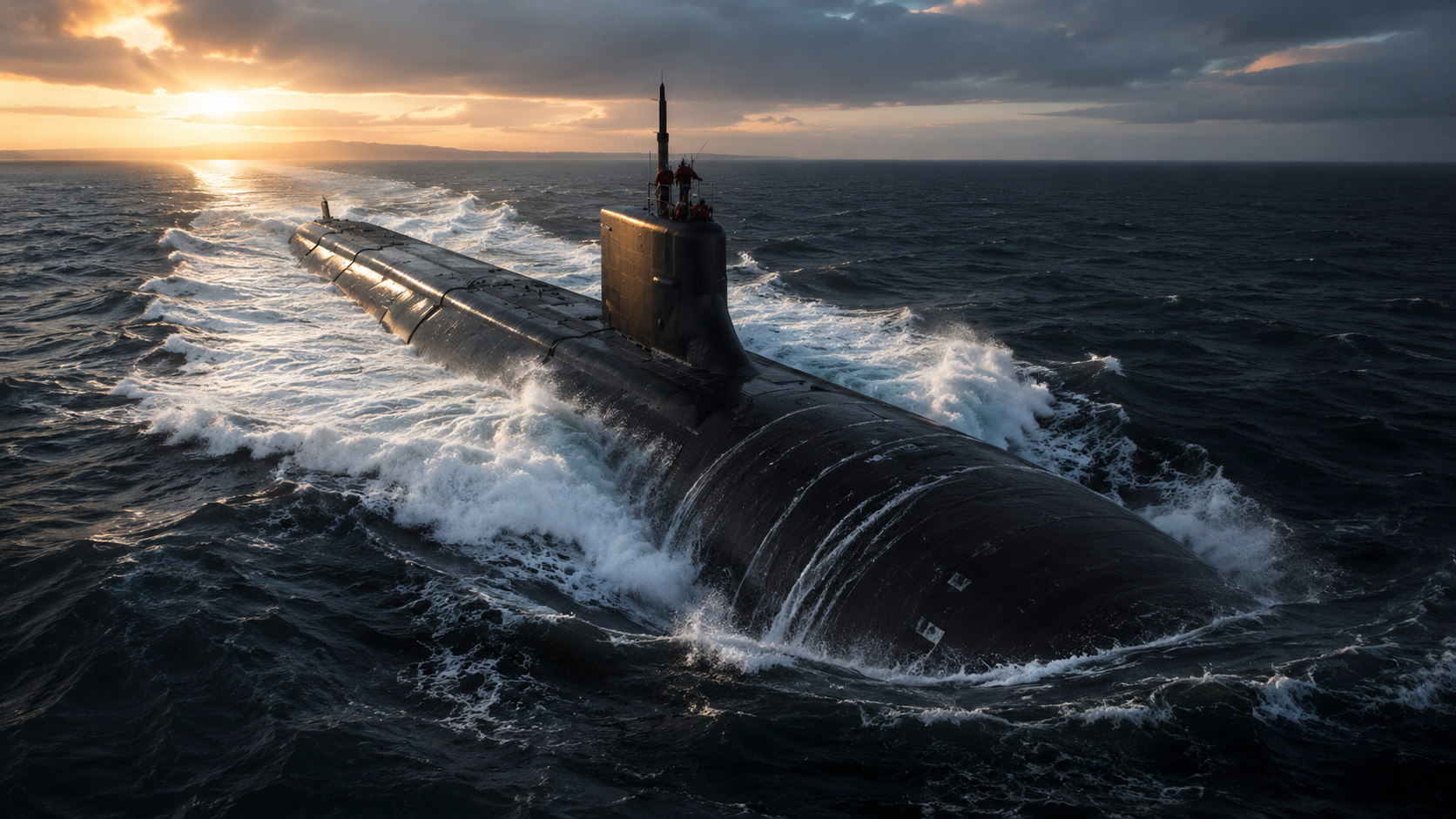
There are machines built for war.
There are machines built for deterrence.
And then there are machines built so far ahead of their time that history struggles to decide whether they were too expensive — or simply too extraordinary.
The Seawolf-class nuclear attack submarine belongs to that rare final category.
Born in the final years of the Cold War, Seawolf was designed to answer one terrifying question: what if the Soviet Union built submarines quiet enough to threaten America’s control of the deep? The U.S. Navy’s response was not modest. It did not build a cheaper submarine. It did not build a cautious upgrade. It built a predator.
Seawolf was designed to dive deeper, move faster, carry more weapons, and remain quieter than the submarines that came before it. It was built to hunt enemy submarines in the open ocean before they could ever threaten the United States or its allies.
You May Also Like
And by most measures, it succeeded.
But Seawolf had one enemy it could not outmaneuver, out-dive, or out-silence.
Its own cost.
1. The Cold War Crisis That Created Seawolf

In the late Cold War, the U.S. Navy faced a problem it could not ignore.
For decades, American submarines had enjoyed a major advantage beneath the waves. They were quieter, more advanced, and better able to track Soviet submarines. But in the 1980s, that advantage began to narrow.
The article explains that Soviet submarine noise had become a critical weakness, and that information from the Walker spy ring helped reveal how U.S. forces were able to track Soviet boats through excessive propeller noise. The Soviet Union then sought advanced Western machinery to build quieter propellers.
Soon, the Soviet Akula-class submarines appeared with dramatically improved acoustic performance. They were quieter, more dangerous, and harder to track. The underwater battlefield was changing.
The United States needed a submarine that could restore its edge.
Not a small improvement.
A revolution.
That revolution became Seawolf.
2. Built for the Deep, Not Just the Sea

Seawolf was not designed like an ordinary attack submarine. It was designed as a deep-ocean hunter.
The article notes that the class used HY-100 steel, a stronger hull material than the HY-80 steel used in earlier Los Angeles-class submarines. This gave Seawolf the strength needed for deeper operations and greater survivability under pressure.
At around 353 feet long and roughly 40 feet wide, Seawolf was wider and heavier than the Los Angeles-class boats it was meant to succeed. That extra size was not wasted. It gave the submarine room for more weapons, more advanced systems, and greater endurance.
Depth matters in submarine warfare because depth is protection. The deeper a submarine can operate, the more options it has. It can hide in difficult acoustic conditions, evade threats, and approach targets from where enemies least expect it.
Seawolf was not built merely to survive underwater.
It was built to rule there.
3. The Ghost Engine: Quietness as a Weapon

A submarine does not need to be invisible to be deadly.
It needs to be unheard.
That was the heart of Seawolf’s design. The article states that the class used a pump-jet propulsor instead of a traditional exposed propeller, helping reduce acoustic signature and improve quiet operation.
The U.S. Navy confirms that the Seawolf class has eight torpedo tubes and can carry up to 50 weapons in its torpedo room. The Navy also confirms that USS Jimmy Carter, the third boat in the class, has a 100-foot hull extension called the Multi-Mission Platform. (Navy)
That silence changed the equation.
A noisy submarine announces itself.
A quiet submarine becomes a question.
A submarine as quiet as Seawolf becomes a fear.
Because if an enemy cannot hear it, the enemy may not know it is there until the moment it attacks.
4. Armed Like an Underwater Battleship
Seawolf was not only quiet. It was heavily armed.
Earlier American attack submarines carried fewer torpedo tubes. Seawolf carried eight. That meant it could launch more weapons faster and fight with greater intensity in a submarine duel. The U.S. Navy states that Seawolf-class submarines carry up to 50 weapons in the torpedo room rather than using vertical launch tubes. (Navy)
Its possible weapons load included:
Mk 48 heavyweight torpedoes for hunting submarines and surface ships.
Tomahawk cruise missiles for long-range land attack.
Harpoon anti-ship missiles in earlier configurations.
Mines for sea-denial missions.
The Mk 48 ADCAP itself is described by the U.S. Naval Undersea Museum as the Navy’s current submarine-launched heavyweight acoustic-homing torpedo, with sophisticated sonar and digital guidance-and-control systems. (U. S. Naval Undersea Museum)
That made Seawolf more than a silent scout.
It was a deep-sea weapons platform built to destroy.
5. Eyes and Ears in the Dark
The ocean is dark. At depth, vision means almost nothing. A submarine survives by listening.
The article describes Seawolf’s advanced sonar suite, including a large bow-mounted spherical sonar array, flank arrays, towed-array sonar, and close-range systems for detecting objects such as mines.
This matters because submarine combat is often decided before a weapon is fired.
The first submarine to detect the other usually controls the fight. It can track, evade, stalk, or strike. The submarine that hears second may never get the chance to answer.
Seawolf was built to hear first.
In the deep ocean, that is power.
6. USS Jimmy Carter: The Spy Submarine
Image caption: USS Jimmy Carter, the most unusual Seawolf-class submarine, was modified for special missions.
Image source: Wikimedia Commons / USS Jimmy Carter photo.
The most mysterious Seawolf is the third and final boat: USS Jimmy Carter.
While USS Seawolf and USS Connecticut were built as elite attack submarines, Jimmy Carter became something even more unusual. The article explains that the Navy added an extra 100 feet to the hull, creating a section known as the Multi-Mission Platform, or MMP.
The U.S. Navy confirms that USS Jimmy Carter has this 100-foot hull extension. (Navy)
That extra section allows the submarine to support special missions, including the deployment and recovery of unmanned underwater vehicles, remotely operated vehicles, divers, and special operations personnel. Much of what Jimmy Carter does is classified, but its design makes one thing clear: it was built for missions ordinary submarines cannot perform.
If Seawolf is a hunter, Jimmy Carter is a ghost with tools.
It does not only patrol the deep.
It works there.
7. The One Enemy Seawolf Could Not Defeat
Seawolf was a triumph of engineering.
But it arrived at the wrong historical moment.
The Soviet Union collapsed in 1991. The massive Cold War threat that justified Seawolf’s extreme performance suddenly looked less urgent. The Navy still needed advanced submarines, but it also needed affordability, flexibility, and numbers.
The original vision was far larger. But the program was cut down to only three boats. The U.S. Navy confirms that the force includes three Seawolf-class submarines, with USS Seawolf commissioned in 1997 and USS Jimmy Carter as the third ship of the class. (Navy)
The article you provided states that the broader program was estimated at about $33 billion for twelve submarines, before being reduced to three boats costing about $7.3 billion.
That is the irony of Seawolf.
It was not defeated by a Soviet torpedo.
It was not defeated by a rival submarine.
It was not defeated by technology.
It was defeated by the price of perfection.
8. Why Seawolf Still Matters Today
After Seawolf, the U.S. Navy turned to the Virginia-class submarine: more affordable, easier to build in larger numbers, and designed for a wider range of post-Cold War missions.
But that does not make Seawolf obsolete.
It makes Seawolf rare.
The class remains one of the most capable attack submarine designs ever placed into service. Its combination of quietness, speed, deep-diving capability, heavy weapons load, and special-mission potential still gives the U.S. Navy options few countries can match.
And that may be Seawolf’s greatest lesson.
Sometimes the most powerful weapon is not the one built in the largest number. Sometimes it is the one built when engineers are told to push performance as far as possible, even if the final result is too expensive to repeat.
Seawolf is not just a submarine.
It is a reminder of what happens when a nation chooses maximum capability over compromise.
Conclusion: The Legend Beneath the Waves
The Seawolf-class submarine is one of the most fascinating military machines ever built because it represents both victory and warning.
It was built to defeat the Soviet Union’s best submarines.
But the Soviet Union collapsed before the fleet could fully arrive.
It was designed to become the future of American undersea warfare.
But its cost made that future impossible at scale.
It was so advanced that only three were built.
Yet those three remain among the most respected and feared attack submarines in the world.
Seawolf was not a failure.
It was a masterpiece built for a world that disappeared.
Its story is not simply about steel, reactors, torpedoes, sonar, or stealth. It is about ambition. It is about the price of dominance. It is about the thin line between building the best weapon possible and building the best weapon a nation can afford.
The Seawolf’s greatest enemy was never another submarine.
It was cost.
And cost is the only thing that stopped America from building more.