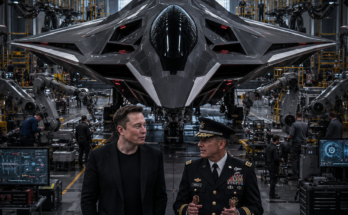
Imagine a black, silent aircraft cutting across the edge of space—faster than missiles, nearly invisible to radar, and powerful enough to change the balance of global power overnight. Online stories call it Elon Musk’s “X-1 UFO fighter jet,” a machine so advanced it seems pulled from science fiction: hypersonic speed, impossible stealth, microwave weapons, and the ability to dominate the skies from 100,000 feet.
It is a thrilling idea.
But there is one problem: there is no credible evidence that this aircraft exists.
That does not make the story meaningless. In fact, the viral myth of Musk’s X-1 fighter jet reveals something even more important: the world is already entering an age where private technology companies, hypersonic aircraft, satellite internet, artificial intelligence, and advanced weapons may reshape war faster than governments can regulate it.
You May Also Like



The X-1 may be fiction. The future it points toward is very real.
A Viral Aircraft Built From Fear and Imagination
The claim spread because it feels believable. Elon Musk is already associated with rockets, reusable spacecraft, Starlink satellites, electric vehicles, artificial intelligence, and ambitious engineering. So when online articles and videos describe a SpaceX-built “UFO fighter jet,” many readers are ready to believe it.
But fact-checking organizations have found no verified announcement from Musk, SpaceX, Tesla, the U.S. military, or major aerospace agencies confirming the X-1 jet. PolitiFact reported that there were no credible reports of Musk unveiling such a fighter jet, and Lead Stories found no evidence that Musk or SpaceX had revealed a UFO-like aircraft. (PolitiFact)
That matters because powerful writing should not only inspire—it should protect readers from being misled.
The better story is not “Elon Musk built a secret UFO jet.” The better story is this: why are people so ready to believe that one private company could create a weapon capable of changing world history?
Why the X-1 Myth Feels So Real

The X-1 rumor borrows from real aerospace breakthroughs.
NASA’s X-43A, for example, was a genuine hypersonic research aircraft designed to explore scramjet technology. It showed that air-breathing hypersonic flight was not just fantasy, but a serious field of research.
The legendary SR-71 Blackbird also proved that extreme speed and altitude could transform reconnaissance. Long before today’s drone wars and satellite networks, the SR-71 became a symbol of what happens when engineering reaches beyond ordinary limits.
So when people hear about a futuristic aircraft flying at several times the speed of sound, they are not reacting to pure fantasy. They are reacting to a century of real aviation progress—from supersonic jets to stealth bombers to experimental hypersonic vehicles.
The myth works because the ingredients are real. The specific aircraft is not.
The Real Revolution: Private Companies Are Entering the Battlefield
The most important part of the X-1 story is not the fictional fighter jet. It is the rising power of private technology in modern conflict.
Starlink proved this dramatically in Ukraine. After Russia’s invasion disrupted communications, Starlink terminals helped restore internet connectivity for Ukrainian users, including civilians and military units. USAID said in 2022 that it worked with SpaceX to provide thousands of Starlink terminals to Ukraine. (euronews)
This changed how people think about war. A private satellite network became more than a commercial service—it became a strategic lifeline.
But that power also created new risks. SpaceX later limited some Ukrainian military uses of Starlink, saying the system was not intended to be weaponized. (arstechnica.com)
That is the real future-war dilemma: when a private company controls technology that armies depend on, who decides how it can be used? The company? The government? The military? International law?
The X-1 jet may be fiction, but the problem it represents is already here.
Hypersonic Flight: The Race That Actually Exists

A real hypersonic arms race is underway. Hypersonic systems—vehicles or weapons traveling above Mach 5—are attractive because they can move extremely fast, maneuver unpredictably, and compress decision-making time for defenders.
This is why the fictional X-1 sounds so frightening. A machine that can cross continents quickly, evade defenses, and strike before enemies can respond would not simply be a new aircraft. It would be a new kind of pressure on global stability.
The danger is not only speed. It is uncertainty.
When a hypersonic object appears on radar, leaders may have only minutes to decide whether it is surveillance, a conventional strike, or a nuclear threat. In a crisis, that uncertainty could become catastrophic.
The Dream and Danger of Invisible Weapons
The X-1 story also reflects another modern obsession: invisibility.
Stealth technology has long promised the ability to see without being seen, strike without warning, and survive where older aircraft cannot. In military terms, that is power. In political terms, it is destabilizing.
A weapon that seems impossible to detect can make nations feel vulnerable. Vulnerable nations often respond by building more weapons, more sensors, more missiles, and more aggressive defense policies. That is how deterrence can turn into an arms race.
The promise of futuristic aircraft is security. The risk is paranoia.
Microwave Weapons and the Question of Control
The original X-1 story describes a microwave weapon capable of disabling electronics or dispersing crowds. Directed-energy systems are a real area of defense research, but the article’s specific claims about the X-1 weapon are not verified.
Still, the concept raises a serious ethical question: what happens when weapons become less visible, less explosive, and easier to deny?
A missile strike is obvious. A microwave attack on electronics may be harder to prove. A non-lethal weapon may sound humane, but it can still be abused. Future warfare may not always look like fire and smoke. It may look like silence: disabled communications, blinded sensors, frozen drones, and cities cut off from information.
That kind of power demands oversight before it becomes normal.
The Civilian Future: Faster Travel or Faster Militarization?
The dream behind hypersonic flight is not only military. Many people imagine a future where passengers fly from New York to Tokyo in under two hours, where emergency supplies cross oceans in minutes, and where aerospace innovation transforms medicine, energy, and communications.
That hopeful vision matters.
But history shows that breakthrough technologies often move first through military channels before reaching civilian life. The internet, GPS, jet engines, satellites, and drones all have military roots or military acceleration. Hypersonic technology may follow the same path.
The question is whether humanity can turn speed into connection before it turns speed into fear.
Why We Should Care About a Jet That Does Not Exist
The “Elon Musk X-1 UFO fighter jet” is not a confirmed aircraft. But it is a powerful symbol.
It symbolizes our fascination with genius inventors.
It symbolizes our fear of secret weapons.
It symbolizes the growing role of private companies in war.
It symbolizes a world where technology moves faster than law, diplomacy, and public understanding.
The real issue is not whether Musk has built a UFO-like fighter jet. The real issue is whether society is ready for the technologies that could make such a machine possible.
Because one day, a hypersonic aircraft with advanced autonomy, satellite connectivity, stealth design, and directed-energy systems may no longer be a rumor.
And when that day comes, the world will need more than excitement. It will need rules. It will need accountability. It will need leaders wise enough to understand that the most dangerous weapon is not always the one that destroys the most.
Sometimes, the most dangerous weapon is the one that makes war feel easy.
Conclusion: The Future Is Coming—But Truth Must Arrive First

The X-1 fighter jet story captures the imagination because it sits at the edge of possibility. It feels like tomorrow’s headline: Elon Musk, SpaceX, hypersonic speed, stealth, microwave weapons, global power.
But powerful stories must be built on truth.
There is no verified X-1 UFO fighter jet from Elon Musk or SpaceX. What does exist is a world racing toward hypersonic flight, AI-driven warfare, private satellite networks, and technologies that could change conflict forever.
So the real headline is not that Musk has built the future of war.
The real headline is that the future of war is already being built—and humanity must decide whether it will be controlled by wisdom, or unleashed by ambition.