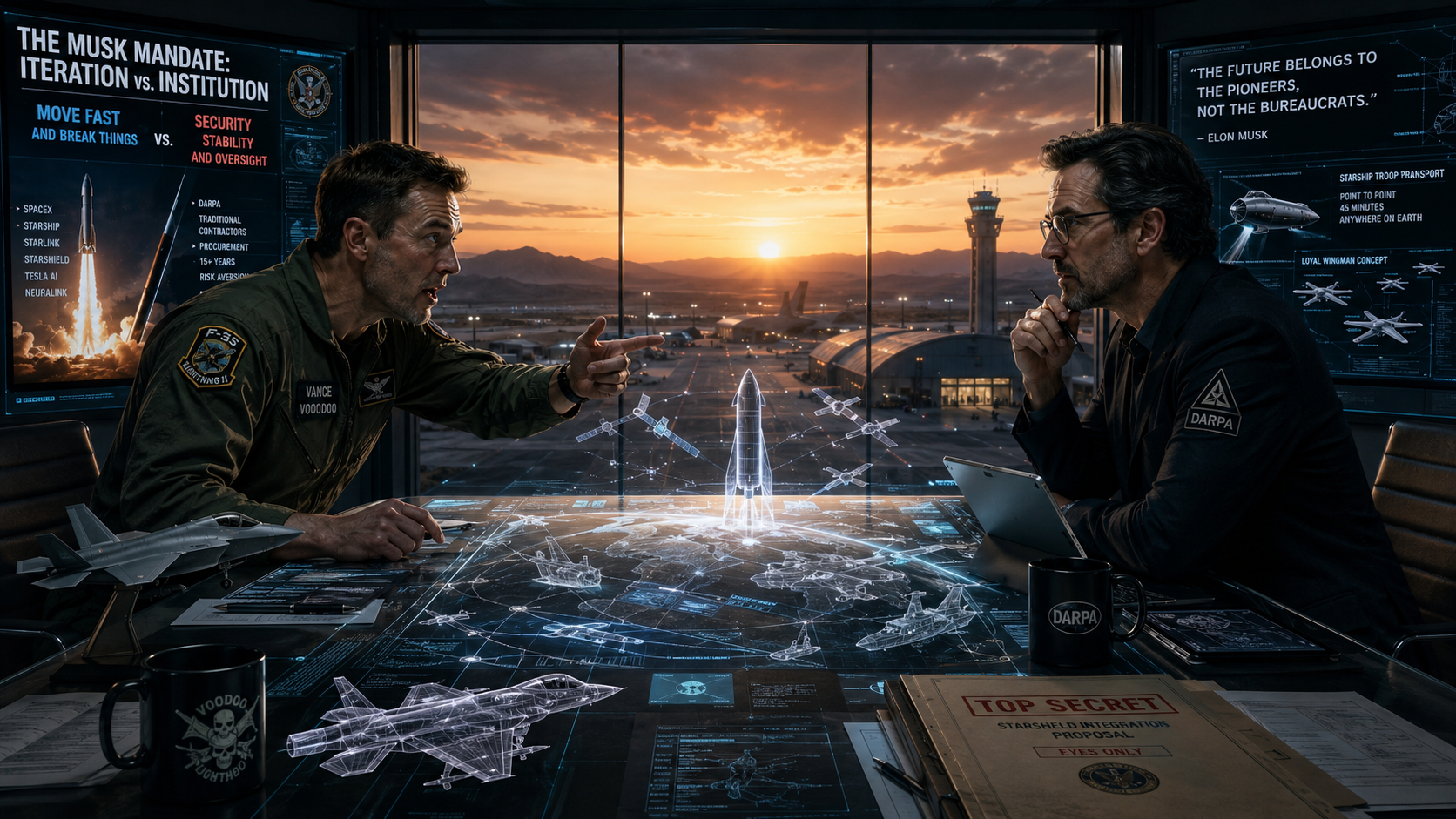
On one side of the table sat COLONEL ELIAS “VOODOO” VANCE, a veteran F-35 test pilot and aerospace engineer whose career had been built on pushing aircraft beyond their design limits. He carried the confidence of someone who had personally fought gravity and won—at least temporarily.
Across from him sat DR. ARIS THALASSA, lead scientist at DARPA and former Navy aviator. Where Vance embodied instinct and speed, Thalassa embodied restraint and systems discipline. Her entire career had been built around one principle: if a system cannot be trusted under pressure, it cannot be deployed at all.
Between them, projected in mid-air by a classified holographic interface, hovered a rotating lattice of global military infrastructure—satellites, drones, hypersonic vectors, and AI-driven command nodes.
The subject of their disagreement was not abstract.
You May Also Like
It was the future of war itself—and the role of Elon Musk within it.
DR. THALASSA: (tapping her stylus against a glowing data slate)
Elias, what you’re proposing is not just integration—it’s dependency. You’re asking the Department of Defense to embed critical national security systems into an ecosystem that updates itself like consumer software.
She rotated the hologram. A section of orbital infrastructure highlighted in red.
If a Starshield satellite experiences a faulty over-the-air update, there is no “rollback” button in a live combat theater. A communications blackout over a carrier strike group is not a software inconvenience. It is operational blindness. It is vulnerability at scale.
She paused.
And vulnerability is not something a superpower can outsource.
COL. VANCE: (leaning forward, unbothered)
You’re describing risk as if it’s optional. It isn’t.
He gestured at the hologram, expanding a segment showing launch systems and orbital deployment networks.
The current defense procurement model is the risk. Fifteen years to design a system that will be obsolete by the time it is fielded. Meanwhile, SpaceX builds orbital systems, tests them, destroys them, learns from failure, and rebuilds within months.
That is not recklessness, Aris. That is accelerated survivability.
He stepped closer.
We are not in a stable environment anymore. We are in an adaptive one. And adaptation requires iteration speed.
DR. THALASSA:
Iteration speed without governance is instability disguised as innovation.
Her voice remained calm, but the weight behind it sharpened.
You keep referencing SpaceX as if it is equivalent to a military command structure. It is not. It is a commercial entity optimized for cost reduction and engineering efficiency—not battlefield survivability under adversarial electronic warfare conditions.
She brought up a simulation.
Now imagine a contested orbit. Jamming. Spoofing. Kinetic anti-satellite threats. In that environment, dependency on proprietary infrastructure controlled outside government command authority becomes a strategic liability.
A pause.
Not a strength.
COL. VANCE: (quietly, but firmly)
Then we bring him inside the architecture.
Not as a vendor. Not as an external contractor.
As a force multiplier embedded in system design.
He pointed toward the expanding orbital grid.
Look at what he has already done: reusable orbital boosters, mass satellite deployment, global low-latency communications infrastructure. These are not isolated achievements—they are components of a planetary logistics backbone.
And logistics wins wars more often than weapons do.
DR. THALASSA:
Logistics also fails wars when it becomes over-centralized.
She adjusted the display. Now multiple systems highlighted shared dependencies.
What you are proposing increases efficiency at the cost of systemic fragility. If one node fails—or if access is restricted due to corporate, legal, or geopolitical decisions—the cascade effect could cripple multiple layers of defense capability simultaneously.
Her gaze hardened slightly.
Tell me, Elias—can national security afford terms of service?
COL. VANCE: (a faint smile)
That’s the wrong question.
The correct question is: can national security afford stagnation?
He activated a new layer of the hologram—showing autonomous drone formations, hypersonic response loops, and AI-assisted command systems.
We are entering an era where decision cycles will be measured in milliseconds. Human command chains alone will not be sufficient. AI-assisted systems, real-time orbital relay networks, and autonomous aerial coordination will define superiority.
And right now, the only ecosystem operating at that speed is being built outside the Pentagon.
By innovators like Elon Musk.
DR. THALASSA: (coldly)
Speed is not superiority. Stability is.
She leaned forward slightly.
A system that reacts faster but breaks under pressure is worse than a slower system that holds. Military history is full of examples where technologically advanced forces lost to structurally resilient ones.
She tapped the table.
You are confusing engineering velocity with combat reliability.
COL. VANCE:
And you are confusing caution with control.
He straightened.
Let me be direct. The adversaries we are preparing for are not waiting for procurement committees. They are building AI-enabled drone swarms, hypersonic strike chains, and space-based surveillance networks right now.
If we do not integrate the fastest innovation ecosystem available, we are not maintaining balance—we are losing it.
DR. THALASSA:
And if we integrate without sovereignty safeguards, we risk losing something more important than speed.
Control of escalation.
She let the phrase settle.
Imagine autonomous systems making engagement decisions based on training data shaped outside military doctrine. Imagine orbital communication networks prioritizing commercial uptime over defense continuity. Imagine AI models optimized for efficiency, not restraint.
That is not warfare advantage.
That is strategic drift.
COL. VANCE: (lowering his voice)
Then we define the boundaries.
We don’t reject the technology. We discipline it.
He pointed at the layered architecture again.
Modular systems. Auditable AI layers. Military override authority at every critical node. Private innovation feeding into sovereign command structure—not replacing it.
That is how you harness exponential capability without losing control of direction.
DR. THALASSA:
In theory, yes.
She looked at him directly now.
But in practice, systems evolve beyond their original containment assumptions. Especially systems that scale as fast as the ones you are describing.
She paused.
The question is not whether we can design control mechanisms.
The question is whether they will still hold once the system becomes globally embedded.
The room fell silent.
Outside, a distant experimental aircraft roared across the desert sky, breaking the sound barrier with a controlled thunder that shook the glass faintly.
Inside, the hologram continued rotating—indifferent to human disagreement.
COL. VANCE: (after a long pause)
Let me ask you something, Aris.
If we had rejected jet propulsion because piston engines were more predictable… where would air power be today?
He didn’t wait for an answer.
Every transformative leap in military capability has come from embracing uncertainty before it became comfortable.
DR. THALASSA:
And every catastrophic failure has come from embracing uncertainty without restraint.
She softened slightly, but only slightly.
We do not reject innovation. We regulate its integration into systems where failure is not an acceptable outcome.
COL. VANCE:
Then we are not arguing about Musk.
We are arguing about whether the United States should evolve at the speed of technological reality—or the speed of institutional comfort.
DR. THALASSA:
No.
She corrected him quietly.
We are arguing about whether the United States can maintain technological leadership without sacrificing systemic sovereignty.
A pause.
Those are not the same question.
The hologram dimmed slightly as if reacting to the unresolved tension.
COL. VANCE: (final tone, firm but reflective)
Then here is the truth neither of us can escape.
The future military will not be defined by platforms.
It will be defined by ecosystems.
And ecosystems evolve faster than institutions.
DR. THALASSA: (softly, almost to herself)
And ecosystems… do not naturally respect command boundaries.
For a long moment, neither spoke.
The desert outside darkened into night, the Mojave transforming into a vast shadowed landscape beneath the stars. Somewhere beyond the base, rockets being tested for future missions ignited briefly, illuminating the horizon like artificial dawns.
Inside the room, the hologram stabilized into a final image:
A fully integrated global defense network—orbital, aerial, terrestrial, autonomous, human-guided, machine-accelerated.
Powerful.
Efficient.
And structurally dependent on design choices not yet fully resolved.
COL. VANCE: (quietly)
We are no longer deciding whether to involve innovators like him.
We are deciding whether we shape the system they are already building.
DR. THALASSA: (after a long silence)
Or whether we ensure the system remains something we can still govern when it no longer looks like what we designed.
The briefing ended without resolution.
Because neither position had truly won.
Instead, something more important had emerged:
A recognition that the next era of military power would not be defined by who built the technology—
but by who could still control it when it stopped behaving like technology and started behaving like infrastructure for civilization itself.