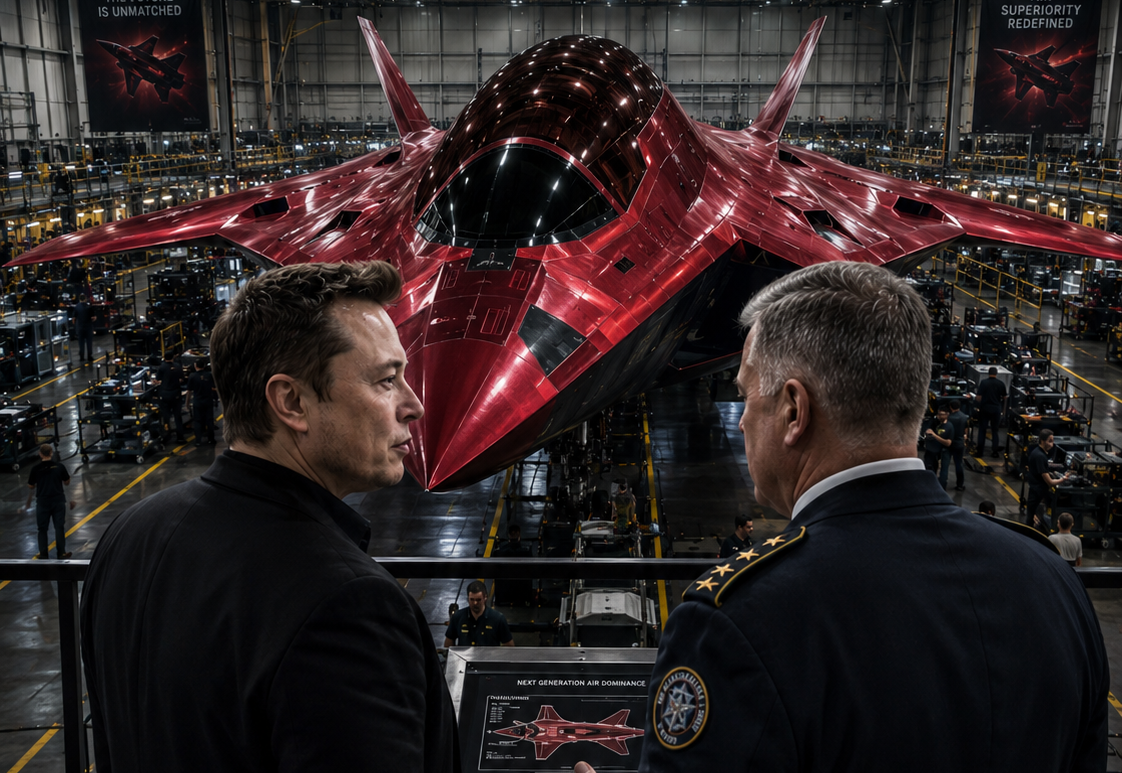
The future of air combat is not being shaped only in military hangars or Pentagon war rooms—but also in Silicon Valley, orbital satellites, and autonomous AI labs.
And while Elon Musk is not building fighter jets, his influence is quietly reshaping how the world thinks about them.


You May Also Like



Musk Is Not Building Jets—But He Is Changing the Battlefield
Contrary to popular belief, Elon Musk is not involved in designing fighter jets like the F-22 or F-35. Those aircraft are developed by defense contractors such as Lockheed Martin and Boeing.
But Musk has become one of the most influential voices shaping modern military thinking.
His core idea is disruptive: future wars will not be dominated by piloted fighter jets—but by autonomous systems, AI, and drone swarms.
The Drone Revolution Is Already Here


Modern warfare is already shifting toward unmanned systems. Drones are cheaper, faster to produce, and capable of entering high-risk zones without risking human pilots.
In Musk’s vision, future air combat could involve thousands of coordinated autonomous drones overwhelming traditional defenses through sheer scale and intelligence.
This idea challenges decades of military doctrine built around expensive, highly trained pilots flying multi-billion-dollar aircraft.
Why Fighter Jets Are Still Not Going Away


Despite the rise of drones, military experts argue that fighter jets are far from obsolete.
Aircraft like the F-22 Raptor and F-35 Lightning II still offer capabilities drones cannot fully match:
- High-speed air dominance
- Complex human decision-making in combat
- Long-range stealth strike missions
- Advanced electronic warfare flexibility
The reality is not replacement—but evolution.
Space, AI, and the New Military Backbone


One of Musk’s most direct impacts on modern warfare comes through SpaceX.
Its satellite network, Starlink, has already shown how space-based communications can reshape battlefield coordination, enabling real-time data flow even in contested environments.
This has pushed militaries worldwide to rethink air combat as part of a larger system involving:
- Space-based communication grids
- AI-assisted targeting systems
- Networked battlefield intelligence
- Autonomous reconnaissance fleets
The Future: Not Jets vs Drones—But Both Together
The next generation of air power will not be a simple replacement of fighter jets. Instead, it will be a hybrid system where humans, machines, and AI operate together.
Future air dominance may look like this:
- Piloted stealth aircraft acting as command hubs
- AI-controlled drone wingmen
- Satellite-linked real-time battlefield networks
- Fully autonomous reconnaissance and strike systems
In this model, the fighter pilot does not disappear—but becomes a commander of an intelligent machine network.
Conclusion: A New Era of Air Warfare
Elon Musk is not building fighter jets—but his ideas, companies, and technologies are accelerating a transformation already underway.
Air power is no longer just about speed and firepower. It is becoming about data, autonomy, and connectivity.
The sky of the future will not belong to a single aircraft.
It will belong to networks.
Best Title Options (Most Powerful)
- Elon Musk and the End of Traditional Air Combat: The Rise of AI Warfare
- Fighter Jets vs Drone Swarms: How Elon Musk Is Shaping the Future of War
- The Future of Air Power: Why Jets Alone May No Longer Be Enough
- Inside the Drone Revolution: Elon Musk and the Reinvention of Military Aviation
- From Fighter Jets to AI Swarms: The New Era of Air Dominance