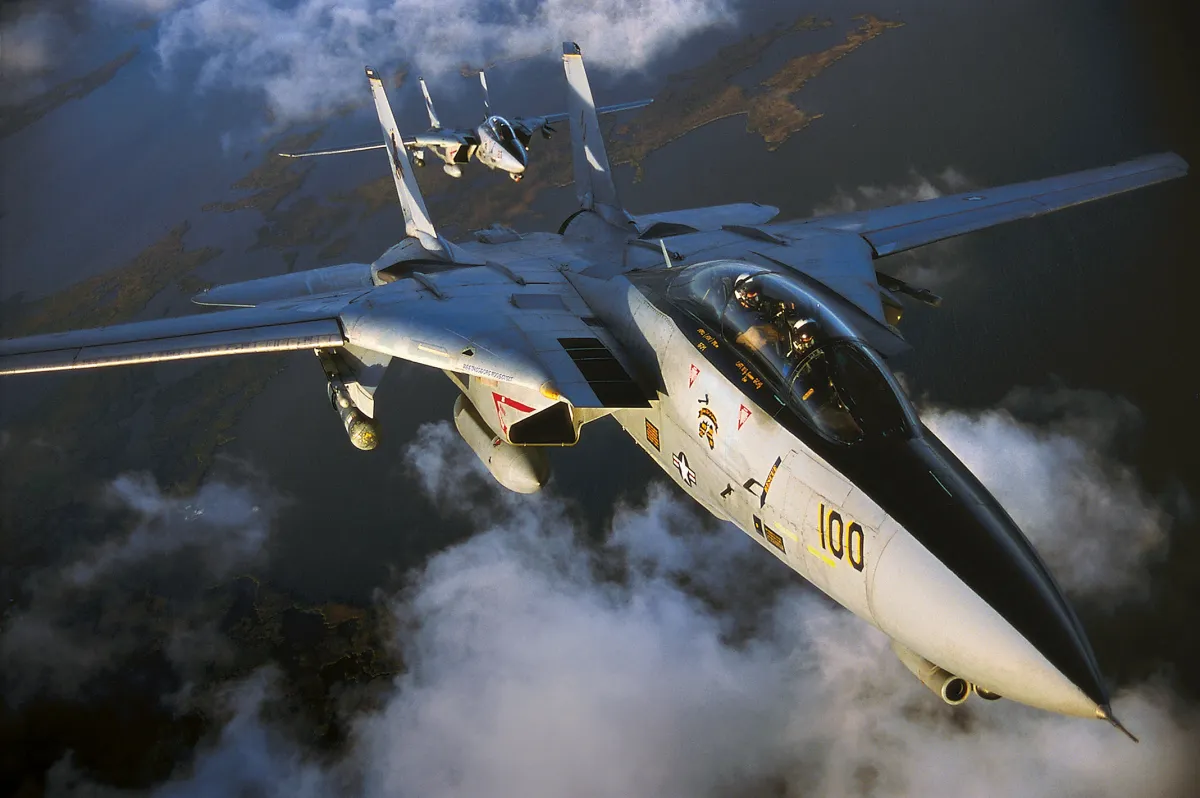
The F-14 Tomcat Refuses To Fade Away: Why America Still Can’t Let Go Of Its Most Legendary Fighter
For nearly two decades, the Grumman F-14 Tomcat was supposed to be gone forever.
Retired.
Buried in the Arizona desert.
Cut apart piece by piece in silence.
The mighty fighter that once ruled the skies from the decks of American aircraft carriers had become a ghost of the Cold War — a relic from another era of military aviation.
Or at least that was the plan.
You May Also Like


Now, against all expectations, the legend may fly again.
In a remarkable move driven by nostalgia, history, military heritage, and renewed fascination with one of America’s most iconic warplanes, lawmakers have passed the “Maverick Act,” legislation that could bring several retired F-14 Tomcats out of the graveyard and possibly restore one to flying condition.
For aviation enthusiasts, veterans, and generations inspired by the roar of afterburners in the movie Top Gun, the proposal represents far more than restoring an old aircraft.
It represents the return of a legend.
Because the F-14 Tomcat was never just a fighter jet.
It was an era.
A symbol.
A machine that defined American airpower, Hollywood heroism, and naval aviation supremacy all at once.
And even in retirement, the Tomcat still captures imaginations in ways few military aircraft ever have.
The Fighter Jet That Became An American Icon
Some aircraft become famous.
The F-14 became immortal.
When Grumman developed the Tomcat during the Cold War, the mission was brutally simple: protect American aircraft carriers from Soviet bombers and missiles before they could destroy the fleet.
The result was unlike anything the Navy had ever flown before.
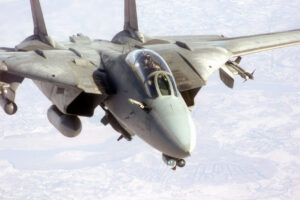
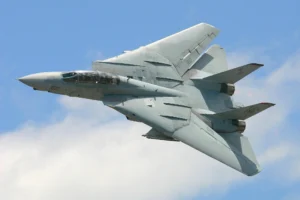
The Tomcat was massive, fast, aggressive, and technologically revolutionary for its time. Its variable-sweep wings allowed it to transform shape during flight — spreading wide for low-speed maneuverability and folding back like a predator preparing to strike at supersonic speed.
Powered by twin engines and equipped with the long-range AIM-54 Phoenix missile system, the aircraft could engage enemy targets from extraordinary distances. At full speed, it could exceed Mach 2 and dominate enormous sections of airspace around carrier strike groups.
But raw performance alone did not make the F-14 legendary.
It was the way the aircraft looked.
The Tomcat looked alive.
Its sweeping wings, twin tails, and predatory profile gave it a personality unlike almost any fighter before or since. Pilots respected it. Rival nations feared it. Aviation fans fell in love with it.
Then Hollywood transformed it into something even bigger.
How “Top Gun” Turned The F-14 Into A Global Phenomenon
In 1986, Tom Cruise starred in Top Gun, forever changing military aviation culture.
The movie did not simply entertain audiences.
It created a myth.
For millions around the world, the F-14 Tomcat became the face of American fighter aviation. The image of Tomcats launching from aircraft carriers at sunset, roaring across the ocean at supersonic speeds, and engaging in dramatic dogfights became embedded in global pop culture.
The impact went far beyond cinema.
The Navy later acknowledged that Top Gun significantly boosted pilot recruitment during the late 1980s and early 1990s. Young Americans who watched Maverick and Goose fly the Tomcat suddenly dreamed of becoming naval aviators themselves.
The aircraft became inseparable from the American idea of speed, courage, and aerial dominance.
Decades later, the legacy remained so powerful that the Tomcat returned triumphantly in Top Gun: Maverick, despite the aircraft having been retired years earlier.
That decision was not accidental.
The filmmakers understood something important:
No modern fighter — not even stealth aircraft like the Lockheed Martin F-35 Lightning II — carries the same emotional weight as the Tomcat.
The F-14 represents a time when fighter jets felt larger than life.
And audiences still respond to that magic.
Why America Destroyed Most Of The F-14 Fleet
Despite its legendary status, the Tomcat faced a grim fate after retirement.
The Navy officially retired the aircraft in 2006, replacing it primarily with the Boeing F/A-18E/F Super Hornet.
But unlike many retired military aircraft, the F-14 was not simply placed into storage.
Most were deliberately destroyed.
The reason involved one nation:
Iran.
Before the 1979 Iranian Revolution, the United States had sold 80 F-14 Tomcats to Iran under the rule of Shah Mohammad Reza Pahlavi. After the revolution transformed Iran into an adversarial Islamic Republic, the existence of those aircraft became a long-term security concern.
American intelligence reports later suggested Iran was attempting to acquire spare Tomcat parts through black markets and surplus networks to keep its aging fleet operational.
The response from Washington was drastic.
Retired American F-14s were systematically dismantled so their components could never be smuggled overseas.
One by one, the world’s most famous fighter jets were cut apart in the Arizona desert.
By 2024, only eight remained at the famous “Boneyard” — the massive aircraft storage facility officially known as the 309th Aerospace Maintenance and Regeneration Group at Davis–Monthan Air Force Base.
Compared to hundreds of stored F-15s and other aircraft, the surviving Tomcats had become extraordinarily rare.
That rarity only increased their legendary status.
The Maverick Act: Bringing Legends Back From The Desert
Now, lawmakers want to rescue some of the final surviving Tomcats before they disappear forever.
The recently passed “Maverick Act,” sponsored by Tim Sheehy and introduced in the House by Abraham Hamadeh, would transfer three retired F-14D Tomcats to the U.S. Space and Rocket Center for preservation.
But one line inside the bill electrified aviation enthusiasts around the world.
The legislation directs the Navy to provide enough spare parts to make at least one Tomcat potentially “flyable.”
That single word changed everything.
Because preserving an aircraft inside a museum is one thing.
Hearing an F-14 Tomcat roar back into the skies again would be something entirely different.
For aviation historians, the idea feels almost impossible.
The Tomcat has been out of service for nearly twenty years. Parts are scarce. Maintenance is enormously expensive. The aircraft itself was famously difficult to maintain even during active Navy service.
Pilots once joked that the Tomcat demanded endless repairs just to stay operational.
Yet despite all of those obstacles, the dream persists.
Because some aircraft transcend practicality.
Two Of These Tomcats Already Made History
What makes the Maverick Act even more remarkable is that some of the aircraft selected for preservation are not ordinary Tomcats.
They are combat veterans tied directly to naval aviation history.
One of the jets reportedly participated in the famous 1989 dogfight over the Mediterranean involving Libyan MiG-23 fighters.
During that confrontation, two F-14s successfully shot down the Libyan aircraft after hostile maneuvers escalated into combat — one of the rare real-world air-to-air victories scored by the Tomcat.
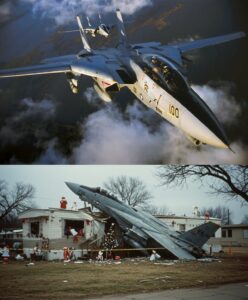
Another selected aircraft became famous after an astonishing mid-flight accident near Naval Air Station Fallon.
During a familiarization flight, a Navy cruiser captain accidentally triggered his ejection seat while seated in the rear cockpit. The sudden ejection tore away the canopy, effectively transforming the Tomcat into an open-air fighter jet mid-flight.
Despite the chaos, the pilot safely landed the aircraft.
The story became part of naval aviation folklore — the kind of unbelievable event that only seems possible in military aviation history.
These surviving aircraft are not just machines.
They are witnesses to history.
Why The F-14 Still Fascinates The World
The Tomcat’s continuing popularity reveals something deeper about military technology and human imagination.
Modern fighter jets are unquestionably more advanced.
The Lockheed Martin F-22 Raptor and F-35 possess stealth capabilities, sensor fusion, advanced networking, and combat systems the Tomcat could never match.
Future sixth-generation aircraft may push warfare even further into the realms of artificial intelligence and autonomous systems.
Yet none of those aircraft inspire the same emotional response.
Why?
Because the F-14 emerged during the final age of romantic fighter aviation.
Pilots still fought within visual range. Aircraft had distinctive personalities. Naval aviation carried an aura of raw danger and heroism. Fighter pilots became cultural icons rather than merely operators inside digital systems.
The Tomcat symbolized that world perfectly.
It was powerful, unpredictable, beautiful, and dangerous.
It represented human skill at the edge of technological possibility.
Even today, younger generations who never saw the aircraft in active service continue discovering it through movies, documentaries, simulators, and online aviation communities.
The Tomcat remains timeless because it embodies the emotional side of flight itself.
Could The Tomcat Truly Fly Again?
Technically, yes.
Practically, it would be extraordinarily difficult.
Restoring a combat jet to flight status after decades in storage requires immense funding, engineering expertise, replacement parts, and safety certifications. The aircraft’s engines, hydraulics, electronics, and structural components would require extensive inspection and rebuilding.
And because the Tomcat no longer serves in the U.S. military, the infrastructure that once supported it largely vanished years ago.
But history has shown that determined aviation communities can achieve astonishing restorations.
Historic aircraft from World War II, the Korean War, and the Vietnam era have all returned to the skies through museum and private restoration efforts.
The emotional power behind the Tomcat may prove strong enough to drive similar efforts.
And if an F-14 ever does fly again, it will not merely be another airshow attraction.
It will feel like resurrecting an entire generation of naval aviation history.
More Than A Fighter Jet

The F-14 Tomcat’s story is ultimately about more than military hardware.
It is about memory.
About generations inspired by flight.
About pilots who trusted the aircraft with their lives.
About sailors launching into darkness from carrier decks in the middle of the ocean.
About Cold War fears, Hollywood dreams, and real combat missions merging into one symbol.
Most military machines eventually disappear into history.
The Tomcat refused.
Even after retirement.
Even after dismantling.
Even after nearly vanishing forever in the Arizona desert.
Now, decades later, America is once again talking about making the F-14 fly.
Not because it is the most modern fighter.
Not because it is the cheapest.
Not because it is strategically necessary.
But because some legends become too powerful to bury.
And somewhere deep in the imagination of aviation fans around the world, the Tomcat is still climbing off the deck of an aircraft carrier at sunset — afterburners blazing, wings sweeping back, racing toward the horizon at full speed.