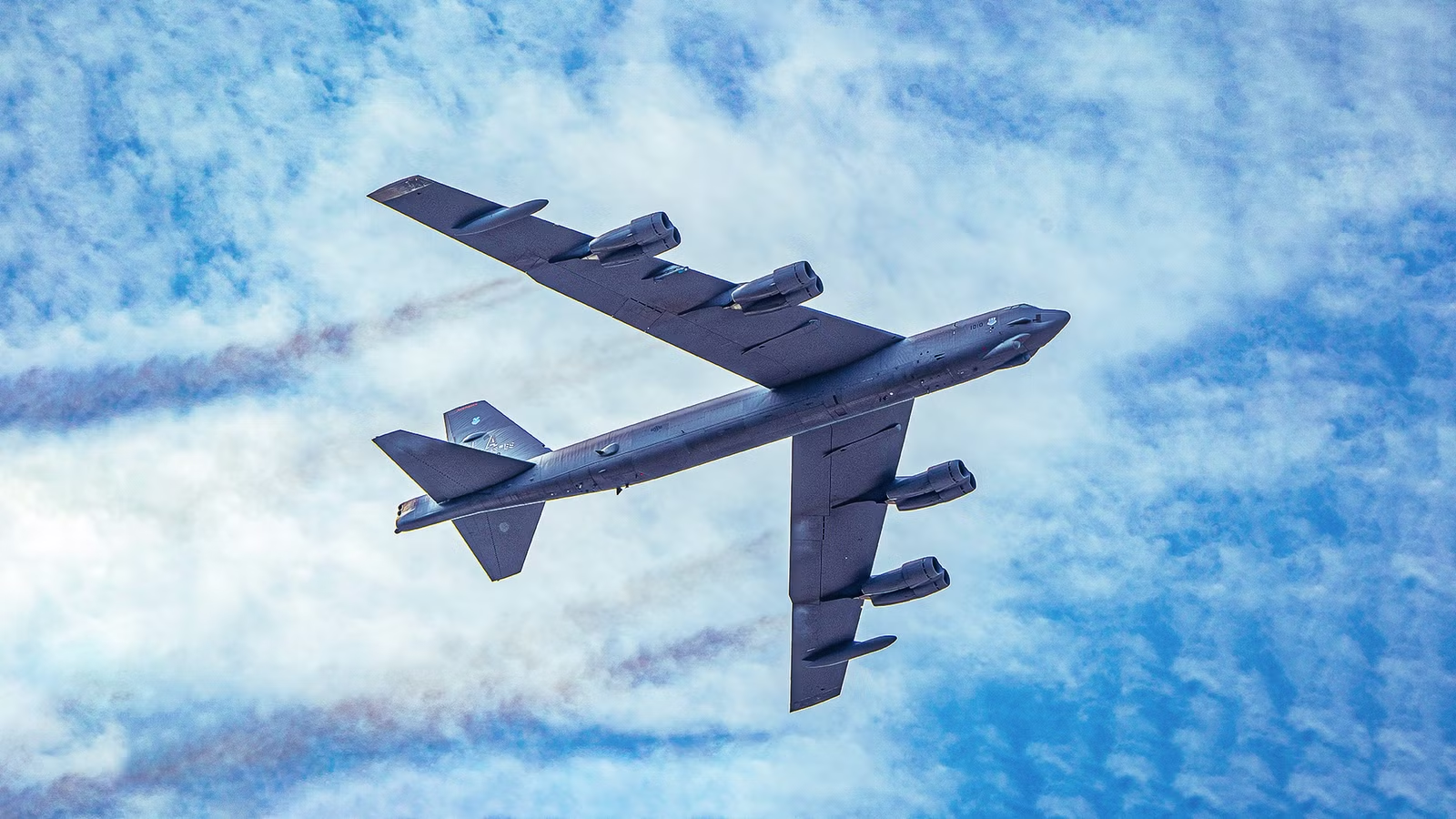
More than seventy years after its first flight, the Boeing B-52 Stratofortress is still one of the most feared aircraft on Earth.
That alone is astonishing.
The world has changed dramatically since the 1950s. Entire empires have collapsed. Generations of fighter jets have come and gone. Warfare has evolved from dogfights and unguided bombs to stealth aircraft, artificial intelligence, hypersonic missiles, and space-based surveillance.
Yet through every era — from the Cold War to the wars in the Middle East, and now into the age of great-power competition — the B-52 remains standing.
You May Also Like



Not because America cannot replace it.
But because no aircraft has truly replaced what it does best.
The B-52 is not simply an old bomber surviving on nostalgia. It is a living example of one of the greatest truths in military history:
When a machine is built with the right design, the right purpose, and the ability to adapt, it can outlive generations.
And in 2026, the Stratofortress is still proving exactly that.
1. The B-52 Carries More Firepower Than Almost Anything In The Sky
The first reason the B-52 still dominates is brutally simple:
It carries an enormous amount of weapons.
The Boeing B-52 Stratofortress can haul up to 70,000 pounds of bombs, missiles, naval mines, and precision-guided munitions in a single mission. That is enough firepower to devastate entire target zones from one aircraft alone.
Few bombers on Earth can match that level of payload.
The B-52 earned the nickname “BUFF” — Big Ugly Fat Fellow — because it was never designed to look elegant. It was designed to deliver overwhelming force.
And it still does.
Modern warfare increasingly depends on precision weapons, but quantity still matters. A single B-52 can launch waves of cruise missiles, long-range anti-ship weapons, or precision-guided bombs against dozens of targets simultaneously.
In war, mass matters.
And the B-52 delivers mass better than almost any aircraft ever built.
2. It Can Strike Almost Anywhere On Earth
Most military aircraft are limited by geography.
The B-52 is limited mainly by crew endurance.
With an unrefueled range of roughly 8,800 miles, and aerial refueling extending that range almost indefinitely, the Stratofortress can launch from the continental United States, strike targets across the globe, and return home without relying on foreign bases.
That capability gives Washington something priceless:
strategic independence.
Even if overseas bases become politically unavailable during a crisis, the B-52 can still operate.
That is why Bomber Task Force missions regularly launch from bases like Barksdale Air Force Base and Minot Air Force Base to conduct missions thousands of miles away.
And unlike ballistic missiles, bombers can be recalled, redirected, or held in the air while leaders make decisions.
That flexibility makes the B-52 more than a bomber.
It is a flying instrument of diplomacy, deterrence, and global pressure.
3. The B-52 Can Do Almost Everything
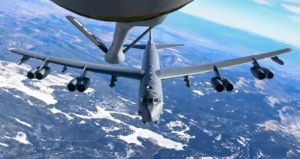
Most aircraft are designed for specific missions.
The B-52 was designed to evolve.
Over decades, it transformed from a Cold War nuclear bomber into one of the most versatile combat aircraft ever created.
Today, the Stratofortress can perform:
- strategic nuclear strike,
- precision bombing,
- maritime attack,
- close air support,
- long-range missile launches,
- air interdiction,
- and electronic mission support.
It can even hunt warships using advanced anti-ship missiles like the AGM-158C Long Range Anti-Ship Missile.
In the Indo-Pacific, where naval warfare may define future conflicts, this matters enormously.
A bomber once associated with Vietnam-era carpet bombing is now part of America’s strategy to counter advanced naval fleets across vast ocean distances.
That adaptability is rare.
And it is one reason the aircraft has survived generation after generation.
4. The B-52 Is Still A Core Part Of America’s Nuclear Deterrent
The world often forgets something critical:
The B-52 is still part of America’s nuclear triad.
The United States maintains three pillars of nuclear deterrence:
- land-based missiles,
- submarine-launched missiles,
- and strategic bombers.
The B-52 remains central to the airborne leg of that system.
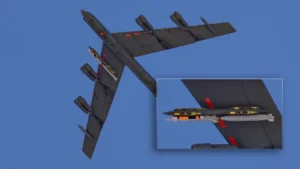
Unlike stealth bombers that penetrate enemy airspace directly, the Stratofortress specializes in launching nuclear cruise missiles from long distances outside enemy defenses.
That role is becoming even more important with the arrival of the AGM-181 Long Range Standoff Weapon, America’s next-generation nuclear cruise missile.
This means the B-52 can remain far from danger while still delivering strategic nuclear capability against heavily defended targets.
Even in the age of stealth, that standoff power remains indispensable.
And until the Northrop Grumman B-21 Raider enters service in large numbers, the B-52 remains absolutely irreplaceable.
5. It Is Surprisingly Cheap To Operate
One of the greatest strengths of the B-52 is not technological.
It is economic.
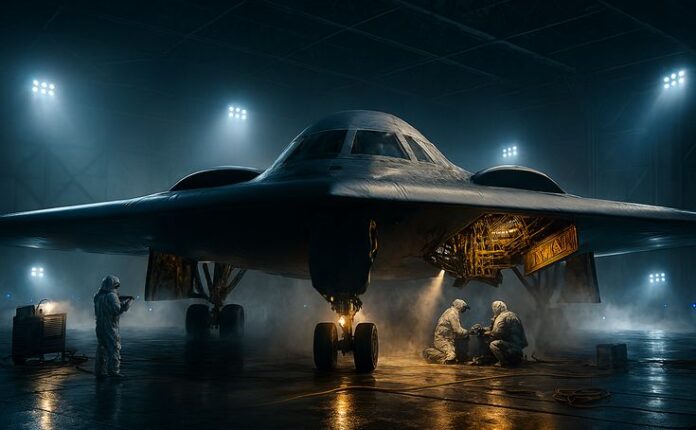
Modern stealth bombers are extraordinarily expensive to maintain. Aircraft like the Northrop Grumman B-2 Spirit require specialized coatings, climate-controlled hangars, and massive maintenance efforts after missions.
The B-52 does not.
It is older.
Simpler.
More rugged.
And far cheaper to keep flying.
Decades of infrastructure, trained crews, logistics networks, and maintenance expertise already exist across the Air Force.
That allows the United States to preserve expensive stealth bombers for the most dangerous missions while using B-52s for large-scale strike operations where stealth is unnecessary.
In military strategy, affordability matters.
A weapon that is too expensive to operate in large numbers becomes strategically limited.
The B-52 avoids that problem.
6. The B-52 Is Becoming A Missile Truck For The Future
Many people assume old bombers become obsolete.
The opposite is happening to the B-52.
The aircraft is evolving into a giant airborne missile carrier capable of launching some of the most advanced weapons ever created.
The future Boeing B-52J Stratofortress will carry:
- AGM-181 Long Range Standoff Weapon nuclear missiles,
- AGM-158 Joint Air-to-Surface Standoff Missile variants,
- hypersonic weapons,
- and advanced anti-ship missiles.
Rather than penetrating enemy air defenses itself, the B-52 can remain hundreds of miles away while unleashing devastating waves of long-range weapons.
This is the future of warfare:
not just platforms,
but networks of precision firepower.
The stealthy Northrop Grumman B-21 Raider will penetrate enemy territory.
The B-52 will stand behind it as an arsenal aircraft launching massive missile salvos from safer distances.
Together, they form a layered strategy.
Not competitors.
Partners.
7. America Is Transforming The B-52 Into A 21st-Century War Machine
The final reason the B-52 still flies is perhaps the most important:
America is not preserving the aircraft.
America is reinventing it.
Under the B-52J modernization program, the Air Force is replacing aging engines, upgrading avionics, improving communications systems, integrating modern digital networks, and preparing the bomber for future weapons.
The most significant upgrade is the replacement of its Cold War-era engines with new Rolls-Royce F130 turbofans.
These engines will:
- reduce fuel consumption,
- improve reliability,
- lower maintenance demands,
- extend operational life,
- and increase efficiency for decades.
The aircraft may look old from the outside.
But internally, it is becoming a modern digital weapons platform.
By the time the B-52 reaches nearly 100 years of service, it may still be among the most capable long-range strike aircraft on Earth.
That is not an accident.
That is engineering excellence combined with strategic patience.
The Real Reason The B-52 Still Flies
The B-52 survives because it represents something bigger than a bomber.
It represents adaptability.
Most military machines are designed for one generation.
The Stratofortress was designed for evolution.
It has outlived presidents, wars, rival superpowers, and entire military doctrines because it keeps adapting faster than people expect.
The world sees an old aircraft.
The United States Air Force sees a proven platform capable of carrying enormous firepower across the globe at lower cost than almost anything else in the arsenal.
That is why the B-52 still matters.
Not because America is stuck in the past.
But because sometimes the most powerful weapon is not the newest one.
It is the one that continues to prove itself decade after decade — while the world changes around it.