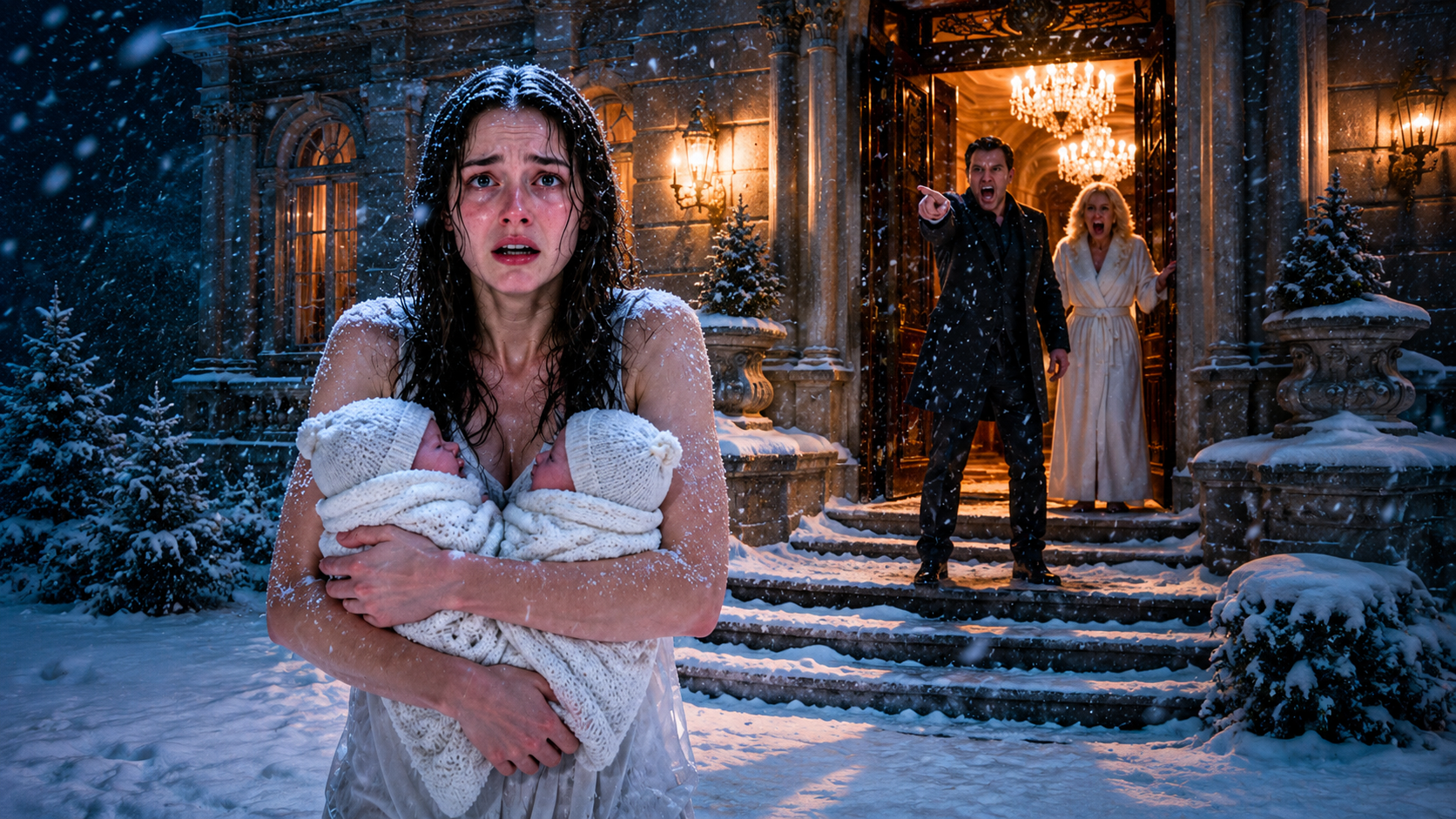
My Husband Threw Me and Our Newborn Twins Into the Snow — Then He Learned His Mansion, Cars, and Company Were All Mine
Best Facebook Title
My Husband Kicked Me and Our 10-Day-Old Twins Into the Snow — Then He Found Out I Owned Everything
Powerful Website Title
My Mother-in-Law Called My Newborn Twins “Bastards” and Threw Us Out — But She Didn’t Know I Was the Billion-Dollar CEO Who Owned Her Life
Viral Opening Hooks
“Get out and take your bastards with you!”
My mother-in-law screamed those words while my husband shoved me and our ten-day-old twins into the freezing night.
You May Also Like




Snow fell over the marble steps of the mansion I had secretly paid for.
One baby whimpered against my chest.
The other slept under the blanket I wrapped around both of them with shaking hands.
My husband leaned close and said:
“You’ll sign the divorce papers tomorrow. No alimony. No house. No money. I’ll say you abandoned the babies if you fight.”
My mother-in-law laughed from behind him.
“Women like her scare easily.”
They thought I was poor.
They thought I was helpless.
They thought I was just a struggling designer Julian had “rescued.”
What they didn’t know was that I owned the mansion.
The cars.
The company that paid Julian’s salary.
And the trust that controlled every luxury they touched.
Standing in the snow with my newborn sons in my arms, I made one call.
Not for rescue.
For revenge.
The Story
My husband, Julian Mercer, shoved a suitcase into my ribs, then pushed me and our ten-day-old twins into the freezing night like we were garbage he had finally decided to throw away.
Snow drifted across the marble steps of the mansion I had quietly paid for.
One of my sons whimpered against my chest.
The other slept, tiny and warm beneath the cream blanket I wrapped around both of them with shaking hands.
Not from fear.
From restraint.
“Julian,” I said softly, “they are your sons.”
His mouth twisted.
“Don’t make me laugh, Audrey. My mother warned me from the beginning. A cheap little designer like you trapping me with babies? You should be grateful I let you stay this long.”
Behind him, Eleanor Mercer stood in her silk robe, diamonds glittering at her throat like pieces of ice.
She had hated me from the moment Julian brought me home.
Not because I was poor.
Because she believed I was.
She called me a charity case.
A seamstress.
A temporary embarrassment.
A woman who should smile because the Mercers had allowed her to stand near their name.
That night, she looked triumphant.
“Get out and take your bastards with you!” Eleanor shrieked, her voice sharp enough to slice through the snow. “I want her gone before the neighbors see.”
I looked down at my sons.
Ten days old.
Still smelling like milk and soft blankets.
Still too new to understand cruelty.
I raised my eyes to my husband.
“Julian, look at them.”
He looked.
Not with love.
Not with guilt.
With irritation.
As if the babies had inconvenienced him by existing.
“You’ll sign the divorce papers tomorrow,” he said. “No alimony. No claim to the house. No claim to my money. No custody games.”
“My sons are not games.”
His eyes narrowed.
“They are leverage if you make them leverage.”
Eleanor stepped forward, wrapping her robe tighter.
“She will fight, Julian. Women like her always do. Poor girls marry up and suddenly think they own the family silver.”
I almost laughed.
Family silver.
The silver in that house had been purchased through my accounts.
The marble beneath their feet had been paid for through my trust.
The chandelier over their heads had been imported by my design division.
But they did not know that.
Because I had made sure they did not.
Julian leaned closer, his breath sharp with whiskey.
“If you try to embarrass me, Audrey, I’ll say you abandoned the children. I’ll say you were unstable after birth. I’ll say I tried to help you, but you ran into the night with them.”
My blood turned cold.
Not because I was surprised.
Because he had already prepared the lie.
Behind him, Eleanor smiled.
“She looks like she finally understands.”
I did understand.
I understood that the man I married had never loved me.
He loved the version of me he thought he could control.
Quiet.
Grateful.
Useful.
Poor.
Wrong.
I looked at him then.
Really looked at him.
The man who had smiled through our wedding vows.
The man who had kissed my forehead in hospital photographs while already planning to erase me.
The man who thought my silence meant weakness.
“You’re sure this is what you want?” I asked.
Eleanor laughed.
“Still pretending you have options?”
The twins stirred.
I kissed their soft heads and stepped back from the door.
The mansion lights glowed behind Julian like a stage built for his victory.
He thought I had nothing but a diaper bag, a suitcase, and two newborns in my arms.
He did not know the deed to that mansion sat in a trust under my signature.
He did not know Mercer Luxury, the company that paid his salary, reported to a parent corporation he had never bothered to research.
He did not know the cars in the driveway were leased through my holding company.
He did not know that every “family asset” Eleanor bragged about at charity lunches existed only because my money had been quietly keeping the Mercer name alive.
He did not know I was not Audrey Lane, struggling designer.
I was Audrey Vance.
Founder and CEO of Vance Global Holdings.
Net worth: eight billion dollars.
I took out my phone with numb fingers and made one call.
Christian answered on the second ring.
“Ms. Vance?”
“Begin the emergency asset freeze,” I said. “Full disclosure package. Legal, corporate, personal. Everything.”
There was a pause.
Only one.
Then my general counsel replied calmly, “At once.”
Julian frowned.
“Who are you calling?”
I looked at him.
“The person who actually works for me.”
His face twisted.
“What?”
I smiled faintly.
“Goodbye, Julian.”
Then I turned and walked down the steps into the snow.
I did not go to a shelter.
I did not knock on a friend’s door crying.
I did not sit on the curb begging my husband to remember that his children were in my arms.
I walked to the black SUV waiting at the end of the driveway.
My driver, Marcus, stepped out with horror on his face.
“Ms. Vance.”
His eyes moved to the babies.
Then to my thin robe beneath the coat Julian had shoved at me.
Then to the mansion door.
His face changed.
“Did he—”
“Not here,” I said.
Marcus opened the rear door immediately.
He wrapped heated blankets around us with shaking hands.
“I should have been closer.”
“You were exactly where I told you to be.”
“I should have ignored that.”
I looked at him.
“Tonight, we all learn.”
He nodded once.
“Where to?”
“The penthouse.”
He closed the door.
As the SUV rolled away, I looked back once.
Julian stood on the steps, watching me leave with the smirk of a man who thought the story had ended.
Eleanor stood behind him, arms folded, satisfied.
Snow blurred them until they looked like ghosts.
By dawn, my sons were sleeping safely in a nursery overlooking the city.
Two private neonatal nurses monitored them.
My security team locked down the floor.
My doctor examined me and nearly lost his professional calm when he saw the bruising on my wrist from where Julian had gripped me.
“You are ten days postpartum,” Dr. Hale said. “You should not have been outside in that temperature.”
“I know.”
“Were the babies exposed long?”
“Less than five minutes.”
He closed his eyes.
“That was five minutes too long.”
I looked through the glass nursery wall at my sons.
“I know that too.”
Christian arrived at six with folders, tablets, and the kind of calm that made billion-dollar predators nervous.
He placed everything on the conference table.
“We have the mansion deed. Vehicle titles. Corporate ownership structure. Employment contract violations. Offshore transfers. Eleanor’s forged reimbursement claims. Julian’s emails to the board attempting to undermine your control of Mercer Luxury without realizing you own the parent corporation.”
I took the tablet.
There it was.
Julian’s email to his mother.
Once the babies are born, I’ll force her out. She has no money, no family, no leverage.
Eleanor’s reply sat beneath it.
Make sure she signs away everything. Women like her scare easily.
I stared at the screen until my reflection looked like a stranger.
“She wanted fear,” I said quietly. “Give her law.”
Christian nodded.
“I also found something else.”
I looked up.
His expression had changed.
“What?”
He slid another tablet toward me.
A draft custody affidavit.
Prepared three weeks before the twins were born.
Signed by Julian.
Witnessed by Eleanor.
The document claimed I had shown “signs of emotional instability,” had expressed “lack of attachment to the unborn children,” and had threatened to “leave the marital home after delivery.”
My throat tightened.
“They were going to say I abandoned them.”
Christian’s voice was cold.
“Yes.”
The twins made soft noises from the nursery.
My hands curled.
“Who prepared it?”
“A Mercer family attorney. But there’s more. Julian also requested a paternity strategy.”
I looked at him.
“A what?”
Christian hesitated.
“He planned to accuse you of infidelity if you fought custody. His attorney advised that it would damage your credibility, even if later disproven.”
For a moment, the room became silent except for the sound of my sons breathing through the monitor.
Julian had not only thrown us into the snow.
He had prepared a future where my sons would grow up hearing their mother had trapped their father with “illegitimate” children.
That was when whatever softness I had left for him disappeared.
“Release the first stage,” I said.
Christian nodded.
“Corporate only?”
“Corporate, property, and security. Hold the personal footage until he lies publicly.”
Christian’s mouth tightened.
“He will.”
“I know.”
By nine, Julian began calling.
First angry.
Then confused.
Then frantic.
I let every call go unanswered.
At ten, security at the mansion changed.
Julian’s hired guards were removed and replaced by mine.
At eleven, every luxury car in the Mercer driveway was remotely disabled pending ownership review.
At noon, Mercer Luxury’s board received an emergency notice.
Julian Mercer had been suspended from his executive role for fraud, coercion, misuse of corporate resources, and reputational risk.
At twelve-thirty, Eleanor attempted to use the mansion’s private bank account.
Denied.
At one, she called from a private number.
I answered while feeding my younger son.
I had named him Leo.
His brother was Noah.
Julian had not cared enough to argue about names.
“You vicious little snake!” Eleanor hissed. “What have you done?”
“What you asked,” I said calmly. “I got out.”
“You cannot touch us. That house belongs to my family.”
“No, Eleanor. Your family has been living in my house.”
Silence.
Then a brittle laugh.
“You are insane.”
“Check the deed.”
I heard movement.
Drawers opening.
Papers rustling.
Her breathing changed.
Then Julian grabbed the phone.
“Audrey, what is this? Some trick?”
I adjusted Leo against my shoulder.
“No trick.”
“Who are you?”
For the first time, my voice turned cold.
“The woman you underestimated.”
He went quiet.
Then said, “Audrey, listen. This is a misunderstanding.”
“No. A misunderstanding is forgetting a dinner reservation. You threw your postpartum wife and newborn sons into the snow.”
“I was angry.”
“You were prepared.”
“What does that mean?”
“It means I saw the custody affidavit.”
Silence.
Then a whisper.
“You had no right to access that.”
I almost smiled.
“Julian, I own the server where your attorney backed up the draft.”
His breathing sharpened.
“You’re bluffing.”
“You have two hours to leave the property with personal items only. Anything purchased through Vance accounts stays. Anything tied to fraudulent spending is evidence.”
“You can’t do this to me.”
“You did this to yourself.”
Eleanor came back on the line.
“You little liar. You were nothing when Julian found you.”
“When Julian found me,” I said, “I was already richer than every donor at your charity gala combined.”
She made a sound.
Not quite a laugh.
Not quite a gasp.
I continued.
“You thought the plain clothes meant poverty. You thought my silence meant shame. You thought the absence of a famous last name meant I had none.”
Julian whispered, “Vance.”
There it was.
Recognition.
Too late.
“You’re Audrey Vance.”
“Yes.”
Eleanor said nothing.
For once.
I ended the call.
That evening, I watched from my office as live security footage showed Julian storming through the mansion.
He tore open closets.
Shouted at staff who no longer obeyed him.
Grabbed watches from drawers that Christian had already flagged as purchased with misused company funds.
Eleanor sat on the staircase, mascara streaking her powdered face, clutching jewelry my lawyers had already listed in the civil complaint.
Without diamonds, without staff, without the mansion accepting her as queen, she looked almost ordinary.
Then Julian made his final mistake.
He called a gossip reporter.
By seven o’clock, the headline hit.
Mercer Executive Claims Wife Vanished With Newborn Twins During Postpartum Breakdown
Christian placed the article in front of me.
I read only the first paragraph.
Julian claimed I had been emotionally unstable.
He claimed he had begged me to stay.
He claimed I had taken the twins into unsafe conditions.
He claimed his mother was “devastated.”
Christian looked at me across the conference table.
“Now?”
I looked into the nursery where Noah and Leo slept under warm lights.
“Yes,” I said. “Release everything.”
Christian did not smile.
He simply opened his laptop and ended Julian Mercer’s illusion.
The next morning, the city woke up to the truth.
Not rumors.
Not whispers.
Documents.
Screenshots of Julian’s threats.
The draft custody affidavit.
Financial records.
Video from the mansion entrance showing him pushing me and the newborn twins into the snow.
Audio of Eleanor shouting, “Get out and take your bastards with you.”
Deeds proving Vance Holdings owned the mansion, the cars, and the corporate division that employed him.
Board statements confirming his suspension.
Legal notices naming Eleanor in a fraud investigation.
By noon, Julian was no longer a charming millionaire husband with a tragic story.
He was a coward in a wrinkled suit standing outside a house he could not enter.
I arrived at three.
The cameras were already gathered beyond the gate.
I did not ask them to come.
Julian did that when he tried to make my pain into a headline.
Now the headline belonged to the truth.
My security team opened a path as I stepped from the car in a black coat, one child in each arm, both bundled in cream blankets.
I did not shout.
I did not cry.
That made Julian look even smaller.
“Audrey,” he said, rushing toward me until security blocked him. “Please. We can fix this.”
I looked at him.
“Can we?”
His eyes moved toward the cameras.
He lowered his voice.
“I made a mistake.”
Eleanor appeared behind him, pale and trembling.
Without diamonds, without staff, without her mansion behind her, she looked like a woman who had mistaken borrowed luxury for identity.
“A mistake?” I repeated.
Julian swallowed.
“I was angry. Mother pushed me. I didn’t mean—”
“You meant every word.”
He glanced at the babies.
“Think of the children.”
That almost made me laugh.
“I did,” I said. “When you threw them into the cold. When you threatened to lie in court. When you tried to destroy their mother because you thought I was poor.”
Eleanor stepped forward, her pride fighting for one last breath.
“You cannot leave us with nothing.”
I looked at her.
“You left newborn babies in the snow.”
Her mouth opened.
No sound came.
Christian stepped beside me and handed Julian a folder.
“Divorce petition. Custody filing. Termination notice. Civil claims. Preservation order. Criminal referrals are already with counsel.”
Julian’s hands shook as he opened the folder.
“This will ruin me.”
“No,” I said. “It will reveal you.”
He looked at me then.
Really looked.
Not at the designer he thought he married.
Not at the quiet woman who sat through his mother’s insults.
Not at the postpartum wife he believed he could threaten into silence.
At Audrey Vance.
The woman who owned the stage he had been performing on.
“You lied to me,” he whispered.
I tilted my head.
“No, Julian. You never asked who I was. You only asked what you could take.”
He flinched.
Eleanor snapped, “Don’t speak to him like that.”
I turned to her.
“You are no longer in a position to give orders on my property.”
A security officer stepped forward.
“Mrs. Mercer, you have been instructed to leave with personal belongings only.”
“This is my home!”
“No,” I said. “It was your costume.”
Julian sank onto the lowest step.
The same step where I had stood holding my sons in the freezing dark.
For one perfect second, the mansion doors closed behind him, locking him outside his own illusion.
The divorce was ugly.
Men like Julian do not lose gracefully.
First, he claimed he had been misled.
Then manipulated.
Then emotionally abused.
Then financially entrapped.
His lawyers argued that I had hidden my wealth in bad faith.
My lawyer responded with one sentence that became my favorite in the entire proceeding:
“Ms. Vance’s private wealth did not give Mr. Mercer permission to commit public cruelty.”
The judge agreed.
Julian demanded access to the twins.
Then claimed he had never doubted their paternity.
Christian played the recorded audio from the night in the snow.
Julian’s own voice:
A cheap little designer like you trapping me with babies?
Then the custody affidavit.
Then the video.
Then the reporter call.
His attorney asked for a recess.
Eleanor tried to testify as a concerned grandmother.
She wore pearls, a navy suit, and the expression of a woman who believed age made her respectable.
My attorney, Amara Bell, approached calmly.
“Mrs. Mercer, did you refer to the newborn twins as bastards?”
Eleanor’s mouth tightened.
“I was upset.”
“Did you tell your son to remove his wife and children from the house?”
“I told him to protect himself.”
“From ten-day-old infants?”
“From manipulation.”
Amara clicked the remote.
The courtroom screen showed Eleanor in her silk robe, pointing toward the snow.
Audio filled the room.
Get out and take your bastards with you!
Eleanor’s face went pale.
Amara paused the video.
“Does that appear to be protection, Mrs. Mercer?”
Eleanor looked toward Julian.
He looked away.
That was the first time she understood her son would sacrifice her as quickly as she had sacrificed me.
The second twist came in the fraud hearing.
Eleanor had claimed for years that Mercer family funds supported their charity work.
But Christian’s audit showed that she had submitted forged reimbursement claims through Mercer Luxury.
Designer gowns labeled as “donor event uniforms.”
Private spa weekends labeled as “executive wellness retreats.”
Jewelry labeled as “auction inventory.”
A $72,000 necklace listed as “client hospitality.”
The courtroom laughed at that one.
The judge did not.
Julian’s offshore transfers were worse.
He had been moving funds from company accounts into a private investment vehicle under a false vendor name.
The same vendor had billed my company for “brand strategy.”
No strategy had been delivered.
Only theft wearing better stationery.
When the prosecutor got involved, Julian’s face changed.
Civil ruin had frightened him.
Criminal exposure broke him.
Six weeks after the snow night, Julian asked to meet.
I almost refused.
Then Amara said, “Closure is not necessary, but sometimes documentation helps.”
So we met in a conference room.
Not alone.
Never alone.
Amara sat beside me.
Christian stood near the window.
A court-appointed mediator sat at the head of the table.
Julian entered in a gray suit that looked slept in.
He had lost weight.
His hair, usually styled perfectly, fell across his forehead.
For the first time since I had known him, he looked like someone who had to pay for his own mistakes.
He sat across from me.
His eyes moved immediately to the empty space beside my chair.
“Where are the boys?”
“Safe.”
His jaw tightened.
“I’m their father.”
“You are biologically connected to them.”
“That’s cruel.”
“So was the snow.”
He looked down.
“I said I was sorry.”
“No,” I said. “You said you made a mistake.”
“What do you want me to say?”
“The truth.”
He looked up.
“I was scared.”
I almost laughed.
“Of what?”
“You.”
That surprised me.
He continued.
“Not then. Not when I thought you were poor. Before that. Sometimes I’d see things. Calls you didn’t answer in front of me. Documents you locked away. People who treated you with too much respect. Mother said you were probably hiding debt or another man.”
I said nothing.
“But part of me knew,” he said. “Not that you were Vance. But that you weren’t what we said you were.”
“Then why did you treat me like nothing?”
His face crumpled slightly.
“Because if you were nothing, I could be everything.”
The room went still.
There it was.
The first honest thing Julian Mercer had ever said to me.
I nodded slowly.
“Thank you.”
His eyes filled with hope.
“For what?”
“For finally admitting it was never about me.”
He leaned forward.
“Audrey, please. I can change.”
“No.”
“You don’t know that.”
“I know you want rescue now that consequences arrived. That is not change.”
He swallowed.
“I love you.”
I looked at him.
“You loved being taller than me.”
His face flushed.
“You’re trying to punish me.”
“No,” I said. “I am trying to raise our sons in a world where love does not sound like contempt.”
The mediator cleared his throat.
Julian stared at me.
“What happens now?”
“Now you sign the temporary custody agreement. Supervised visitation only, pending evaluation. You cooperate with the financial investigation. You stop speaking to reporters. You stop using our sons as props in your reputation repair.”
“And if I refuse?”
Christian finally spoke.
“Then we proceed with every civil and criminal remedy available.”
Julian looked at him.
Then at me.
“You really hate me.”
I shook my head.
“No. I just stopped funding your illusion.”
Eleanor lasted longer.
She refused to surrender anything until the tax investigators arrived.
That was when pride turned into panic.
Her charity accounts were frozen.
Her social clubs removed her from boards.
The women who once kissed both her cheeks at luncheons suddenly could not recall knowing her well.
She called me from a blocked number three months later.
I should not have answered.
But Leo was sleeping against my chest, Noah was in his bassinet, and I felt strong enough to hear her powerless.
“You have destroyed my life,” she said.
I looked out at the city.
“No. I reclaimed mine.”
“You turned my friends against me.”
“I released documents.”
“You humiliated me.”
“You were recorded.”
Her voice shook.
“Do you know what it feels like to have everyone look at you like you are disgusting?”
I looked at Noah.
Then Leo.
Then remembered the snow.
“Yes,” I said. “You taught me.”
Silence.
Then, quieter:
“I was protecting my son.”
“No, Eleanor. You were protecting a throne that was never yours.”
“You don’t understand mothers.”
That was when my voice changed.
“I understand one thing better than you ever will.”
“What?”
“A mother does not throw babies into the cold to keep her adult son warm.”
She said nothing.
I ended the call.
And this time, I blocked her.
The final hearing was held in spring.
By then, the twins were four months old.
Round-cheeked.
Loud.
Offended by naps.
Noah had discovered his hands and treated them like miracles.
Leo smiled only when he wanted something.
They were perfect.
Not because they were easy.
Because they were here.
I walked into court wearing a cream suit with my hair pulled back.
Not to look powerful.
Because I no longer needed to hide that I was.
Julian sat with his attorney, shoulders bent.
Eleanor sat two rows behind him, smaller without diamonds.
The judge reviewed everything.
The video.
The emails.
The financial records.
The custody affidavit.
The paternity smear strategy.
The testimony from nurses, security, and staff.
Then the judge spoke.
“Mr. Mercer, the court finds credible evidence that you endangered your postpartum spouse and newborn children, attempted to coerce a divorce settlement through intimidation, and participated in a public smear campaign after the fact.”
Julian stared at the table.
“Temporary full physical custody remains with Ms. Vance. Visitation will be supervised and contingent upon compliance with psychological evaluation, parenting education, and ongoing legal conditions.”
My breath left me slowly.
The boys were safe.
That was all that mattered.
Then came property and support.
Julian tried to claim spousal support.
The judge looked over his glasses.
“From the woman you publicly called a gold digger?”
Julian’s attorney touched his arm.
No more was said.
The divorce was finalized later that year.
No grand scene.
No screaming.
Just signatures.
But unlike the papers Julian wanted me to sign in fear, these papers were signed under truth.
When it was over, he waited in the hallway.
“Audrey.”
I stopped but did not move closer.
He looked exhausted.
“Do they know me?”
“The boys?”
He nodded.
“They know faces that are safe.”
Pain crossed his face.
“Will they ever know mine?”
“That depends on who you become when no one is watching.”
He nodded slowly.
“I’m sorry.”
For the first time, it sounded less like strategy.
Still, I did not step closer.
“Be sorry in behavior,” I said.
Then I walked away.
I sold the mansion.
Not because I needed the money.
Because I did not want my sons growing up inside walls that had heard Eleanor call them unwanted.
The buyer was a film producer who loved marble, cliffs, and houses with scandals attached.
Good for him.
I moved into a quieter house by the water.
Not as large.
Not as cold.
Warm wood floors.
Wide windows.
A garden.
A nursery painted soft blue and green.
A kitchen where the morning sun touched the table.
There were no silk-robed women on staircases.
No husband smelling of whiskey.
No doors slammed for performance.
Just nurses.
Soft music.
Bottles warming.
Tiny socks disappearing in impossible places.
And two baby boys who turned every room into evidence that life could be loud without being cruel.
I returned to work on my own terms.
At first, only from home.
Then board meetings twice a week.
Then public appearances when I was ready.
The first time I walked into Vance Global headquarters after the story broke, the lobby went silent.
Not because people feared me.
Because they knew.
They had seen the video.
They had read the headlines.
They had learned that their CEO had once sat quietly through a thousand insults because she had been testing whether love could survive without money.
It could not.
Not with Julian.
But respect did.
My executive assistant, Priya, approached with tears in her eyes.
“Welcome back, Ms. Vance.”
I smiled.
“Thank you.”
She whispered, “The board is waiting.”
“Let them.”
For three minutes, I stood in the lobby and looked around.
At the company I built.
At the people I employed.
At the life I had earned before I ever became anyone’s wife.
Then I walked upstairs.
The board rose when I entered.
Every single member.
Christian later told me it had not been planned.
That made it better.
Six months after the divorce, I launched the Vance Foundation for Women and Children Escaping Financial Abuse.
Not a pretty charity for headlines.
A practical weapon.
Emergency housing.
Legal support.
Postpartum protection.
Document recovery.
Asset tracing.
Custody defense.
Security planning.
Because revenge without repair felt too small for the life I wanted.
At the launch, a reporter asked, “Do you see this foundation as a response to what happened with your ex-husband?”
I looked at the cameras.
“Yes.”
The room quieted.
I continued.
“But not only him. It is a response to every person who has ever told a woman she owns nothing because her name is not on the loudest mouth in the room.”
A murmur moved through the crowd.
I looked down at my prepared speech.
Then ignored it.
“When I was pushed into the snow with my newborn sons, I had resources most women do not. Lawyers. Security. Wealth. Corporate power. That is why my outcome was fast.”
My voice tightened.
“But many women are pushed out with nothing. No driver waiting. No penthouse. No general counsel. No hidden deed. No one to believe them before the lie hardens.”
I looked at Christian.
Then at Priya.
Then at the women in the front row who had survived things no cameras had captured.
“This foundation exists because safety should not depend on wealth.”
The applause began slowly.
Then filled the room.
That day, I stopped thinking of what happened as only humiliation.
It became fuel.
Years passed.
Noah and Leo grew strong.
Too strong, sometimes.
They climbed everything.
Couches.
Tables.
Bookshelves.
Once, Christian, who had made the mistake of lying on the carpet during a meeting at my house.
Noah was cautious, thoughtful, always studying people before smiling.
Leo was bold, loud, and offended when gravity disagreed with him.
They knew Julian as “Dad Julian” because their therapist suggested clarity mattered more than adult comfort.
He completed parenting classes.
Therapy.
Supervised visits.
Then longer visits.
He became quieter.
Less polished.
More careful.
He never regained what he lost.
Not the company.
Not the mansion.
Not me.
But he did become, slowly and imperfectly, safer around the boys.
I did not forgive him quickly.
Some people wanted me to.
“Children need their father,” they said.
I always answered:
“Children need safe people.”
When Julian became safer, I allowed more.
Not for him.
For them.
Eleanor never became safe.
She sent birthday cards for the twins.
I returned them unopened.
She sent gifts.
They were donated after legal review.
She sent a letter to me once.
Christian asked if I wanted it.
I held it over the shredder.
For a moment, I almost opened it.
Then I remembered the snow.
Her voice.
Her diamonds.
Her words.
Get out and take your bastards with you.
I dropped the letter into the shredder.
Noah toddled into the office holding a wooden train.
“What dat, Mommy?”
“Old paper,” I said.
He handed me the train.
“Play?”
I smiled.
“Yes.”
That was the correct answer.
Not the past.
Play.
Life.
Warm floors.
Children who never had to earn their place.
When the twins were five, Noah asked why we did not live in “the big house from the picture.”
He had seen an old photo online.
The mansion was famous enough that the internet never fully let it disappear.
We were sitting in the garden.
Leo was digging a hole he insisted was “for treasure or maybe worms.”
Noah held my phone.
“This house,” he said. “Why not live there?”
I looked at the image.
Marble steps.
Tall windows.
Cold beauty.
A place that had once looked like victory.
Then became a warning.
“That house was not kind to us,” I said.
Noah frowned.
“Houses can be kind?”
“Yes.”
Leo looked up from the dirt.
“Our house kind?”
“Very.”
Noah studied the photo.
“Did bad people live there?”
I thought carefully.
“People made bad choices there.”
“Dad Julian?”
“Yes.”
“Grandma Eleanor?”
I paused.
“Yes.”
Leo lifted his muddy hand.
“She in timeout?”
A laugh escaped me.
“A very long one.”
Noah looked at me seriously.
“Did you cry?”
I brushed hair from his forehead.
“Yes.”
“Did we cry?”
“You were babies. Babies cry.”
“Did someone help?”
I looked toward the kitchen window.
At the warm light.
At the home we had built after losing the illusion.
“Yes,” I said. “Many people helped.”
Noah leaned against me.
“Good.”
Then he ran to help Leo search for worms.
Children can carry truth when you give it to them without poison.
That night, after they slept, I stood in the doorway of their room.
Two beds.
Two soft blankets.
Two boys breathing peacefully.
I thought of the snow again.
Not with fear this time.
With distance.
Like remembering a storm I had survived.
Ten years after the night Julian threw us out, the foundation opened its fiftieth emergency family residence.
We named it The Warm Door House.
The ribbon cutting happened on a bright winter morning.
Snow fell lightly.
Not cruelly.
Softly.
Noah and Leo stood beside me in matching coats, both pretending they were too old to hold my hands until the cameras appeared.
Then they held on tightly.
Julian attended quietly from the back.
He had been invited by the boys, not by me.
He did not approach the microphone.
He did not try to stand beside me.
That was part of his growth.
Understanding that some stories are not his to retell.
After the ceremony, he walked over.
“The boys did great,” he said.
“They did.”
He looked at the building.
“You built something good from something terrible.”
I looked at him.
“I built something necessary.”
He nodded.
“I know.”
There was a pause.
Then he said, “I was cruel because I thought power meant never being exposed.”
I said nothing.
He continued.
“You taught them better than I would have.”
I looked toward Noah and Leo, who were helping hand out blankets.
“They taught me too.”
Julian smiled sadly.
“I’m glad they have you.”
I accepted that sentence.
Not as forgiveness.
As truth.
Then he walked away.
Christian stood beside me a moment later.
“He seems less awful.”
I laughed.
“That is not a legal standard.”
“It could be.”
“Please never become a judge.”
He smiled.
“Never planned to.”
A woman approached us then.
Young.
Holding a baby girl.
Her coat was too thin.
Her eyes were tired.
She looked at the sign on the building.
“Are you Ms. Vance?”
“Yes.”
She swallowed.
“My husband locked me out last night. He said the house was his because he paid the mortgage. But my name is on the deed too.”
I looked at Christian.
Then at her.
“Come inside,” I said. “It’s warm.”
Her face crumpled.
That was why we built it.
Not for speeches.
For doors.
Warm ones.
People sometimes ask if I regret hiding who I was from Julian.
I answer honestly.
No.
My identity was never the problem.
His character was.
Money does not create cruelty.
It reveals what cruelty thinks it can get away with.
Julian believed I was poor, so he treated me as disposable.
Eleanor believed I had no leverage, so she treated my babies like trash.
They did not become cruel when they learned I was rich.
They were cruel when they thought I was powerless.
That is the part people miss.
The truth did not destroy them.
The truth removed the protection their lies had been enjoying.
And me?
I stopped confusing silence with grace.
I stopped believing being underestimated was always an insult.
Sometimes it is an advantage.
Sometimes silence is not surrender.
Sometimes a woman standing in snow with newborn twins in her arms is not helpless.
Sometimes she is making one phone call before the whole empire falls.
The night Julian shoved me out, he thought he was ending my story.
But he was only ending the chapter where I allowed his family to mistake my humility for poverty.
I did not destroy the Mercers.
I simply stopped paying for the stage they performed on.
Julian lost the mansion.
Eleanor lost the borrowed crown.
The company survived without them.
The foundation grew.
My sons learned that home is not the biggest house.
It is the safest one.
And I learned that revenge is satisfying for a moment, but rebuilding is what makes the victory last.
On winter nights, when snow falls softly against our windows, Noah and Leo sometimes ask for hot chocolate.
I make it too sweet.
They complain if there are not enough marshmallows.
We sit by the fireplace in the warm house by the water, and I watch them laugh with chocolate on their faces.
They do not remember the cold.
They do not remember the marble steps.
They do not remember Eleanor’s voice.
Good.
I remember enough for all of us.
And every time I tuck them into bed, I whisper the same promise over their sleeping heads:
“No one gets to throw you out of a life you belong in.”
Because that is the real ending.
Not that Julian begged.
Not that Eleanor fell.
Not that the headlines told the truth.
The real ending is two boys growing up warm, wanted, protected, and loud in a house where love does not depend on power.
The real ending is a mother who was pushed into the snow and chose not only revenge, but repair.
And if anyone asks whether I regret making that call, I always say the same thing:
“No. I regret only one thing.”
They ask, “What?”
I smile.
“That I didn’t make it sooner.”
Julian thought he was throwing a poor, helpless wife into the snow. Eleanor thought my newborn twins were powerless because they had no voice yet. But I was the CEO who owned their mansion, cars, and company. One call froze their assets, exposed their lies, and turned the coldest night of my life into the beginning of my sons’ safest future.