I Was Homeless With My Little Girl When a Millionaire at the Soup Kitchen Turned Around and Whispered My Name
I Took My Freezing Daughter to a Soup Kitchen and Found the Boy I Once Loved Serving Food — Then Her Father Burst In With the Secret That Changed Everything
I almost left before anyone could feed us.
Snow was melting in my hair.
You May Also Like




My three-year-old daughter was shaking in my arms.
And the man standing behind the soup counter was the boy I had once promised I would never become a stranger to.
Luke Mitchell.
Ten years ago, he kissed me beneath the bleachers after a Friday night football game and whispered:
“Promise me we don’t become strangers.”
Now he was a millionaire.
And I was homeless.
I wanted to run before he saw me.
But then he turned around, froze, and said my name like a prayer.
“Khloe?”
Before I could answer, my daughter whispered, “Mommy, do they have soup?”
That broke me.
Then the front doors burst open.
Darren, the man who abandoned us before Lily was born, stepped inside holding the eviction notice I thought I had left behind.
And the secret he carried was bigger than hunger, bigger than shame, and dangerous enough to make Luke Mitchell’s entire foundation turn against him.
The Story
I almost left before anyone could feed us.
Snow was melting in my hair.
My three-year-old daughter was shaking in my arms.
And the man standing behind the serving counter was the boy I had once promised I would never become a stranger to.
Luke Mitchell.
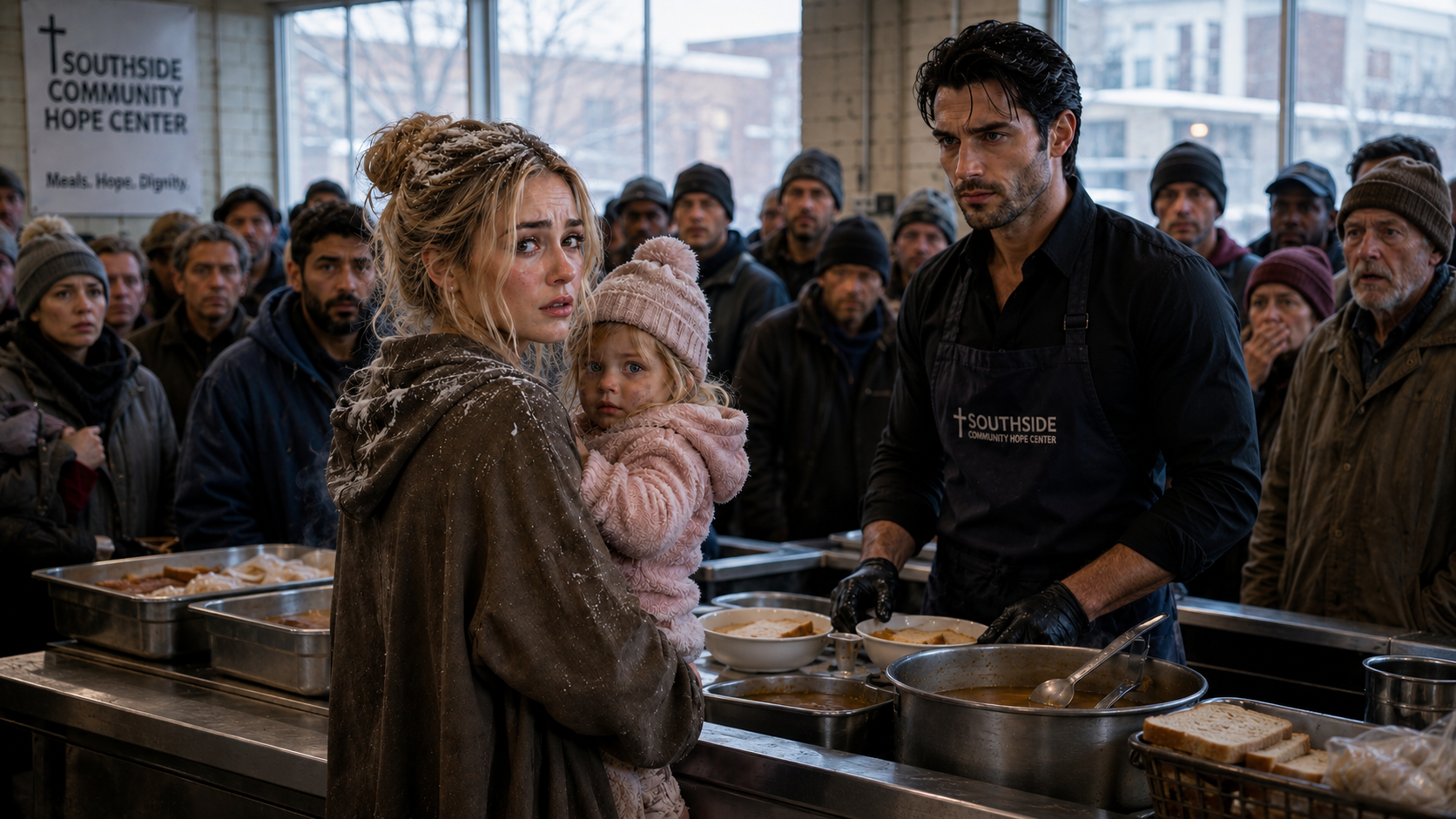
For three seconds, the whole soup kitchen disappeared.
The clatter of spoons.
The scrape of chairs.
The volunteers calling for more bread.
The wind rattling the old windows of the Southside Community Hope Center.
All I could see was him.
Ten years ago, Luke had kissed me beneath the bleachers after a Friday night football game and whispered, “Promise me we don’t become strangers.”
Back then, I was Khloe Davis.
Fearless.
Loud.
Full of impossible plans.
I wore thrift-store sundresses like couture, argued with teachers when I knew I was right, and wrote my dreams on diner napkins while Luke listened like I was drawing a map to the stars.
Law school.
A corporate office.
A little house for my mother.
Children who never had to wonder if dinner was coming.
That girl was gone.
The woman standing in line now was twenty-eight, homeless, exhausted, and holding a starving child whose toes were numb from the cold.
Lily tightened her arms around my neck.
“Mommy,” she whimpered, “my toes are cold.”
The words nearly split me open.
I adjusted her faded pink hat and pressed my frozen cheek to her forehead.
“I know, baby,” I whispered. “Just a few more minutes.”
But we were not almost anywhere.
We were at the end of everything.
Six months earlier, I still had a life.
Not glamorous.
Not easy.
But real.
A second-floor apartment in Bridgeport.
A front-desk job at a dental clinic.
A refrigerator covered in Lily’s sticker charts.
A little bed with butterfly sheets.
A bathroom window that stuck in the winter.
A life.
Then Lily’s daycare closed after a pipe burst.
I missed work.
Then missed more.
I begged for patience, traded shifts, apologized until the words tasted like dust.
My manager said she understood.
Then she fired me on a Friday afternoon with security standing nearby while I packed my desk into a cardboard box.
After that, everything fell fast.
Bills.
Late fees.
Shutoff warnings.
Eviction.
Shelters.
The back seat of my rusted Toyota.
On nights when no shelter had room, I told Lily we were camping.
“See the buildings?” I whispered through frost-streaked windows. “They’re giant silver trees.”
She believed me.
That was the worst part.
The trust.
Now the temperature had dropped near zero, and the car was no longer shelter.
It was a metal coffin.
The soup kitchen was not charity.
It was survival.
And Luke Mitchell was standing behind the counter holding a silver ladle over a steaming pot of chicken vegetable soup.
He looked older now.
Sharper.
Quieter.
His hair was neatly cut, his dark apron tied over a charcoal sweater that looked expensive without trying.
The boy I remembered had been all charm and bright ambition.
This man looked like he had built something huge, lost sleep over it, and learned how to command a room without raising his voice.
I took one step backward.
Maybe I could leave.
Maybe we could find somewhere else.
Maybe Lily could last another hour.
Then she whispered again.
“Mommy, soup?”
I closed my eyes.
Pride is easy when you are full.
When your child is hungry, pride becomes a luxury you cannot afford.
So I stayed.
The line moved slowly.
A volunteer handed out bread.
Someone near the front coughed.
Lily’s little body shivered against mine.
Then Luke turned.
His eyes passed over the line once.
Then stopped.
On me.
For a moment, he did not move.
The ladle hovered over the pot.
His face changed so completely that the volunteer beside him glanced over in confusion.
“Luke?” she asked.
He did not answer her.
He stared at me like he had seen a ghost who still had snow melting on her shoulders.
“Khloe?”
Not loudly.
Not dramatically.
Just my name, spoken like a prayer that escaped before he could stop it.
I could have survived pity.
I could have survived surprise.
Maybe even judgment.
But tenderness almost broke me.
My throat tightened.
“Hi, Luke.”
Lily lifted her head from my shoulder.
Her little face was red from cold, her eyelashes wet with tears.
Luke looked at her, and something in his expression softened.
“Who’s this?” he asked gently.
“My daughter,” I whispered. “Lily.”
“How old is she?”
“Three.”
He smiled at her.
“Hi, Lily. I’m Luke.”
Lily sniffled.
“Do you have soup?”
A wounded laugh slipped out of him.
“I do. The best soup in Chicago tonight.”
He filled two bowls so generously the broth almost touched the rims.
Then he added extra bread, two cartons of milk, and a banana from behind the counter.
“There’s a table in the back corner,” he said softly. “By the radiator. It’s warmer there.”
“Thank you,” I whispered.
I carried the tray with shaking hands, terrified I would drop it.
Lily took one spoonful, and her whole body changed.
Her shoulders dropped.
Her eyes widened.
She ate in fierce silence, like hunger had become bigger than language.
I could not touch my own food.
I just watched my daughter get warm.
Watched her get fed.
For one moment, shame and relief fought so hard inside me I almost sobbed.
Then a shadow fell across our table.
Luke placed down two mugs of hot chocolate, two sugar cookies, and a soft brown teddy bear with a red heart stitched to its chest.
Lily froze.
“For me?” she whispered.
Luke nodded.
“For you.”
She reached for it carefully, as if kindness might disappear if she touched it too quickly.
“What’s his name?” Luke asked.
Lily hugged the bear.
“Mr. Soup.”
Luke smiled.
“That’s a strong name.”
Then he looked at me.
The smile faded, replaced by something deeper.
Something hurt.
“Khloe,” he said quietly, “why didn’t you call me?”
Before I could answer, the front doors burst open.
Cold wind rushed inside.
Snow blew across the entryway.
Several people turned.
A man stepped in, covered in snow, his eyes locked on me.
Darren.
Lily’s father.
The man who had abandoned us before she was born.
And in his hand was the eviction notice I thought I had left behind.
Darren Blake had always known how to enter a room like he owned someone inside it.
That was how he fooled me in the beginning.
He was not handsome in a gentle way like Luke had been.
Darren was sharp.
Fast-talking.
Confident.
The kind of man who could borrow twenty dollars and make you feel grateful he asked.
When I met him, I was twenty-four, tired, grieving my mother, and working two jobs.
He noticed things.
Or pretended to.
He brought me coffee when I worked late.
He remembered Lily’s first ultrasound appointment after I told him I was pregnant.
For two weeks, he acted terrified but happy.
Then one morning, he disappeared.
No goodbye.
No money.
No support.
Just a message three months later:
Don’t contact me again. I’m not ready for a family.
Now he stood inside the soup kitchen wearing a black coat, leather gloves, and the same arrogant mouth I remembered too well.
His eyes moved to Lily.
For one second, something flickered there.
Not love.
Calculation.
Then he looked at me.
“There you are.”
Luke turned slightly.
“You know him?”
I pulled Lily closer.
“Unfortunately.”
Darren walked toward us.
A volunteer stepped into his path.
“Sir, if you need a meal, please get in line.”
Darren looked at her like she had insulted him.
“I’m not here for soup.”
His eyes stayed on me.
“I’m here for her.”
Lily hugged Mr. Soup tighter.
“Mommy?”
I stood.
My legs felt weak, but I stood.
“Don’t come near us.”
Darren smiled.
“Still dramatic.”
Luke’s expression changed.
Not loud.
Not angry.
Controlled.
Dangerously controlled.
“I think she asked you not to come closer.”
Darren looked him up and down.
“And you are?”
Luke removed his apron slowly.
“Someone listening.”
Darren laughed.
“Cute.”
He held up the eviction notice.
“You forgot something, Khloe.”
My stomach dropped.
The paper was folded but unmistakable.
The notice from our apartment.
The one I had left in the car because I could not bear to look at it again.
“How did you get that?” I asked.
Darren smiled.
“You left your car unlocked.”
A cold feeling moved through me.
“You went into my car?”
“Our daughter was sleeping in that car?”
His voice rose slightly.
Several people turned.
A few volunteers moved closer.
His performance had begun.
“I was concerned,” Darren said. “Any father would be.”
I almost laughed.
“Father?”
His eyes hardened for one second.
Then he recovered.
“I made mistakes.”
Luke stepped closer.
“Then make this one somewhere else.”
Darren looked at him again.
Recognition slowly crossed his face.
“Wait.”
He smiled.
“Luke Mitchell?”
Luke said nothing.
Darren’s smile widened.
“The millionaire soup boy.”
The room grew quieter.
Darren looked at me and laughed.
“Of course. Of course it would be him.”
I frowned.
“What are you talking about?”
He held up the eviction notice.
“Did you tell him? Did you tell your old boyfriend that you were living in one of his buildings?”
I stared at him.
“What?”
Luke went still.
Darren’s eyes glittered.
“You didn’t know?”
I looked at Luke.
He looked genuinely confused.
“What building?” Luke asked.
Darren unfolded the notice and read the address aloud.
Luke’s face changed.
Not embarrassment.
Alarm.
“That property is owned by Hopewell Housing Trust,” he said.
Darren clapped once.
“There it is. His foundation.”
I looked at Luke.
“Your foundation evicted me?”
His mouth opened.
No answer came fast enough.
The room seemed to tilt.
The soup.
The radiator.
Lily.
Luke.
Darren’s smile.
Everything blurred.
Luke stepped toward me.
“Khloe, I didn’t know.”
Darren laughed.
“Of course he didn’t. Men like him never know who gets pushed out. They just sign checks and smile for cameras.”
Luke turned slowly toward him.
“How do you know about Hopewell properties?”
For the first time, Darren’s smile slipped.
Only for a second.
Then he shrugged.
“I read.”
Luke’s eyes sharpened.
“No. You said one of his buildings. Not one of Hopewell’s. You knew the ownership structure.”
Darren’s jaw tightened.
I looked between them.
“What is going on?”
Darren pointed at me.
“What’s going on is you need to leave with me before this becomes ugly.”
Luke’s voice lowered.
“Too late.”
A woman in a navy coat approached from the volunteer station.
She had silver hair, reading glasses, and the calm face of someone who had ended many arguments without raising her voice.
“Luke,” she said. “Do you need me?”
He nodded once.
“Call Marcus. Tell him to pull the Bridgeport property file. Full tenant ledger, eviction records, management correspondence. Now.”
Darren’s face changed.
“Don’t do that.”
Luke looked at him.
“Why?”
Darren laughed again, but it sounded thinner.
“You really want to embarrass her? In front of all these people?”
“I’m not the one who came in waving her eviction notice.”
Darren stepped toward me.
“Khloe, get your things.”
“No.”
He blinked.
“What?”
I held Lily closer.
“I said no.”
His eyes darkened.
“I’m trying to help you.”
“You don’t help. You take.”
He leaned close enough that I could smell cigarettes and mint.
“You’re in no position to be proud.”
Luke moved between us.
“She said no.”
Darren smiled at him.
“You always did like rescuing broken girls, didn’t you?”
That landed somewhere old.
Luke’s jaw flexed.
I saw the boy under the millionaire for one second.
The boy who once punched a locker because someone called my mother a drunk.
But this Luke did not swing.
He looked toward the security guard near the entrance.
“Please escort Mr. Blake outside.”
Darren lifted both hands.
“I’m leaving. But she needs to sign this.”
He pulled another paper from his coat.
I stared at it.
“What is that?”
“Release form.”
“For what?”
“To confirm you vacated voluntarily.”
I frowned.
“I didn’t.”
His eyes flashed.
“Just sign it.”
Luke reached for the paper.
Darren pulled it back.
“Not for you.”
Luke looked at me.
“Khloe, don’t sign anything.”
“I wasn’t going to.”
Darren’s voice sharpened.
“Then you’ll regret it.”
Lily started crying.
That was when something inside me changed.
Not because he threatened me.
I was used to that.
Because my daughter had finally gotten warm.
Because she had soup in her belly.
Because for one fragile moment, she held a teddy bear and believed she was safe.
And Darren had walked in carrying our fear like he owned it.
I looked at him and said, “Get out.”
Darren stared.
Then he laughed bitterly.
“You think soup and a rich boyfriend fix your life?”
“No,” I said. “But watching you panic over a signature tells me something can.”
His face went pale.
Luke noticed.
So did I.
The silver-haired woman returned.
“Luke,” she said quietly. “Marcus is on the phone.”
Luke took the phone.
Listened.
His expression hardened.
“When?”
He listened again.
“Who authorized it?”
Another pause.
His eyes moved to Darren.
“Send everything to my tablet. Now.”
Darren backed toward the door.
Luke lowered the phone.
“Darren Blake.”
Darren stopped.
Luke’s voice was calm.
“You worked for Northgate Property Management.”
Darren smiled weakly.
“For a while.”
“Northgate managed Hopewell’s Bridgeport properties.”
“So?”
Luke stepped closer.
“Marcus says you were terminated three months ago after irregularities in rental assistance applications.”
Darren’s face twisted.
“That’s a lie.”
Luke continued.
“Your name appears on Khloe’s eviction file.”
My heart stopped.
“What?”
Darren pointed at Luke.
“You have no right—”
Luke ignored him.
“You submitted a tenant abandonment report. You claimed she refused emergency rental assistance. You certified she vacated voluntarily.”
I could barely breathe.
“I never did that.”
Darren looked at me.
“Khloe—”
Luke’s voice grew colder.
“You also redirected assistance funds approved under her name to a holding account linked to a Blake Consulting LLC.”
A volunteer gasped.
Darren’s mouth opened.
No words came out.
The room went silent.
Even the soup line seemed to freeze.
I stared at him.
“You stole from us?”
Darren’s eyes darted toward the door.
“You don’t understand.”
I laughed once, but it broke.
“My daughter slept in a car because you stole the money that could have kept us housed?”
He swallowed.
“It wasn’t that simple.”
Lily whispered, “Mommy?”
I pressed her face gently against my shoulder.
“It’s okay, baby.”
But it was not okay.
It had never been okay.
Luke stepped closer to Darren.
“You came here tonight because you heard Khloe was at this center.”
Darren said nothing.
“You came because you knew if I saw her, I might check the file.”
Darren’s silence answered.
I looked at the paper in his hand.
“The release form.”
Luke nodded slowly.
“He needed you to sign away the claim.”
Darren snapped, “She already lost the apartment!”
Luke’s eyes hardened.
“She lost housing because of your fraud.”
Darren’s voice rose.
“You don’t get to judge me, Mitchell! You built your little charity empire off people like her!”
Luke did not flinch.
“Maybe. But tonight, I can do something about it.”
Then he turned to the security guard.
“Lock the front doors. Call the police.”
Darren lunged for the exit.
He did not get far.
The police arrived twelve minutes later.
Darren screamed the entire time.
“This is a misunderstanding!”
“She’s my child’s mother!”
“I was trying to help!”
“You can’t hold me!”
The officers were not impressed.
Maybe because the release form had Khloe Davis’s name printed at the top.
Maybe because Luke’s legal team had already emailed the records.
Maybe because Darren still had my eviction notice in his hand like a trophy.
An officer turned to me.
“Ma’am, did you authorize Mr. Blake to access your vehicle?”
“No.”
“Did you sign any document stating you vacated voluntarily?”
“No.”
“Did you receive emergency rental assistance?”
I looked down at Lily.
“No. I never knew it was approved.”
The officer’s face softened.
“We’ll need a full statement.”
I nodded.
Darren shouted from near the door.
“Khloe, don’t do this!”
I looked at him.
For years, I had imagined what I would say if he came back.
I thought I would ask why.
Why did he leave?
Why did he block my number?
Why did he never send diapers?
Why did he never ask if his daughter had his eyes?
But standing there in the soup kitchen, with Lily warm in my arms and evidence finally breathing in the room, I realized I no longer needed his why.
I needed his consequences.
“You did this,” I said.
His face twisted.
“After everything we had?”
I stared at him.
“We had a pregnancy you abandoned.”
The officer led him out.
The doors closed behind him.
The soup kitchen stayed silent for a long moment.
Then Lily lifted her head.
“Mommy?”
“Yes, baby?”
“Can I finish my soup?”
That tiny question shattered the room.
The silver-haired volunteer turned away, crying.
Luke closed his eyes.
I held Lily tighter.
“Yes,” I whispered. “You can finish your soup.”
After Darren was taken away, Luke brought us into a small office behind the kitchen.
It had old filing cabinets, a heater that clicked loudly, and a framed photo of the Hope Center’s first building on the wall.
Lily sat on a worn couch with Mr. Soup under one arm and a cookie in the other.
She was fighting sleep.
I sat across from Luke, hands wrapped around a paper cup of tea.
For several minutes, neither of us spoke.
Finally, Luke said, “I’m sorry.”
I stared into the tea.
“For what?”
“For not knowing.”
“You can’t know every tenant in every building.”
“I should know when someone is being illegally evicted from one.”
His voice was quiet, but it carried weight.
I looked up.
“You really own that apartment building?”
“The foundation does. Hopewell Housing Trust. We buy distressed properties and keep them affordable. That’s the point, anyway.”
His mouth tightened.
“Or it was supposed to be.”
I looked toward Lily.
“She liked the window in that apartment. It stuck in winter, but she used to press stickers on it.”
Luke looked like that hurt him.
“I’ll fix this.”
I gave a tired laugh.
“You can’t fix six months.”
“No,” he said. “But I can start with tonight.”
I looked at him.
“What does that mean?”
“It means you and Lily are not sleeping in a car.”
“I don’t want charity.”
His eyes softened.
“I know.”
“You don’t know anything about me now.”
That landed.
He nodded slowly.
“You’re right.”
The room went quiet.
Then he said, “I know you used to draw houses on diner napkins.”
My throat tightened.
He continued.
“You always put a porch on them. And a little room for your mom. And bookshelves, even though you said bookshelves made a house look smarter.”
I looked away.
“Luke.”
“I know you once gave your winter coat to a girl at school because she said she was cold, then lied and told everyone you liked the wind.”
My eyes filled.
“I was sixteen.”
“I know you worked two jobs after your mom got sick. I know you cried in the school bathroom the day you got your law school acceptance letter because she wasn’t there to see it.”
I wiped my face quickly.
“Stop.”
His voice broke.
“I know you disappeared after graduation, and I thought maybe you chose a life that didn’t have room for me.”
I looked at him then.
“That’s not what happened.”
He leaned forward.
“What happened?”
I laughed softly, bitterly.
“Life.”
“That’s not an answer.”
“It’s the only one I had.”
He shook his head.
“No. Something happened.”
I looked toward Lily, asleep now with chocolate on her cheek.
“My mother died. I lost the scholarship deposit because I used the money for her funeral. I was too ashamed to tell you. Then your letters stopped.”
His face changed.
“My letters?”
I nodded.
“You wrote two. Then nothing.”
Luke stood slowly.
“Khloe, I wrote every week for a year.”
I stared at him.
“No, you didn’t.”
“Yes. I did.”
My heart began pounding.
“I only got two.”
He looked toward the door, as if the past itself had walked in.
“Who collected your mail back then?”
I swallowed.
“My aunt. Sometimes Darren. He lived in the building downstairs.”
Luke’s jaw tightened.
“Darren knew me?”
“He knew of you.”
Luke closed his eyes.
“He was already there.”
I did not understand at first.
Then I did.
Darren had not only appeared in my life later.
He had been near the edges long before.
A neighbor.
A helpful guy.
A shoulder after my mother died.
The person who told me Luke had “probably moved on with college girls.”
The person who said rich boys always forget girls like us.
The person who carried groceries, fixed my sink, made me laugh when I was lonely.
The person who slowly stepped into the space where Luke’s letters should have been.
My stomach turned.
“He took them,” I whispered.
Luke sat down heavily.
“We don’t know that.”
But his face said he believed it too.
I covered my mouth.
For ten years, I had thought Luke forgot me.
For ten years, Luke had thought I left.
And Darren had been standing somewhere between us, smiling.
The next morning, everything moved fast.
Luke’s foundation placed Lily and me in temporary housing.
Not a luxury hotel.
Not a dramatic penthouse like in movies.
A clean, warm apartment connected to a family recovery program.
Two bedrooms.
A stocked fridge.
A pink blanket folded at the foot of Lily’s bed.
When Lily saw the room, she froze.
“This is for me?”
I knelt beside her.
“For now, yes.”
She touched the blanket.
“Can Mr. Soup sleep here?”
“Yes.”
She looked at me, serious.
“Can we stay camping here?”
My heart broke and healed at the same time.
“No, baby,” I whispered. “This isn’t camping. This is a room.”
She smiled.
“A room with soup?”
I laughed through tears.
“We can make soup.”
That night, Lily slept in a bed for the first time in weeks.
I sat beside her until her breathing deepened.
Then I went into the kitchen and cried quietly into a dish towel.
Not because I was sad.
Because warmth felt suspicious after so much cold.
The next day, Luke arrived with two people from Hopewell Housing’s legal team.
I nearly refused to let him in.
Not because he had done anything wrong.
Because gratitude can feel dangerous when life has taught you that everything kind comes with a price.
He seemed to understand.
He stood at the threshold and said, “I can leave the documents and go.”
I opened the door wider.
“Come in.”
He introduced the attorneys.
They explained everything.
Darren had processed multiple fraudulent claims through Northgate Property Management.
He targeted tenants who were already vulnerable.
Single mothers.
Elderly renters.
People without lawyers.
People likely too overwhelmed to fight eviction paperwork.
My name had been used to claim emergency assistance funds I never received.
My “voluntary move-out” had been forged.
My apartment had been marked vacant and scheduled for renovation under a premium housing program that violated Hopewell’s affordability terms.
Luke’s face stayed calm while the lawyers spoke.
But his hands were clasped so tightly his knuckles were pale.
One attorney said, “Ms. Davis, you may be entitled to restitution, housing reinstatement, damages, and back assistance.”
I stared at her.
“I can get my apartment back?”
Luke’s jaw tightened.
“If you want it.”
I looked around the clean temporary kitchen.
Then toward Lily’s room.
“I don’t know.”
“That is okay,” the attorney said. “You do not have to decide today.”
That sentence made me cry again.
You do not have to decide today.
For months, every choice had been urgent.
Where to sleep.
What to eat.
Which bill to ignore.
Whether to spend five dollars on gas or milk.
Now someone was giving me time.
It felt like mercy.
Darren made bail after three days.
The first thing he did was call me from an unknown number.
I answered because I thought it might be a shelter caseworker.
His voice came through soft.
“Khloe.”
I froze.
“Don’t hang up.”
I walked into the bathroom and closed the door.
“How did you get this number?”
“You think Luke Mitchell can protect you forever?”
My stomach tightened.
“Do not call me again.”
“Listen to me. I can explain.”
“No.”
“You owe me that.”
I almost laughed.
“I owe you nothing.”
“I was there when your mother died.”
“You used my grief.”
“I helped you.”
“You stole from my child.”
His voice hardened.
“You always were ungrateful.”
There he was.
The real Darren.
I pressed the phone tighter.
“Did you take Luke’s letters?”
Silence.
My heart stopped.
“Darren.”
He exhaled.
“You were a mess. He was gone. I was there.”
“That is not an answer.”
His voice sharpened.
“He would have left anyway.”
I leaned against the sink.
My knees felt weak.
“You took them.”
“He had money. Options. A future. You had funeral debt and a sick apartment and no mother. I did what I had to do.”
A cold calm moved through me.
“You stole letters from a grieving nineteen-year-old girl so you could make her easier to control.”
He laughed bitterly.
“You make it sound so ugly.”
“It was ugly.”
“You think he wants you now? With a kid? With debt? With your whole life in garbage bags?”
I looked at myself in the mirror.
Pale.
Tired.
But still standing.
“He fed my daughter when you stole from her.”
Darren said nothing.
I continued.
“You lost the right to speak about my worth.”
Then I hung up.
My hands were shaking.
But I had recorded every word.
The letters arrived one week later.
Not from Darren.
From his storage unit.
Police found a plastic bin filled with old papers, stolen IDs, tenant documents, and a bundle tied with a blue shoelace.
My name was written across the top of each envelope.
Khloe Davis.
Luke’s handwriting.
The first letter was dated ten years earlier.
I opened it in the temporary apartment while Lily colored at the table and Luke sat across from me, silent.
My hands trembled so badly I almost tore the paper.
Khloe,
I don’t know if you’re angry or just busy or trying to become a famous lawyer without distractions, but I promised I would write, so I’m writing. Campus is huge. Everyone acts like they know where they’re going, but I got lost twice and ended up outside the music building with a sandwich I didn’t order. You would have laughed for ten minutes.
I laughed.
Then cried.
Luke looked down.
“Keep reading,” he whispered.
The next letter.
I saw a girl in a yellow dress today and turned around because for half a second I thought it was you. That was stupid because you hate yellow. You always said it makes people look like nervous bananas.
I covered my mouth.
The next.
I called your aunt’s apartment and Darren answered. He said you were sleeping. I didn’t want to push. Tell me when is good to call. I miss your voice.
I looked up.
Luke’s face had gone pale.
“He answered?”
I nodded.
Luke’s jaw clenched.
The next letter was harder.
Khloe,
I don’t know what I did wrong. Darren said you need space and that I should stop making things harder. I don’t want to be another person you have to carry. But I promised not to become a stranger, and I don’t know how to keep that promise alone.
Tears fell onto the paper.
The last letter was short.
I will love you quietly now. I don’t know if that is noble or cowardly. Maybe both. But if you ever need me, if life ever gets too heavy, call. I don’t care if it has been ten days or ten years. I will come.
I pressed the letter to my chest and sobbed.
Luke stood, then stopped himself.
He did not touch me without asking.
That small restraint broke me even more.
“Can I?” he asked.
I nodded.
He sat beside me and pulled me gently into his arms.
For a long time, neither of us spoke.
Then I whispered, “I thought you forgot.”
His voice broke.
“I thought you chose silence.”
“I didn’t.”
“I know.”
“I was so alone.”
His arms tightened.
“I’m sorry.”
“You didn’t do it.”
“No,” he said. “But I still hate that you were alone.”
Lily looked up from her coloring.
“Mommy sad?”
I wiped my face and held out my arms.
She climbed into my lap.
Luke smiled at her gently.
“Your mommy found some old letters.”
Lily frowned.
“Letters make crying?”
“Sometimes,” I said, kissing her hair. “But sometimes they also fix something.”
She thought about that.
Then held out a purple crayon to Luke.
“You can draw Mr. Soup.”
Luke took it solemnly.
“I would be honored.”
Darren’s case became bigger than mine.
Hopewell Housing launched a full audit.
Northgate collapsed under investigation.
Sixteen families were found to have been wrongfully displaced.
Nine had assistance funds stolen or redirected.
Three elderly tenants had been pressured into signing voluntary move-out forms they did not understand.
One woman had spent two months sleeping in a church basement because Darren’s paperwork said she had “abandoned” her apartment.
Luke did not hide behind press statements.
He held a public meeting in the community center gym.
Not a gala.
Not a polished event.
A folding-chair meeting under buzzing lights with angry tenants, local reporters, and people who had every right to distrust him.
I sat in the back with Lily.
Darren was in custody by then.
But the damage he caused sat in every chair.
A man stood and shouted, “You’re the millionaire! You signed the contracts!”
Luke did not flinch.
“Yes,” he said.
The room quieted slightly.
“I trusted the wrong management company. That is my responsibility.”
A woman yelled, “Your responsibility put my mother in a motel!”
Luke nodded.
“Yes.”
No excuses.
No “we are investigating.”
No “mistakes were made.”
He stood there and let people be angry.
Then he said, “Hopewell will restore housing where possible, pay emergency relocation, cover legal fees, and create a tenant oversight board with voting authority over management contracts.”
A reporter asked, “Is this damage control?”
Luke looked at him.
“No. Damage control protects image. Accountability repairs harm. We owe repair.”
I watched him from the back.
The boy under the bleachers had dreamed big.
The man at the microphone had learned that big dreams could crush people if not watched carefully.
That mattered.
After the meeting, a woman approached me.
“You’re Khloe?”
I nodded.
“My mother was in one of the buildings,” she said. “She got her apartment back today.”
My eyes filled.
“I’m glad.”
The woman looked toward Luke.
“You know him?”
“I used to.”
“And now?”
I looked at Lily, asleep against my shoulder.
Then at Luke, surrounded by tenants with complaints he was actually listening to.
“I’m learning.”
My apartment was restored on paper.
I could have moved back.
But when Luke took me to see it, I stopped in the doorway.
The window was still there.
The radiator still clanked.
The kitchen still had the small crack in the tile near the sink.
For a moment, I saw everything.
Lily’s sticker charts.
The late notices.
The empty fridge.
The night I packed our clothes into garbage bags while she slept.
The shame.
The fear.
The lies.
Luke stood beside me.
“You don’t have to come in.”
I nodded.
“I know.”
I stepped inside anyway.
Lily ran to the window.
“Mommy! This was camping house?”
I closed my eyes.
“No, baby. This was our old home.”
She looked around.
“Where’s Mr. Soup’s bed?”
I laughed softly.
“He didn’t live here.”
She seemed disappointed.
Luke knelt.
“Mr. Soup is very selective about real estate.”
Lily nodded seriously.
“He likes warm.”
Luke looked up at me.
“So do we.”
I walked through the apartment slowly.
Touched the counter.
Opened the bedroom door.
Looked at the space where Lily’s bed had been.
Then I turned back.
“I don’t want to live here again.”
Luke nodded immediately.
“Okay.”
“You don’t think I’m ungrateful?”
His face softened.
“Khloe, not wanting to return to the place where you suffered is not ingratitude.”
I looked out the window.
“I want another family to have it. Someone who still sees it as a beginning.”
Luke nodded.
“We can do that.”
“What happens to us?”
He smiled slightly.
“That depends what you want.”
I looked at Lily.
“I want to work again. I want childcare. I want to finish the paralegal certification I started online. I want to sleep without checking the gas tank.”
Luke’s eyes shone.
“All of that is possible.”
“Don’t say it like a fairy tale.”
“I’m not.”
“Luke.”
He stepped closer, careful.
“I’m not offering you rescue, Khloe. I’m offering resources. You decide what to build.”
That sentence stayed with me.
Rescue ends when the hero leaves.
Resources let you stand.
I chose resources.
Months passed.
Not magically.
Not easily.
Healing never moves like a movie montage.
Lily still hid crackers in her pillowcase.
I still panicked when my bank balance dropped below twenty dollars.
I still woke up some nights convinced the car was freezing.
But slowly, life returned.
I got a job at the Hope Center intake desk.
Not because Luke gave it to me.
Because I applied, interviewed, and argued with the director about improving the paperwork system until she laughed and said, “You’re either very annoying or exactly what we need.”
I became exactly what they needed.
I helped mothers fill out housing forms.
I caught missing signatures.
I called agencies and refused to hang up until someone found the file.
When women apologized for crying, I handed them tissues and said, “You don’t have to be neat to deserve help.”
Lily started preschool.
On her first day, she wore a yellow sweater because she said it made her look like sunshine.
I almost told her I used to hate yellow.
Then I decided some opinions deserve to die before becoming family traditions.
She carried Mr. Soup in her backpack for courage.
Luke came by often.
At first, always for work.
Then sometimes with groceries.
Then sometimes with coffee.
Then sometimes with no excuse good enough to fool either of us.
One evening, after Lily fell asleep on the couch during a movie, Luke stood in the kitchen drying dishes.
“You know,” I said, “millionaires usually have people for that.”
He smiled.
“Very inefficient people. I’m faster.”
“You were terrible at dishes when we were seventeen.”
“I was distracted.”
“By what?”
He looked at me.
“You.”
The air changed.
Softly.
Carefully.
I looked down.
“Luke…”
“I know,” he said quickly. “I’m not asking for anything.”
“I’m not the girl under the bleachers anymore.”
“I know.”
“I have a daughter.”
“I know.”
“I have debt.”
“I know.”
“I am tired in places sleep doesn’t fix.”
His voice softened.
“I know.”
I looked at him.
“You keep saying that.”
“Because none of it scares me.”
Tears burned my eyes.
“It scares me.”
He nodded.
“Then we go slow.”
“How slow?”
He smiled gently.
“As slow as trust needs.”
That was the first time I believed he might really mean it.
One year after the soup line, the Hope Center hosted a winter dinner.
Not a charity gala.
A community dinner.
Families.
Volunteers.
Former tenants.
Kids running between tables with cookies.
Lily wore a blue dress and proudly announced to everyone that Mr. Soup was “the guest of honor.”
Luke gave a short speech.
He thanked the volunteers.
He thanked the tenant board.
He announced that Hopewell had restored housing to twenty-three families and created direct emergency assistance accounts that no outside property manager could touch.
Then he paused.
His eyes found mine.
“I also want to say something personal,” he said.
My stomach flipped.
“Ten years ago, someone I loved taught me that dreams written on napkins still count as plans. One year ago, I found her again in this room, and she reminded me that charity without accountability is just reputation with better lighting.”
People laughed softly.
I covered my face.
Lily shouted, “Mommy, he means you!”
Everyone laughed louder.
Luke smiled.
“Yes, Lily. I mean your mommy.”
Then he looked at the room.
“Khloe Davis now runs our housing intake reform program. Because she understands something no spreadsheet can teach: people in crisis do not need pity first. They need someone who believes the paperwork should not be harder than survival.”
Applause filled the room.
I did not cry.
Almost.
Lily climbed into my lap and whispered, “Mommy, you famous?”
“No, baby.”
“You soup famous?”
I laughed.
“Yes. Soup famous.”
After dinner, Luke found me near the radiator.
The same radiator where Lily had eaten that first bowl of soup.
He held two mugs of hot chocolate.
“For old times,” he said.
I took one.
“Old times were freezing.”
“Then for new times.”
We stood quietly.
Then he reached into his coat pocket and pulled out a folded napkin.
My breath caught.
It was from the diner near our old high school.
He had kept it.
On it, in my teenage handwriting, was a messy list.
Law school.
Mom’s house.
A porch.
Bookshelves.
Kids who always know dinner is coming.
I touched the paper carefully.
“You kept this?”
He nodded.
“You drew stars around the word porch.”
“I was dramatic.”
“You were hopeful.”
I stared at the napkin until the words blurred.
“I didn’t become her,” I whispered.
Luke stepped closer.
“You became someone she would be proud of.”
I shook my head.
“She wanted law school.”
“You fight harder with housing forms than most lawyers fight in court.”
“She wanted a house.”
“You made a home wherever Lily could sleep.”
“She wanted children who never wondered if dinner was coming.”
He looked toward Lily, who was eating cookies with three other children.
“She doesn’t wonder anymore.”
That broke me.
I cried against his chest while the room laughed and clattered around us.
For once, my tears did not come from shame.
They came from being seen.
Darren was sentenced the following spring.
I attended the hearing.
Not because I wanted to see him suffer.
Because I wanted him to see that I was no longer hiding in survival.
Several tenants testified.
An elderly man spoke about losing his apartment after forty years.
A mother described her son crying in a motel bathroom because he missed his school bus stop.
Then I stood.
Darren looked thinner.
Angrier.
Still convinced, somehow, that he was the victim of a story he had written with other people’s pain.
I faced the judge.
“Darren Blake did not only steal money,” I said. “He stole time. He stole safety. He stole trust. He took letters from a nineteen-year-old girl grieving her mother because he wanted her lonely enough to control. Years later, he took rental assistance from my daughter’s name and left us sleeping in a car.”
My voice shook.
But it did not break.
“He did not make me homeless alone. Life was already hard. But he made survival harder on purpose.”
Darren muttered, “You always exaggerate.”
The judge looked at him sharply.
I turned toward Darren.
“No,” I said. “I used to make your cruelty smaller so I could survive it. I don’t do that anymore.”
He looked away.
That was enough.
After the hearing, Luke waited outside with Lily.
She ran to me.
“Mommy!”
I lifted her and spun her once.
She giggled.
“Is the bad paperwork man gone?”
I laughed through tears.
“Yes, baby. The bad paperwork man is gone.”
Luke smiled.
“Bad paperwork man is very accurate.”
Lily nodded seriously.
“Paperwork should be nice.”
I kissed her cheek.
“Yes. It should.”
Two years after that first night in the soup line, I moved into a small townhouse.
Not owned by Luke.
Not gifted.
Mine through a housing purchase program I qualified for after steady work, savings, and a grant for displaced tenants.
It had a tiny porch.
Crooked bookshelves.
A kitchen window that opened smoothly.
And a room for Lily painted soft yellow because she insisted sunshine should live indoors too.
On moving day, Luke carried boxes while Lily supervised with a clipboard made from cardboard.
“Mr. Luke,” she said, “that box says kitchen.”
He looked at the box in his arms.
“It does.”
“You’re going to the living room.”
He turned around immediately.
“My mistake, manager Lily.”
She nodded.
“I forgive you.”
I stood in the doorway watching them.
A porch.
Bookshelves.
A child who knew dinner was coming.
Not the exact dream from the napkin.
Better.
Because it had survived reality.
That night, after Lily fell asleep in her yellow room, Luke and I sat on the porch steps.
The air was cold, but not cruel.
He handed me tea.
I looked at the streetlights.
“I used to think finding you again would feel like going backward.”
“And?”
“It doesn’t.”
“What does it feel like?”
I thought about the soup kitchen.
Darren.
The letters.
The families.
The courtroom.
Lily’s bed.
The napkin.
“This feels like the part of the story I didn’t know I was allowed to have.”
Luke reached for my hand.
I let him take it.
“Khloe,” he said softly, “I loved you quietly for a long time.”
I smiled through tears.
“I know. I read the letters.”
“I don’t want to love you quietly anymore.”
My heart trembled.
“Luke…”
“No pressure. No rescue. No debt. Just truth.”
I looked at our hands.
Then at the little house.
Then at the window where Lily’s nightlight glowed like a tiny moon.
“I love you,” I whispered.
His eyes filled.
“Yeah?”
I laughed softly.
“Don’t make me say it twice. I’m emotionally tired.”
He laughed too.
Then he kissed my hand.
Not like a hero claiming a prize.
Like a man grateful to be trusted near something tender.
The long ending came slowly, the way real happy endings do.
Not all at once.
In breakfasts.
In school drop-offs.
In paychecks.
In bills paid on time.
In Lily growing taller.
In me saying no without apologizing.
In Luke learning not to solve everything before asking what I wanted.
In Mr. Soup losing one button eye and being repaired with purple thread.
In the Hope Center becoming warmer every winter.
In letters finally read.
In families returning home.
Years later, Lily asked me why her teddy bear was named Mr. Soup.
She was eight then, missing two front teeth and wearing a superhero cape over her pajamas.
I was making pancakes.
Luke was fixing a bookshelf in the living room, pretending not to listen.
“Mommy,” Lily said, “was I really that hungry?”
I paused.
Some truths should be told gently.
“Yes,” I said. “We were having a very hard time.”
“Were we poor?”
I turned down the stove and knelt beside her.
“We didn’t have enough money or a safe place to sleep for a while.”
Her eyes widened.
“Was I scared?”
“Yes.”
“Were you scared?”
I smiled sadly.
“Very.”
She looked toward Mr. Soup sitting on the table.
“Then Luke gave me soup?”
“Yes.”
“And a bear?”
“Yes.”
She thought about that.
Then she asked, “Did he save us?”
I looked toward Luke.
He had stopped pretending to fix the shelf.
I looked back at Lily.
“He helped,” I said. “But we saved us too.”
She frowned.
“How?”
“We kept going. We accepted help. We told the truth. We built again.”
Lily nodded slowly.
“Then Mr. Soup is a brave bear.”
“The bravest.”
She picked him up and hugged him.
Then she looked at Luke.
“Do you want pancakes, Mr. Luke?”
Luke smiled.
“More than anything.”
Lily looked at me.
“See? Dinner always comes now.”
I turned away quickly because tears had filled my eyes.
Luke walked into the kitchen and touched my shoulder.
“You okay?”
I nodded.
“Yes.”
And I was.
Not perfectly.
Not without scars.
But truly.
Sometimes I think about the moment I almost walked away from the soup line.
If Lily had not whispered that her toes were cold, I might have left.
Pride might have carried us back into the snow.
Shame might have kept me from being seen.
But hunger is honest.
Children are honest.
Cold is honest.
And sometimes honesty pushes you through the door pride wants you to avoid.
I thought walking into that soup kitchen was the lowest moment of my life.
Instead, it became the doorway.
To food.
To warmth.
To truth.
To Luke.
To the letters Darren stole.
To the families his fraud had harmed.
To the work that gave my pain purpose.
To the porch I once drew on a diner napkin.
Darren thought he could keep me desperate enough to control.
He thought stolen letters could erase love.
He thought forged paperwork could erase a home.
He thought if I was hungry, cold, and ashamed, I would sign anything.
He was wrong.
Luke thought he had failed me because he did not know.
He was wrong too.
The truth is, we were both young when life separated us.
But when life brought us back together, we were not the same people.
I was no longer the fearless girl under the bleachers.
He was no longer the boy promising forever with nothing but hope in his pockets.
We were older.
Wounded.
Careful.
But maybe that made the love better.
Not louder.
Better.
Because it did not arrive pretending to fix everything.
It arrived with soup.
A teddy bear.
A file review.
A courtroom statement.
A front porch.
A child laughing in a yellow room.
And the quiet promise that no one in our home would ever have to wonder if dinner was coming.
That is not charity.
That is grace.
That is justice.
That is home.
I walked into the soup kitchen ashamed, homeless, and freezing with my little girl in my arms. I thought seeing Luke Mitchell again would break me. Instead, it exposed the man who stole our home, uncovered the letters that had kept us apart, and helped me build the life I once wrote on a diner napkin.