My Pregnant Daughter Came to My Door at Midnight and Said, “The Police Work for Him” — Then I Made One Phone Call That Ended His Empire
He Told My Pregnant Daughter No One Would Save Her — But He Didn’t Know Her Mother Had Just Signed the Warrant for His Entire Syndicate
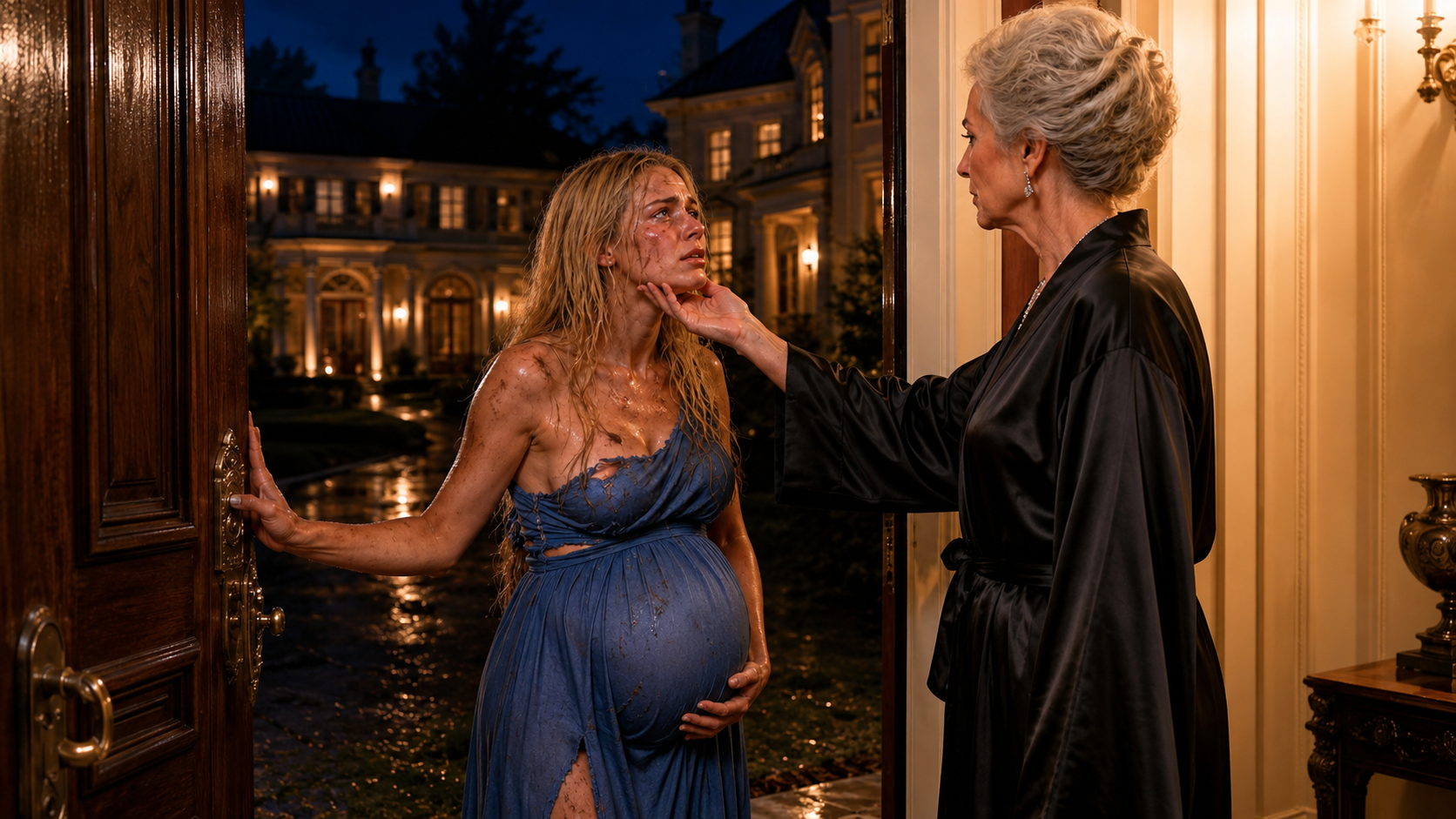
My daughter collapsed on my porch at midnight, barefoot, bruised, and clutching her pregnant belly.
“He said the police work for him, Mom,” she sobbed.
You May Also Like




Then my phone buzzed.
It was my son-in-law.
Send her back, or I’ll make sure you both lose everything.
I wiped my daughter’s tears, wrapped her in my robe, and poured myself a glass of scotch.
He thought he owned the local precinct.
He thought he owned the mayor.
He thought he owned the judges.
But he had made one fatal mistake.
He believed I was just a retired widow living quietly in an old brick house.
He had no idea I was Judge Victoria Sterling.
And six hours earlier, I had signed the federal wiretap warrant that would bring his entire criminal empire down by sunrise.
The Story
At midnight, my daughter collapsed on my porch like someone had thrown her there for the rain to finish.
She was barefoot.
Bleeding from one knee.
Her designer dress was torn at the shoulder and ripped across the side.
One hand clutched the iron railing.
The other was wrapped protectively around her seven-month pregnant belly.
For one second, I did not recognize her.
Not because she looked different.
Because no mother ever expects to open her door and find her child broken on the steps.
Then lightning flashed.
And I saw her face.
“Clara.”
She lifted her head.
Her eyes were swollen.
A purple bruise darkened beneath her cheekbone.
Rain ran down her hair, her neck, her trembling lips.
“Mom,” she whispered.
Then her knees gave out.
I caught her before she hit the porch.
For three seconds, I was only a mother.
Not Judge Victoria Sterling of the United States District Court.
Not the woman whose signature had frozen cartel accounts, seized warehouses, and sent men with private armies into federal custody.
Not the name whispered carefully in courtrooms by defense attorneys who knew I did not tremble easily.
Just a mother kneeling in the doorway, pulling her pregnant daughter into my arms while thunder cracked over the old brick steps.
“Clara, look at me,” I said. “Is the baby moving?”
She nodded, sobbing so hard her words came apart.
“Yes. I think so. I ran before he could—”
Her voice broke.
Before he could.
Those three words were enough to turn my blood cold.
I helped her inside.
Her bare feet left wet marks across the hallway floor.
She kept looking over her shoulder, as if the storm itself might open the door and drag her back.
“He said the police work for him, Mom,” she whispered. “He said no officer in this county would touch him.”
I locked the door.
Then I locked the deadbolt.
Then the second one.
Then the security latch.
Clara flinched at every sound.
“It’s okay,” I said softly. “You’re in my house now.”
She shook her head.
“No. You don’t understand. Dominic said if I ran to you, he would ruin you too.”
My phone buzzed on the hall table.
I looked down.
Dominic Ward.
My son-in-law.
The man who fooled my daughter with charity galas, hand-tailored suits, expensive flowers, and a wedding so grand the local papers called it “a union of two American dynasties.”
The same man who smiled beside me at fundraisers.
The same man who once held my hand and said, “Judge Sterling, I’ll spend my life protecting Clara.”
I opened the message.
Send her back, or I’ll make sure you both lose everything.
I stared at the words until they became perfectly clear.
Cold little bullets fired by a man who thought money made him untouchable.
Clara saw my face.
Her voice trembled.
“What did he say?”
I turned the phone screen away.
“Nothing important.”
“Mom.”
I looked at her.
Her eyes filled again.
“I’m not a child.”
“No,” I said gently. “Tonight, you are a daughter who made it home alive. That is enough.”
She broke then.
Not loud.
Not dramatic.
Just a painful collapse into the hallway bench as she pressed both hands over her belly and sobbed like she had been holding her breath for years.
I knelt in front of her.
“Tell me where you’re hurt.”
“My knee.”
“What else?”
“My shoulder.”
“What else?”
She looked away.
“Clara.”
Her lip trembled.
“He grabbed me by the arms. He threw my phone. He said if I screamed, he would tell everyone I was unstable.”
My fingers curled into fists.
“What happened tonight?”
She swallowed.
“I found papers.”
“What papers?”
She shook her head.
“I don’t know. Ledgers. Names. Police badges. Payments. He caught me taking pictures.”
The room became very still.
I had spent thirty-six years learning how to hear the truth underneath a frightened sentence.
Ledgers.
Names.
Police badges.
Payments.
I stood.
“Come with me.”
I led her into the living room and wrapped her in my cashmere robe. The robe swallowed her narrow shoulders. She looked too young, too frightened, too much like the little girl who used to run to me after nightmares.
I called the obstetrician I trusted with federal secrets.
“Dr. Park,” I said when she answered, “I need you at my house immediately. Clara is pregnant, assaulted, and in shock.”
Dr. Park’s voice changed at once.
“I’m leaving now.”
“Use the side entrance.”
“Understood.”
Then I poured one finger of scotch.
Not because I needed courage.
Because my hands had stopped shaking, and I wanted Dominic Ward to know that when I answered him, my voice would be steady.
Clara stared at me from the couch.
“Mom, what are we going to do?”
I kissed her forehead.
“We’re going to let him keep talking.”
Then I walked to the library.
Behind the third shelf of legal volumes was a biometric safe.
I opened it.
Inside was a sealed copy of the warrant I had signed six hours earlier.
Clara watched from the doorway, confused and afraid.
“What is that?”
I looked down at the federal seal.
“Dominic Ward does not own the local precinct,” I said. “He owns three officers, two councilmen, a port supervisor, and part of a smuggling network disguised as medical imports.”
Her face went pale.
“Mom…”
“And at dawn,” I said, “the federal government is coming for all of them.”
Dominic arrived at 12:37 a.m. with two black SUVs and the kind of confidence only criminals mistake for power.
His headlights washed across my porch.
Clara flinched so hard I felt it from across the room.
I placed one hand over hers.
“Look at me,” I said softly. “You are not going outside.”
The doorbell rang once.
Then came pounding.
Hard.
Entitled.
Dominic’s voice followed through the storm.
“Victoria,” he called. “Open the door before this becomes embarrassing.”
Clara’s eyes widened.
“He’s here.”
“I know.”
“He brought people.”
“I know.”
“Mom, please don’t open it.”
“I won’t open it for him.”
I walked to the foyer and opened the door with the security chain still latched.
Dominic Ward stood under the porch light in a navy suit, rain sliding off his shoulders. Somehow, even in the storm, his hair was neat, his gold watch gleaming.
Behind him stood Officer Miller from the county precinct.
I recognized him.
Everyone did.
He had been photographed at Dominic’s charity golf tournament three months earlier, smiling beside a giant check for “police community outreach.”
Miller rested one hand on his belt and avoided my eyes.
Dominic smiled.
“My wife is unstable,” he said smoothly. “Pregnant women get emotional. Send her out, and I’ll forget this little scene.”
I looked past him at Miller.
“You came with police for a family conversation?”
Miller cleared his throat.
“Ma’am, we’re here for a welfare check.”
“How generous.”
Dominic leaned closer to the small opening in the door.
“Don’t play clever with me, Victoria. Clara is carrying my heir. She belongs at my house.”
The word belongs moved through me like a blade being sharpened.
From the living room, Clara whispered, “Please don’t let him in.”
Dominic heard her and laughed.
“Sweetheart, stop performing. You’ll upset the baby.”
I lifted my phone.
“Say that again.”
His smile thinned.
“Record all you want. Who do you think they’ll believe? A hysterical wife? Or me?”
That was his first gift of the night.
Arrogance.
“I know every judge worth knowing in this state,” he continued. “I fund campaigns. I fund police foundations. I fund hospitals. People answer when I call.”
I smiled faintly.
“Federal judges do not run campaigns.”
For the first time, his eyes flickered.
Behind him, Officer Miller shifted his weight.
Dominic recovered quickly.
“Cute. You think a title protects you?”
“No,” I said. “Evidence does.”
His jaw tightened.
“You old women and your little speeches.”
I watched him carefully.
This was the man my daughter had married.
This smooth, cruel thing standing on my porch, threatening a pregnant woman through a door while calling it love.
“I’m going to say this once,” he said. “Open the door. Send Clara out. We will go home, and tomorrow everyone will pretend this never happened.”
I looked into his eyes.
“No.”
The word seemed to confuse him.
“No?”
“No.”
His face hardened.
“Miller.”
Officer Miller stepped forward.
“Judge Sterling, we need to verify Mrs. Ward is safe.”
I looked at his badge.
“Officer Miller, you are standing on my property at midnight with a man my daughter has accused of assaulting her. You have no warrant, no emergency access, and no authority to remove a pregnant adult from my home against her will.”
Miller’s mouth opened.
No words came out.
Dominic laughed.
“She’s quoting law at you, Miller. Do something.”
Miller looked at him, then at me.
For one second, shame crossed his face.
Then fear won.
“Ma’am,” he said, “I’m asking you to let us speak with her.”
“No.”
Dominic leaned closer.
“Do you know what happens to women who stand in my way?”
I heard Clara gasp behind me.
I held Dominic’s gaze.
“That threat was recorded.”
His eyes flashed.
Then his phone rang.
He glanced down, irritated, and stepped away to answer.
He did not know the line was live.
He did not know his private calls had been lawfully intercepted for weeks by a federal task force investigating cargo theft, witness intimidation, bribery, and narcotics concealed inside medical equipment shipments.
He did not know that earlier that evening, before Clara reached my porch, he had told his operations manager:
“If Clara runs to her mother, pressure the old woman. Burn her reputation if necessary.”
He turned his back slightly and snapped into the rain.
“Keep the trucks moving. No delays. The judge signed nothing. I’d know.”
I almost smiled.
No, Dominic.
You would not.
Inside, Dr. Park arrived through the side entrance with a medical bag and a face full of controlled alarm. Behind her entered a U.S. Marshal in plain clothes.
Marshal Dean Carter.
He nodded once.
“Safe house is ready.”
Clara gripped my sleeve.
“You’re sending me away?”
I cupped her face.
“I’m sending you somewhere he cannot reach.”
“And you?”
“I’m staying right here.”
“Mom—”
“He wanted an old woman on a porch,” I said. “Let’s give him one.”
Dr. Park checked Clara in the back room while the marshal waited near the side door.
I stood in the hallway, listening to my daughter answer medical questions through tears.
“Any cramping?”
“No.”
“Is the baby moving?”
“Yes.”
“Any bleeding?”
“No.”
“Can you breathe deeply?”
“I think so.”
Every answer felt like a verdict.
Alive.
Still safe.
Still fighting.
A few minutes later, Dr. Park stepped into the hall.
“She needs monitoring, but the baby’s heartbeat is strong.”
I closed my eyes.
For one second, I let myself feel relief.
Then the marshal said, “We need to move her.”
Clara came into the hallway, wrapped in my coat, still shaking.
“I don’t want to leave you.”
“You are not leaving me,” I said. “You are leaving his reach.”
“What if he comes after you?”
I smiled.
“Clara, I have put men worse than Dominic Ward in federal custody before breakfast.”
She almost laughed.
Almost.
Then she broke again.
“I should have told you sooner.”
I pulled her into my arms.
“No.”
“I was ashamed.”
“He built that shame to keep you quiet.”
“I thought if I loved him better—”
“Stop.”
She froze.
I softened my voice.
“Listen to me. A woman cannot love a cruel man into becoming safe.”
Her tears fell against my shoulder.
“He said I was nothing without him.”
I held her face between my hands.
“Then let me remind you who you are.”
She looked at me.
“You are Clara Sterling Ward only on paper. Before him, you were Clara Sterling. My daughter. Your father’s joy. A woman with a spine made of steel even when fear taught her to bend. And soon, you will be someone’s mother.”
Her hand moved to her belly.
“That child will never learn love from watching you disappear.”
Clara closed her eyes.
Then she nodded.
The marshal led her toward the side entrance.
Before she left, she turned back.
“Mom?”
“Yes?”
“Make him stop.”
I looked toward the front door, where Dominic’s shadow moved under the porch light.
“I already started.”
At 2:10 a.m., Dominic texted again.
Last chance. By morning, you’ll wish you had obeyed.
I forwarded the message to the federal prosecutor.
Then I sat by the front window with my glass of scotch and watched Dominic’s SUVs idle in the storm.
He stayed for forty-two minutes.
Pacing.
Calling.
Texting.
Threatening.
Officer Miller remained near the second SUV, soaked through his uniform, looking less like law enforcement and more like a man realizing he had chosen the wrong master.
At 2:58 a.m., Dominic approached the door again.
“Victoria,” he called. “You still have time.”
I did not answer.
He hit the door once with his fist.
“You think your robe and your judge title make you untouchable?”
I let the security camera record every word.
“You think I won’t bury both of you?”
Another recording.
“You think Clara can raise my child away from me?”
Another recording.
“I own this county.”
Another recording.
Finally, at 3:19 a.m., he left.
The SUVs disappeared into the rain.
I sat alone in the living room.
For the first time since Clara collapsed on my porch, the house became quiet.
But it was not peaceful.
Not yet.
I walked into the guest room where she had been examined. Her wet dress lay folded in a medical evidence bag. Dr. Park had written notes in a neat, careful hand.
Bruising.
Shock.
Protective response over abdomen.
Possible coercive control.
My daughter’s pain had become documentation.
I hated that.
I was grateful for it.
Both truths sat beside each other like two knives.
At 4:06 a.m., the federal prosecutor called.
“Judge Sterling,” he said.
“Don’t call me Judge on this line.”
A pause.
“Victoria.”
“Better.”
“Clara is safe. The marshal delivered her to the protected location. Medical team is with her.”
I breathed.
“Thank you.”
“Dominic made more calls after leaving your home. We have him directing movement from Warehouse 9.”
“Enough?”
“More than enough.”
“Then move at dawn.”
“We are.”
I looked toward the window. The sky was still black, but somewhere behind it, morning was gathering its strength.
“Counsel,” I said, “the moment my daughter became a victim witness, I became conflicted. You know what to file.”
“Already prepared.”
“Good.”
“You should rest.”
I almost laughed.
“No mother rests on a night like this.”
At 6:04 a.m., Dominic Ward walked into his downtown headquarters carrying coffee and a smile.
By 6:06, both were gone.
Federal agents came through the glass doors in tactical jackets, calm and fast, spreading through the marble lobby like a verdict.
At the same time, warrants hit his warehouses.
His lake house.
His private airstrip.
His financial office.
The county precinct’s evidence room.
His charity foundation.
And Warehouse 9 near the port, where imported medical equipment crates hid packages that had never belonged in any hospital.
Phones lit up across the city.
Councilman Hayes arrested.
Officer Miller detained.
Ward Logistics sealed.
County evidence room under federal control.
Dominic tried to call the police chief.
No answer.
He tried the mayor.
Voicemail.
He tried Officer Miller.
Federal custody.
He tried Clara.
A federal agent took the phone from his hand.
I watched the first reports from my kitchen, wearing the same robe Clara had worn hours earlier.
The television showed Dominic being led outside beneath a gray morning sky, wrists cuffed in front of him, cameras flashing like lightning.
He saw the reporters and shouted:
“This is political! I’m being framed!”
Then he saw me.
I stood across the street beside the federal prosecutor.
Not presiding.
Not pretending neutrality where my child was concerned.
I had already disclosed the conflict and stepped aside from any judicial role touching Dominic’s case the moment Clara became a victim witness.
That was the difference between power and corruption.
Power obeyed rules.
Corruption screamed when rules finally arrived.
Dominic’s face twisted.
“You did this?”
I walked close enough for him to hear me over the cameras.
“No,” I said. “You did. I only signed where the evidence pointed.”
His eyes burned with hate.
“You’ll regret this.”
I tilted my head.
“That threat was recorded too.”
The prosecutor smiled faintly.
“Thank you, Mr. Ward.”
For one beautiful second, all his money could not buy him silence.
Then a black federal vehicle pulled up.
Clara stepped out with a marshal beside her.
She wore flat shoes.
A long coat.
No makeup.
The bruise on her face was visible to every camera.
Dominic went pale.
“Clara,” he said. “Don’t.”
She walked toward him slowly.
Her hand rested on her belly.
She was still afraid.
I could see it.
But fear was no longer steering her.
“You told me nobody would believe me,” she said.
Dominic shook his head.
“Clara, sweetheart—”
“No,” she said. “You do not get to call me that anymore.”
The reporters went silent.
Cameras zoomed in.
She looked at the federal agents.
Then at the prosecutor.
Then at me.
Finally, she looked at Dominic.
“So I brought everyone.”
Those four words destroyed what remained of him.
But Dominic Ward did not fall alone.
Men like him never do.
They build ladders out of weaker men.
Investigators found bribery ledgers hidden inside a false wall in his private office.
Offshore accounts connected to council members.
Payments to Officer Miller and two other police officers.
Falsified charity records showing money meant for maternal health clinics being routed into shell companies.
Cargo manifests that did not match warehouse inventories.
Text messages ordering “pressure” on witnesses.
Videos from his own security system.
Dominic had believed cameras protected him.
Instead, they testified against him.
One video showed Clara standing in his study two weeks before she ran to me.
She was holding a folder.
Dominic stood near the fireplace.
“You don’t understand what you found,” he said.
Clara’s voice shook.
“Then explain it.”
He laughed.
“Pregnant women should not worry their pretty heads over business.”
“I saw police badge numbers.”
His smile vanished.
“Put the folder down.”
“No.”
The screen showed him moving toward her.
The recording stopped there, but the message was clear.
My daughter had been living inside a house full of evidence and danger.
And still, she had found the courage to take pictures.
Still, she had hidden copies.
Still, she had run.
When the prosecutor showed me the file Clara had created, the label made my chest ache.
For Mom, if I disappear.
Inside were photos of ledgers.
Screenshots.
Voice recordings.
Dates of threats.
Names of officers.
Notes about shipments.
And one video Clara recorded in a locked bathroom, whispering into her phone.
“Mom, if you’re watching this, I’m sorry I didn’t tell you sooner. I thought I could manage him. I thought if I gave him the baby, he would soften. But he doesn’t want a family. He wants ownership.”
I had to stop the video.
The prosecutor looked away while I gathered myself.
When I could breathe again, I said, “Use everything she gives you.”
“Victoria,” he said gently, “she wants to testify.”
I closed my eyes.
Of course she did.
She was my daughter.
Terrified, wounded, pregnant—and still stubborn enough to walk toward truth.
Dominic’s mother arrived at the courthouse three days later.
Margaret Ward.
A tall woman with silver hair, black gloves, and the cold elegance of old money trying to pretend it had not been touched by crime.
She had never liked Clara.
At the wedding, she told me, “My son needs a wife who understands legacy.”
I had replied, “My daughter understands truth. That should be enough.”
Margaret had smiled.
“Truth is often inconvenient.”
Now she entered the courthouse flanked by attorneys.
I was standing near the hallway window when she approached me.
“Victoria.”
“Margaret.”
Her gaze moved over me.
“You must be pleased.”
“No mother is pleased when her daughter is bruised.”
Her mouth tightened.
“This could have been handled privately.”
I stared at her.
“That sentence has buried more women than cemeteries.”
Her eyes flashed.
“Dominic is my son.”
“And Clara is my daughter.”
“He has rights to his child.”
I stepped closer.
“A child he referred to as leverage in an intercepted call.”
Margaret’s face flickered.
She had not known that part.
Good.
Let truth bruise her too.
“He was angry,” she said.
“No,” I replied. “He was honest.”
She lowered her voice.
“You cannot keep my grandchild from me.”
“Watch me do it lawfully.”
Her jaw tightened.
“You Sterlings always think the law belongs to you.”
“No,” I said. “We think everyone belongs under it. That is what frightens people like you.”
Margaret stared at me for a long moment.
Then she said, “Dominic will not go down alone.”
I smiled faintly.
“He already hasn’t.”
Her face went still.
That was the second twist Dominic never saw coming.
Margaret Ward’s name was in the ledgers too.
Not as a victim.
Not as an innocent mother.
As the woman who signed off on “foundation disbursements” that moved bribery money through charity accounts.
Dominic had inherited more than money.
He had inherited a system.
And my daughter had married into it.
The first hearing drew every reporter in the city.
Dominic’s attorney stood before the judge and argued that the arrest was political, the wiretap overbroad, and Clara emotionally unstable.
When he said those words, Clara’s hand tightened around mine.
Emotionally unstable.
The oldest weapon in the world against a woman who tells the truth.
The prosecutor stood.
“Your Honor, the government has recordings of Mr. Ward threatening Mrs. Ward, instructing associates to intimidate witnesses, directing shipments tied to contraband, and discussing payments to law enforcement officials.”
Dominic sat still.
Perfect suit.
Perfect posture.
Perfect predator caught in daylight.
Then the prosecutor played the porch audio.
Dominic’s voice filled the courtroom.
“Clara is carrying my heir. She belongs at my house.”
A murmur moved through the room.
The judge’s face remained neutral, but his pen stopped moving.
Then came another clip.
“You think I won’t bury both of you?”
Then another.
“I own this county.”
Officer Miller lowered his head at the defense table where he sat separately with his own counsel.
The prosecutor looked at the judge.
“The defendant does not merely pose a flight risk. He poses a documented intimidation risk.”
Bail was denied.
Dominic’s face did not change until the judge said he would remain detained.
Then he turned and looked at Clara.
Not pleading.
Not sorry.
Furious.
Clara lifted her chin.
For the first time since midnight on my porch, she did not look away.
The trial took ten months to begin.
By then, Clara had given birth.
A girl.
A tiny, furious, perfect little girl with my eyes and Clara’s stubborn chin.
We named her Hope.
Clara chose it.
Not because everything was fixed.
Because everything was not.
Hope is not the absence of fear.
It is the decision that fear will not name the future.
The first time Clara held her, she cried so hard the nurse cried with her.
“I thought he would take her,” Clara whispered.
I stroked her hair.
“He won’t.”
“What if one day she asks about him?”
“Then we tell her the truth in pieces small enough for her age and strong enough for her dignity.”
Clara looked at Hope’s tiny hand.
“I don’t want her to come from him.”
I understood what she meant.
I also knew what she needed to hear.
“She comes through you,” I said. “Not from him.”
Clara pressed Hope to her chest.
That became our family truth.
Hope came through Clara.
Through pain.
Through courage.
Through a storm.
Through a locked door.
Through a mother who ran.
Not from Dominic.
Toward safety.
When Clara testified, the courtroom was full.
Dominic watched her as she walked to the stand.
Margaret Ward sat behind him, her pearls gone, her hair still perfect, her face carved from ice.
Clara wore navy.
No jewelry except a small silver necklace with Hope’s initial.
The prosecutor asked gentle questions first.
“How long were you married to Dominic Ward?”
“Three years.”
“When did the controlling behavior begin?”
“Before the wedding. I just didn’t know what to call it yet.”
“What did it look like?”
Clara breathed slowly.
“He called it protection. He wanted to know where I was. Who I talked to. What I spent. At first, it sounded like love. Then it became rules.”
“Did he threaten you?”
“Yes.”
“How?”
“He said no one would believe me. He said the police worked for him. He said my mother’s reputation could be destroyed.”
Dominic’s attorney stood for cross-examination with the polite smile of a man preparing to cut.
“Mrs. Ward,” he said, “you were aware your mother was a federal judge.”
“Yes.”
“You understood that your accusations against your husband could trigger enormous pressure.”
Clara looked at him.
“My bruises triggered pressure.”
A ripple passed through the courtroom.
He adjusted his glasses.
“You were emotional that night.”
“I was afraid.”
“Pregnant women can experience intense emotions, correct?”
Clara did not flinch.
“Yes. Especially when their husbands threaten them.”
The attorney’s smile faded.
“You had access to your mother’s legal connections.”
“I had access to my mother’s porch.”
The room went silent.
Clara continued.
“I ran there barefoot, bleeding, and scared for my baby. That is the connection that saved me.”
The attorney closed his folder sooner than expected.
Dominic did not look at Clara after that.
Margaret Ward’s testimony was colder.
She denied knowing about the full syndicate.
She denied understanding the payments.
She denied approving intimidation.
Then prosecutors showed foundation records.
Her signature.
Her emails.
Her voice on a call with Dominic.
“The Sterling girl is becoming inconvenient,” Margaret said in the recording.
Dominic replied, “I can handle Clara.”
Margaret answered, “Then handle her before the baby arrives. Once there is a child, everything becomes more complicated.”
In the courtroom, Clara inhaled sharply.
I reached for her hand.
Margaret’s face went gray.
The prosecutor asked, “Mrs. Ward, when you said ‘handle her,’ what did you mean?”
Margaret’s mouth opened.
No answer came.
Sometimes silence is the only confession powerful people cannot polish.
Dominic was convicted on racketeering, bribery, witness intimidation, conspiracy, and related charges.
Margaret took a plea deal after two more foundation executives agreed to testify.
Officer Miller pleaded guilty and named two other officers.
Councilman Hayes cried on the stand.
The police chief resigned.
Three warehouses were seized.
The charity foundation was dissolved and its remaining funds redirected to victim protection programs and maternal health clinics—the very women and children the Ward name had pretended to support.
When Dominic was sentenced, he asked to speak.
Of course he did.
Men like him always believe they deserve the final word.
He turned toward Clara.
“I loved you,” he said.
She sat still.
“I made mistakes.”
The judge watched him carefully.
Dominic continued.
“I was under pressure. Business pressure. Family pressure. Political pressure. Clara misunderstood things that were never meant to hurt her.”
Clara stood.
Her attorney touched her arm.
She shook her head.
The judge allowed her to speak.
She walked to the podium holding a folded paper, but when she looked at Dominic, she did not read from it.
“You did not love me,” she said. “You loved access. You loved control. You loved the child as an heir before she was even born. You loved the word mine more than any person you ever claimed to protect.”
Dominic stared at her.
She continued.
“You told me the police worked for you. You told me no one would believe me. You told me my mother would lose everything.”
Her voice shook only once.
“But my daughter will grow up knowing this: power is not the ability to frighten people. Power is the courage to tell the truth when someone has trained you to whisper.”
Dominic looked away first.
That was the closest thing to victory Clara needed.
Years passed.
Not easily.
No one heals from fear just because a courtroom says guilty.
Clara had nightmares.
She hated black SUVs.
She panicked when unknown numbers called.
Some days, she felt strong.
Some days, she felt foolish for ever loving him.
On those days, I made tea and said the same thing every time.
“Loving a mask does not make you foolish. It makes him a liar.”
Hope grew.
She learned to crawl across my library rug.
Then walk.
Then climb onto the bench by the piano and bang the keys like she was cross-examining music itself.
Clara laughed more.
At first, softly.
Then fully.
One summer evening, she stood barefoot on my porch again.
This time, there was no rain.
No blood.
No torn dress.
No fear.
Hope slept against her shoulder, one fist curled beneath her chin.
The sunset burned gold across the lawn.
Clara looked at the steps where she had collapsed years earlier.
“Do you ever think about that night?” she asked.
“Every day.”
She looked at me.
“Does it make you angry?”
“Yes.”
“Still?”
“Anger is not the problem,” I said. “Where we put it matters.”
She smiled faintly.
“Spoken like a judge.”
“Spoken like a mother.”
She looked down at Hope.
“I used to think safety meant being locked away from danger.”
“And now?”
“Now I think safety means having doors that open when you need to run.”
I swallowed hard.
“That is a good definition.”
She leaned her head against my shoulder.
“Mom?”
“Yes?”
“Thank you for opening the door.”
I kissed Hope’s hair.
“I always will.”
One year after Dominic’s sentencing, Clara created The Porch Fund.
She used part of the restitution awarded to her and money recovered from the dissolved Ward charity.
The fund helped pregnant women escaping abuse, especially those whose abusers had connections to police, politics, or money.
The first safe house was an old brick home two counties away.
On the front door, Clara placed a small brass plaque:
You are believed here.
At the opening ceremony, reporters came.
Advocates came.
Federal marshals stood discreetly near the back.
I sat in the front row holding Hope, who kept trying to steal my reading glasses.
Clara stepped to the microphone.
She looked nervous.
Then she looked at the porch.
And her face changed.
“My story did not begin the night I ran,” she said. “It began the first time I explained away a cruel sentence because it came wrapped in charm.”
The crowd went quiet.
She continued.
“I used to think abuse had to look obvious. I thought if a man wore a suit, funded hospitals, smiled at galas, and kissed his wife in public, then the fear behind closed doors must be too complicated to name.”
Her voice trembled.
“It was not complicated. It was control.”
I held Hope tighter.
Clara looked at the women standing near the back.
“So this house is for the woman who is still telling herself, ‘It isn’t that bad.’ It is for the woman whose husband knows officers by name. It is for the woman who has been told no one will believe her. It is for the mother who runs with one shoe, no bag, no plan, and a child inside her.”
Her eyes found mine.
“And it is for the doors that open.”
People stood before she finished.
Not because the speech was polished.
Because it was true.
Hope was four when she asked about her father for the first time.
We were baking blueberry muffins in my kitchen.
She had flour on her nose and an extremely serious expression.
“Grandma?”
“Yes, little star?”
“Do I have a daddy?”
Clara froze at the sink.
I looked at her.
She turned slowly.
This was her question to answer.
She dried her hands and knelt in front of Hope.
“Yes,” Clara said softly. “You have a father.”
“Where is he?”
Clara’s lips trembled.
“He made choices that hurt people. So he cannot live with us.”
Hope frowned.
“Did he hurt you?”
Clara closed her eyes briefly.
Then opened them.
“Yes.”
Hope looked down at the mixing bowl.
“Did he hurt me?”
Clara pulled her close.
“He tried to make our life unsafe. But you were protected. And you are loved.”
Hope thought about that.
Then she asked, “Can I still have muffins?”
Clara laughed and cried at the same time.
“Yes,” she said. “You can still have muffins.”
Later, after Hope ran outside to chase butterflies, Clara sat beside me on the porch.
“That was hard,” she whispered.
“Yes.”
“Did I say enough?”
“You said the truth she could carry.”
Clara nodded.
“I don’t want hate to be her inheritance.”
I looked at Hope in the yard, laughing beneath the sun.
“It won’t be.”
Ten years after the midnight storm, I retired.
This time, truly.
No chambers.
No emergency warrants.
No late-night calls from prosecutors.
At my retirement dinner, people spoke about my career.
The cases.
The rulings.
The sentences.
The integrity.
The courage.
But when Clara stood to speak, she did not mention my most famous opinions.
She looked at the room full of judges, attorneys, marshals, clerks, and family friends.
Then she said:
“My mother spent her life believing in the law. But the night I came to her porch, she taught me something deeper. Law matters because people matter. Evidence matters because victims matter. Power matters only when it protects the vulnerable instead of protecting itself.”
Her voice softened.
“I used to think my mother was fearless. Now I know she was afraid that night. She opened the door anyway.”
I cried then.
Quietly.
Hope, now ten years old, leaned against me and whispered, “Grandma, are you crying because Mom is good at speeches?”
I laughed through tears.
“Yes.”
Hope nodded.
“She gets it from you.”
That night, after everyone left, Clara and I stood once more on the porch.
The same porch.
The same old brick steps.
No rain this time.
Only moonlight.
She touched the railing.
“I can still see myself there sometimes.”
“So can I.”
“Does that ever go away?”
I thought carefully.
“No. But it changes shape.”
She looked at me.
“How?”
“At first, it is the place where terror found you. Then it becomes the place where help answered. One day, it becomes the place where you stand and realize you survived.”
Clara smiled softly.
“I survived.”
“Yes,” I said. “You did.”
From inside, Hope shouted, “Grandma! Mom! The muffins are ready!”
Clara laughed.
“Muffins at ten at night?”
I shrugged.
“I’m retired. The court has lost jurisdiction over my kitchen.”
She laughed harder than the joke deserved.
So did I.
And for a moment, the porch held everything.
The storm.
The fear.
The door opening.
The warrant.
The trial.
The baby.
The years.
The healing.
The laughter.
Justice does not always look like thunder.
Sometimes it looks like a safe house with a brass plaque.
A child asking hard questions over muffin batter.
A daughter standing barefoot on a porch without fear.
A mother who was underestimated by the wrong man.
Dominic Ward once told my daughter the police worked for him.
He told her no one would believe her.
He told her she had nowhere to run.
But he forgot something men like him always forget.
Sometimes the woman they threaten has already found the door.
Sometimes the mother they dismiss has spent a lifetime learning how powerful men fall.
And sometimes, by the time a cruel man says, “Last chance,” justice has already signed his name.
Dominic thought he owned the police, the politicians, and my daughter’s future. But the night Clara ran barefoot to my porch, bruised and pregnant, he exposed the one weakness every corrupt man has: arrogance. By sunrise, his warehouses were sealed, his officers were detained, his mother’s charity was exposed, and the woman he called powerless became the witness who helped bring his empire down.