Thirty Elderly Strangers Dressed in Black Came to My Door — Then They Told Me the Truth About My Birth Mother
A Crowd of Elderly People in Black Filled My Yard — I Thought It Was a Funeral, But They Had Come to Confess a 35-Year Secret
I opened my front door expecting a quiet Saturday.
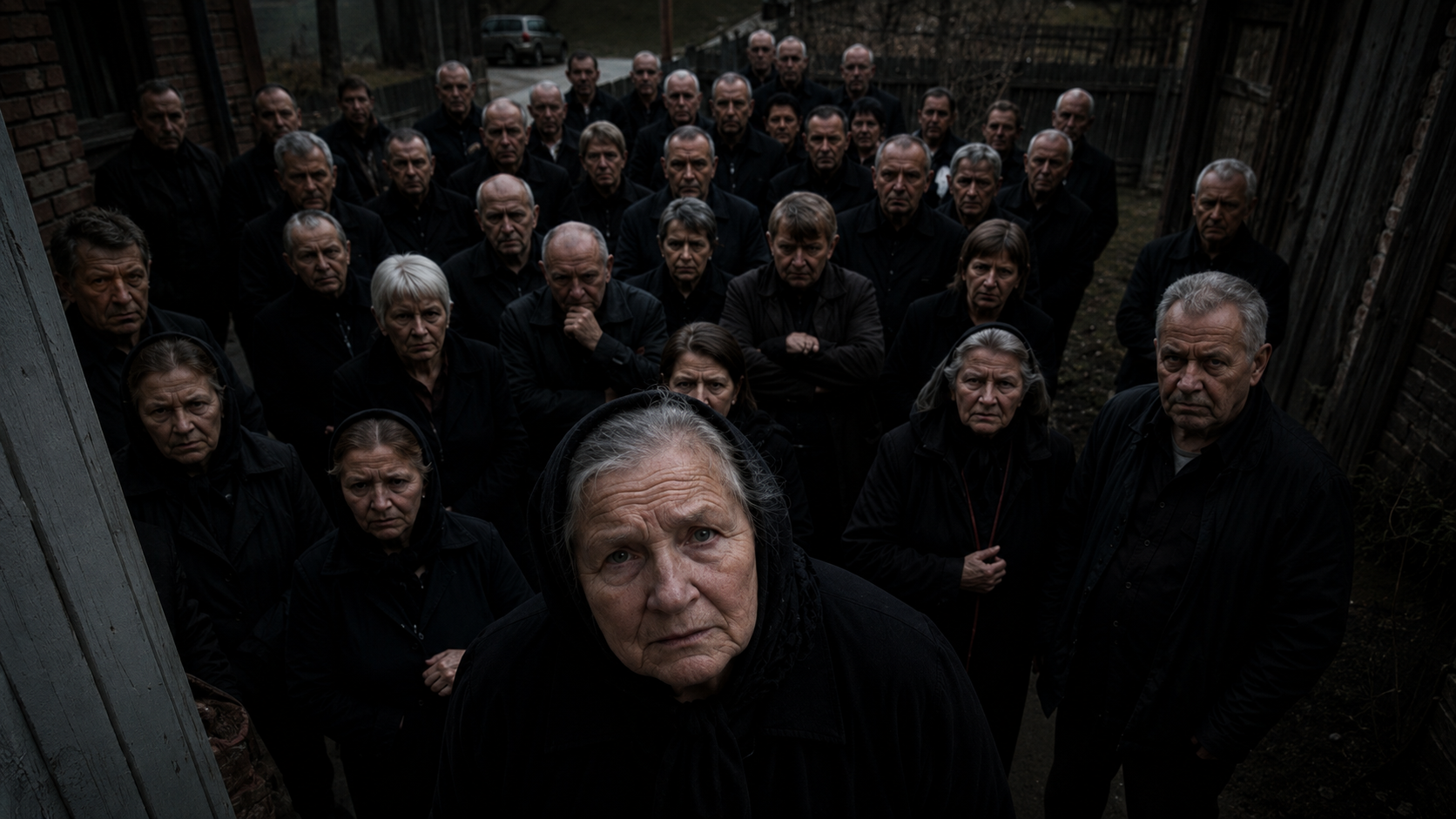
Instead, thirty elderly strangers stood in my yard, all dressed in black.
You May Also Like




Some carried white flowers.
Some held old photographs.
Some were crying before I even knew their names.
Then one woman stepped forward with a cane and asked:
“Your name is Elizabeth, isn’t it?”
My heart stopped.
I had never met her before.
But when she said my birth mother’s name, the world I knew cracked open.
They had not come for a funeral.
They had come to bury a shame they had carried for thirty-five years.
And what they brought with them was the truth about why I was given away.
The Story
It was supposed to be a quiet Saturday.
My husband, Ben, had taken our two children on a fishing trip the day before, which meant that for the first time in months, the house belonged only to me.
No cartoons playing too loud.
No cereal bowls abandoned in the sink.
No little voices asking where their socks, shoes, crayons, or favorite dinosaur had disappeared to.
Just silence.
Beautiful silence.
I spent the morning drinking coffee, folding the last load of laundry, and watching an old black-and-white comedy I had seen at least ten times before. The house felt peaceful in a way it rarely did.
The kitchen was clean.
The hallway was clear.
Even the couch pillows were exactly where they belonged.
Around noon, I made another cup of coffee and settled into the living room.
That was when I heard the voices.
At first, I ignored them.
Our neighborhood was usually quiet, but people sometimes stopped to talk while walking their dogs or watering their gardens. A few voices outside were nothing strange.
Then the voices grew louder.
Not angry.
Not excited.
Just many.
Too many.
I paused the movie and walked toward the front window.
The moment I looked out, my coffee mug almost slipped from my hand.
My driveway was full of people.
Not five.
Not ten.
At least thirty.
All elderly.
All dressed in black.
Some stood on the grass.
Some lined the driveway.
Some held white flowers in their hands.
One man clutched a bouquet of lilies against his chest like he was afraid they might fall apart.
A woman near the mailbox held an old photograph so tightly her fingers had turned pale.
Nobody was laughing.
Nobody looked confused.
They were all staring at my house like they had arrived for a funeral.
My heart began pounding.
“What in the world…”
I rushed to the front door and opened it.
The moment I stepped onto the porch, every conversation stopped.
Thirty unfamiliar faces turned toward me at once.
The silence was so sudden that it felt physical.
I tightened my grip on the doorframe.
“Can I help you?”
No one answered at first.
Then an elderly woman stepped forward.
She was probably around seventy-five, dressed in black from her coat to her shoes. A black scarf covered her gray hair, and she leaned heavily on a wooden cane.
Her face was lined with age, but her eyes were sharp.
Sad.
Almost afraid.
She looked at me for several seconds before speaking.
“Elizabeth,” she said softly. “Your name is Elizabeth, isn’t it?”
My stomach tightened.
“Yes,” I answered slowly. “Who are you?”
The woman swallowed.
“My name is Martha Bell.”
I waited.
She glanced behind her at the crowd, then back at me.
“We’re from Ashton.”
“I don’t know any place called Ashton.”
“It’s a small town about three hours from here.”
“Okay,” I said, folding my arms across my chest. “And why are thirty strangers from Ashton standing in my yard dressed like they’re going to a funeral?”
A few of the people lowered their heads.
Martha gripped her cane tighter.
“We have come because someone in this house has been part of our story for thirty-five years.”
I stared at her.
“What does that mean?”
“It means,” she said quietly, “we may have found the person we should have protected a long time ago.”
A cold feeling moved through me.
“I think you have the wrong house.”
“I hope we don’t,” Martha whispered.
Behind her, an elderly man stepped forward. He wore a black suit that looked too large for him, and his hands trembled around the bouquet of white lilies.
“My name is Walter,” he said. “We don’t want to frighten you.”
“You are thirty people in black standing on my lawn,” I said. “You are a little late for that.”
A few of them looked ashamed.
Another woman, slightly younger than Martha, stepped forward.
“I’m Agnes,” she said gently. “Please. We’re not here to hurt you.”
“Then why are you here?”
Martha looked directly into my eyes.
“We’re here because of a woman named Grace.”
The name meant nothing to me.
But the way they said it made the hair on my arms rise.
“Grace who?”
“Grace Miller,” Martha said.
“I don’t know her.”
“We didn’t expect you to.”
“Then why are you here?”
Martha reached carefully into her coat pocket.
I stepped back.
“Please don’t come closer.”
She stopped immediately.
“I won’t.”
She pulled out an old newspaper clipping, yellowed with age and folded so many times the corners had weakened.
She opened it slowly and held it out, not forcing me to take it.
The photo was grainy and black-and-white.
A group of people stood in front of a small white church.
In the middle was a young woman with dark hair, a gentle smile, and eyes that looked strangely familiar.
I frowned.
“Who is she?”
Martha’s voice trembled.
“Grace.”
I looked at the photo again.
“I told you, I don’t know her.”
“No,” Martha said. “But she knew you.”
My mouth went dry.
“What?”
“She knew a baby girl named Elizabeth.”
I stared at her.
For a moment, the only sound was the wind moving through the trees.
Then I said, “How do you know my name?”
Martha looked at Agnes.
Agnes looked away.
Walter pressed the lilies closer to his chest.
I felt my pulse quicken.
“Answer me.”
Martha’s voice dropped.
“Were you adopted?”
The word hit me so hard I forgot how to breathe.
It was not a secret exactly.
Ben knew.
Our children knew.
My closest friends knew.
But I rarely talked about it.
My adoptive parents had loved me with everything they had, and I had never wanted anyone to think I was searching for a replacement family.
Still, somewhere deep inside me, there had always been a small locked room full of questions.
Why was I given away?
Did she hold me first?
Did she cry?
Did she forget me?
I took one step back.
“Who told you that?”
“No one,” Martha said quickly. “We didn’t know. We only suspected.”
“You suspected what?”
“That you might be Grace’s daughter.”
The world tilted slightly.
I looked past Martha at the people standing in my yard.
All in black.
All watching me with grief in their faces.
My voice came out barely above a whisper.
“What happened to Grace?”
Martha’s eyes filled.
“That is why we came.”
I almost shut the door.
I almost told them to leave.
I almost called the police.
But something stopped me.
Maybe it was the photo.
Maybe it was the name Elizabeth written into a story I had never been told.
Maybe it was the fact that none of them looked like people who had come to take something.
They looked like people carrying something too heavy to hold any longer.
I glanced at the street.
My neighbor Ruth stood across the road, pretending to water flowers while openly staring.
A teenage boy had stopped on his bike and was recording everything on his phone.
Curtains were moving in nearly every house.
The whole neighborhood was watching.
I rubbed my forehead.
“This is not the place for this conversation.”
Martha nodded.
“We know.”
“You can’t all come inside.”
“We understand.”
I looked at the crowd again.
“Only three of you.”
Martha turned to the others.
“Please wait here.”
No one argued.
That unsettled me more than if they had protested.
They simply nodded and remained in place, still holding flowers, still dressed for mourning.
I led Martha, Agnes, and Walter into my living room.
They sat carefully on the couch like they were afraid to disturb the furniture.
I sat across from them in my armchair, phone in my lap, ready to call Ben or the police if things became strange.
Martha noticed.
“You should feel safe,” she said. “Keep your phone.”
“I plan to.”
She nodded.
“Good.”
For a few seconds, none of us spoke.
Then Agnes looked around the room.
“You have a beautiful home.”
“Thank you.”
“Children?”
“Two.”
Her eyes softened.
“Grace would have liked that.”
The name made my chest tighten.
“Tell me who she was.”
Martha unfolded the old newspaper clipping and laid it on the coffee table.
“Grace Miller lived in Ashton thirty-five years ago. She was kind. Quiet. A little shy. She sang in the church choir and worked at the bakery near Main Street.”
Walter looked down at his hands.
“She made cinnamon rolls every Friday morning. People lined up before sunrise for them.”
Agnes smiled sadly.
“She had a laugh that made people turn around.”
“Then what happened?” I asked.
Martha’s smile faded.
“She became pregnant.”
Silence.
I understood before she said more.
“She wasn’t married?”
“No,” Martha said.
Walter closed his eyes.
“And Ashton was not kind to unmarried pregnant women back then.”
Agnes’s voice grew thick.
“People whispered. People judged. Some stopped speaking to her. Some crossed the street when she passed.”
Walter opened his eyes.
“I was one of them.”
I looked at him.
He swallowed hard.
“I never called her names. I never threw stones. I never shouted at her.”
He pressed his hand over his chest.
“But I also never defended her. And sometimes silence is just cowardice wearing clean clothes.”
No one spoke for a moment.
Martha continued.
“Grace carried the baby quietly. She kept working as long as she could. One day, she stopped coming to the bakery. A week later, she disappeared.”
“Disappeared?”
Martha nodded.
“Not long after, a burned car was found outside town. There were remains inside. People believed it was Grace.”
My hand tightened around my phone.
“You believed she died?”
“Yes.”
“And you held a funeral?”
“We did,” Agnes whispered.
Walter looked toward the window.
“Empty coffin. Closed service. White lilies.”
I looked toward my front yard, where the others were still waiting.
“That’s why everyone brought flowers.”
Martha nodded.
“For thirty-five years, we believed we had mourned Grace.”
“But now you don’t?”
Martha reached into her handbag and removed a bundle of old envelopes tied together with blue ribbon.
“We found these four months ago.”
She placed them on the table.
“They were discovered during renovations at the old church. A storage room was being cleared out. Behind a cabinet, someone found a small box. Inside were these letters.”
Agnes touched the top envelope.
“They were written by Grace.”
My throat tightened.
“To who?”
“To Pastor Samuel,” Martha said. “He died years ago. We believe he hid them and never mailed them.”
“Why would he hide them?”
Walter’s face darkened.
“Because some men love reputation more than truth.”
Martha opened the first letter carefully.
“I think you should read it.”
My hands shook as I took the fragile paper.
The handwriting was neat and slanted.
The first line made my breath catch.
If you are reading this, it means I left before I found the courage to say goodbye.
I kept reading.
I cannot stay in Ashton. Not because I am ashamed of my daughter, but because everyone else has decided she should carry shame that does not belong to her.
My vision blurred.
Daughter.
I looked up.
Martha was crying silently.
I looked down again.
Her name is Elizabeth. I named her after my grandmother, who was the only woman in my family who ever taught me that love could be gentle.
I pressed my hand to my mouth.
Agnes whispered, “We are so sorry.”
I kept reading.
I am arranging a private adoption. If someone kind raises her, she will have a better life than I can give her here. Please do not let anyone tell my daughter I did not love her. I am not leaving because she is unwanted. I am leaving because she is worth more than this town will allow me to give.
A sound broke from my chest.
For thirty-five years, I had told myself I was fine.
I had wonderful parents.
A happy childhood.
A husband who loved me.
Children of my own.
I did not need answers.
That was what I always said.
But the little girl inside me had never stopped wondering.
Was I too much?
Was I a mistake?
Was I forgotten?
Now, on a quiet Saturday, surrounded by strangers in black, I held the answer in my hands.
I had not been abandoned.
I had been protected.
I cried for a long time.
Not loud sobbing.
Not the kind of crying people do in movies.
Just quiet tears that would not stop.
Martha handed me tissues.
Agnes kept whispering, “Take your time.”
Walter sat with his head bowed, the lilies across his knees.
Finally, I said, “My adoptive parents loved me.”
Martha smiled through tears.
“Then Grace’s prayer was answered.”
“They were good people,” I said. “My mom made pancakes every Saturday. My dad taught me to ride a bike. They came to every school play, even when I only had one line.”
Agnes wiped her eyes.
“Grace would have wanted to know that.”
I looked at the letter again.
“She didn’t hate me.”
Walter shook his head.
“No.”
“She didn’t throw me away.”
“No,” Martha said. “She gave you away with love because she believed staying would hurt you.”
I held the paper against my chest.
“Did she die in that car?”
The three exchanged a look.
That look made my stomach drop.
“What?”
Martha folded her hands.
“This is where the story becomes more difficult.”
I sat straighter.
“What does that mean?”
Agnes looked at Martha.
Martha nodded slowly.
“The remains in the burned car were recently tested because another family from Ashton reopened a missing-person case.”
Walter added, “The woman in the car was not Grace.”
My heart stopped.
“What?”
Martha’s voice shook.
“Grace did not die that day.”
I stood up so quickly the coffee table rattled.
“Are you telling me my birth mother might still be alive?”
Agnes’s eyes filled again.
“We don’t know.”
“How can you not know?”
Martha reached into the bundle and pulled out another envelope.
“Because Grace left Ashton under a different name.”
She handed me another letter.
This one was shorter.
The paper was more worn, as if it had been carried for a long time.
Pastor Samuel,
I know you told me to stay quiet. I know you said the town would never forgive me. But I need someone to know the truth. I am leaving with help from a woman named Ruth Calder. She says she can place Elizabeth safely. After that, I will go where no one knows me. If anyone asks, let them believe I died. A dead woman cannot be chased. A dead woman cannot be shamed. A dead woman cannot have her baby taken.
I lowered the letter.
“Ruth Calder?”
Martha nodded.
“She was a midwife who sometimes helped women leave difficult situations. She died twenty years ago.”
“Did she arrange my adoption?”
“We believe so.”
I sat down slowly.
“So Grace lived.”
“Yes.”
“And nobody looked for her?”
Walter’s face twisted.
“We thought she was dead.”
“But after the letters?”
Martha looked down.
“We searched.”
“And?”
Agnes took a folded photograph from her purse.
“This was found inside the same box.”
She handed it to me.
It was a newer photo than the newspaper clipping, but still old. A woman stood near a lake, wearing a blue sweater, her dark hair streaked with gray. She looked older than the church photo, but the eyes were the same.
On the back, someone had written:
For Elizabeth, if she ever wants to know I survived. — Grace
My hands trembled.
“She left this for me?”
Martha nodded.
“We believe Pastor Samuel hid it.”
“Why?”
Walter’s voice became bitter.
“Because if Grace survived, then the town had to admit we buried a lie. And if Elizabeth existed, then everyone had to admit we had judged a mother who was only trying to save her child.”
I stared at the photo.
“Where is she now?”
No one answered.
“Where is she?”
Martha’s lips trembled.
“We found one more record.”
My heart pounded.
“A death record?”
“No.”
She reached into her bag and removed a small blue envelope.
“A nursing home record.”
I forgot how to breathe.
Martha continued gently.
“A woman named Grace Caldwell lived in a care home two towns away from Ashton. She passed away last winter.”
The room blurred.
“No.”
Agnes whispered, “We are so sorry.”
“She was alive all this time?”
“Yes.”
“And she died before I knew?”
Martha lowered her head.
“Yes.”
I stood again, but my legs felt weak.
I walked to the window and looked outside at the crowd in black.
Thirty people had come to my yard carrying flowers for a woman they thought they had buried decades ago.
But Grace had not died then.
She had lived.
She had aged.
She had maybe wondered about me every day.
And now she was gone.
I pressed my hand against the glass.
“Did she know about me?”
Martha stood slowly.
“We contacted the care home. They said Grace Caldwell kept a small wooden box beside her bed. Inside were birthday cards.”
I turned around.
“What birthday cards?”
Martha’s tears spilled.
“One for every year.”
My knees nearly gave out.
Agnes quickly stood.
“She never mailed them because she did not know where you were. But she wrote them.”
Martha held out a small key.
“The care home sent the box to our church because Grace had listed Ashton Chapel as her only contact. We brought it with us.”
Walter looked toward the front door.
“It’s outside.”
I could barely speak.
“Bring it in.”
The box was small, wooden, and worn smooth at the corners.
Someone had carved tiny flowers along the lid.
I sat at the dining room table while Martha placed it in front of me.
The crowd outside had grown quiet.
Even the neighbors had stopped pretending not to watch.
I inserted the key.
My hands shook so badly that Martha gently steadied the box.
The lock clicked.
Inside were envelopes.
Dozens of them.
Each marked with a number.
All the way to 35.
My age.
At the bottom was a folded blue scarf.
The same color as the ribbon around the letters.
I opened the envelope marked 1.
My sweet Elizabeth,
Today you are one year old. I do not know if you are walking yet. I do not know if you like applesauce or mashed carrots. I do not know if someone sings to you at night. But I pray that someone does. I pray you are warm. I pray you are safe. I pray you never feel the coldness Ashton tried to give us.
I sobbed into my hands.
Ben should have been there.
My children should not have seen me like this.
But at that moment, I was not a wife.
Not a mother.
Not an adult woman in a quiet suburban home.
I was a daughter hearing her mother’s voice for the first time.
I opened another.
Age 10.
My dear Elizabeth,
If you are anything like me, you ask too many questions and pretend not to be afraid of storms. I hope your parents answer your questions kindly. I hope they let you be loud. I was never good at being loud. Maybe you will be.
Age 18.
My beautiful girl,
Today you may be grown. Perhaps you are leaving home. Perhaps you are falling in love. Perhaps you hate the color blue, though I hope not. I wish I could tell you that giving you away was the hardest love I ever gave. I did not give you away because I wanted less of you. I gave you away because I wanted more for you.
Age 30.
Elizabeth,
I saw a woman in the grocery store today with two children. For a moment, I imagined it was you. I do that often. I imagine you in strangers. I imagine you laughing. I imagine you loved. It is the only way I know how to be close to you.
I could not read anymore.
I pressed the letters to my chest and cried.
Martha stood near the table, trembling.
“I am sorry,” she whispered. “We should have found you sooner.”
I looked at her through tears.
“You didn’t know.”
“But we judged her before we lost her. Then we mourned her because mourning was easier than admitting we had abandoned her while she was alive.”
Walter stepped forward.
His voice broke.
“I brought flowers for Grace today. But I think I need to say something to you.”
I wiped my face.
He set the lilies on the table.
“I was twenty-six when Grace became pregnant. Old enough to know better. Young enough to be a coward. I heard people call her names. I stayed quiet. I watched her walk home alone from church. I stayed quiet. I saw her cry behind the bakery once. I stayed quiet.”
His lips trembled.
“Silence is not innocence. I know that now.”
Agnes added, “We came dressed in black because we thought we were mourning Grace.”
Martha removed the black scarf from her head.
“But truly, we came to bury our shame.”
At that exact moment, a truck pulled into the driveway.
Ben.
The fishing trip had ended early.
Our children jumped out first, laughing, fishing rods in their hands.
Then they saw the crowd.
My daughter Lily froze.
My son Caleb moved closer to Ben.
Ben hurried toward the porch, his face full of concern.
“Elizabeth?”
I stepped outside before he could panic.
“I’m okay.”
He studied my face.
“You’ve been crying.”
“Yes.”
His eyes moved over the crowd.
“What happened?”
I looked back at Martha.
Then at the flowers.
Then at the letters in my hands.
“I found my mother.”
Ben’s expression changed.
He understood immediately that I did not mean my adoptive mother.
He came up the steps and wrapped his arms around me.
I broke all over again.
“I found her,” I whispered. “But I was too late.”
Ben held me tighter.
“No,” he said softly. “You found her love. That is not too late.”
The strangers stayed for another hour.
Not all inside.
There were too many.
But one by one, they came to the porch and introduced themselves.
Some had known Grace from church.
Some from school.
Some from the bakery.
Some had only known the gossip and carried shame for believing it.
Each person placed a flower near my door.
Not like a funeral anymore.
More like an offering.
Martha stood beside me as the last flowers were laid down.
“These were meant for Grace,” she said. “But today, we leave them with her daughter.”
My neighbors watched silently from the sidewalk.
No one recorded anymore.
No one whispered.
Even Ruth from across the street wiped her eyes.
My daughter Lily tugged my sleeve.
“Mommy, who are all these people?”
I knelt in front of her.
“They knew a woman who loved me before I was born.”
Caleb frowned.
“Your mom?”
I smiled through tears.
“One of them.”
He looked confused.
“But Grandma Susan was your mom.”
“Yes,” I said gently. “Grandma Susan raised me and loved me every day. But Grace was the woman who gave me life.”
Lily looked at the flowers.
“Was she nice?”
I looked down at the letters in my hand.
“Yes,” I said. “I think she was very nice.”
Martha covered her mouth.
Ben placed a hand on my shoulder.
“What now?” he asked quietly.
I looked toward the box of birthday letters.
Then toward the elderly people in black.
Then at my children.
“I want to go to Ashton.”
Martha’s eyes widened.
“You do?”
“Yes.”
Not to accuse.
Not to reopen every wound.
Not to punish old people for being young and cruel before I was even born.
I wanted to see the town where Grace had lived.
The church where she had sung.
The bakery where she made cinnamon rolls.
The place she left so I could have a gentler life.
And, if possible, the grave where she had finally been buried under another name.
“I want to bring her flowers,” I said.
Walter nodded, tears falling freely.
“We will take you.”
Two weeks later, Ben drove me to Ashton.
The children stayed with my sister-in-law because I did not know how emotional the trip would be.
Martha, Agnes, and Walter met us near the old church.
Ashton was smaller than I expected.
A main street.
A bakery.
A white chapel with chipped paint and stained-glass windows.
A cemetery on a hill.
Martha led me inside the church first.
The sanctuary smelled of wood polish and old hymnals.
I stood near the front pew and looked at the choir area.
“Grace sang there?”
Agnes nodded.
“Every Sunday.”
“What did she sound like?”
Walter smiled sadly.
“Like someone praying even when the song was happy.”
I closed my eyes and tried to imagine her.
Young.
Pregnant.
Judged.
Still singing.
Still trying to hold herself together.
I walked to the back storage room where the letters had been found.
It was small and dusty, with shelves of old Christmas decorations and hymnbooks.
Martha pointed to the corner.
“The box was there.”
Behind a cabinet.
Hidden from me for decades.
I touched the wall.
For a moment, anger rose in me.
Not loud.
Not wild.
But hot enough to hurt.
“She should not have had to hide,” I said.
“No,” Martha whispered. “She should not have.”
Then we went to the bakery.
It had a new owner now, but the original sign still hung above the door.
Miller’s Bakery.
Grace’s last name.
The owner had heard we were coming. She made cinnamon rolls from the old recipe Martha had found in the church records.
I took one bite and started crying again.
Ben put his arm around me.
“Good?” he asked.
I laughed through tears.
“Really good.”
Martha smiled.
“She would have liked that.”
Finally, we went to the cemetery.
Grace was not buried under Grace Miller.
Her headstone read:
Grace Caldwell
Beloved Friend
A Gentle Heart Remembered
There was no mention of daughter.
No mention of mother.
No mention of me.
I knelt and placed blue flowers on the grave.
For a long time, I could not speak.
Then I whispered, “Hi, Mom.”
The word felt strange.
Tender.
Allowed.
“I’m sorry I didn’t find you sooner.”
The wind moved through the trees.
Ben stood behind me.
Martha, Agnes, and Walter waited at a respectful distance.
“I had a good life,” I continued. “I want you to know that. My parents loved me. They were kind. You chose well.”
My voice broke.
“And I have children. Lily and Caleb. You would have loved them.”
I touched the name on the stone.
“I read your letters. Every one. You never missed a birthday.”
I smiled through tears.
“So I won’t miss this.”
I pulled a small envelope from my purse and placed it beneath the flowers.
It was a letter I had written the night before.
Dear Grace,
I spent my whole life wondering if I had been unwanted. Now I know I was loved twice. Once by the woman who gave me life, and again by the parents who raised me. I wish I could have known your voice. I wish I could have held your hand. But your words found me, and they were enough to heal a wound I did not know was still open.
You asked Pastor Samuel not to let anyone tell me you didn’t love me. He failed you. But your letters did not.
I know now.
And I love you too.
I placed the letter down.
Then I stood.
Martha stepped beside me, shaking.
“Elizabeth,” she said, “there is one more thing.”
I turned.
“What?”
She took a breath.
“Grace asked to be buried in Ashton only if Elizabeth was ever found.”
I stared at her.
“She left that instruction in the nursing home record.”
My chest tightened.
“She wanted to come back?”
Martha nodded.
“Not because the town deserved her. But because she wanted to be near where your story began.”
Walter wiped his eyes.
“We are planning a proper memorial. Not the empty funeral we held from guilt. A real one. With the truth spoken aloud.”
Agnes reached for my hand.
“We wondered if you would allow us to say your name.”
I looked at Grace’s headstone.
For thirty-five years, people had buried her story under shame.
For thirty-five years, she had loved me in secret.
Now the secret was over.
“Yes,” I said. “Say my name.”
The memorial happened that afternoon.
The church filled slowly.
Elderly people in black came again, but this time some wore blue ribbons pinned to their coats.
Blue for Grace.
Blue for the scarf in her box.
Blue for the life she tried to give me.
Martha stood at the front.
Her voice trembled as she spoke.
“We once judged a young woman when we should have protected her. We once buried an empty coffin because it was easier than asking why Grace Miller believed death was safer than staying among us.”
The church was silent.
Martha looked at me in the front pew.
“Today, we tell the truth. Grace was a mother. Her daughter’s name is Elizabeth. And Grace loved her.”
I lowered my head and cried.
Walter stood next.
“I was silent when kindness was needed,” he said. “Today, I ask forgiveness not because I deserve it, but because Grace deserved better than our silence.”
Agnes read one of Grace’s letters aloud.
Not the most painful one.
The one from my eighteenth birthday.
When she reached the line, “I gave you away because I wanted more for you,” half the church was crying.
Then Martha invited me to speak.
I had not planned to.
But I stood.
My legs shook as I walked to the front.
I looked out at the faces.
Some guilty.
Some grieving.
Some too young to have known Grace but old enough to learn from her.
“My adoptive parents gave me a beautiful life,” I said. “I want that said first. They were my parents in every way that matters.”
I took a breath.
“But Grace gave me life. And now I know she gave me something else too. She gave me a chance to grow up without the shame this town tried to place on her.”
Several people bowed their heads.
“I cannot speak for Grace. I cannot forgive every wound on her behalf. But I can say this: her love reached me. Late, but not too late.”
My voice broke.
“And if there is anyone here carrying shame because someone else told you your story was dirty, broken, or unforgivable, I hope you remember Grace. She was not the shame. She was the courage.”
No one moved.
Then Martha began crying openly.
One by one, people stood.
Not clapping.
Just standing.
For Grace.
For the truth.
For the young woman they had failed.
For the daughter she had loved from a distance.
For the silence finally broken.
When I returned home that evening, the house was quiet again.
Just like it had been on that Saturday morning.
But it was not the same quiet.
Before, the silence had felt empty.
Now, it felt full.
Full of answers.
Full of letters.
Full of a mother’s love I had discovered too late to hold, but not too late to receive.
Ben found me sitting at the dining room table with Grace’s birthday letters spread around me.
He sat beside me.
“Are you okay?”
I smiled faintly.
“I don’t know.”
“That’s fair.”
“I feel sad. And grateful. And angry. And peaceful.”
“That’s a lot.”
I laughed softly.
“Yes.”
He picked up one of the envelopes.
“She wrote every year?”
“Every year.”
“She must have loved you very much.”
I looked at the box.
“She did.”
For the first time in my life, that sentence did not feel like a question.
Later that night, Lily came downstairs in her pajamas.
“Mommy?”
“Yes, sweetheart?”
“Can we put Grace’s picture with Grandma Susan and Grandpa Paul?”
Tears filled my eyes again.
My adoptive parents’ framed photo sat on the hallway table.
They were smiling at our wedding, my mother holding a handkerchief, my father pretending not to cry.
I looked at Ben.
He nodded.
So I took Grace’s lake photo and placed it beside theirs.
Three people who had loved me in different ways.
One gave me life.
Two gave me a home.
All of them belonged to my story.
Caleb came down next, rubbing his eyes.
“Is Grace our grandma too?”
I knelt in front of him.
“If you want to think of her that way, yes.”
He nodded sleepily.
“Okay. Then she needs a better frame.”
I laughed and pulled him close.
“Yes,” I said. “She does.”
Months passed.
Martha and I began writing letters.
Then phone calls.
Then visits.
She told me stories about Grace.
Small stories.
Important ones.
Grace loved blueberry jam.
Grace hated thunder but pretended not to.
Grace once rescued a stray cat and named him Bishop because he always looked judgmental.
Grace sang too softly until she thought no one was listening.
Grace wanted to leave Ashton long before she became pregnant, but never had the money.
Grace was brave before anyone called her that.
One day, a package arrived from Martha.
Inside was a cookbook from Miller’s Bakery.
On the first page, written in Grace’s handwriting, was a recipe for cinnamon rolls.
At the bottom, she had written:
For Elizabeth someday, if God is kind.
I pressed the book to my heart.
Then I made the cinnamon rolls with Lily and Caleb.
Flour covered the counter.
Caleb spilled sugar.
Lily put too much cinnamon in the bowl.
Ben walked in, took one look at the kitchen, and said, “Should I be afraid?”
Lily said, “We’re making Grandma Grace’s rolls.”
Ben softened.
“Then I’m very brave.”
When the rolls came out of the oven, the whole house smelled sweet and warm.
I took one bite and closed my eyes.
For a moment, I imagined Grace standing in a bakery at sunrise, kneading dough, one hand resting on her belly, whispering my name like a promise.
I had spent years thinking part of me was missing.
Now I understood something better.
Part of me had been waiting.
Not gone.
Not empty.
Waiting.
One year after the elderly crowd appeared in my yard, I returned to Ashton with Ben and the children.
This time, Lily and Caleb placed flowers on Grace’s grave.
Blue ones.
Caleb showed her the better frame he had chosen.
Lily read a little note she had written.
“Dear Grandma Grace, Mommy says you were brave. I hope heaven has cinnamon rolls.”
Ben cried at that.
So did I.
Martha stood beside us, wearing a blue scarf instead of black.
Walter had passed away that spring, but before he died, he wrote a letter for me.
Martha gave it to me at the cemetery.
It said:
Elizabeth,
Thank you for allowing an old coward to tell the truth before his time was gone. I cannot undo what I failed to do for Grace, but I have spent my final months speaking differently. When I hear cruelty now, I answer it. I wish I had learned that sooner.
Forgive what you can. Release what you must. And know this: your mother was loved too late by many, but she loved you from the beginning.
I folded the letter carefully.
“Did he find peace?” I asked Martha.
She smiled sadly.
“I think he found honesty. Sometimes that is the doorway to peace.”
We stood together under the trees.
No black clothing.
No funeral silence.
No empty coffin.
Just blue flowers.
Warm wind.
And the truth finally resting where it belonged.
People ask me sometimes whether I forgave Ashton.
The answer is complicated.
I did not forgive every person instantly.
I did not pretend the past was harmless.
Grace suffered because people chose judgment over mercy.
She lived far from her daughter because shame chased her out of the place that should have helped her.
That matters.
But I also learned that regret can become holy when it turns into truth.
Those elderly people could have stayed silent.
They could have let the letters rot in a box.
They could have told themselves it was too late.
Instead, they dressed in black, drove three hours, stood trembling in my yard, and said:
“We were wrong.”
Sometimes that does not erase the wound.
But it opens a window.
And sometimes, after a lifetime of unanswered questions, a window is enough to let light in.
I still keep Grace’s letters in the wooden box.
Every birthday, I read one.
Not because I live in the past.
Because love that had to hide for thirty-five years deserves to be heard out loud.
My children know her name.
My husband knows her story.
Her photo sits beside my parents’ photo in the hallway.
And every Saturday, when the house is quiet, I make coffee, open the kitchen window, and sometimes bake cinnamon rolls from her recipe.
The smell fills the house.
Warm.
Sweet.
Alive.
And when silence comes now, it no longer feels like emptiness.
It feels like Grace sitting somewhere close, finally able to rest.
Because the daughter she protected knows the truth.
She was not abandoned.
She was loved.
She was not forgotten.
She was searched for.
She was not the end of Grace’s story.
She was the reason Grace survived long enough to keep writing letters.
Thirty strangers in black came to my door and frightened me.
But they left behind flowers, truth, and a mother’s voice.
And sometimes, the people who arrive dressed for mourning are not there to bury the dead.
Sometimes they are there to help the living finally heal.