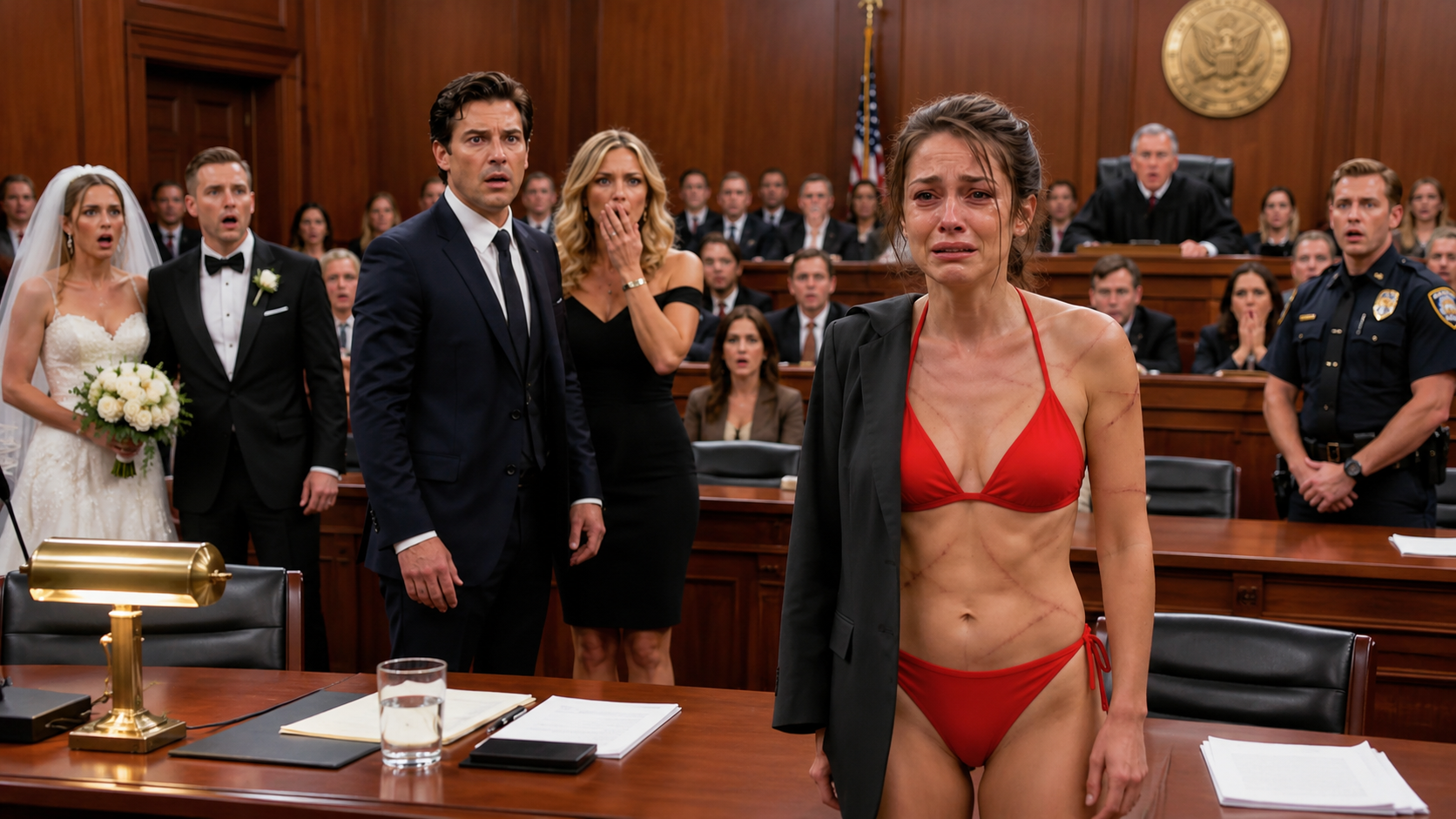
My Husband Told Me I’d Starve After Divorce — Then I Removed My Coat in Court and His Mistress Went Pale
In Divorce Court, My Husband Said the Company, House, and Cars Were His — Then I Revealed the Scars and the Secret That Took Everything Back
In the divorce courtroom, my husband stood beside his mistress and smiled like he had already buried me.
“The company, the house, the cars—they’re mine now,” he said. “You’ll starve in the street.”
You May Also Like




His mistress laughed softly.
His lawyer smiled.
Everyone thought I was finished.
So I stood up.
Slowly, I removed my gray coat.
The courtroom went silent when they saw the scars across my body.
Then I looked at my husband and whispered:
“This is no longer a divorce trial. This is the trial for every dark secret you thought would stay buried forever.”
And for the first time in ten years, my husband stopped smiling.
The Story
The courtroom was cold enough to make people keep their coats on.
But I was not cold.
Not anymore.
I sat at the plaintiff’s table in a simple gray coat with my hands folded neatly in front of me. My attorney, Marcus Hale, sat beside me, calm and quiet, with three thick folders stacked near his elbow.
Across the courtroom stood my husband, Julian Vance.
No.
My soon-to-be ex-husband.
He stood beside his mistress like a king standing over a conquered city.
His dark suit cost more than some people’s rent. His shoes shone beneath the courtroom lights. His silk tie was deep blue, the same color he wore to investor dinners when he wanted people to believe he was trustworthy.
Beside him stood Nora Reid.
His mistress.
She wore white.
That almost made me laugh.
White, as if she had not spent the last two years sleeping in my bed while I was out of town.
White, as if she had not signed my name on hotel receipts.
White, as if she had not smiled at me during charity dinners while wearing the perfume I once gave Julian for our anniversary.
She looked at me with soft pity, the kind of pity women use when they want everyone in the room to think they have already won.
Julian leaned toward her and whispered something.
Nora laughed.
Then Julian turned back to me.
“The company, the house, the cars,” he said loudly enough for the back row to hear, “they’re mine now.”
A few people in the courtroom gasped.
Julian smiled wider.
Then he added, “You’ll starve in the street.”
The judge’s eyes narrowed.
Julian’s lawyer did not stop him.
Why would he?
On paper, Julian had already won.
Vance Medical Technologies was in his name.
The mansion was in his name.
The cars were in his name.
Three days before I filed for divorce, every major bank account had been drained.
Every financial document Julian submitted told the same story.
I had nothing.
No ownership.
No savings.
No power.
No future.
At least, that was the story he had paid people to believe.
“Say something, Iris,” Julian said softly.
I looked at him.
He smiled.
“Beg, maybe.”
Nora placed a hand on his arm and looked at me with fake concern.
“She looks tired,” she said. “Poor thing.”
I said nothing.
That bothered Julian more than tears would have.
For years, he had trained himself to enjoy my fear. He liked my silence when it came from pain. But he hated my silence when it came from control.
He tilted his head.
“What’s wrong, Iris? No speech? No tears? No final dramatic performance?”
My attorney leaned toward me.
Marcus did not look at Julian.
He looked at me.
“Now?” he asked quietly.
I looked at the judge.
Then at Julian.
Then at Nora.
“Now,” I whispered.
Marcus stood.
“Your Honor,” he said, “before we proceed with the financial division, my client has a statement and evidence directly relevant to asset concealment, abuse, fraud, and corporate control.”
Julian laughed.
“This is desperate.”
His lawyer stood quickly.
“Your Honor, this is a divorce proceeding. Counsel is trying to turn a routine matter into—”
“Sit down,” the judge said.
The lawyer froze.
The judge looked at me.
“Mrs. Vance, you may proceed.”
Slowly, I stood.
The courtroom shifted.
Reporters from the legal press lifted their cameras.
Julian’s smile faded slightly.
Nora’s eyes moved over me with irritation.
I reached for the buttons of my gray coat.
Julian’s expression changed.
“Iris,” he said quietly.
I undid the first button.
Then the second.
His face tightened.
“Iris, don’t.”
His voice was not loud.
But I heard the warning inside it.
The same warning I had heard in our kitchen.
In our bedroom.
In the hallway outside my office.
In the garage.
In the laboratory.
I removed the coat.
A cold shock moved through the courtroom.
No one spoke.
Nora’s fake pity vanished.
Julian’s face turned white.
The scars across my ribs, shoulders, and arms were not small.
They were long.
Pale.
Cruel.
Some had healed into thin white lines.
Others were thick and raised, proof of a history Julian had believed his money had erased.
The judge sat forward.
“Mrs. Vance?”
I placed both hands on the table.
My voice was steady.
“This is no longer only a divorce trial,” I said. “This is the trial for every dark secret Julian Vance thought would stay buried forever.”
Julian whispered, “Iris, please.”
Please.
That word almost made me smile.
He had never said please when I begged him to stop.
Not once.
So I looked straight at him.
And for the first time in ten years, I smiled.
Julian recovered quickly because arrogant men always mistake panic for strategy.
“This is cheap theater,” he snapped. “She is unstable.”
The courtroom murmured.
Julian pointed at me.
“She hurt herself. She has been mentally fragile for years. Ask anyone.”
Nora nodded quickly.
Too quickly.
“I was afraid to say it, Your Honor,” she said, her voice soft and trembling in a performance she must have practiced, “but Iris has always been dramatic. Julian tried so hard to help her.”
I turned my head slowly toward Nora.
She looked away first.
Marcus buttoned his suit jacket.
“Then I’m sure Mr. Vance and Ms. Reid will not object to the introduction of medical records, emergency-room photographs, private security footage, and encrypted audit files.”
Julian froze.
His lawyer finally stopped smiling.
“Your Honor,” the lawyer said quickly, “this is highly prejudicial.”
The judge’s voice became sharp.
“If the evidence relates to domestic abuse, asset concealment, or fraud, it is not only relevant. It is urgent. Proceed.”
Marcus lifted a tablet.
The large courtroom screen lit up.
A video appeared.
My old kitchen.
Three years earlier.
I stood near the marble counter, wearing a cream blouse and holding a glass of water. Julian entered the frame. He was angry. His mouth moved, but at first there was no sound.
Marcus pressed play.
Julian’s voice filled the courtroom.
“You embarrassed me in front of the board.”
My voice answered.
“I corrected a false number in the report.”
“You corrected me.”
“The device failed safety checks, Julian.”
He stepped closer.
“You do not speak against me in my own company.”
“It is not your company.”
His hand came up fast.
The sound of the slap cracked through the courtroom.
In the video, my head hit the marble counter.
A woman in the back row gasped.
Nora covered her mouth.
Not from horror.
From fear.
The next clip played.
Julian dragging an encrypted hard drive from my home office at 2:17 in the morning.
The next.
Julian and Nora meeting outside the corporate laboratory, handing sealed folders to a man named Victor Crane.
Victor Crane was currently under federal investigation for medical-device fraud.
The next.
Nora entering my office after midnight, using a copied key card.
The next.
Julian standing over me in the garage while I sat on the floor, holding my ribs.
I did not look at the screen.
I looked at Julian.
His face had lost all its color.
“That’s edited,” he shouted.
My voice stayed calm.
“No. It is backed up in six secure locations.”
He stared at me like he was seeing a stranger.
That was his first mistake.
He had married me when I was twenty-four and quiet.
The daughter of a nurse.
The girl who remembered birthdays, passwords, schedules, investor names, and every lie told in a room where men assumed she was only taking notes.
He forgot who I had been before I became his wife.
Before I became Mrs. Vance.
Before he locked me out of meetings and told investors I was too emotional for leadership.
Before he used my softness as proof I was weak.
I was not weak.
I was the head cybersecurity architect who built Vance Medical’s internal audit system.
I built the walls of his kingdom.
And I knew every hidden door.
Marcus placed a thick folder on the table.
“Your Honor, we also have evidence that Mr. Vance transferred marital assets into shell companies owned by Ms. Nora Reid.”
Nora stood up.
“I didn’t know!”
I looked directly at her.
“You signed twelve transfers.”
Her lips parted.
No sound came out.
“And you used my forged signature on four.”
Nora turned to Julian.
“You told me Iris approved those.”
Julian shot her a look.
“Sit down.”
That was the first crack between them.
The judge noticed.
Marcus noticed.
And I noticed most of all.
Julian had spent years teaching Nora that she was special.
But now, in court, he spoke to her the same way he used to speak to me.
Like a thing he owned.
Nora sat down slowly.
Her face had changed.
Marcus opened the second folder.
“One more matter, Your Honor.”
Julian’s lawyer rubbed his forehead.
Marcus looked at the judge.
“Mrs. Vance did not come here merely as a spouse seeking divorce. She came as the majority silent shareholder of Vance Medical Technologies.”
The courtroom erupted.
Julian’s head snapped toward me.
“What?”
For the first time that morning, I picked up my bag.
I removed an old blue folder.
The edges were worn.
The paper inside was older than my marriage.
Julian stared at it.
I placed the original incorporation documents on the table.
“My father left me a family trust when he died,” I said. “Julian called it a useless little inheritance.”
The judge leaned forward.
I continued.
“That trust provided the original seed capital for Vance Medical Technologies. Julian filed later amendments hiding my involvement from the board and investors. But the founding agreement was never legally dissolved.”
Marcus added, “The company was not founded by Mr. Vance alone. It was created with Mrs. Vance’s capital, her technical architecture, and her intellectual property.”
Julian laughed once.
It sounded broken.
“This is absurd.”
I looked at him.
“You used my code. My audit system. My family trust. My medical compliance designs. You put your name on the door because I trusted you.”
His eyes burned.
“You were my wife.”
“I was your partner.”
“No,” he snapped. “You were nothing before me.”
The courtroom went quiet again.
I smiled sadly.
“That is what you needed to believe.”
Marcus turned to the judge.
“We request immediate freezing of all corporate restructuring attempts, all shell-company accounts linked to Mr. Vance and Ms. Reid, and emergency protection of evidence due to documented destruction attempts.”
Julian slammed his hand on the table.
“She planned this!”
The judge banged the gavel.
“Mr. Vance, control yourself.”
But he could not.
That was the beautiful thing about men like Julian.
Give them enough rope, and they will call it a throne.
“She trapped me!” he shouted, pointing at me. “She sat there like a saint while collecting evidence!”
I looked at him fully.
“No, Julian. I survived you.”
The heavy double doors at the back of the courtroom opened.
Two federal agents entered.
Nora started crying instantly.
“Julian told me everything was legal!”
Julian turned on her.
“Shut up.”
Nora flinched.
Then she stared at him.
Something in her face finally broke open.
Not innocence.
Nora was not innocent.
But fear has a way of waking people from dreams they called love.
One federal agent approached the court clerk.
Another handed a document to the judge.
The judge read silently.
The room held its breath.
Then the judge looked at Julian.
“Mr. Vance, there are federal warrants connected to corporate fraud, evidence tampering, medical-device safety violations, aggravated assault, embezzlement, and witness intimidation.”
Julian looked at me.
For the first time, his eyes were not cruel.
They were afraid.
“Iris,” he whispered.
I said nothing.
“Iris, please.”
There it was again.
Please.
I stepped closer to the railing.
Not too close.
Just enough for him to hear me clearly.
“You told me I would starve in the street,” I whispered. “Now you can explain to a prison judge how you stole from a woman you thought was too broken to count.”
But that was not the final twist.
The final twist came from Nora.
She stood suddenly.
Her lawyer grabbed her arm.
“Nora, sit down.”
But Nora pulled away.
“No.”
Julian glared at her.
“Nora.”
She looked at him, tears running down her face.
“You said you loved me.”
Julian’s jaw tightened.
“This is not the time.”
“No,” she said. “This is exactly the time.”
The judge looked at her.
“Ms. Reid, if you wish to make a statement, you should consult your counsel.”
Nora shook her head.
“I have recordings.”
Julian went still.
Every person in the courtroom felt the air change.
Nora looked at me.
For the first time since I had known her, there was no smirk on her face.
No pity.
No victory.
Just terror.
“I thought I was replacing you,” she said quietly. “But I was only becoming you.”
I did not answer.
She reached into her purse.
Her attorney whispered harshly, “Nora, don’t.”
She placed a small drive on the table.
“Julian recorded himself threatening board members. Investors. Lab staff. He made me keep copies in case someone betrayed him.”
Julian’s face twisted.
“You stupid—”
“Enough,” the judge snapped.
Nora’s voice shook.
“He told me if I ever left him, he would make me disappear like he made Iris disappear from the board.”
The courtroom was silent.
Nora looked at me again.
“I hated you because he told me you were weak,” she said. “Then I saw what he did to you. And I knew one day he would do it to me.”
I studied her.
Part of me wanted to hate her forever.
Part of me still did.
But another part of me recognized the look in her eyes.
The look of a woman who had finally realized the man beside her was not a prize.
He was a cage.
I said quietly, “Then tell the truth.”
Nora nodded.
“I will.”
Julian lunged toward her.
The agents moved instantly.
One caught his arm.
The other stepped between him and Nora.
The courtroom exploded into noise.
The judge banged the gavel again and again.
“Order! Order!”
Julian struggled, his perfect suit wrinkling, his face red with rage.
“You ruined me!” he screamed at me.
I looked at him, calm.
“No,” I said. “I only stopped hiding what you were.”
The rulings came quickly.
Divorce granted.
Emergency asset freeze enacted immediately.
Corporate accounts locked.
Shell companies preserved for federal investigation.
Julian’s passports surrendered.
Nora’s luxury properties seized pending review.
Temporary control of Vance Medical Technologies returned to me under court supervision.
A federal investigation opened into fraud, product safety violations, forged signatures, witness intimidation, and assault.
The judge looked at me with something I had not seen from authority in years.
Respect.
“Mrs. Vance,” she asked gently, “are you safe tonight?”
For years, safety had felt like a word meant for other women.
Women with family nearby.
Women whose husbands did not control the locks, the money, the doctors, the calendar, the narrative.
I breathed in deeply.
The air filled my lungs without fear.
“Yes, Your Honor,” I said. “I am now.”
Julian was taken out first.
He fought until the agents tightened their grip.
At the door, he turned back.
“Iris!”
I looked at him one last time.
He waited for something.
Tears.
Anger.
A final word.
I gave him nothing.
That was the first gift I gave myself.
Silence, not from fear.
Silence, from freedom.
Nora was escorted out later.
She paused beside me.
My attorney tensed.
But Nora only whispered, “I’m sorry.”
I looked at her.
For a moment, I saw the white dress, the fake pity, the hotel receipts, the stolen years.
Then I saw the shaking hand, the fear, the drive on the table.
“I don’t forgive you today,” I said.
She nodded, crying harder.
“I know.”
“But telling the truth was the first decent thing you’ve done.”
She closed her eyes.
“Thank you.”
“Don’t thank me,” I said. “Testify.”
She nodded.
And then she was gone.
The weeks that followed were brutal.
Truth does not clean a house gently.
It tears open walls.
It pulls rot into the light.
Investigators moved through Vance Medical Technologies like surgeons.
They found hidden accounts.
Deleted emails.
Suppressed safety reports.
Bribed compliance officers.
Forged investor summaries.
The device Julian had rushed toward approval had failed internal tests three times.
Three times, I had flagged it.
Three times, Julian had overruled me.
When I pushed back, he told the board I was unstable.
When I demanded a formal halt, he locked me out of the lab.
When I threatened to go public, he put me in the hospital.
That was where some of the scars came from.
Not all.
Some scars came earlier.
Some came later.
But every scar had a date.
A record.
A photograph.
A witness.
A lie Julian had told to cover it.
During one deposition, Julian tried to perform innocence again.
He sat in a navy suit, hands folded, speaking calmly into the record.
“My wife was emotionally unwell. I loved her deeply. She became obsessed with controlling the company.”
Marcus played one audio recording.
Julian’s voice filled the room.
“If you ever speak to the board again, Iris, I will make sure everyone believes you are insane.”
The room went silent.
Julian’s attorney asked for a break.
Marcus smiled.
“Take your time.”
By the fourth deposition, Julian stopped performing.
By the sixth, Nora began cooperating fully.
By the eighth, two board members resigned.
By the tenth, the company was mine in every way that mattered.
Not just legally.
Morally.
Practically.
Publicly.
The same investors who once avoided my eyes at board dinners began sending carefully worded emails.
“We always respected your contributions.”
“We were unaware of the extent of Mr. Vance’s misconduct.”
“We look forward to your leadership.”
I deleted most of them.
Respect that arrives only after power changes hands is not respect.
It is survival instinct.
Six months later, Julian pleaded guilty to federal fraud, aggravated assault, evidence tampering, and corporate embezzlement.
He avoided trial because the evidence was too strong.
Nora took a plea deal for her role in the financial transfers and forged documents. She lost the properties, the cars, the accounts, and the illusion that she had won anything by standing beside him.
At sentencing, Julian asked to speak.
I almost did not attend.
Marcus told me I did not have to.
“You owe him nothing,” he said.
“I know.”
“Then why go?”
I looked at the courthouse steps.
“Because I want to see who he is when no one is clapping.”
Inside the courtroom, Julian looked smaller.
No silk tie.
No perfect smile.
No mistress in white.
No board members waiting to shake his hand.
Just a man in a plain suit, standing before a judge who had read every record he thought money had erased.
He turned toward me.
“Iris,” he said.
My body remembered fear.
My mind did not obey it anymore.
He swallowed.
“I was wrong.”
I said nothing.
“I let ambition change me.”
That almost made me laugh.
Ambition had not changed him.
It had revealed him.
He continued, “I hurt you. I stole from you. I convinced myself I deserved what you built because I was better at being seen.”
For the first time, he said something true.
“I don’t expect forgiveness,” he said.
“Good,” I whispered.
He heard me.
His face tightened.
The judge sentenced him to prison, restitution, and permanent restrictions connected to corporate leadership.
When they led him away, he did not look like a king.
He looked like a man finally forced to carry the weight of his own name.
Outside the courtroom, Nora waited near the hallway.
She looked different too.
No diamonds.
No white dress.
No performance.
She held a folder against her chest.
“I’m entering a witness protection-related relocation program,” she said quietly. “Not forever. Just until the remaining people connected to Julian’s fraud are handled.”
I nodded.
She looked ashamed.
“I don’t know who I am without wanting someone else’s life.”
That sentence surprised me.
Not because it was beautiful.
Because it was honest.
I said, “Then start there.”
She nodded.
“Iris… I know sorry does not fix anything.”
“No,” I said. “It doesn’t.”
“But I am.”
I looked at her for a long moment.
“I hope you become someone who never does to another woman what you did to me.”
Her eyes filled with tears.
“I hope so too.”
Then she walked away.
I never saw her again.
And that was enough.
A year after the divorce, Vance Medical Technologies no longer existed.
At least, not by that name.
I stood on the top floor of the corporate headquarters, looking out at the sunrise spilling gold across the city skyline.
The new sign had gone up the night before.
Sterling Medical Systems.
Sterling was my mother’s family name.
My mother had been a nurse.
She worked double shifts.
She wore tired shoes.
She taught me that medicine was not about profit first.
It was about people.
She used to say, “If a device touches a human body, then honesty has to touch every part of its creation.”
Julian had laughed at that once.
Now her name was on the building.
A young engineer knocked softly on my office door.
“Ms. Sterling?”
I turned.
The name still felt new.
Good.
Clean.
“Yes?”
“The board is ready for you.”
I looked down at my wrist.
A pale scar crossed the skin there.
For years, I hid it under bracelets.
Now I let it show.
Not because pain should be displayed for everyone.
But because shame was never mine to carry.
I walked into the conference room.
Every person stood.
Not because I was Julian’s wife.
Not because I was someone’s silent partner.
Not because a man had allowed me into the room.
They stood because I owned the table.
At the far end of the room, Marcus sat with a small smile.
I took my seat.
“Good morning,” I said.
“Good morning, Ms. Sterling,” the board replied.
I opened the first folder.
“Our first order of business is patient safety.”
No one argued.
No one smirked.
No one called me emotional.
And for the first time in years, the silence in the room did not feel like fear.
It felt like respect.
But the ending was not only about taking back the company.
That would have been too small.
A company can be rebuilt.
Money can be recovered.
Houses can be sold.
Cars can be replaced.
But a woman’s soul?
That takes longer.
The mansion was returned to me in the settlement.
For two months, I could not enter it.
I would sit in the car outside the gate and stare at the windows.
That house had seen too much.
It had heard me cry behind locked doors.
It had watched me cover bruises with makeup.
It had held Nora’s perfume in the hallway and Julian’s lies in every room.
One afternoon, Marcus asked, “Are you going to sell it?”
I looked at the house.
“No.”
He frowned.
“You want to live here?”
“No.”
“Then what?”
I smiled softly.
“I want to change what it remembers.”
Six months later, the mansion became The Sterling House, a recovery residence and legal support center for women leaving abusive marriages and financial control.
The marble kitchen where Julian had struck me became a counseling room.
The office where he stole my hard drive became a legal aid center.
The bedroom where I once cried silently became a nursery for mothers arriving with children in the middle of the night.
The garage where I had once sat on the floor holding my ribs became a secure entrance with warm lights, cameras, and a guard who greeted every woman by name.
On opening day, I stood in the foyer.
The same foyer where Julian used to adjust his cufflinks before investor dinners.
The same foyer where Nora once walked in wearing my perfume.
The same foyer where I had learned how lonely wealth could be.
Now there were flowers on the table.
Warm blankets in baskets.
A sign near the door that read:
You are safe here.
A young woman arrived that evening with a little girl asleep against her shoulder.
She looked terrified.
Her lip was split.
Her hands shook.
“I’m sorry,” she whispered. “I didn’t know where else to go.”
I stepped forward.
My voice was gentle.
“You came to the right place.”
She looked at my scars.
Not with pity.
With recognition.
Then she began to cry.
I took the little girl’s backpack from her hand.
“What’s your name?” I asked.
“Emily.”
“Emily,” I said, “tonight you and your daughter are safe.”
Her knees almost gave out.
I caught her before she fell.
And for one strange, holy moment, I understood something.
Julian had tried to turn my pain into silence.
Instead, it had become a doorway.
Two years later, Sterling Medical Systems became one of the most trusted medical technology companies in the country.
Not the fastest.
Not the flashiest.
The most trusted.
Every product passed independent safety review.
Every whistleblower report went directly to an outside ethics board.
Every executive signed accountability agreements that could not be buried by internal politics.
During one investor meeting, a man asked me, “Do you worry that your strict safety policies slow growth?”
I looked at him.
“My ex-husband believed speed mattered more than safety,” I said. “He is currently in prison. So no, I do not worry.”
No one asked that question again.
After the meeting, a young female engineer approached me.
She was nervous.
“Ms. Sterling?”
“Yes?”
She held a notebook to her chest.
“I just wanted to say… I watched the courtroom footage when I was in college.”
I nodded slowly.
She continued, “I was in a bad relationship then. I thought if someone powerful hurt you, you just had to survive quietly.”
Her eyes filled.
“But then I saw you stand up.”
My throat tightened.
“I’m glad you got out,” I said.
She nodded.
“I did. And now I work here.”
That was when I knew Julian had lost in a way prison could never fully measure.
He had wanted my story to end with humiliation.
Instead, it had become someone else’s beginning.
On the third anniversary of the trial, I returned to the courthouse.
Not for Julian.
Not for Nora.
For myself.
The courtroom was empty when I stepped inside.
The clerk recognized me and gave me a few minutes alone.
I walked to the plaintiff’s table.
I touched the back of the chair where I had sat in my gray coat.
I could still see him standing across the room.
Julian smirking.
Nora in white.
The lawyer smiling.
The reporters waiting for a broken woman to collapse.
I remembered his words.
“You’ll starve in the street.”
I looked around the silent courtroom and smiled.
I had not starved.
I had fed others.
I had not lost the company.
I had rebuilt it.
I had not been erased.
I had put my mother’s name on the skyline.
I had not stayed broken.
I had become dangerous to every lie that tried to survive in the dark.
Marcus appeared at the doorway.
“I thought I’d find you here.”
I turned.
“I just wanted to see it again.”
“The room?”
“The place where I stopped being afraid.”
He walked beside me.
“You were never weak, Iris.”
“I know that now.”
He smiled.
“That matters more than me saying it.”
I looked toward the judge’s bench.
“For years, I thought justice would feel like revenge.”
“And?”
“It feels quieter.”
Marcus nodded.
“It usually does.”
I picked up my coat from the chair.
Not the gray one.
A new one.
Cream-colored.
Soft.
Warm.
Mine.
As we walked out, my phone buzzed.
A message from the director of Sterling House.
A mother and two children arrived safely tonight. They’re resting.
I stopped in the hallway.
Marcus looked at me.
“Everything okay?”
I smiled through sudden tears.
“Yes.”
Because that was the true victory.
Not Julian in prison.
Not Nora losing the diamonds.
Not the headlines.
Not the company.
Not even the courtroom silence when I removed my coat.
The true victory was that somewhere, because I survived, another woman did not have to sleep in fear.
Somewhere, a child was warm.
Somewhere, a locked door had opened.
People still ask me if I hate Julian.
The answer is no.
Hate is too heavy to carry for a man who already lost the privilege of standing in my future.
I do not hate him.
I remember him.
There is a difference.
I remember what he did.
I remember what I survived.
I remember the woman I was before him.
And I honor the woman who walked out after him.
As for Nora, I heard years later that she changed her name, moved away, and started working with a nonprofit that helped women understand financial abuse.
Maybe that was guilt.
Maybe redemption.
Maybe both.
I did not need to know.
Not every person who hurts you gets a place in your ending.
Some only serve as proof that you escaped the chapter where they mattered.
Julian once told me I would starve in the street.
But he never understood hunger.
I had been hungry for peace.
Hungry for safety.
Hungry for the sound of my own voice.
Hungry to sit at a table where no one could remove my chair.
And in the end, I received all of it.
The company.
The truth.
The house transformed into shelter.
The name Sterling shining above the city.
And a life where no one smirked when I entered the room.
The scars remained.
They always would.
But they no longer told the story Julian wanted them to tell.
They were not proof that he broke me.
They were proof that he failed to finish the job.
And when I stand in front of a room now, whether it is a boardroom, a courtroom, or a shelter full of women learning how to breathe again, I do not hide them.
Because somewhere, someone needs to see that survival has a body.
That truth has a voice.
That justice can arrive late and still arrive powerful.
And that the woman a cruel man calls weak may be the one holding every key to his kingdom.