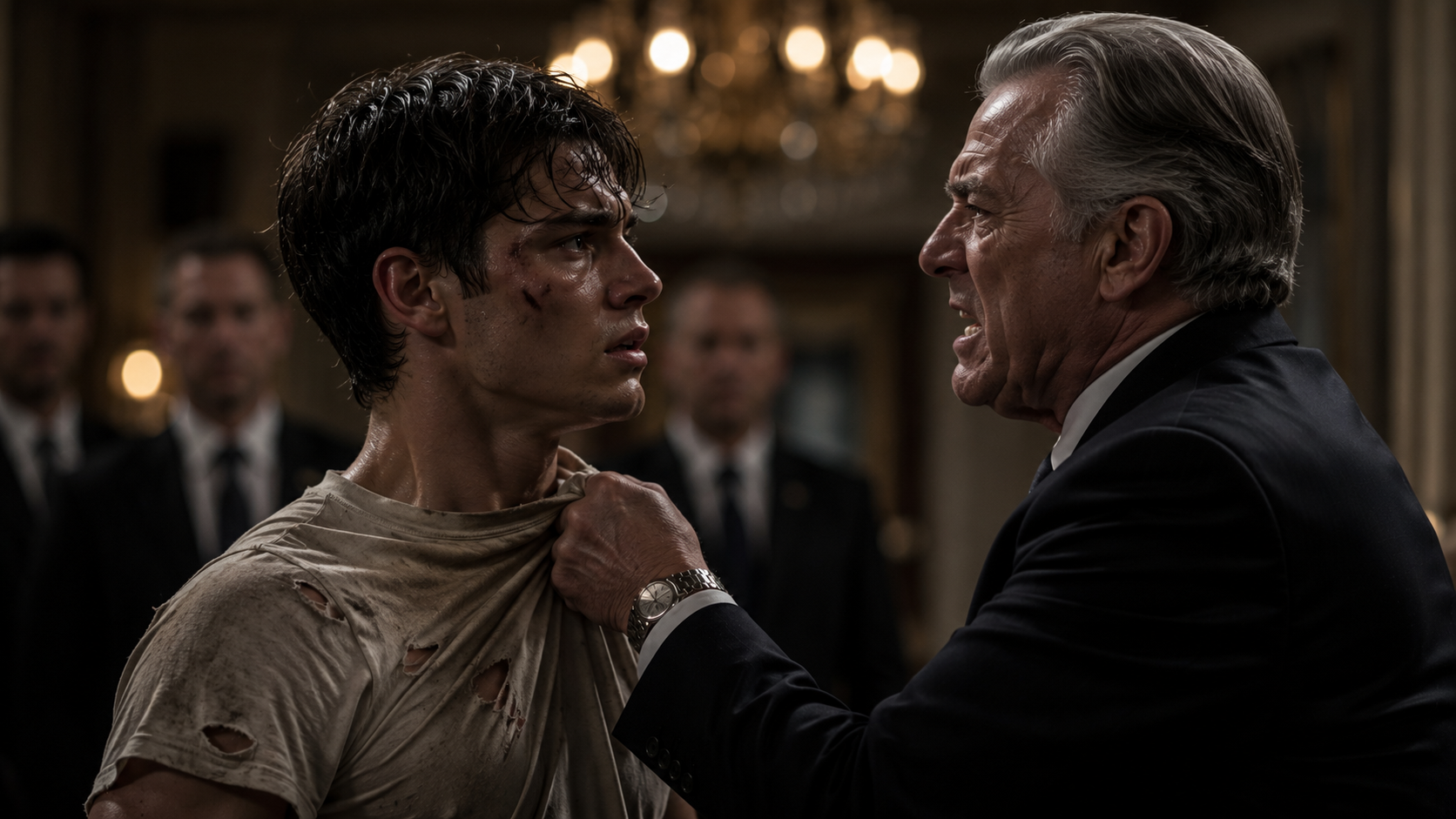
The entire military hall laughed when David Son’s name was called.
It started as a small sound.
One short laugh from the back row.
Then another.
You May Also Like
Then a wave of cruel whispers moved through the ceremony hall like smoke.
David stood near the side entrance in an old, faded uniform that had been cleaned too many times. His boots were polished, but cracked. His sleeves were slightly loose around his thin wrists. His face was calm, but his fingers trembled against the medal case in his hand.
On stage, a colonel glanced at the paper in front of him.
“Private First Class David Son,” he announced.
A soldier whispered loudly, “That charity case?”
Another muttered, “What is he getting? A medal for sweeping floors?”
A few men laughed.
David heard every word.
He had spent his whole life hearing words like that.
Weak.
Poor.
Useless.
Nobody.
But this time, he did not lower his eyes.
He stepped forward.
Across the hall, General Marcus Vey stood from his chair. His jaw tightened. His eyes narrowed at David as if the young soldier had walked into a room where he did not belong.
The general lifted one hand.
“Stop.”
The hall went silent.
David froze halfway to the stage.
The colonel leaned toward the microphone.
“Sir?”
General Vey stared at David.
“There has been a mistake.”
David’s throat moved.
The medal case felt heavy in his palm.
The general walked slowly toward him.
“This soldier is under review for disobedience during the northern base incident.”
Gasps spread across the hall.
David’s commanding officer, Captain Elias Grant, stood near the front row with his hands clenched.
“That is not true,” Captain Grant said.
General Vey turned.
“Careful, Captain.”
Grant stepped forward.
“No, sir. You be careful.”
The entire ceremony hall stiffened.
David looked at Grant with shock.
Nobody had ever defended him like that.
General Vey’s voice lowered.
“Are you challenging me in front of everyone?”
Grant’s eyes did not move.
“I am correcting a lie in front of everyone.”
The hall became so quiet that David could hear the rain hitting the tall windows.
Then Captain Grant raised a sealed black folder.
“And before this ceremony ends, every person here will know what David Son really did.”
General Vey’s face changed.
Just slightly.
But David saw it.
Fear.
The man who had tried to bury him was suddenly afraid.
And for the first time in David’s life, the people who laughed at him stopped laughing.
David Son was born in a town nobody talked about unless they had escaped it.
It sat between an abandoned railway station and a dry riverbed, where dust stuck to skin and broken streetlights flickered like tired stars.
His father died when David was nine.
His mother washed clothes for families richer than hers and came home every night with red hands and swollen feet.
David learned early that hunger had a sound.
It was not the growl of a stomach.
It was the silence of a mother pretending she had already eaten.
“Mom,” David would say, pushing his plate toward her. “I’m full.”
She would smile.
“You are a terrible liar.”
“So are you.”
She would laugh softly, then touch his cheek.
“You have your father’s heart.”
David did not remember much about his father, only a warm voice and a strong hand holding his during storms.
But he remembered one sentence.
“Power is not making people fear you, David. Power is protecting someone who cannot repay you.”
That sentence stayed with him.
Even when life tried to beat it out of him.
At school, boys mocked his torn shoes.
“Careful,” one would say. “His shoes might retire before graduation.”
David never fought back.
Not because he had no anger.
Because he feared what his anger might become.
He had watched men in his neighborhood use anger like a weapon. He saw fists. Broken bottles. Mothers crying behind closed doors.
So David swallowed everything.
Insults.
Humiliation.
Pain.
He told himself patience was strength.
But sometimes patience was only fear wearing a quiet face.
At twenty-one, after his mother became sick, David enlisted in the army.
He had one goal.
Earn enough money to pay for her treatment.
The recruiting officer looked at his thin body and worn clothes.
“You sure about this?”
David nodded.
“Yes, sir.”
“Army life is hard.”
“So is poverty.”
The officer looked up.
David’s voice stayed soft.
“But the army pays on time.”
That was how David became a soldier.
Not for glory.
Not for medals.
For medicine.
Training nearly broke him.
His body was not used to heavy packs, endless running, cold mornings, shouted orders, and men who laughed when he fell behind.
Sergeant Pike, the drill instructor, loved making examples.
“Son!” Pike shouted one muddy morning. “Is that your last name or your life story?”
The platoon laughed.
David struggled up from the mud.
“Yes, Sergeant.”
Pike leaned close.
“You look like a strong wind could defeat you.”
David’s lips trembled, but he answered, “Then I’ll learn to stand in stronger wind.”
The laughter faded.
Not completely.
But enough.
One recruit named Mason Cole shoved David in the barracks that night.
“You think that was clever?”
David looked down.
“No.”
“You trying to make us look bad?”
“No.”
Mason stepped closer.
“Say it again.”
David said nothing.
Mason pushed him.
“Say something.”
David finally looked up.
“I don’t want trouble.”
Mason smiled.
“That’s why trouble likes you.”
From that day, David became the easiest target in the unit.
His locker was emptied.
His boots were hidden.
His food disappeared.
Sometimes he found notes on his bed.
GO HOME.
WEAK DOG.
CHARITY SOLDIER.
He never reported them.
Captain Elias Grant noticed.
One evening Grant found David alone behind the supply shed, stitching a torn uniform sleeve with careful hands.
“Who did that?”
David did not look up.
“I caught it on a nail, sir.”
Grant crouched in front of him.
“The nail also wrote ‘trash’ on your locker?”
David stopped sewing.
Grant’s voice softened.
“Look at me, Son.”
David raised his eyes.
“Why don’t you fight back?”
David swallowed.
“Because if I start fighting everyone who looks down on me, sir, I’ll never have time to become better.”
Grant studied him for a long moment.
Then nodded.
“That’s either wisdom or fear.”
David looked away.
“Maybe both, sir.”
Captain Grant became the first officer who saw something in David besides weakness.
He noticed David remembered every route map after seeing it once.
He noticed David could fix old field radios others threw away.
He noticed David stayed behind to help slower soldiers even after being mocked by them.
One night, during a communications drill, the unit’s tactical network failed.
Officers shouted.
Technicians panicked.
Rain hammered the metal roof.
General Vey was visiting the base that week, and everyone wanted to impress him.
“Get that system back now!” Major Keller shouted.
A technician shook his head.
“The relay is fried.”
David stood near the back, holding a toolbox.
Quiet.
Ignored.
Captain Grant turned.
“Son.”
David straightened.
“Sir?”
“You’ve been studying the relay systems, haven’t you?”
Mason snorted.
“He studies trash because he comes from trash.”
Grant snapped, “One more word, Cole, and you’ll be cleaning latrines with your toothbrush.”
Mason shut up.
Grant looked at David.
“Can you fix it?”
David hesitated.
The old fear rose.
What if he failed?
What if they laughed again?
Grant saw it.
“David.”
“Yes, sir?”
“You don’t need permission from people who want you small.”
David’s fingers tightened around the toolbox.
He stepped forward.
For fifteen minutes, David worked in silence. He opened panels, crossed wires, reset channels, bypassed a damaged converter, and used an old copper strip from a broken flashlight to bridge the relay.
The screens blinked.
Static cleared.
Voices returned.
The network came alive.
The room froze.
Major Keller whispered, “How did he do that?”
David stepped back.
“Temporary fix, sir. It should hold for six hours.”
Captain Grant smiled.
General Vey watched from the doorway.
His face was unreadable.
Then he said, “Interesting.”
It was not praise.
It was a warning.
The normal world broke two weeks later.
Northern Base Ardent sat near a mountain border, wrapped in fog and surrounded by pine forests. It was a cold place where breath turned white and engines groaned awake before dawn.
David’s unit was sent there for a joint defense exercise.
The base held supplies, communication servers, and a small civilian medical camp nearby.
David wrote to his mother every night.
Mom, I’m doing okay. Don’t worry about me. Take your medicine. I’ll send more money soon.
She replied when she could.
My son, eat properly. Stand straight. Don’t let people convince you that quiet means weak.
David read that line many times.
Then came the incident.
At 2:13 a.m., alarms screamed across Base Ardent.
Red lights flashed.
Soldiers ran through freezing darkness.
The smell of smoke filled the air.
A communications tower had exploded.
Then another.
The base lost contact with central command.
Inside the operations room, officers shouted over each other.
“Radar blind!”
“Backup generators unstable!”
“Medical camp is exposed!”
“Where is General Vey?”
“On the eastern command route!”
Captain Grant grabbed David by the shoulder.
“Son, with me.”
They rushed into the communications bunker.
Screens flickered.
Static screamed.
David looked at the system logs.
His stomach tightened.
“This wasn’t an accident.”
Grant turned.
“What?”
David pointed.
“The shutdown sequence came from inside the base.”
Major Keller barked, “Impossible.”
David shook his head.
“No, sir. Someone used command clearance.”
The room went cold.
Grant asked, “Can you trace it?”
David’s fingers flew across the keyboard.
Then his eyes widened.
“What is it?” Grant asked.
David whispered, “The clearance belongs to General Vey.”
Nobody spoke.
Major Keller stepped back.
“You better be sure before you say that again.”
David looked at the screen.
“I’m sure.”
Then the door opened.
General Vey walked in.
Clean uniform.
Calm face.
Cold eyes.
“Sure about what, Private?”
David’s blood turned to ice.
Captain Grant stepped between them.
“We found unauthorized shutdown activity.”
Vey looked at David.
“Did you?”
David said nothing.
Vey moved closer.
“You look nervous.”
David’s hands trembled.
Grant said, “Sir, we need to investigate command access.”
Vey smiled.
“There is no time. Enemy drones are approaching the civilian camp. We need the south defense grid online.”
David turned back to the screen.
“The south grid is trapped.”
Grant frowned.
“What?”
David pointed to a hidden signal pattern.
“If we activate it, it will overload the generators.”
Major Keller shook his head.
“No, the south grid is our only protection.”
David’s voice rose.
“It’s bait.”
Vey’s expression hardened.
“Private Son, step away from the console.”
David did not move.
Grant said quietly, “David?”
David looked at him.
Then at the map showing the civilian camp.
Dozens of doctors.
Families.
Children.
If he was wrong, they would die.
If he obeyed, they might die.
His weakness had always been fear.
Fear of speaking.
Fear of being wrong.
Fear of becoming a problem.
But his father’s voice rose in his memory.
Power is protecting someone who cannot repay you.
David sat down at the console.
Vey shouted, “That is an order!”
David’s fingers moved.
He bypassed the south grid.
Rerouted power through the old maintenance line.
Opened a manual frequency.
The room erupted.
“Stop him!”
“He’s disobeying!”
“David!” Grant shouted.
David whispered, “I’m sorry, sir.”
Then he activated the reroute.
The bunker shook.
Lights exploded overhead.
For three seconds, darkness swallowed everything.
Then the north defense batteries came alive.
Outside, a thunderous roar split the night.
Enemy drones fell from the sky in burning pieces before reaching the civilian camp.
The base survived.
The people lived.
But when emergency lights returned, General Vey stood over David.
His face was white with fury.
“Arrest him.”
Captain Grant stepped forward.
“Sir, he saved the base.”
Vey snapped, “He sabotaged a direct command.”
Major Keller hesitated.
Vey shouted, “Now!”
Military police seized David.
He did not resist.
As they dragged him away, Captain Grant called out, “David! I’ll fix this!”
David looked back.
His face was pale.
“Please check the logs, sir.”
Then the steel door closed between them.
David spent three days in isolation.
A narrow room.
Concrete walls.
One thin blanket.
One metal toilet.
The air smelled of disinfectant and cold dust.
He was questioned again and again.
Major Keller sat across from him first.
“Why did you disobey General Vey?”
David answered, “Because his order would have killed people.”
“You’re accusing a decorated general?”
“I’m telling you what the system showed.”
“Where is the proof?”
“In the logs.”
“The logs are gone.”
David stared.
“What?”
Keller leaned forward.
“Deleted.”
David’s mouth went dry.
“That’s impossible.”
“No, Private. What’s impossible is a poor communications assistant claiming he understood a battlefield better than a general.”
David’s hands curled into fists.
“I saved them.”
Keller’s voice softened, but not kindly.
“You embarrassed him.”
David looked up.
Keller stood.
“And men like Vey don’t forgive embarrassment.”
That night, Mason Cole was brought to identify David’s “pattern of unstable behavior.”
Mason sat across from him with a nervous smile.
“Tell them,” David whispered.
Mason looked away.
“You saw me fix the relay. You saw I knew the system.”
Mason swallowed.
“They asked if you were reckless.”
“And what did you say?”
Mason’s jaw tightened.
“I said yes.”
David’s face fell.
“Why?”
Mason snapped, “Because you make everyone look bad.”
David stared at him.
Mason’s voice shook.
“You think being quiet makes you noble? You think taking hits makes you better than us?”
“No.”
“Yes, you do.”
David leaned forward.
“I never wanted to be better than you.”
Mason’s eyes glistened.
“Then why did everyone start looking at you like you mattered?”
David sat back slowly.
There it was.
The truth.
Not hatred.
Shame.
Mason had not betrayed him because David was weak.
He betrayed him because David was becoming strong.
The midpoint twist came when Captain Grant vanished.
Officially, he had been reassigned.
David knew better.
On the fourth night, the door to David’s isolation room opened.
A young female medic stepped in with a food tray.
Her name tag read: LENA ORTIZ.
She placed the tray down.
Then whispered, “Don’t eat the bread.”
David looked at her.
“What?”
She kept her eyes on the door.
“There’s a note inside the cup.”
David’s heartbeat quickened.
“Who sent you?”
“A man who believes you.”
“Captain Grant?”
She did not answer.
The door closed.
David opened the metal cup.
A folded paper was taped beneath it.
Three words were written inside.
BUNKER CAMERA 6.
David stared at it.
The next morning, during another interrogation, he finally understood.
The system logs had been deleted.
But the camera footage remained.
Camera 6 faced the communications bunker entrance.
If it captured General Vey entering before the shutdown, it could prove he lied about his location.
But David was locked away.
Grant was gone.
The evidence was unreachable.
Until Lena returned.
“You need to trust me,” she whispered.
David looked at her.
“I don’t even know you.”
Her eyes filled with pain.
“My brother was in the civilian camp.”
David froze.
“He’s alive because of you.”
She pushed a small access badge into his hand.
“You have ten minutes after midnight.”
David whispered, “Why risk this?”
Lena’s voice cracked.
“Because powerful men stay powerful when good people stay scared.”
At midnight, David escaped isolation.
Not with violence.
Not with force.
With patience.
He waited until the guard stepped away.
Used the badge.
Moved through service corridors.
Cold air brushed his face.
Alarms hummed far away.
Every shadow looked like a soldier.
Every sound felt like a warning.
He reached the security office.
The camera archive was locked.
David opened the panel beneath the desk and rewired the emergency battery into the backup drive.
The screen flashed.
Footage loaded.
Camera 6.
2:06 a.m.
General Vey entered the communications bunker.
Seven minutes before the first explosion.
Then another figure appeared.
Major Keller.
David’s breath stopped.
Keller handed Vey a device.
Vey placed it inside the console.
Then both men left.
The sabotage was real.
But before David could copy the footage, the door opened.
Major Keller stood there.
Gun drawn.
“Well,” Keller said. “You are clever.”
David slowly raised his hands.
Keller stepped inside.
“You should have stayed weak, Son.”
David’s throat tightened.
“Why did you do it?”
Keller laughed softly.
“You still think this is about one attack?”
“What is it about?”
“Contracts. Promotions. Defense systems. Fear creates money.”
David’s eyes narrowed.
“You risked the civilian camp for money?”
Keller’s jaw clenched.
“Don’t pretend the world is clean. Men like you are always protected by fairy tales. Honor. Sacrifice. Justice.”
David whispered, “My mother washed clothes until her hands bled. Don’t lecture me about the world.”
Keller’s eyes hardened.
“Delete the footage.”
“No.”
“Delete it, or Captain Grant dies.”
David froze.
Keller smiled.
“Yes. He’s alive.”
David’s voice shook.
“Where?”
“Delete the footage.”
David looked at the screen.
Then at Keller.
The old David would have obeyed.
The old David would have chosen fear.
But power had started growing inside him, not like anger, but like a spine finally straightening.
David pressed one key.
Keller smiled.
Then his smile disappeared.
“What did you do?”
David met his eyes.
“Sent it.”
“To who?”
David’s voice was steady.
“Everyone.”
The base sirens exploded.
The footage had been transmitted to every command screen in Base Ardent.
Every officer.
Every barracks.
Every security station.
Every phone connected to the emergency channel.
Keller lunged.
David ducked.
The gun fired into the ceiling.
Soldiers rushed in seconds later.
Keller was tackled to the floor.
As they restrained him, he shouted, “He’s lying! He’s lying!”
David stood over him, breathing hard.
“No,” David said quietly. “I finally stopped being silent.”
They found Captain Grant two hours later in an abandoned maintenance bunker.
Beaten.
Tied to a chair.
Alive.
David rushed to him.
“Sir!”
Grant opened one swollen eye.
“Did you get the footage?”
David nodded.
Grant laughed weakly.
“Good.”
David knelt beside him.
“I’m sorry.”
“For what?”
“For not being stronger sooner.”
Grant grabbed his wrist.
“Listen to me.”
David leaned close.
“Strength isn’t never being afraid.”
Grant’s voice cracked.
“It’s doing the right thing while your hands are shaking.”
David’s eyes filled.
Grant smiled.
“Your hands shake a lot, Son.”
David laughed through tears.
“Yes, sir.”
“But they saved lives.”
The investigation moved fast after that.
General Vey was arrested before dawn.
Major Keller confessed after financial records were discovered.
Mason Cole admitted he lied during questioning.
But the army did not immediately call David a hero.
Institutions move slowly when truth embarrasses powerful people.
For weeks, David remained under review.
Some officers wanted silence.
Some wanted a quiet commendation.
Some wanted him discharged to avoid scandal.
Then the families from the civilian camp spoke.
Doctors.
Nurses.
Children.
Parents.
They sent letters.
Videos.
Photographs.
One little boy, Lena’s brother, appeared in a recorded message holding a handmade sign.
THANK YOU, SOLDIER DAVID.
The video spread.
News outlets picked it up.
Public pressure rose.
And finally, the military announced a ceremony.
A formal honor.
Public.
National.
Unavoidable.
That was why David stood in the grand military hall while people laughed.
Some laughed from ignorance.
Some from old cruelty.
Some because they still saw poverty when they looked at him.
But now Captain Grant held the black folder.
And General Vey stood exposed.
Grant walked to the microphone.
His voice filled the hall.
“Before Private First Class David Son receives this honor, there is something this room must understand.”
General Vey snapped, “Captain, this is not authorized.”
Grant opened the folder.
“No, sir. What wasn’t authorized was sabotaging a base and blaming the soldier who saved it.”
A wave of shock rolled through the hall.
David stood still.
Grant continued.
“David Son was mocked for being poor.”
He looked toward the soldiers in the back.
“Mocked for being quiet.”
His eyes moved to Mason.
“Mocked for refusing to become cruel.”
Mason lowered his head.
Grant’s voice grew stronger.
“But on the night Base Ardent fell under attack, he saw what trained officers missed. He disobeyed an unlawful order. He rerouted power under fire. He saved the civilian medical camp. He saved soldiers who had mocked him. He saved children who will grow old because he was brave enough to be hated.”
The hall became silent.
Then the screen behind the stage lit up.
The footage played.
Vey entering the bunker.
Keller handing him the device.
The sabotage.
The lie.
The truth.
By the end, no one moved.
Military police approached General Vey.
He backed away.
“This is a political attack.”
Grant said, “No. This is accountability.”
Vey looked at David with hatred.
“You think this makes you powerful?”
David looked at him.
For years, he had imagined power as a loud voice, a rich man’s suit, a general’s stars, or the ability to frighten others.
Now he understood.
Power was standing in truth when lies had better weapons.
David stepped toward him.
“No, sir.”
His voice was quiet.
“But it makes your power fake.”
The words struck harder than shouting.
Vey’s face twisted.
“You are nothing.”
David’s lips trembled.
But he did not look away.
“I used to believe that.”
He touched the worn sleeve of his uniform.
“Men like you taught me to believe it.”
Then he lifted his chin.
“But my mother raised me from nothing. My captain trusted me with nothing. And when the night came, nothing was enough to save everyone you were willing to sacrifice.”
Vey had no answer.
The military police took him away in front of everyone.
Then Colonel Reyes returned to the microphone.
His voice was thick with emotion.
“Private First Class David Son, step forward.”
David walked to the stage.
This time nobody laughed.
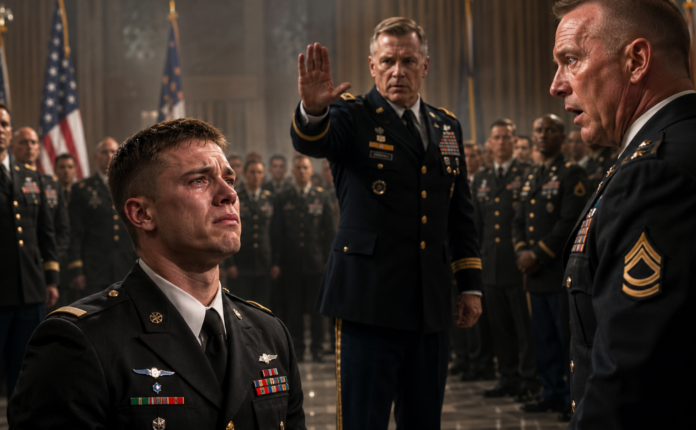
Every boot in the hall struck the floor as soldiers stood.
One by one.
Rows and rows.
Until the entire hall was standing.
David’s breath caught.
Captain Grant stood despite his injuries.
Lena stood beside her little brother.
Mason stood at the back, tears in his eyes.
Colonel Reyes opened the medal case.
“For courage under extreme pressure.”
“For saving military and civilian lives.”
“For exposing corruption at great personal risk.”
“For proving that honor does not belong to rank, wealth, or birth, but to the heart willing to protect others.”
He pinned the medal to David’s uniform.
The metal felt cold against David’s chest.
Then something happened David never expected.
Captain Grant raised his hand in salute.
Then Colonel Reyes.
Then every officer.
Then every soldier.
Hundreds of hands rose.
A full military salute.
For David Son.
The poor boy.
The weak recruit.
The silent soldier.
The man who had finally found his voice.
David’s eyes blurred.
He tried to stand straight, but his chin trembled.
In the front row, his mother sat in a wheelchair, wrapped in a blue shawl.
She had been brought in quietly before the ceremony.
David saw her.
His strength almost broke.
She smiled through tears.
He walked off the stage and knelt before her.
“Mom.”
She touched the medal with shaking fingers.
“My son.”
“I was scared.”
“I know.”
“I almost stayed silent.”
“But you didn’t.”
His voice cracked.
“I wanted to make you proud.”
She cupped his face.
“You were my pride before any medal.”
David lowered his forehead to her hands.
For a moment, the hall disappeared.
There was no general.
No ceremony.
No applause.
Only a mother and son who had survived hunger, shame, fear, and the long road from weakness to power.
Then his mother whispered, “Stand up, David.”
He looked at her.
She smiled.
“Heroes should not kneel too long.”
David laughed through tears.
Then he stood.
The hall erupted.
Applause thundered through the walls.
Boots struck the floor.
Soldiers cheered.
Cameras flashed.
And David Son, who once believed quiet meant weakness, finally understood the truth.
He had never been weak.
He had been growing.
In silence.
In pain.
In poverty.
In fear.
And when the moment came, he became powerful enough to protect people who could never repay him.
That day, in front of officers, soldiers, families, and the whole nation, David Son was honored as a hero in front of everyone.